Cobalt Metal or Cobalt Alloy: Which Kind of Scrap Do You Have?
Most enquiries that say "cobalt scrap" turn out to mean one of two very different things. The first is cobalt metal: refined cobalt with nothing deliberately added, sold by refineries as electrolytic cathode, briquettes, rounds and powder. The second is a cobalt-base alloy, such as hardfacing rod, a cast F75 implant alloy or a turbine vane in MAR-M 509, where cobalt is the largest element but chromium, tungsten, nickel and carbon make up a large share. This page is about the first kind. The second belongs on our cobalt alloy scrap page.
The difference matters because the buyers are different. A battery chemical plant, a magnet maker or a carbide powder producer needs cobalt with only small amounts of nickel, iron, copper, sulfur and carbon. To them, a piece of cobalt-chromium alloy is a contaminant, not a bonus. Superalloy melters can use both, but they charge cobalt metal to adjust a heat and they treat alloy scrap as revert of a known grade. Put the two in one drum and the lot fits neither use without sorting.
Cobalt metal scrap is mostly new material with a damaged history rather than worn parts. Cathode sheets crack and break in handling, briquettes get spilled from torn bags, powder drums are opened and partly used, and lots fail a purity or particle-size clause. Each piece keeps the analysis it left the refinery with, unless it has since oxidised, been wetted or picked up foreign matter. That is why the paperwork that came with the material counts for so much.
Refined cobalt is a hard, silvery metal with a faint blue tint, about 8.9 g/cm³ and strongly magnetic, which it shares with nickel. Refining capacity is concentrated in China, Finland, Canada, Japan and a few other countries, while most mined cobalt comes from the Democratic Republic of Congo.
Typical Composition
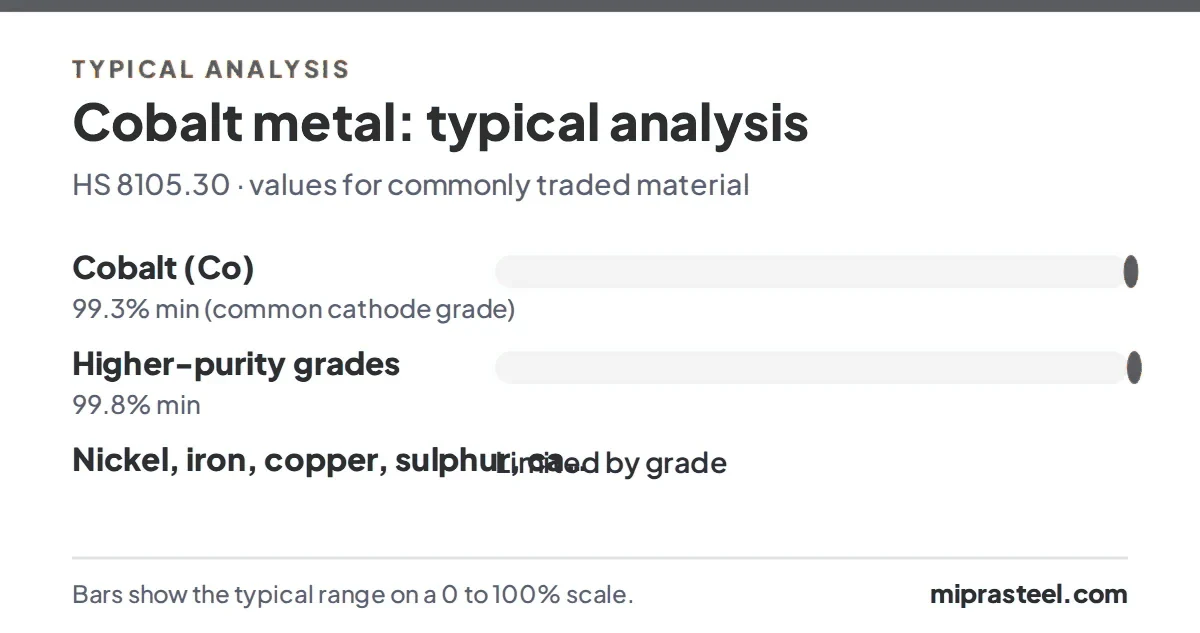
| Element or property | Typical value |
|---|---|
| Cobalt (Co) | 99.3% min (common cathode grade) |
| Higher-purity grades | 99.8% min |
| Nickel, iron, copper, sulfur, carbon | Limited by grade |
Typical values for commonly traded material. The certificate or analysis of each lot governs.
Forms Cobalt Metal Scrap Comes In
- Broken cathode
- Briquettes
- Rounds
- Powder
- Remnants and part-used drums
Where Cobalt Metal Is Used
- Nickel- and cobalt-base superalloys
- Binder for cemented carbides
- Permanent magnets
- Hardfacing alloys
- Battery and chemical production
What Buyers Check in a Lot
Purity
Cobalt content is the main figure in the lot description and is confirmed by XRF or laboratory analysis.
Nickel and Iron
Nickel commonly accompanies cobalt, and both nickel and iron are limited by grade.
Copper, Sulfur and Carbon
These are restricted in many uses and need laboratory analysis for accurate values.
Alloy Separation
Cobalt-base alloys and cobalt-bearing superalloys should be kept apart from cobalt metal.
Form and Contamination
Powder, cathode and briquettes are described separately, along with any oxidation, oil or foreign material.
How to Recognise Cobalt Metal
A magnet and a balance will not tell cobalt from nickel. Paperwork and analysis do the sorting.
| Check | What it shows for Cobalt metal |
|---|---|
| Cobalt by XRF or ICP | The headline figure. Commercial cathode is commonly specified at 99.3% or 99.8% cobalt minimum. |
| Nickel and iron | Nickel travels with cobalt through refining and is the first impurity buyers read; iron usually comes from handling and steel contact. |
| Chromium, tungsten and molybdenum | Any noticeable reading means cobalt alloy has got into the lot; those pieces are taken out before it is described. |
| Copper, sulfur and carbon | Low-level impurities that matter to battery and magnet users; sulfur and carbon need combustion analysis. |
| Oxygen and surface condition | Powder and fine broken cathode oxidise in damp storage. Dark or powdery surfaces are noted, and oxygen is measured for powder. |
| Form and particle size | Cathode, briquettes, rounds and powder are each described separately; powder lots state particle size. |
Grades Most Often Confused with Cobalt Metal
- Cobalt alloy: Usually 20 to 30% chromium plus tungsten or molybdenum on XRF; it is valued as an alloy and kept out of cobalt metal lots.
- Nickel cathode or rounds: Same silver colour, almost the same density and also magnetic; only XRF separates nickel metal from cobalt metal.
- ECY 768 and similar vane alloys: Cast cobalt-base superalloy parts with chromium, nickel, tungsten and tantalum; recognisable by shape and confirmed by analysis.
Magnetic
Cobalt is strongly attracted to a magnet, which separates it from most stainless steels and non-ferrous metals.
Similar to Nickel
Cobalt and nickel have almost the same density and are both magnetic, so XRF is needed to tell them apart.
Not Cobalt Alloy
Cobalt-chromium-tungsten hardfacing and cobalt superalloys look like plain metal but show chromium and tungsten on XRF.
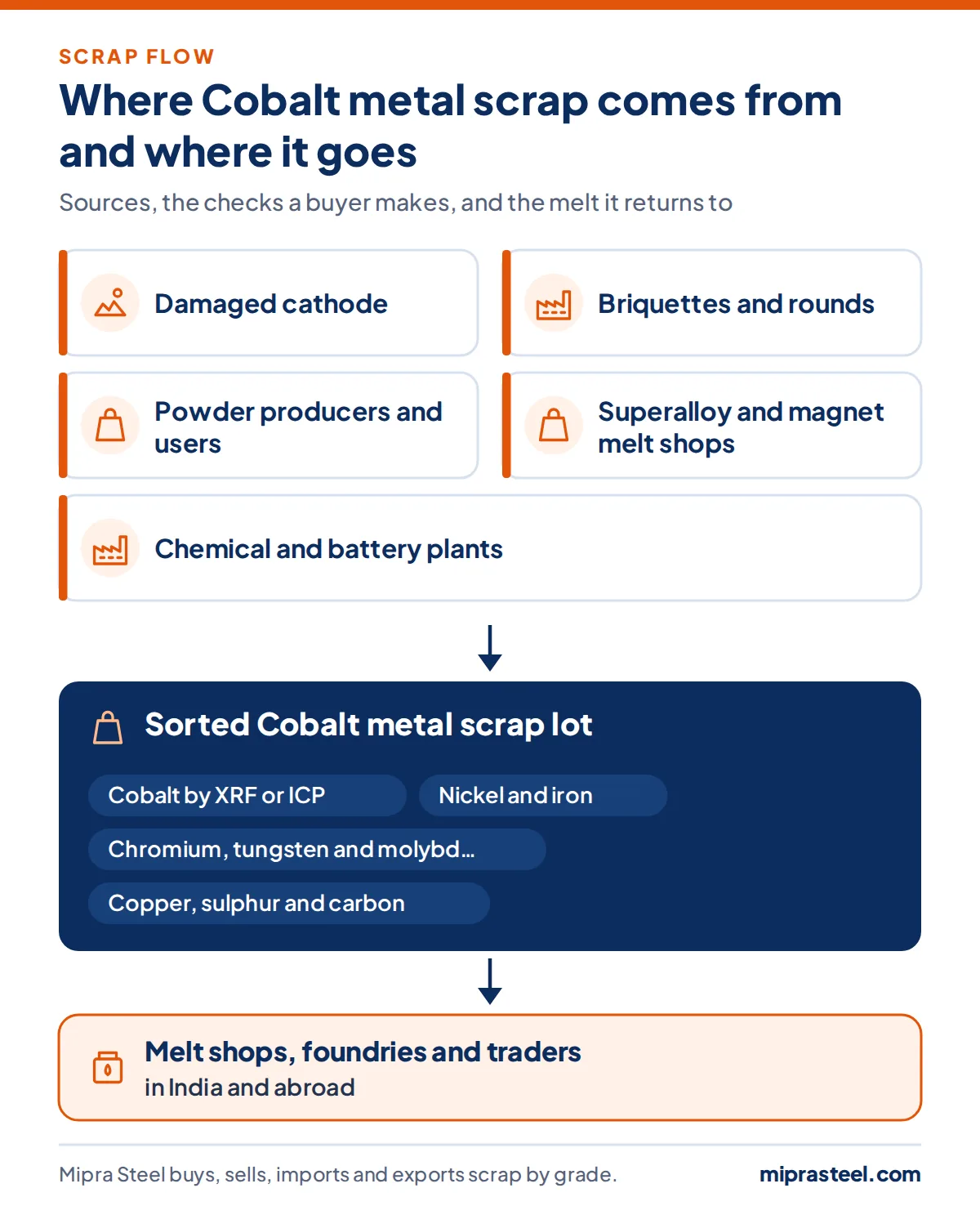
Where Cobalt Metal Scrap Comes From
Because cobalt metal is a refined commodity, the scrap comes from the handling chain around it more than from finished products.
Damaged Cathode
Electrolytic cathode sheets are often cut or broken to size. Edges, cracked pieces and floor sweepings from that work are collected as broken cathode.
Briquettes and Rounds
Torn bags, spilled pallets and surplus left after a plant changes supplier or product release briquettes and rounds that are still refinery grade.
Powder Producers and Users
Extra-fine cobalt powder for cemented carbide binders and diamond tools is rejected if particle size or oxygen drifts; opened drums are also released at the end of a campaign.
Superalloy and Magnet Melt Shops
Melters of nickel and cobalt superalloys and of samarium-cobalt or AlNiCo magnets sometimes hold surplus cobalt metal when an order changes.
Chemical and Battery Plants
Plants that dissolve cobalt metal to make salts may sell surplus or off-grade feed that their process cannot accept.
Cobalt Metal Scrap Buyer, Importer and Exporter in India
Mipra Steel trades cobalt metal scrap and surplus from Khetwadi, Mumbai, linking refiners' customers, melt shops and powder users with buyers in India and abroad.
Sell Cobalt Metal Scrap
Holding broken cathode, surplus briquettes or rounds, or off-specification cobalt powder? Tell us the form, the weight and where it is stored, and send photographs of the material and any bag or drum labels. Attach the refinery certificate or a recent analysis if you have one. Say clearly if any cobalt alloy, nickel or steel may be mixed in, and whether powder drums have been opened. We review incoming enquiries and respond with relevant next steps.
Buy Cobalt Metal Scrap
Looking for cobalt metal for superalloy melting, carbide binder, magnets or salt production? Send your minimum cobalt figure, limits on nickel, iron, copper, sulfur and carbon, the forms you accept, the quantity and the delivery port. Surplus and off-specification lots can suit melters whose limits are wider than a battery plant's, and each is offered with the documents that came with it.
Preparing Cobalt Metal Scrap for Sale
- Check every unlabelled piece for chromium and tungsten and remove any cobalt alloy.
- Keep cathode, briquettes, rounds and powder in separate, labelled containers.
- Store powder in closed drums, dry and away from acids.
- Match each bag or drum label to its refinery certificate and photograph both.
- Sweep and bag broken cathode fines apart from whole pieces.
- Keep nickel cathode and rounds well away from cobalt stock to avoid mix-ups.
Cobalt Metal Scrap Price per Kg: What Decides It
A cobalt scrap price per kg is anchored to the refined cobalt market and then adjusted for what stands between the lot and a usable refinery-grade product.
- Cobalt content and grade: a lot that still meets a standard cathode or briquette specification is worth more than one that has slipped below it.
- Nickel and other impurities: battery, magnet and carbide users set tight limits, and a lot above them has fewer buyers.
- Alloy contamination: even a small amount of cobalt-chromium alloy in a metal lot forces sorting or a lower description.
- Form: briquettes and rounds are easy to sample and charge; fine broken cathode and powder need more care.
- Oxidation and moisture: oxide skin on powder or fines reduces recoverable metal and can rule out powder users.
- Documents: a refinery certificate matched to bag or drum labels reduces the analysis a buyer must commission.
Cobalt prices move with the battery and superalloy markets, so offers are dated and reviewed if a lot is held. The contained metal calculator helps estimate the cobalt units in a lot.
Cobalt Metal Scrap Import and Export
Importing Cobalt Metal Scrap into India
Cobalt metal surplus and scrap reach India from refiners and traders in Europe, East Asia and the Gulf, and from users of Chinese and Finnish refined cobalt. A scrap consignment bound for an Indian port needs its pre-shipment inspection done at origin, and the certificate goes with the invoice, packing list and bill of lading. On the invoice, give the form and measured cobalt content: customs uses that to decide whether the goods are scrap or unwrought metal, which sit in different subheadings. Mundra and Nhava Sheva (JNPT) handle most of these boxes, while Chennai suits users in Tamil Nadu and Karnataka. See importing alloy scrap into India.
Exporting Cobalt Metal Scrap from India
Indian carbide makers, magnet producers and melt shops occasionally release cobalt metal surplus that overseas powder plants and superalloy melters can use. For export, each lot is listed by form and cobalt assay, weighed drum by drum, and loaded in sealed steel drums so powder and fines cannot escape in transit. With people on the ground in Korea and Dubai, we speak regularly to battery and alloy buyers across East Asia and the Gulf, and lots also go to Japan and the Netherlands. Read export documents for alloy scrap.
Customs heading: 8105.30 (cobalt waste and scrap). The HS code is the international tariff heading the scrap is declared under; national tariff lines add further digits, so confirm the full line with your customs broker.
Related Reading
Cobalt Metal Scrap FAQ
Under which HS code is cobalt metal scrap shipped?
HS 8105.30 is the subheading typically used for cobalt waste and scrap. Refined cobalt that is not scrap, such as unwrought cathode or powder, normally falls under a different subheading of heading 8105, and national lines add digits, so a customs broker should confirm the full code.
Is cobalt alloy scrap the same as cobalt metal scrap?
No. Cobalt metal scrap is refined, unalloyed cobalt. Cobalt-base alloys such as F75, MAR-M 509 and ECY 768 carry 20% or more chromium plus tungsten or molybdenum, and they are sold as alloy revert. See cobalt alloy scrap for those grades.
Why does nickel content matter in cobalt scrap?
Nickel and cobalt are refined together and the last traces are hard to separate. Battery chemical plants and magnet makers set limits on nickel, so the nickel figure often decides which buyer can take a lot.
Can broken cobalt cathode be sold as scrap?
Yes. Broken and cut cathode keeps its refinery analysis, so long as it is dry, clean and not mixed with other metals. Sweepings and fines are bagged separately because they tend to carry dust and oxide.
Is off-specification cobalt powder still usable?
Often. Powder rejected by a carbide or diamond tool maker for particle size or oxygen may suit a melt shop or a chemical plant. State the particle size, oxygen if known and whether drums were opened.
Does a magnet tell cobalt from stainless steel?
Mostly. Cobalt is strongly magnetic, while common austenitic stainless is not, so a magnet quickly flags stainless pieces. It does not separate cobalt from nickel or from ferritic steel, so an XRF reading is still needed.
How do I start a cobalt metal deal with Mipra Steel?
Sellers can share photographs, the cobalt form, tonnage, storage location and refinery paperwork on the sell scrap form; buyers can write in with their purity limits via the contact page. Mipra Steel deals in cobalt metal both ways, and runs separate lines for superalloy scrap and cobalt alloy scrap.
Published by Mipra Steel, Khetwadi, Mumbai · Updated