PWA 1484 Scrap Buyer, Importer and Exporter in India
Mipra Steel handles PWA 1484 as its own grade, keeping rhenium-bearing single-crystal lots apart from every rhenium-free blade alloy from first enquiry to shipment.
Sell PWA 1484 Scrap
Holding PWA 1484 blades or revert? Tell us the weight, whether the blades are coated or stripped, how many pieces and where they are. Clear photographs of the root and any part numbers help, as do readings showing rhenium and tantalum. Removal records or foundry heat certificates make the description simpler. We review incoming enquiries and respond with relevant next steps.
Buy PWA 1484 Scrap
Sourcing PWA 1484 for a single-crystal remelt or for rhenium recovery? Tell us the quantity, whether you need revert, stripped blades or coated blades, the coating limits your process accepts, and the destination port. Lots are described as PWA 1484 with the rhenium-bearing status stated, and we can discuss which readings and documents travel with them.
What Is PWA 1484, and Why Does Its Scrap Get Special Handling?
PWA 1484 is a Pratt & Whitney material specification for a cast single-crystal superalloy used in high-pressure turbine blades of aero engines. A single-crystal blade is grown as one grain, so it has no grain boundaries for creep to work along. That design lets the alloy shed most of the grain-boundary elements that equiaxed blade alloys need, and spend its chemistry on strengthening the matrix instead. In PWA 1484 that means a heavy load of refractory metals: about 8.7% tantalum, 5.9% tungsten, 1.9% molybdenum and 3% rhenium, with only about 5% chromium and roughly 0.1% hafnium.
Rhenium is the reason this scrap is handled differently. It is scarce, it is produced in small quantities worldwide, and most of the rhenium in industrial use sits inside nickel superalloys. A tonne of PWA 1484 carries about 30 kg of rhenium, so a melt shop or refiner that receives it as a clean, single-grade lot can put that rhenium back to work. Once PWA 1484 is tipped into a mixed bin of rhenium-free blades, the rhenium is diluted and nobody pays for it.
Second-generation single-crystal alloys were designed around that 3% rhenium level. PWA 1484 sits beside René N5 and CMSX-4 in that generation, and the three are easy to confuse on paper. They are not interchangeable as melt stock, because tantalum, titanium and chromium differ enough to move a remelt off specification.
Trade descriptions vary: "PWA1484", "1484 SX", or simply "rhenium blades". The density is 8.95 g/cm³, noticeably heavier than most equiaxed blade alloys, which is one quick sense check on a sample. For the family view, see PWA alloy scrap.
PWA 1484 belongs to the PWA family, part of superalloy scrap.
Where PWA 1484 Scrap Is Generated
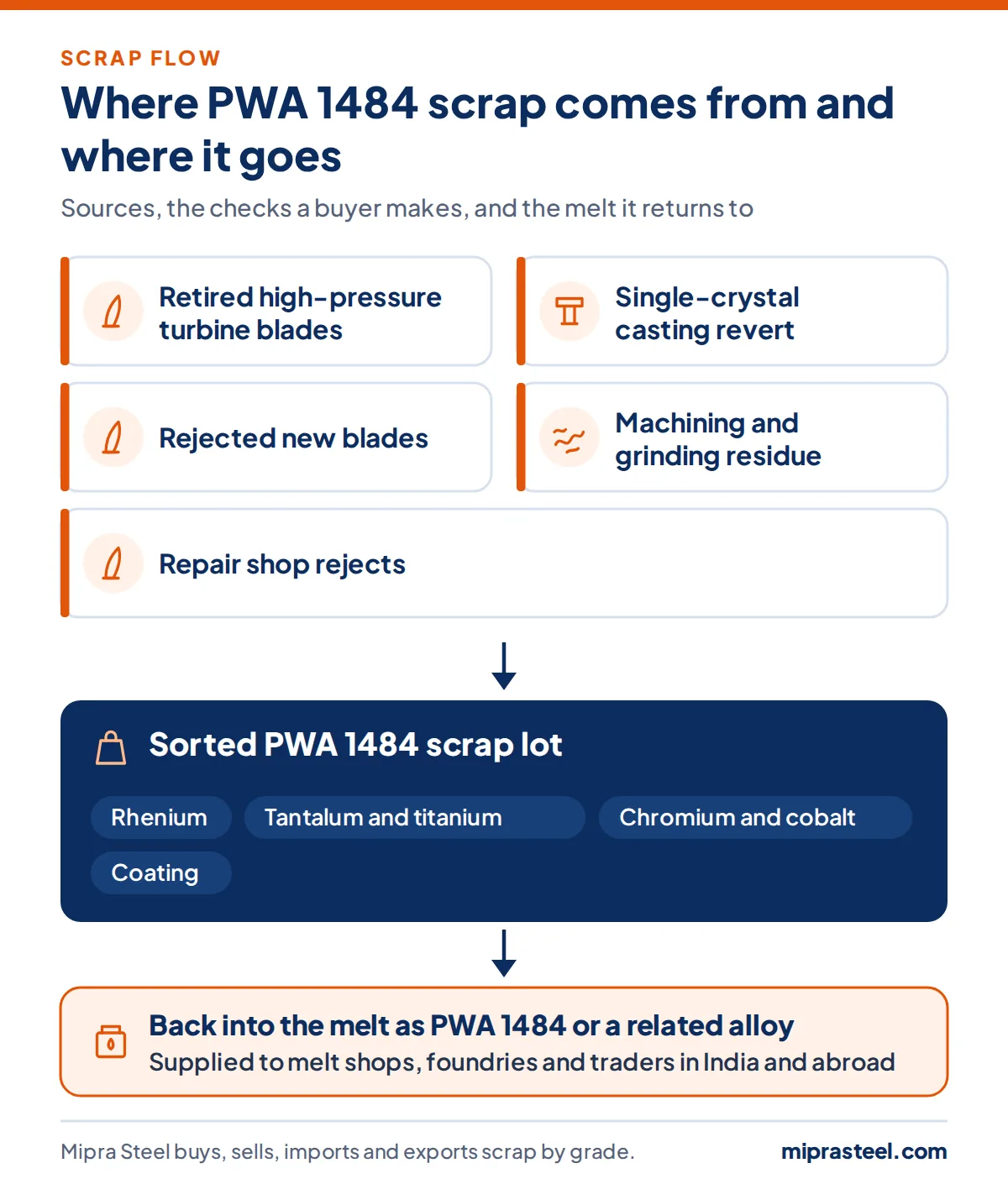
Because the alloy is used almost entirely for turbine blades, PWA 1484 scrap arrives in a narrow set of forms. Each form has a different paper trail.
Retired High-Pressure Turbine Blades
Blades removed at engine shop visits that cannot be repaired. They usually carry a protective coating and sometimes internal cooling passages with ceramic core residue, both of which a buyer will ask about.
Single-Crystal Casting Revert
Gates, risers, starter blocks, helix sections and rejected castings from single-crystal foundries. Revert is uncoated and its alloy is known from the foundry heat, so it is the cleanest PWA 1484 form available.
Rejected New Blades
Blades that fail inspection after machining or coating, for example on grain defects or wall thickness. They often come with part numbers and rejection records.
Machining and Grinding Residue
Root-form grinding and tip machining produce sludge and fine swarf. It is low in weight and usually needs chemical recovery rather than direct remelting, so it is described separately.
Repair Shop Rejects
Blades scrapped during tip or coating repair, typically after the coating has been stripped. Read how turbine blade scrap is sold.
PWA 1484 Scrap Specification Chart
| Grade | PWA 1484 |
|---|---|
| UNS | Not assigned (proprietary Pratt & Whitney alloy) |
| W.Nr. / EN | Not assigned; specified by Pratt & Whitney specification PWA 1484 |
| Identified by | The PWA 1484 specification itself, with casting records |
| Also known as | PWA1484, PWA-1484 |
| Alloy type | Second-generation single-crystal nickel superalloy (3% rhenium) |
| Density | 8.95 g/cm³ (0.323 lb/in³) |
| Magnetic | Non-magnetic. |
| HS code (customs heading) | 7503.00 (nickel waste and scrap) |
PWA 1484 Chemical Composition
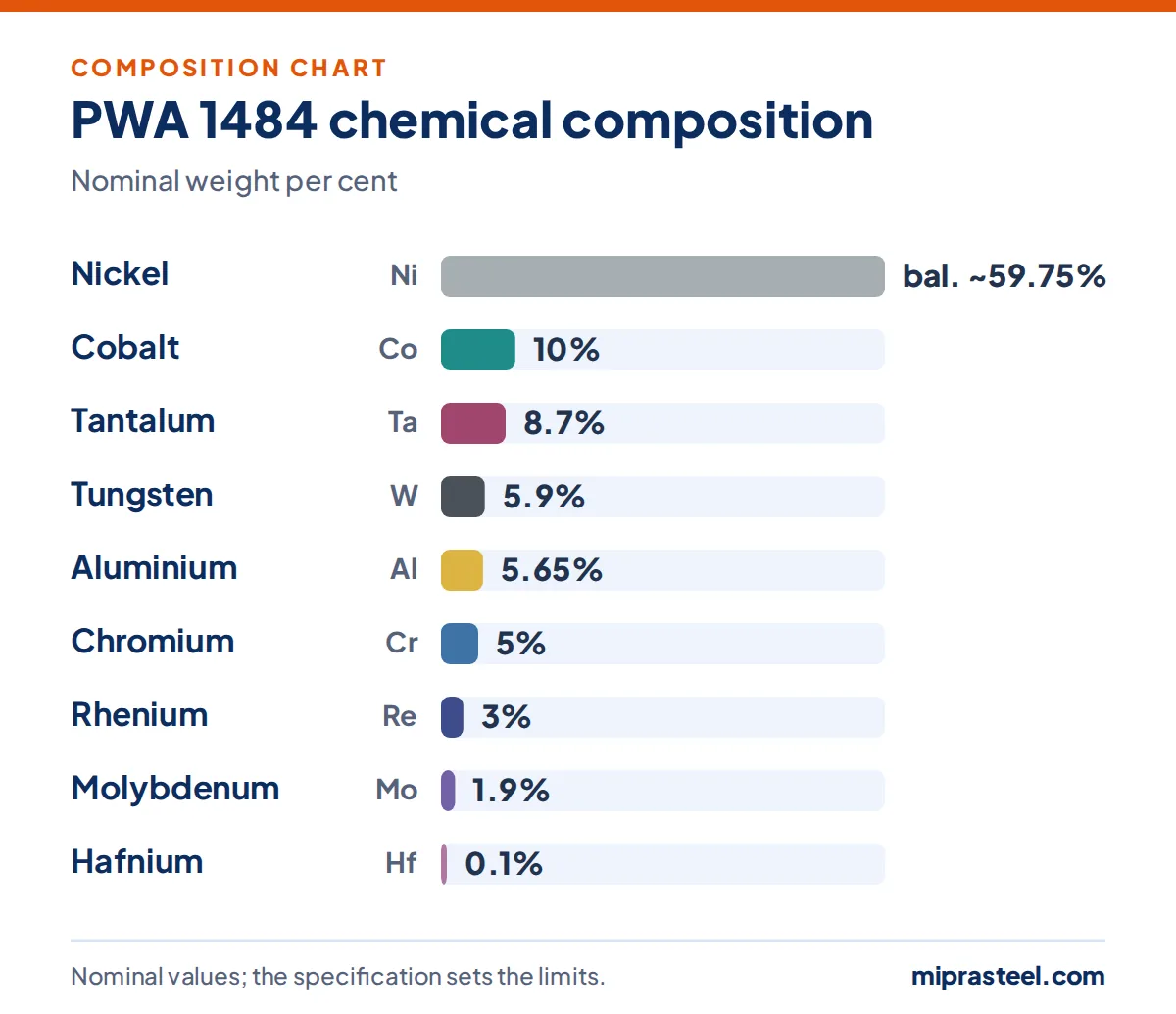
Nominal composition in weight per cent, used to describe and identify the grade. The governing specification sets the limits for each product.
| Element | Symbol | Nominal wt% | |
|---|---|---|---|
| Nickel | Ni | Balance (about 59.8) | |
| Cobalt | Co | 10 | |
| Tantalum | Ta | 8.7 | |
| Tungsten | W | 5.9 | |
| Aluminium (aluminum) | Al | 5.7 | |
| Chromium | Cr | 5 | |
| Rhenium | Re | 3 | |
| Molybdenum | Mo | 1.9 | |
| Hafnium | Hf | 0.1 |
PWA 1484 Equivalent Grades and Other Names
| Designation | Value |
|---|---|
| Trade name | PWA 1484 |
| UNS | Not assigned (proprietary Pratt & Whitney alloy) |
| W.Nr. / EN | Not assigned; specified by Pratt & Whitney specification PWA 1484 |
| Key specification | Pratt & Whitney specification PWA 1484 |
| Other names in the trade | PWA1484, PWA-1484 |
Look up any designation in the grade name converter or the equivalent grade chart.
PWA 1484 Standards and Specifications
Pratt & Whitney specification PWA 1484.
PWA 1484 Applications
- Single-crystal high-pressure turbine blades in aero engines
Source industries: aerospace.
How PWA 1484 Scrap Is Identified
A handheld XRF reads tantalum, tungsten and hafnium well on a clean surface, so PWA 1484 is identified by its pattern of heavy elements; rhenium lines overlap with tantalum and tungsten, so the rhenium figure is confirmed by a laboratory. The first job is getting through the coating to the base metal.
| Check | What it shows for PWA 1484 |
|---|---|
| Rhenium | About 3%, ideally confirmed by laboratory analysis. A lab result near zero rules out PWA 1484 and points to a rhenium-free alloy such as PWA 1483 or René N500. |
| Tantalum and titanium | About 8.7% tantalum with no titanium is the PWA 1484 pairing. A 3% rhenium alloy showing around 1% titanium suggests CMSX-4. |
| Chromium and cobalt | About 5% chromium and 10% cobalt. René N5 reads closer to 7% chromium and 7.5% cobalt. |
| Coating | Aluminide or MCrAlY coatings distort a surface reading. Grind a small spot on the root or read a section to see the base alloy. |
| Macrostructure | A single-crystal blade shows no grain boundaries after a light etch. Visible columnar grains mean a directionally solidified part, which is a different alloy. |
| Documents | Part numbers, removal records from the engine shop and foundry heat certificates turn a reading into a description buyers accept. See XRF, OES or lab analysis. |
Grades Most Often Confused with PWA 1484
- René N5: also 3% rhenium, but about 7% chromium, 7.5% cobalt and 6.5% tantalum against 5%, 10% and 8.7% in PWA 1484.
- PWA 1483: the same maker's industrial single-crystal alloy: no rhenium, about 12.2% chromium and 4.1% titanium.
- René N500: a rhenium-free single-crystal alloy with about 6.5% tantalum and 6% chromium.
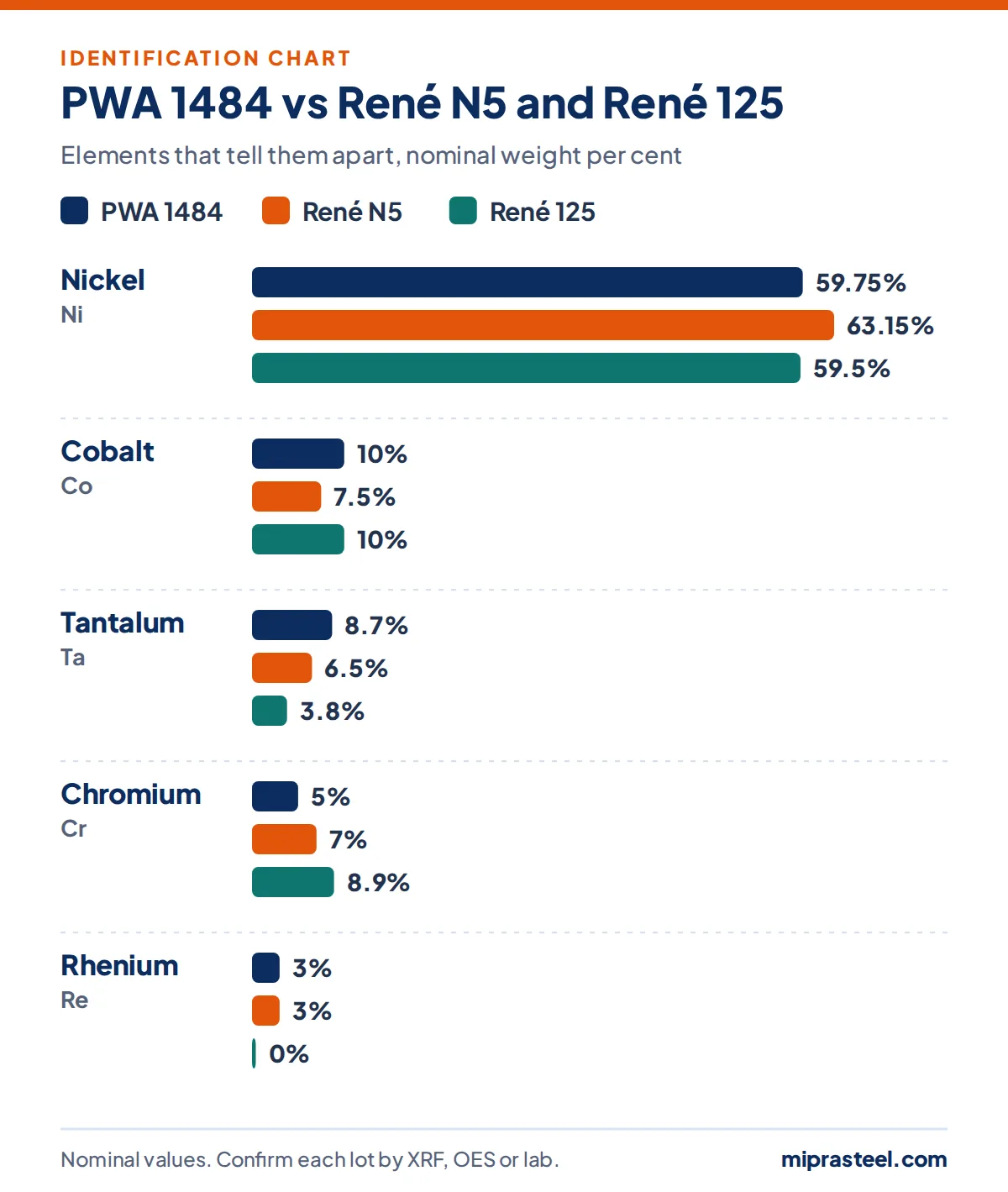
Nominal values for PWA 1484 against its closest grades on this site.
Preparing PWA 1484 Scrap for Sale
- Keep PWA 1484 in its own sealed container, away from every rhenium-free blade.
- Separate coated, stripped and revert material and label each.
- Record part numbers and piece counts before packing.
- Bag grinding sludge separately and keep it dry.
- Keep removal records and heat certificates with the lot.
PWA 1484 Scrap Price per Kg: What Decides It
The PWA 1484 scrap price per kg is set mainly by how much of the rhenium and tantalum a buyer can be confident of recovering. Nickel is the base, not the story.
- Contained rhenium (about 3%) and the rhenium market on the day, which moves on its own cycle and not with nickel.
- Contained tantalum (about 8.7%), plus tungsten and cobalt, which a melt shop would otherwise buy as virgin additions.
- Purity of the lot: PWA 1484 only, with no rhenium-free blades, no CMSX-4 and no René N5 mixed in.
- Coated or stripped: coatings add aluminium, platinum or MCrAlY elements and are either removed or allowed for in the offer.
- Form: revert and whole blades remelt directly; grinding sludge and fines need chemical recovery and are valued on a different basis.
- Traceability: part numbers, shop removal records and heat certificates reduce the testing a buyer has to repeat.
Because rhenium dominates, two lots of identical weight can be far apart in value. Read how nickel alloy scrap is valued and how superalloy revert is recycled.
PWA 1484 Scrap Import and Export
Importing PWA 1484 Scrap into India
Most PWA 1484 scrap arises outside India, so Indian buyers rely largely on imports. Material comes from engine overhaul centres and single-crystal foundries in Europe, North America and East Asia, often through specialist traders. Each consignment travels with a pre-shipment inspection certificate, commercial invoice, packing list and bill of lading, and arrives through Nhava Sheva, Mundra or Chennai. Naming the grade and stating that the lot is rhenium-bearing on the invoice keeps customs, the inspector and the buyer reading from the same page. Read importing nickel alloy scrap into India.
Exporting PWA 1484 Scrap from India
When PWA 1484 blades or revert do surface with an Indian seller, the quantities are usually small. Exported PWA 1484 is described by grade on the invoice and packing list, weighed, and shipped in sealed drums or bags inside containers, because blades are small and easy to lose in a loose load. Buyers for rhenium-bearing scrap are concentrated in a few countries; our South Korea and UAE offices sit close to buyers and suppliers in East Asia and the Gulf. See export documents for alloy scrap.
Customs heading: 7503.00 (nickel waste and scrap). The HS code is the international tariff heading the scrap is declared under; national tariff lines add further digits, so confirm the full line with your customs broker.
Other PWA Scrap Grades
Related Reading
PWA 1484 Scrap FAQ
How much rhenium is in PWA 1484?
About 3% by weight, the level that defines a second-generation single-crystal superalloy. That is roughly 30 kg of rhenium per tonne of clean metal. Actual content in a scrap lot depends on how much coating, core residue or foreign material is present, which is why buyers ask for readings on the base alloy.
Is PWA 1484 the same as CMSX-4 or René N5?
No. All three carry about 3% rhenium, but PWA 1484 has no titanium and about 8.7% tantalum. CMSX-4 carries about 1% titanium and 6.5% tantalum. René N5 has about 7% chromium and 7.5% cobalt against 5% and 10% in PWA 1484. A single-crystal remelt needs the right one.
Why should rhenium blades never go into a mixed superalloy lot?
Because the rhenium stops being paid for. In a mixed lot it is diluted to a fraction of a percent, too low for a rhenium-alloy melt and of no use to a rhenium-free one. Kept as a single grade, PWA 1484 is valued on its full rhenium and tantalum content.
Does the coating on retired PWA 1484 blades lower the value?
It can. Aluminide, platinum-aluminide and MCrAlY coatings add elements a single-crystal melt has to control. Buyers either want blades stripped or allow for the coating in their offer. Say whether blades are coated or stripped when you enquire.
Can PWA 1484 revert be recycled back into new castings?
Clean single-crystal revert with known heat history is the form most suited to remelting into new master alloy, subject to the caster's own rules on revert use. Ex-service blades and grinding residue more often go to rhenium recovery or to other superalloy melts.
What HS code do importers use for PWA 1484 scrap?
It is nickel-base, so it is typically declared under HS 7503.00, nickel waste and scrap. India and other countries add national digits. Confirm the exact tariff line with your customs broker before booking.
Can I sell a small quantity of PWA 1484 blades to Mipra Steel?
Yes. Rhenium-bearing blades are worth keeping and selling even in small quantities, provided they are kept as one grade. Send the piece count, weight, coating condition, photographs and any part numbers or readings.
What is PWA 1484 made of?
Nominally 59.8% nickel, 10% cobalt, 8.7% tantalum, 5.9% tungsten, 5.7% aluminium, 5% chromium, 3% rhenium, 1.9% molybdenum, 0.1% hafnium. Specification ranges vary by product form and standard.
Published by Mipra Steel, Khetwadi, Mumbai · Updated