Which Cobalt Alloys Are Traded as Scrap, and How Are They Kept Apart?
A cobalt-base alloy is a poor fit for a nickel melt and an equally poor fit for a steel furnace, so it needs its own lot, its own buyer and usually its own customs line. Inside that group there are two chemistries that look alike on a magnet test and almost nothing alike on an analyser.
The first is the vane alloys. ECY-768 and MAR-M 509 are carbide-strengthened casting alloys for gas turbine nozzle guide vanes and vane segments, at roughly 55% cobalt with 23.5% chromium, 10% nickel, 7% tungsten, 3.5% tantalum and about 0.6% carbon. ECY-768 was developed from MAR-M 509 to reduce mould-metal reaction and surface problems in casting, mainly by cutting zirconium from about 0.5% to 0.05% or less. On a handheld XRF the two can read almost identically, which is why their lots stay separated by part origin and casting records. MAR-M 509 has its own page in the MAR-M family because it is traded alongside 247 revert from the same foundries.
The second is implant alloy. F75 (UNS R30075, ISO 5832-4) is cast cobalt-chromium-molybdenum with about 28% chromium and 6% molybdenum, while nickel, iron and tungsten are held to very low limits. Its scrap is clean investment-casting revert from orthopaedic and surgical foundries. Put a vane alloy into an F75 lot and the nickel and tungsten it carries take the lot out of implant-grade use; put F75 into a vane lot and the molybdenum is unwanted. Neither group should be mixed with cobalt metal scrap or with cemented carbide, which uses cobalt only as a binder.
Cobalt Alloy Scrap Grades We Buy and Sell
Cobalt Alloy Chemical Composition
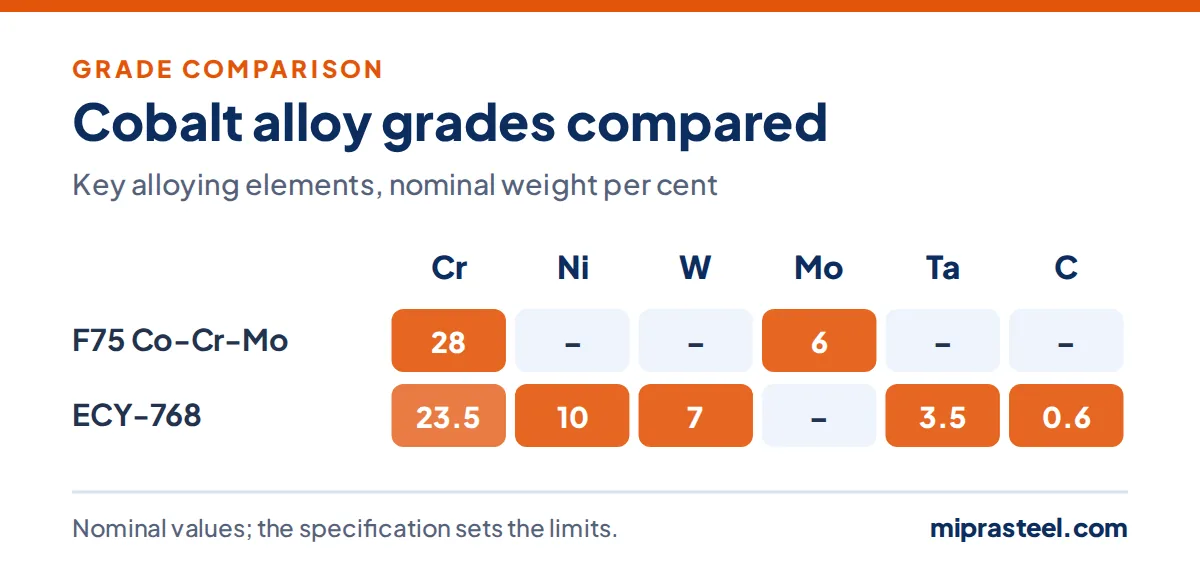
| Grade | Co | Cr | Ni | W | Mo | Ta | C |
|---|---|---|---|---|---|---|---|
| F75 Co-Cr-Mo | 66 | 28 | – | – | 6 | – | – |
| ECY-768 | 55.1 | 23.5 | 10 | 7 | – | 3.5 | 0.6 |
Nominal weight per cent. Specification ranges vary by product form and standard.
How to Tell Cobalt Alloy Grades Apart
Start by confirming cobalt is the main element; then molybdenum and tungsten split the groups, and zirconium splits the two vane alloys.
| Check | What it shows for Cobalt alloy |
|---|---|
| Main element | A cobalt reading of about 55% to 66% confirms a cobalt-base alloy. A high-nickel reading sends the piece to the superalloy or nickel lots. |
| Molybdenum | About 6% with almost no tungsten or nickel identifies F75. |
| Tungsten and nickel | About 7% tungsten and 10% nickel with 3.5% tantalum identify the vane alloys. |
| Zirconium | About 0.5% points to MAR-M 509, 0.05% or less to ECY-768. Low-level zirconium needs OES, laboratory analysis or a well-prepared XRF reading. |
| Magnet | Not a reliable test for these alloys. Use it only to pull out obvious steel fixtures. |
| Part origin and paperwork | Vane part numbers, turbine type and casting certificates are often the deciding evidence between ECY-768 and MAR-M 509. |
Grades Most Often Confused with Cobalt Alloy
- MAR-M 509: reads almost the same as ECY-768; zirconium (about 0.5% against 0.05% or less) is the practical separator.
- Haynes alloys: include cobalt-bearing nickel alloys whose cobalt reading can mislead; nickel above cobalt places them in the nickel lots.
- Tungsten carbide: also reads cobalt, but tungsten dominates at well over half the weight, and the density is far higher.
Molybdenum Marks F75
F75 shows about 6% molybdenum and almost no tungsten or nickel; the vane alloys show about 7% tungsten and 10% nickel.
Zirconium Separates 509 from ECY-768
The two vane alloys differ mainly in zirconium, which needs OES or laboratory analysis.
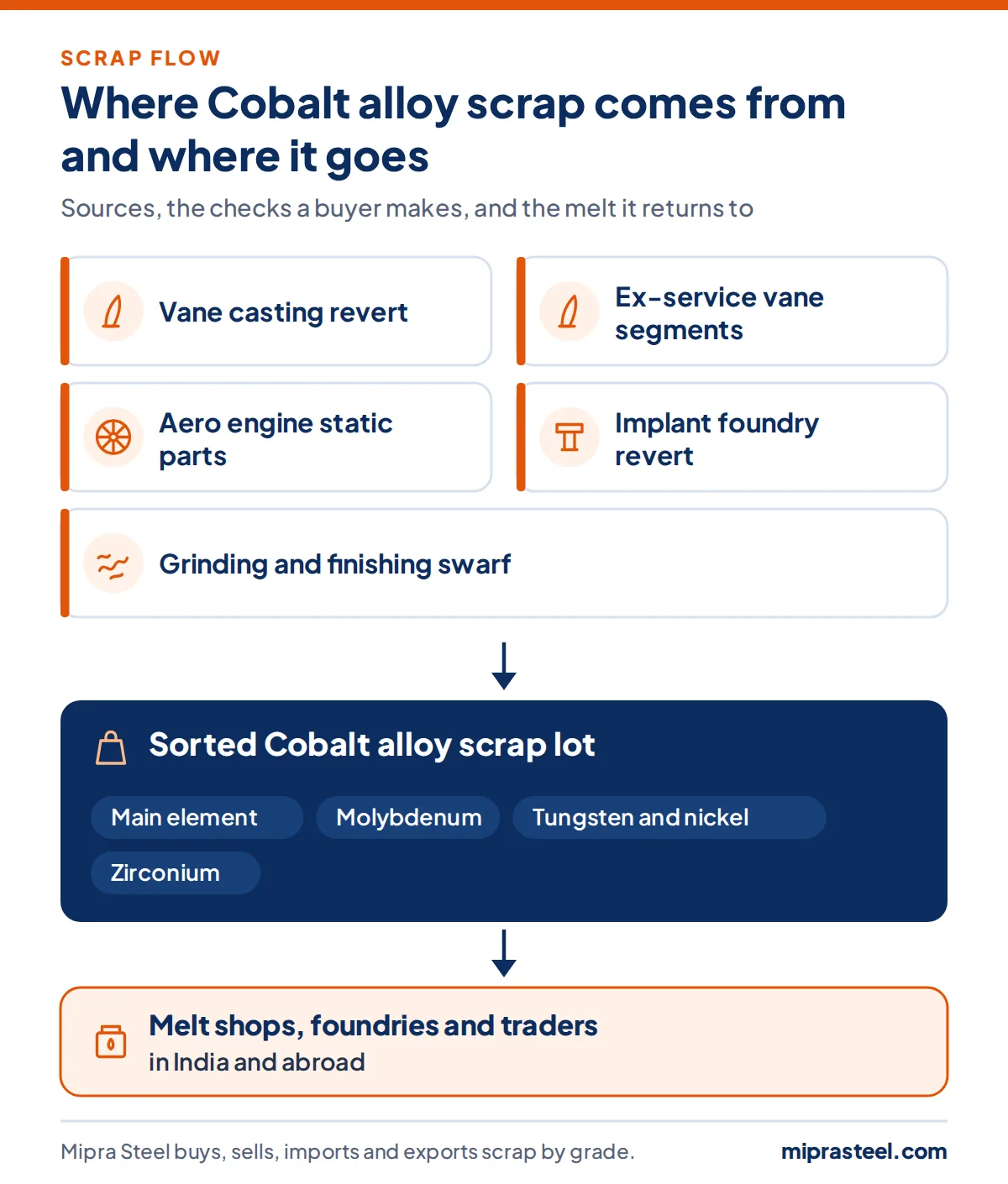
Where Cobalt Alloy Scrap Comes From
Cobalt alloy scrap comes from a small number of foundry and overhaul streams, each with a recognisable shape.
Vane Casting Revert
Gates, runners, risers and pour cups from ECY-768 and MAR-M 509 vane castings, plus castings rejected at inspection. Uncoated and single-heat.
Ex-Service Vane Segments
Nozzle guide vanes and vane segments removed at industrial gas turbine overhauls. They may carry coatings and weld or braze repairs. See power generation scrap.
Aero Engine Static Parts
Retired cobalt vanes and other static hot-section castings from engine shop visits. See aerospace scrap.
Implant Foundry Revert
F75 sprues, gates and rejected castings from investment-cast hip and knee component production.
Grinding and Finishing Swarf
Fine F75 or vane alloy swarf from fettling and finishing, sold separately from solids because of abrasive, oil and moisture.
Source industries: power generation.
Cobalt Alloy Scrap Buyer, Importer and Exporter in India
Mipra Steel buys cobalt alloy scrap from turbine overhaul shops, investment foundries and traders, and supplies vane alloy and F75 lots to cobalt melters and traders in India and overseas.
Sell Cobalt Alloy Scrap
Have vane segments, vane casting revert or F75 implant revert? Tell us which alloy you believe it is, whether it is foundry or ex-service material, the weight, location and whether vanes are coated or repaired. Readings showing cobalt, tungsten, molybdenum and, if you have it, zirconium make the lot easier to describe. For F75, casting records from the foundry help most. We review incoming enquiries and respond with relevant next steps.
Buy Cobalt Alloy Scrap
Cobalt alloy melters and traders sourcing revert can tell us the alloy, the acceptable forms, any limits on nickel, tungsten or zirconium, the quantity and the destination port. Vane alloy and F75 lots are described separately and are never offered as a blend.
Preparing Cobalt Alloy Scrap for Sale
- Check every piece for cobalt as the main element before it goes into a cobalt lot.
- Keep F75 implant revert completely apart from vane alloys.
- Keep ECY-768 and MAR-M 509 in separate drums unless analysis proves the lot.
- Remove steel fixtures, ceramic shell and grit from castings.
- Keep grinding swarf dry and away from solid revert.
- Label each drum with the alloy, origin and any casting or part references.
Cobalt Alloy Scrap Price per Kg: What Decides It
Cobalt sets the floor for every lot in this family; the other elements and the condition of the material decide how far above it an offer goes.
- Contained cobalt: about 55% in the vane alloys and about 66% in F75.
- Tungsten and tantalum in the vane alloys, about 7% and 3.5%, which a vane melt would otherwise buy separately.
- For F75, how well nickel, iron and tungsten stay within the low limits of the standard, since that decides whether the revert can return to an implant melt.
- Separation of ECY-768 from MAR-M 509, backed by zirconium analysis or casting records.
- Condition: foundry revert ranks above coated, repaired ex-service vanes, and solids above swarf.
- Lot size and documentation: cobalt alloy streams are small, so a consolidated, well-described lot is easier to place.
Cobalt prices are volatile and react to supply news from a few producing countries, so offers are dated. See how alloy scrap value is worked out.
Cobalt Alloy Scrap Import and Export
Importing Cobalt Alloy Scrap into India
Cobalt alloy scrap reaches India from turbine repair centres and foundries in the Gulf, Europe and East Asia. Shipments travel with a pre-shipment inspection certificate, commercial invoice, packing list and bill of lading. Because cobalt is the main element, the lots are typically declared under HS 8105.30, cobalt waste and scrap, rather than under the nickel heading, and the documents should name the alloy (ECY-768, MAR-M 509 or ASTM F75) so the declaration and the commercial description match. See importing alloy scrap into India for the general paperwork.
Exporting Cobalt Alloy Scrap from India
Indian investment foundries and turbine service work release small but steady cobalt alloy volumes, which are consolidated into exportable lots. Each alloy is listed separately on the invoice and packing list, weighed and shipped in drums or bags inside containers from Nhava Sheva or Mundra. Our Dubai and South Korea offices help with buyers in the Gulf and East Asia, and lots also move to Japan and Europe. See export documents for alloy scrap.
Customs heading: 8105.30 (cobalt waste and scrap). The HS code is the international tariff heading the scrap is declared under; national tariff lines add further digits, so confirm the full line with your customs broker.
Related Reading
Cobalt Alloy Scrap FAQ
What HS code is used for cobalt alloy scrap?
Cobalt-base alloy scrap such as ECY-768, MAR-M 509 and F75 is typically declared under HS 8105.30, cobalt waste and scrap, because cobalt is the largest element by weight. National tariff lines add digits, so confirm the exact line with your customs broker.
Is MAR-M 509 the same as ECY-768?
Not quite. Their chemistry is almost identical, at about 23.5% chromium, 10% nickel, 7% tungsten and 3.5% tantalum on a cobalt base, but MAR-M 509 carries about 0.5% zirconium against 0.05% or less in ECY-768. Lots are kept apart and confirmed by zirconium analysis or casting records.
What is F75 cobalt chrome scrap?
It is revert and rejects from castings made to ASTM F75, the cobalt-28% chromium-6% molybdenum alloy (UNS R30075) used for orthopaedic and surgical implants. Its scrap is usually clean foundry material: sprues, gates and rejected castings, plus finishing swarf.
Can cobalt vane scrap be mixed with nickel superalloy revert?
No. A cobalt vane alloy dropped into a nickel superalloy lot brings 55% cobalt and around 23% chromium into a melt that was not designed for them, and it changes the customs heading of the lot. Sort cobalt pieces out by XRF before the lot is weighed.
Why is a magnet no use for sorting cobalt alloy scrap?
These alloys do not respond to a magnet in a consistent way, so a magnet cannot separate F75 from a vane alloy or either from a nickel superalloy. It is only useful for spotting steel fixtures. Composition readings do the real sorting.
Does Mipra Steel buy small quantities of cobalt alloy revert?
Yes, small foundry and overhaul lots are common in this family. Send the alloy, weight, location, photographs and any readings or casting records. Smaller lots are easier to place when they are clean, single-alloy and well documented.
Is tungsten carbide scrap a cobalt alloy?
No. Cemented carbide is mostly tungsten carbide with a cobalt binder, so tungsten is the main element and it is traded and declared separately. See tungsten carbide scrap for that material.
Published by Mipra Steel, Khetwadi, Mumbai · Updated