Why Are PWA 1483 and PWA 1484 Traded as Two Different Products?
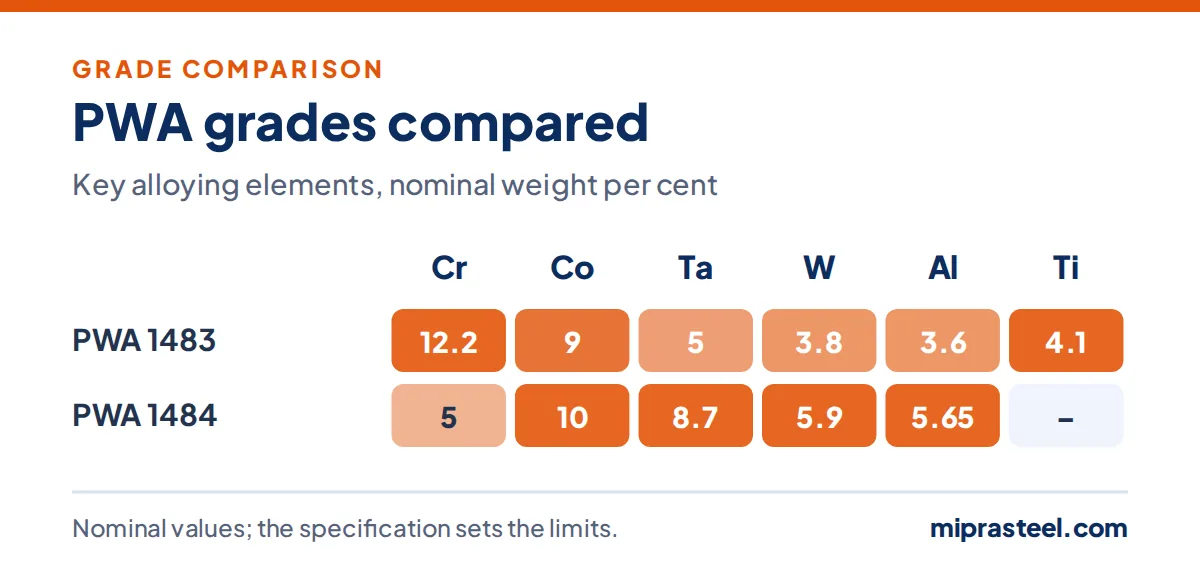
Both alloys are grown as single crystals, so a finished blade has no grain boundaries at all, and both come from the same designer. That is where the likeness ends. They were built for opposite problems. PWA 1484 answers the question of how to hold strength at the very top of an aero engine's temperature range: it carries about 3% rhenium, 8.7% tantalum and 5.9% tungsten, with chromium dropped to about 5% and no titanium. PWA 1483 answers a different one: how to survive years of hot corrosion from fuel and sea air in land and marine turbines. It keeps chromium at about 12% and titanium at about 4%, and has no rhenium.
For anyone buying or selling the scrap, rhenium is the dividing line. Superalloys account for most of the world's rhenium use, and retired blades and casting revert are a recognised route for recovering it, either back into superalloy melts or through chemical recovery. A drum of PWA 1484 is therefore priced as a rhenium-bearing material, while a drum of PWA 1483 is priced as a high-chromium, tantalum-bearing superalloy. Put the two together and the result is neither: the rhenium is diluted below what a 1484 melt needs, and the 1483 buyer receives an element their specification does not call for.
The rest of the family logic follows from that. Lots are kept by alloy, then by origin (foundry revert, rejected castings or engine-run blades) and by coating condition. Related single-crystal and directionally solidified grades are covered under René alloy scrap and the wider superalloy scrap section.
PWA Scrap Grades We Buy and Sell
PWA Chemical Composition
| Grade | Ni | Cr | Co | Ta | W | Al | Ti | Re | Mo |
|---|---|---|---|---|---|---|---|---|---|
| PWA 1483 | 60.3 | 12.2 | 9 | 5 | 3.8 | 3.6 | 4.1 | – | 1.9 |
| PWA 1484 | 59.8 | 5 | 10 | 8.7 | 5.9 | 5.7 | – | 3 | 1.9 |
Nominal weight per cent. Specification ranges vary by product form and standard.
How to Tell PWA Grades Apart
Chromium and titanium separate the two PWA grades in one reading, and rhenium, ideally confirmed by a laboratory, settles it. The harder job is telling PWA 1484 from other 3% rhenium alloys, which is where tantalum, chromium and cobalt come in.
| Check | What it shows for PWA |
|---|---|
| Rhenium | About 3% marks PWA 1484. PWA 1483 reads none. |
| Chromium | About 5% fits PWA 1484; about 12% fits PWA 1483. |
| Titanium | About 4% in PWA 1483 and none in PWA 1484. |
| Tantalum | About 8.7% in PWA 1484 is high even for a rhenium alloy, and helps separate it from René N5 at 6.5%. |
| Crystal structure | A single-crystal blade shows no grain boundaries on an etched surface. Equiaxed or columnar grains mean a different alloy or casting type. |
| Part and documents | Part numbers, engine type and casting records support the alloy name, and are the evidence melters ask for on engine-run material. |
Grades Most Often Confused with PWA
- René N5: also carries about 3% rhenium, but with about 7% chromium, 6.5% tantalum and 7.5% cobalt against 5%, 8.7% and 10% in PWA 1484.
- René N500: is a rhenium-free single-crystal alloy with about 6% chromium and 6.5% tantalum; no titanium, which also keeps it apart from PWA 1483.
- MGA 1400: is a rhenium-free industrial blade alloy with about 14% chromium and 2.7% titanium, against roughly 12% and 4% in PWA 1483.
Rhenium Separates 1484 from 1483
PWA 1484 shows about 3% rhenium and no titanium; PWA 1483 shows about 4% titanium and no rhenium.
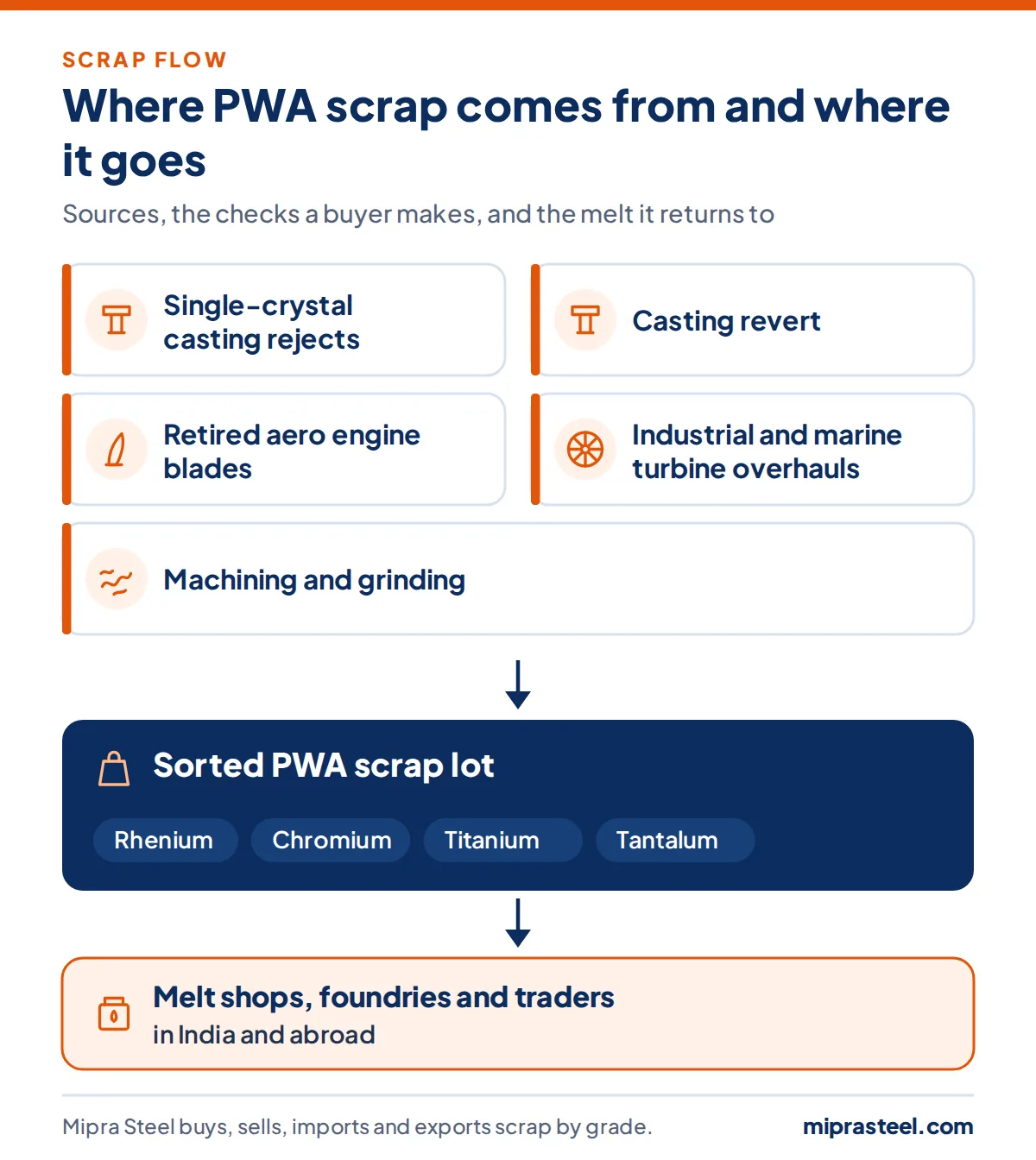
Where PWA Scrap Comes From
Single-crystal casting is unforgiving, so a good share of PWA scrap is new metal that never entered service.
Single-Crystal Casting Rejects
Blades scrapped for stray grains, freckles, recrystallised zones or misaligned crystal orientation. Chemistry is exactly as cast, but ceramic cores may remain inside cooled blades.
Casting Revert
Starter blocks, grain selectors, gates and pour cups from single-crystal moulds. Clean, uncoated and tied to a single heat.
Retired Aero Engine Blades
PWA 1484 high-pressure turbine blades removed at shop visits once they pass repair limits. They usually carry protective and thermal barrier coatings. See aerospace scrap.
Industrial and Marine Turbine Overhauls
PWA 1483 blades from land-based and marine gas turbines, released at scheduled overhauls. See power generation scrap.
Machining and Grinding
Root grinding and tip machining swarf from blade finishing, traded apart from solids.
Source industries: power generation, marine and shipbuilding, aerospace.
PWA Single-Crystal Alloy Scrap Buyer, Importer and Exporter in India
Mipra Steel trades PWA 1483 and PWA 1484 scrap as separate products, buying from casting houses, overhaul shops and traders and supplying documented lots to melters and recovery buyers.
Sell PWA Scrap
Selling PWA 1484 blades or single-crystal revert? Tell us which alloy you have, whether the material is foundry revert, casting rejects or engine-run blades, the weight and location, and whether parts are coated. Rhenium readings on a sample of pieces, part numbers and casting records shorten the conversation. PWA 1483 lots need the same detail without the rhenium readings. We review incoming enquiries and respond with relevant next steps.
Buy PWA Scrap
Melters of single-crystal alloys and rhenium recovery buyers can send us the alloy, the minimum rhenium content they need for 1484, the forms they accept (revert, rejects, ex-service blades), quantity and destination. Each lot is described by alloy, origin and coating condition, so the buyer knows which melt or process it suits before it ships.
Preparing PWA Scrap for Sale
- Never let a PWA 1483 blade into a PWA 1484 drum, or the reverse.
- Read rhenium on a sample from every drum and keep the readings with it.
- Keep casting revert and rejects apart from engine-run blades.
- Record part numbers and engine type for ex-service blades.
- Note whether hollow blades still contain ceramic core.
- Seal and number each drum before weighing.
PWA Scrap Price per Kg: What Decides It
The two PWA grades are valued on different elements, so the factors below carry different weight for each.
- Rhenium in PWA 1484: about 3%, the single largest driver of a 1484 offer and the reason the lot must stay undiluted.
- Tantalum: about 8.7% in PWA 1484 and 5% in PWA 1483, both well above most cast nickel alloys.
- Cobalt and tungsten: around 10% and 5.9% in 1484, 9% and 3.8% in 1483.
- Origin and coatings: uncoated casting revert and rejects are new metal; engine-run blades carry coatings and service damage.
- Ceramic core content in hollow blades, which adds weight that is not metal.
- Proof of alloy: rhenium readings on each drum, or casting and part records, let a buyer commit with confidence.
Rhenium is a thinly traded metal and its price can move sharply, so PWA 1484 offers are dated and short-lived. See what decides superalloy scrap value.
PWA Scrap Import and Export
Importing PWA Scrap into India
PWA scrap enters India mainly from countries with aero engine and industrial turbine repair work, including the Gulf, Europe and East Asia. The shipment travels with a pre-shipment inspection certificate, commercial invoice, packing list and bill of lading, and both alloys are typically declared under HS 7503.00 as nickel waste and scrap. Describing PWA 1484 by name, with rhenium readings attached, keeps the customs and commercial descriptions consistent and avoids it being treated as generic superalloy. See importing nickel alloy scrap into India.
Exporting PWA Scrap from India
Rhenium-bearing scrap travels to wherever it can be melted or recovered, so PWA 1484 lots from India are mostly exported. Each drum is weighed, sealed and listed by alloy on the invoice and packing list, with readings and part records attached, then shipped in containers from Nhava Sheva or Mundra. Our South Korea and UAE offices sit close to buyers in East Asia and the Gulf. See export documents for alloy scrap.
Customs heading: 7503.00 (nickel waste and scrap). The HS code is the international tariff heading the scrap is declared under; national tariff lines add further digits, so confirm the full line with your customs broker.
Related Reading
PWA Single-Crystal Alloy Scrap FAQ
How much rhenium is in PWA 1484?
About 3% by weight, alongside roughly 8.7% tantalum, 5.9% tungsten and 10% cobalt. That rhenium content places PWA 1484 among the second-generation single-crystal alloys and is the main reason its scrap is sorted and documented so carefully.
Does PWA 1483 contain rhenium?
No. PWA 1483 is a rhenium-free single-crystal alloy built for hot-corrosion resistance, with about 12% chromium and 4% titanium. Its value comes from tantalum (about 5%), cobalt, tungsten and its clean single-crystal chemistry, not from rhenium.
Is PWA 1484 the same as CMSX-4 or René N5?
No, although all three are 3% rhenium single-crystal alloys. PWA 1484 has no titanium and about 8.7% tantalum. René N5 has about 6.5% tantalum and 7% chromium. Melters treat each as a separate alloy, so blades from different engine makers should not share a drum.
Why should rhenium-bearing blades be kept away from other superalloy scrap?
Because mixing destroys the value of both. Rhenium diluted into a general superalloy lot is no longer enough for a rhenium alloy melt, and a melter making a rhenium-free alloy does not want it at all. A clean, documented PWA 1484 lot can be placed where its rhenium is used.
Are coated PWA turbine blades still worth selling?
Yes. Engine-run blades with protective or thermal barrier coatings are traded regularly, but the coating and any service damage are declared and the material is valued below uncoated revert. Grinding a small spot clean gives a truer reading than testing through the coating.
How does Mipra Steel handle an enquiry for PWA 1484 scrap?
Send the alloy, form, weight, location, photographs and any rhenium readings or part records. Mipra Steel buys and sells PWA scrap, and the more of the lot you can document, the sooner a dated offer can be discussed.
What tariff heading do PWA single-crystal blades go under?
As nickel-base alloy scrap they are typically declared under HS 7503.00, nickel waste and scrap. The rhenium content does not change the heading, but naming the alloy on the documents helps. Confirm the national tariff line with your customs broker.
Published by Mipra Steel, Khetwadi, Mumbai · Updated