Incoloy 825 Scrap Buyer, Importer and Exporter in India
Mipra Steel buys and sells Incoloy 825 scrap from Khetwadi, Mumbai, working with acid plants, pickling lines, fabricators and traders in India and overseas.
Sell Incoloy 825 Scrap
Clearing 825 from a plant rebuild or a fabrication job? Send the form (plate, sheet, tube bundles, turnings, mixed parts), the approximate weight, where it is, and photographs. Say whether any of it is clad or lined on carbon steel and whether it has been in acid service. XRF readings showing copper, iron and titanium, or mill certificates, help us respond sooner. We review incoming enquiries and respond with relevant next steps.
Buy Incoloy 825 Scrap
Buying 825 scrap as melt input or for resale? Tell us the form you can take, whether clad material is acceptable, the tonnage, and the port of delivery. Lots are described as Incoloy 825, UNS N08825, and we can discuss what analysis and documents are provided with them.
Is Incoloy 825 a Nickel Alloy or a Stainless Steel?
Neither label fits perfectly, and that confusion shows up in scrap offers all the time. With 42% nickel and 30% iron, 825 sits between the austenitic stainless steels and the true nickel-base alloys. It is often sold as "Inconel 825", but it belongs to the Incoloy family, the iron-nickel-chromium alloys, and it is listed that way under Incoloy scrap.
Each element is there for a reason. The nickel level is high enough to resist chloride stress-corrosion cracking, which kills ordinary stainless steel in hot brine. Nickel together with molybdenum and copper gives resistance in reducing acids, which is why 825 is a standard choice for sulfuric acid service, phosphoric acid evaporators and steel pickling lines. Molybdenum helps against pitting and crevice attack. Titanium ties up carbon so welds and heat-affected zones do not become sensitised to intergranular corrosion.
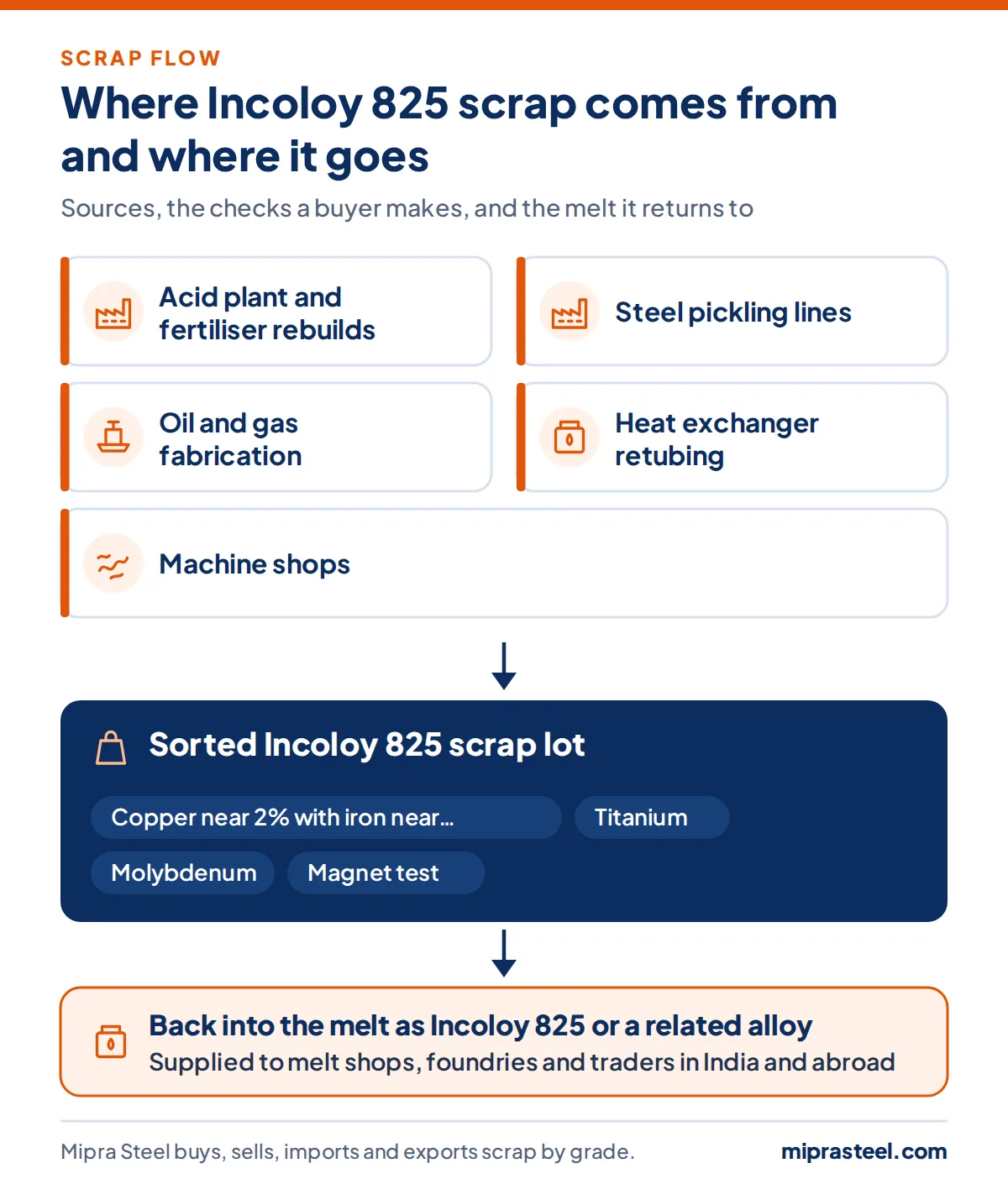
Those uses decide where the scrap appears: plate trim and sheet from acid-plant fabrication, exchanger bundles and internals from plant rebuilds, and offcuts from clad and lined pipe work for sour oil and gas service. 825 is also used in pollution-control equipment and nuclear fuel reprocessing.
For a scrap buyer, the copper is the giveaway. No Inconel carries both 2% copper and 30% iron, so a single XRF reading separates 825 from the Inconel grades it is confused with. The difficult neighbours are its own relatives: Incoloy 925 and acid-service alloys like 20Mo-4.
Incoloy 825 belongs to the Incoloy family, part of nickel alloy scrap.
Where Incoloy 825 Scrap Comes from in Practice
825 scrap follows corrosive service. Look for it wherever acid, brine or sour gas is handled.
Acid Plant and Fertiliser Rebuilds
Sulfuric and phosphoric acid equipment, evaporator internals, agitators and tank linings released when a plant is refurbished. See chemical processing scrap.
Steel Pickling Lines
Tanks, hooks, baskets, heating coils and fan parts from acid pickling of steel strip and wire. Often contaminated with acid residue and scale.
Oil and Gas Fabrication
Plate and sheet trim from making mechanically lined and metallurgically clad components for sour service, plus rejected solid parts. See oil and gas scrap.
Heat Exchanger Retubing
Tube bundles and baffles from exchangers built with 825 tubes to ASTM B163, when exchangers are retubed or replaced.
Machine Shops
Turnings and bar crops from valves, fittings and flanges machined from 825 bar and forgings.
Incoloy 825 Scrap Specification Chart
| Grade | Incoloy 825 |
|---|---|
| UNS | N08825 |
| W.Nr. / EN | 2.4858 |
| Also known as | Inconel 825, Alloy 825 |
| Alloy type | Solid-solution iron-nickel-chromium |
| Density | 8.14 g/cm³ (0.294 lb/in³) |
| Magnetic | Non-magnetic. |
| HS code (customs heading) | 7503.00 (nickel waste and scrap) |
Incoloy 825 Chemical Composition
Nominal composition in weight per cent, used to describe and identify the grade. The governing specification sets the limits for each product.
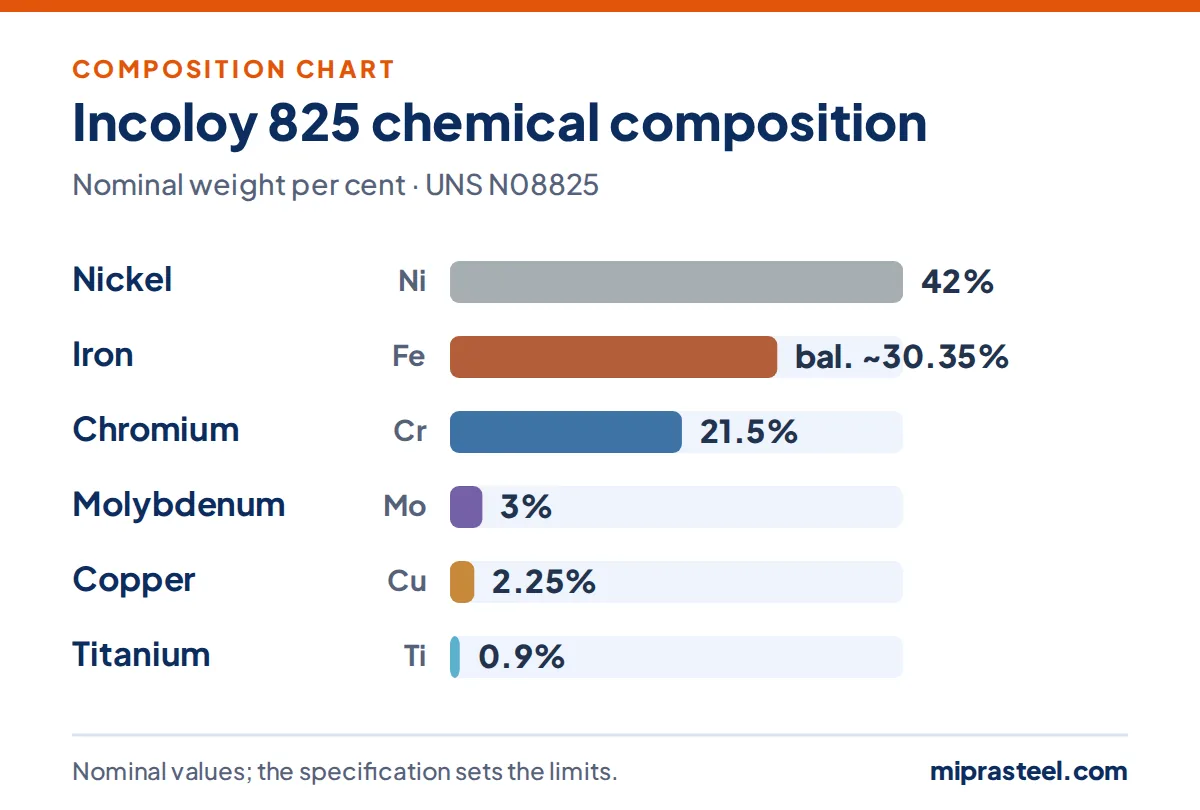
| Element | Symbol | Nominal wt% | |
|---|---|---|---|
| Nickel | Ni | 42 | |
| Iron | Fe | Balance (about 30.4) | |
| Chromium | Cr | 21.5 | |
| Molybdenum | Mo | 3 | |
| Copper | Cu | 2.3 | |
| Titanium | Ti | 0.9 |
Incoloy 825 Equivalent Grades and Other Names
| Designation | Value |
|---|---|
| Trade name | Incoloy 825 |
| UNS | N08825 |
| W.Nr. / EN | 2.4858 |
| Other names in the trade | Inconel 825, Alloy 825 |
Look up any designation in the grade name converter or the equivalent grade chart.
Incoloy 825 Standards and Specifications
| Product form | Standard | ASME equivalent |
|---|---|---|
| Plate, sheet and strip | ASTM B424 | ASME SB-424 |
| Rod and bar | ASTM B425 | ASME SB-425 |
| Seamless pipe and tube | ASTM B423 | ASME SB-423 |
| Condenser and heat-exchanger tube | ASTM B163 | ASME SB-163 |
| Welded tube | ASTM B704 | ASME SB-704 |
| Welded pipe | ASTM B705 | ASME SB-705 |
| Forgings | ASTM B564 | ASME SB-564 |
| Butt-weld fittings | ASTM B366 | ASME SB-366 |
Incoloy 825 Applications
- Sulfuric acid pickling and processing equipment
- Phosphoric acid evaporators
- Clad pipe and tubing for sour oil and gas
- Pollution-control and nuclear fuel reprocessing equipment
Source industries: chemical processing, oil and gas.
How Incoloy 825 Scrap Is Identified
Copper and iron do most of the work when identifying 825. Titanium then decides between 825 and 925.
| Check | What it shows for Incoloy 825 |
|---|---|
| Copper near 2% with iron near 30% | The 825 signature. Nickel near 42% and chromium near 21.5% complete the picture. |
| Titanium | About 0.9%. A reading near 2% titanium, with aluminium present, means Incoloy 925. |
| Molybdenum | About 3%. Readings of 4% or more, with less nickel, suggest 20Mo-4 or a super-austenitic stainless. |
| Magnet test | 825 is non-magnetic, but so are 316 stainless and many other grades. A magnet only catches carbon steel backing and ferritic parts. See the magnet test. |
| Clad or lined material | Test both surfaces. An 825 face over a magnetic carbon-steel substrate is clad material and must be traded separately. |
| Certificates | Mill certificates quoting ASTM B424, B425, B423 or B163, or W.Nr 2.4858, support the description. See reading mill test certificates. |
Grades Most Often Confused with Incoloy 825
- Incoloy 925: the age-hardened version: about 2.1% titanium and 0.3% aluminium against 0.9% titanium in 825.
- 20Mo-4: a nickel-iron-chromium-molybdenum acid-service alloy with about 37.5% nickel, 33% iron, 4.25% molybdenum and only about 1% copper.
- Inconel 625: shares acid-plant service but reads under 5% iron, about 62% nickel, 9% molybdenum and no copper.
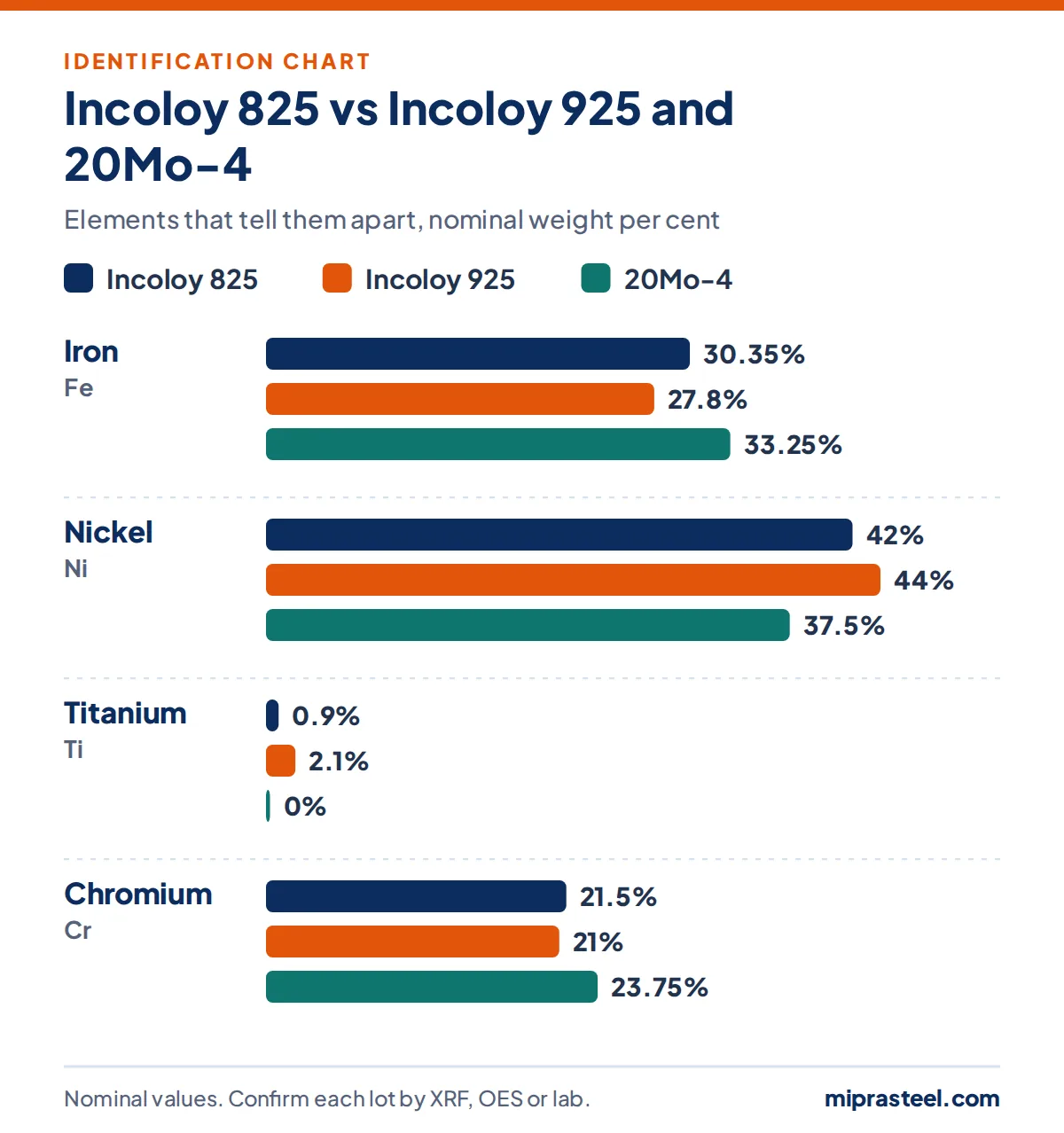
Nominal values for Incoloy 825 against its closest grades on this site.
Preparing Incoloy 825 Scrap for Sale
- Read every piece for copper and titanium to keep 825 apart from 925 and 20Mo-4.
- Keep 316 and other stainless steel out of the lot; it is non-magnetic too.
- Separate clad and lined pieces and label them as clad.
- Wash off acid residue and scale from plant scrap and let it dry.
- Remove carbon-steel supports, tie rods and flanges from tube bundles.
- Bag turnings separately from solids.
Incoloy 825 Scrap Price per Kg: What Decides It
With 30% iron in it, 825 carries less nickel than the Inconel grades, so the way the lot is presented has a large effect on what it fetches.
- Contained nickel (about 42%), chromium and molybdenum; the iron adds little and copper adds little value.
- Purity of grade: 316 stainless or 20Mo-4 mixed into an 825 lot looks similar on a magnet and pulls the lot down.
- Clad and lined material: valued on the 825 layer only, and must be declared separately from solid 825.
- Process residue: acid deposits, sludge and scale from pickling and acid plant work add weight and need cleaning.
- Form: plate trim and solids are worth more than turnings or tube bundles with baffles and tie rods of other metals.
- Lot size and location: a sorted container from a port city costs less to move than scattered small lots inland.
Nickel markets set the base, so no Incoloy 825 scrap price per kg holds for long. The contained metal calculator shows what a lot carries.
Incoloy 825 Scrap Import and Export
Importing Incoloy 825 Scrap into India
825 scrap reaches India mainly from Gulf refineries and gas plants, European chemical plants and East Asian fabrication yards. Every consignment needs a pre-shipment inspection certificate, a commercial invoice, packing list and bill of lading, and usually lands at Nhava Sheva, Mundra or Chennai. Material from acid service should be clean and dry before loading. Declaring it as "Incoloy 825" rather than "Inconel 825" avoids confusion between the invoice and the inspection report. See importing nickel alloy scrap into India.
Exporting Incoloy 825 Scrap from India
Indian fabricators of acid plant, fertiliser and refinery equipment release 825 plate trim and offcuts regularly. Exported lots are described by grade and UNS number on invoice and packing list, weighed, and shipped in bags, drums or loose in containers. Melters and traders in Europe, including Spain, and in the Gulf take 825; our Dubai office covers the UAE and neighbouring markets. See export paperwork for alloy scrap.
Customs heading: 7503.00 (nickel waste and scrap). The HS code is the international tariff heading the scrap is declared under; national tariff lines add further digits, so confirm the full line with your customs broker.
Comparisons
Other Incoloy Scrap Grades
Related Reading
Incoloy 825 Scrap FAQ
Is "Inconel 825" the same as Incoloy 825?
Yes, in scrap offers they mean the same alloy. The correct name is Incoloy 825 (UNS N08825), because with about 30% iron it belongs to the iron-nickel-chromium Incoloy family. "Inconel 825" is a common trade misnomer. Use the UNS number on invoices to avoid any doubt.
Is Incoloy 825 scrap worth more than stainless steel scrap?
Generally yes. 825 carries about 42% nickel, plus molybdenum and copper, while 316 stainless carries roughly 10% to 14% nickel. Because both are non-magnetic and look alike, 825 lots must be read with XRF to make sure stainless has not been mixed in, which would reduce the value of the whole lot.
How is Incoloy 825 different from Incoloy 925 scrap?
The two are close in nickel, iron, chromium, molybdenum and copper. 925 has about 2.1% titanium and some aluminium so it can be age-hardened, while 825 has about 0.9% titanium. An XRF reading of titanium separates them. They should be traded as different grades.
Does 825 scrap from a pickling line need cleaning before sale?
It helps. Pickling tanks, hooks and coils carry acid residue, scale and sludge that add weight and must be removed before melting. Washed, dry material is easier to inspect and describe, and a buyer does not have to allow for unknown residue in the offer.
Can Incoloy 825 clad plate be sold as 825 scrap?
It can be sold, but as clad material, not as solid 825. The 825 is a layer bonded to carbon or low-alloy steel, so the lot is valued on the 825 it contains. Keep clad offcuts apart from solid 825 and label them clearly.
What HS heading do exporters use for Incoloy 825 scrap?
Although 825 contains about 30% iron, nickel is its largest element, so it is typically declared under HS 7503.00, nickel waste and scrap. Countries add their own national digits. Your customs broker should confirm the full line before shipment.
How do I sell 825 scrap to Mipra Steel?
Send the form, weight, location, photographs and any readings or mill certificates, and mention whether any of it is clad or from acid service. Mipra Steel buys 825 from plants, fabricators and traders in India and abroad, and also supplies described 825 lots.
What is Incoloy 825 made of?
Nominally 42% nickel, 30.4% iron, 21.5% chromium, 3% molybdenum, 2.3% copper, 0.9% titanium. Specification ranges vary by product form and standard.
Published by Mipra Steel, Khetwadi, Mumbai · Updated