René N5 Scrap Buyer, Importer and Exporter in India
Mipra Steel trades René N5 revert and blade scrap from Khetwadi, Mumbai, as a single-alloy, rhenium-bearing material that is never pooled with rhenium-free superalloys.
Sell René N5 Scrap
Selling René N5 scrap? Tell us whether it is foundry revert, rejected castings or ex-service blades, the weight, and whether the blades are coated. Send photographs of roots and part numbers, and any lab report showing rhenium. Engine-run lots should list the engine type they came from. We review incoming enquiries and respond with relevant next steps.
Buy René N5 Scrap
Sourcing N5 for a vacuum melt or for rhenium recovery? Say which you need, because the two buyers want different lots: a melter wants clean, uncoated, single-alloy revert, while a recovery plant can accept coated or mixed rhenium-bearing material. Give the quantity, destination and the analysis you require before shipment.
What Is René N5 Scrap, and Why Does the Rhenium Matter?
René N5 belongs to the generation of single-crystal blade alloys that added rhenium to hold creep strength at higher metal temperatures. A single-crystal blade has no grain boundaries at all, so the alloy has little need for grain-boundary strengtheners and can carry more of the heavy refractory elements instead. In N5 those are tantalum, tungsten, molybdenum and, above all, about 3% rhenium.
Rhenium is the reason this scrap is handled with more care than almost any other nickel alloy. Superalloys take an estimated four-fifths of all rhenium end use, and the supply is small. Every tonne of genuine N5 holds roughly 30 kg of rhenium, so a revert buyer is paying for that element as much as for the nickel. A melt shop making N5 or another rhenium-bearing alloy can put clean revert straight back into the furnace. Material that cannot go back as revert is a candidate for rhenium recovery instead.
The trade risk runs both ways. A few rhenium-free blades in an N5 lot dilute what the buyer is paying for. A few N5 blades in a rhenium-free lot, such as René N500 or GTD-111, put rhenium into a melt that was never meant to carry it. Either mistake shows up in the lab report, and the lot is repriced.
Spellings vary in enquiries: René N5, Rene N5, René' N5 or plain "N5". The designation is GE's; this page is about scrap of that alloy and implies no link with the engine maker.
René N5 belongs to the René family, part of superalloy scrap.
Where René N5 Scrap Turns Up
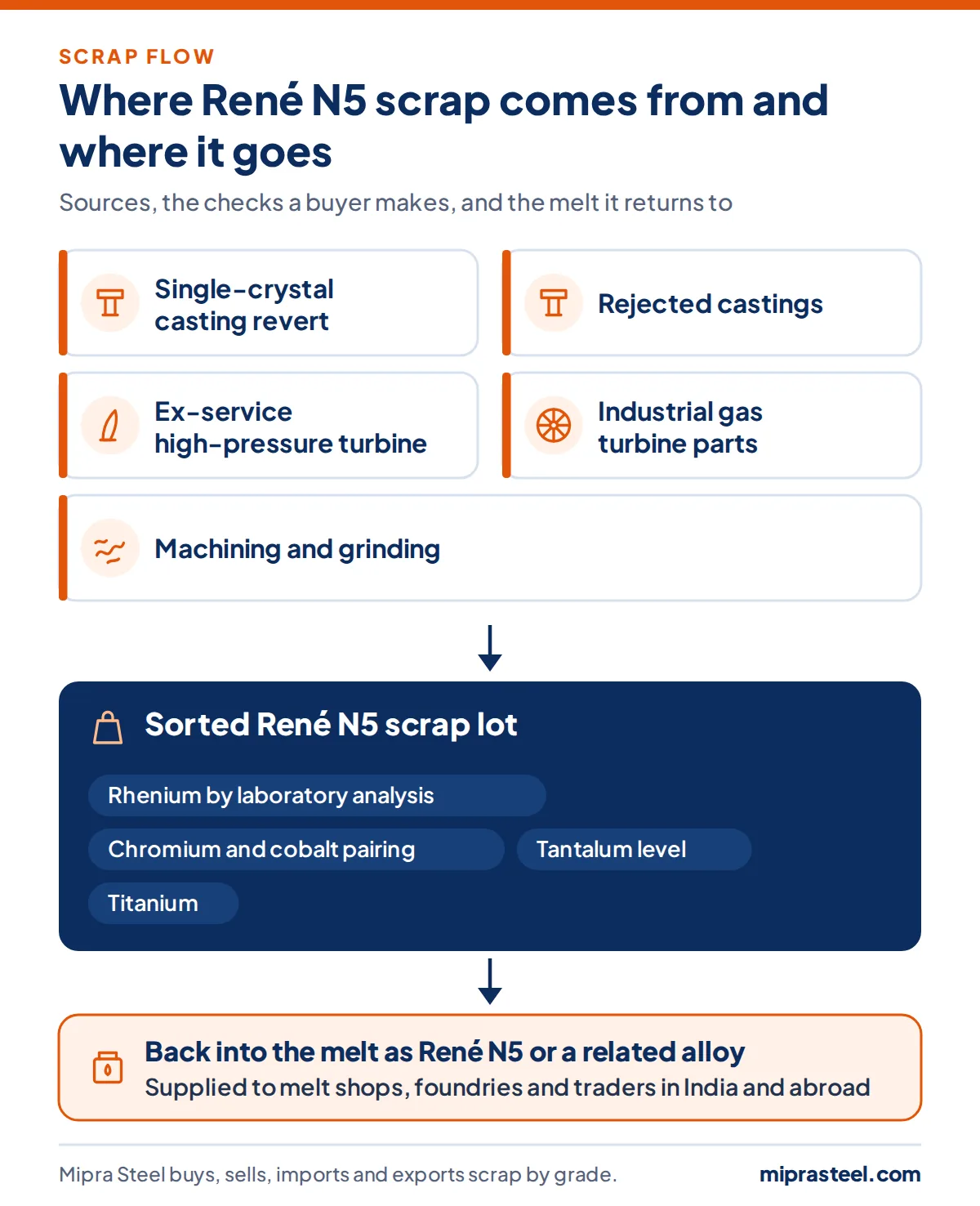
N5 reaches the scrap market from two very different ends of a blade's life: the foundry, before the part ever flies, and the overhaul shop, after it has done its hours.
Single-Crystal Casting Revert
Starter blocks, grain selectors, gating and the clusters cut away from blade castings. This is uncoated, traceable to a heat and usually the cleanest N5 a buyer will see.
Rejected Castings
Blades scrapped for stray grains in the platform, recrystallised areas or dimensional faults. Chemistry is sound; only the crystal structure failed inspection. Some still hold fused-silica core material inside.
Ex-Service High-Pressure Turbine Blades
Blades retired at engine overhaul in aerospace work. Most are coated, many are cooled with internal passages, and lots often mix N5 with other alloys from the same engine.
Industrial Gas Turbine Parts
Some heavy-duty and aero-derivative power generation machines use N5 in hot-section blades and vanes, which return as service scrap when sets are replaced.
Machining and Grinding
Root-form grinding of blades leaves fine swarf. It contains rhenium but is hard to keep pure, so it is sold as a separate, lower-grade lot.
René N5 Scrap Specification Chart
| Grade | René N5 |
|---|---|
| UNS | Not assigned (proprietary GE alloy) |
| W.Nr. / EN | Not assigned |
| Identified by | GE material specification, casting records and analysis |
| Also known as | Rene N5 |
| Alloy type | Single-crystal cast superalloy (second generation) |
| Density | Not published |
| Magnetic | Non-magnetic. |
| HS code (customs heading) | 7503.00 (nickel waste and scrap) |
René N5 Chemical Composition
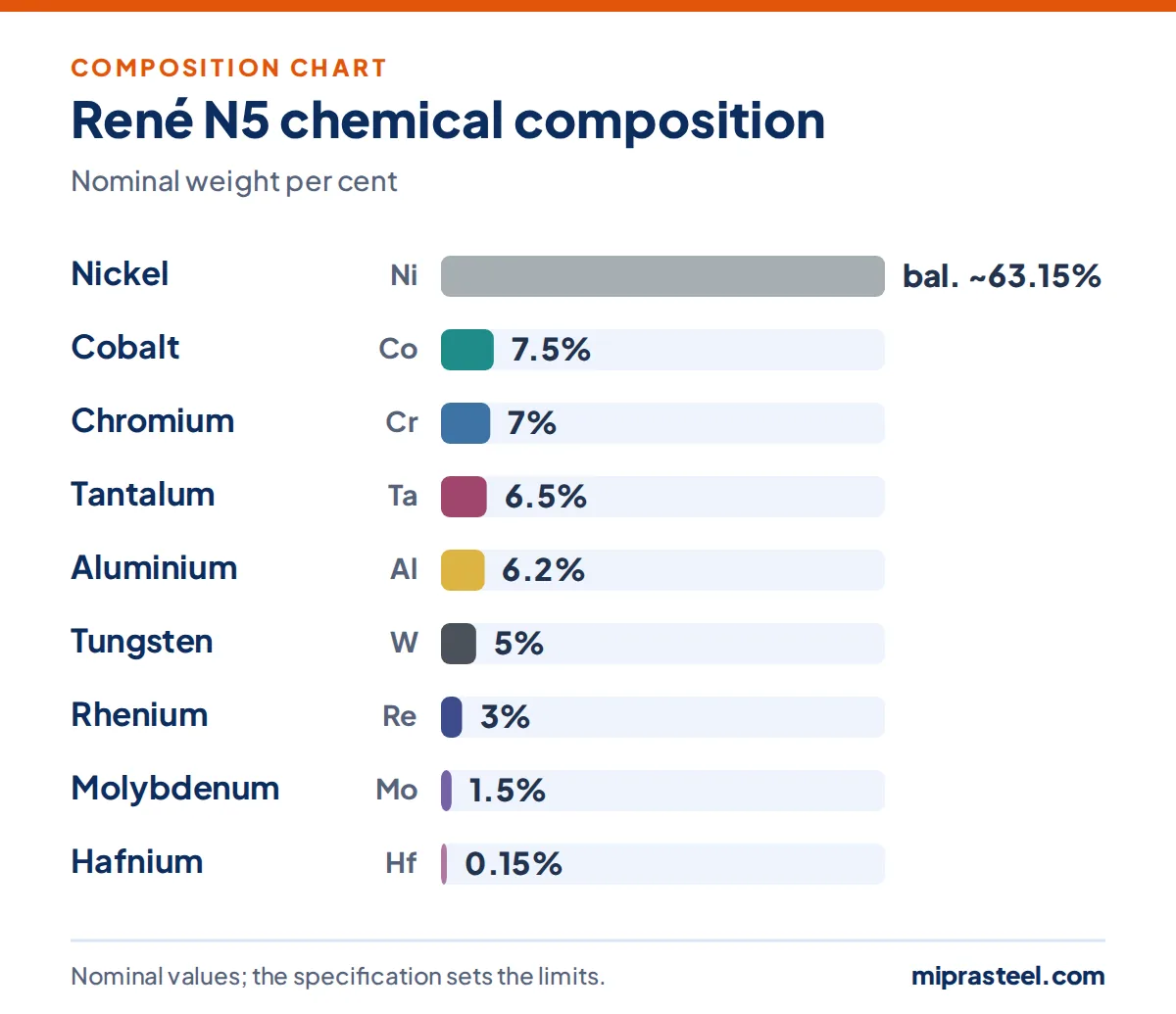
Nominal composition in weight per cent, used to describe and identify the grade. The governing specification sets the limits for each product.
| Element | Symbol | Nominal wt% | |
|---|---|---|---|
| Nickel | Ni | Balance (about 63.2) | |
| Cobalt | Co | 7.5 | |
| Chromium | Cr | 7 | |
| Tantalum | Ta | 6.5 | |
| Aluminium (aluminum) | Al | 6.2 | |
| Tungsten | W | 5 | |
| Rhenium | Re | 3 | |
| Molybdenum | Mo | 1.5 | |
| Hafnium | Hf | 0.15 |
René N5 Equivalent Grades and Other Names
| Designation | Value |
|---|---|
| Trade name | René N5 |
| UNS | Not assigned (proprietary GE alloy) |
| W.Nr. / EN | Not assigned |
| Other names in the trade | Rene N5 |
Look up any designation in the grade name converter or the equivalent grade chart.
René N5 Standards and Specifications
Supplied to turbine OEM specifications.
René N5 Applications
- High-pressure turbine blades and vanes in aero engines
- Some industrial gas turbine hot sections
Source industries: aerospace, power generation.
How René N5 Scrap Is Identified
N5 cannot be confirmed by eye or magnet, and a handheld reading is only the first step. Rhenium is the element that decides the lot, and it is also the hardest one to read accurately.
| Check | What it shows for René N5 |
|---|---|
| Rhenium by laboratory analysis | Rhenium X-ray lines overlap with those of tantalum and tungsten, so a handheld XRF figure for rhenium is indicative only. Buyers expect a lab result (OES, ICP or XRF on a prepared sample) before a lot is priced as rhenium-bearing. |
| Chromium and cobalt pairing | About 7% chromium with 7.5% cobalt. Readings near 5% chromium and 10% cobalt point to PWA 1484 instead. |
| Tantalum level | About 6.5%. A figure near 8.7% with 3% rhenium suggests PWA 1484. |
| Titanium | N5 carries none. A rhenium-bearing reading with about 1% titanium points to CMSX-4. |
| Coating | Ex-service blades usually carry a platinum aluminide or MCrAlY bond coat and sometimes a yttria-stabilised zirconia thermal barrier. Grind a clean spot on the root before reading, and declare the coating. |
| Grain structure and markings | A single-crystal blade shows no visible grain pattern after etching. Part numbers and casting marks help tie a lot to an engine and alloy. |
Grades Most Often Confused with René N5
- PWA 1484: also 3% rhenium, but with about 10% cobalt, 8.7% tantalum and only 5% chromium.
- René N500: nearly the same base chemistry with no rhenium, about 6% chromium and 6.25% tungsten.
- MAR-M 247: an older DS and equiaxed blade alloy with 10% tungsten, 1.5% hafnium and no rhenium.
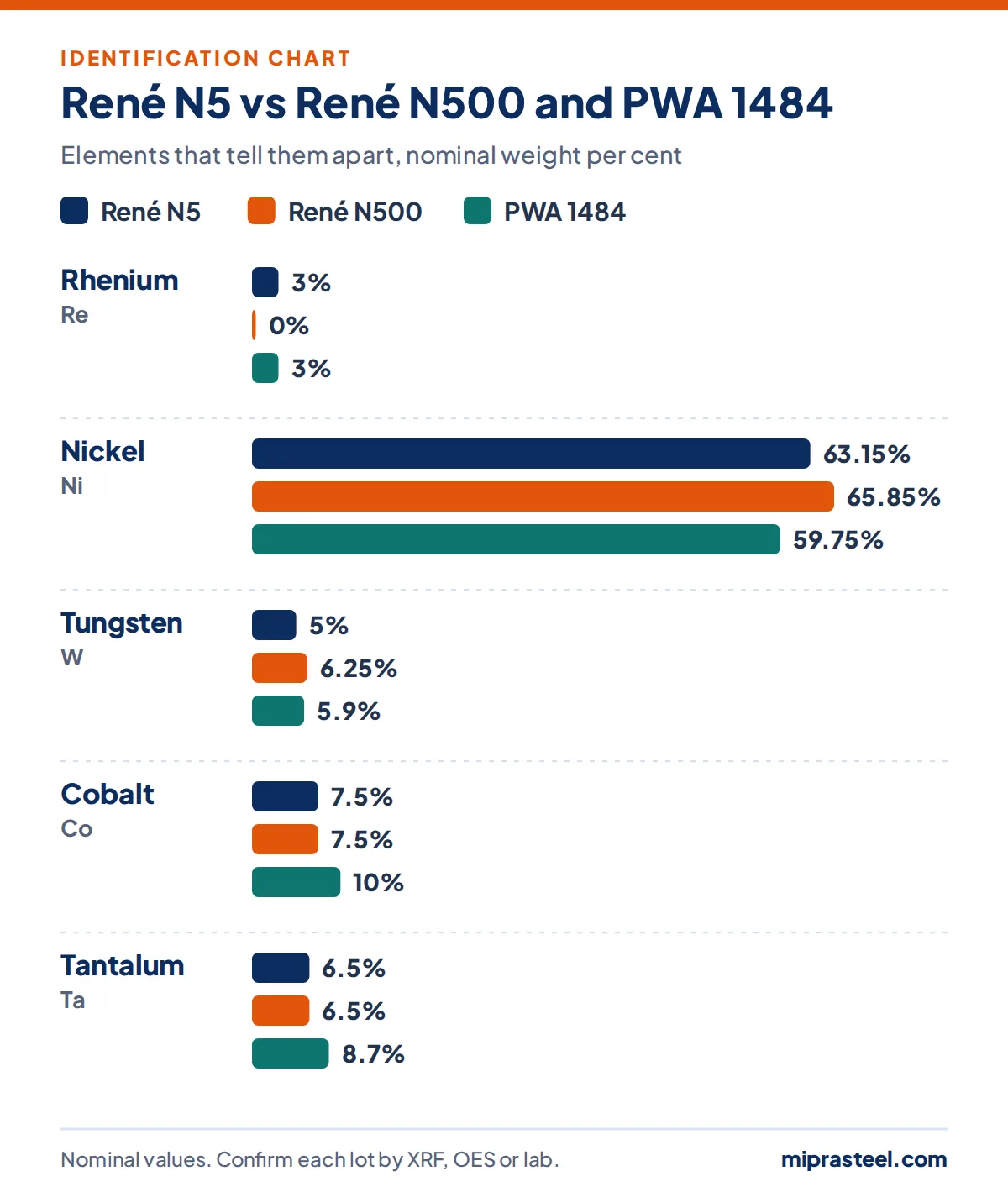
Nominal values for René N5 against its closest grades on this site.
Preparing René N5 Scrap for Sale
- Keep N5 in its own sealed drums, away from every rhenium-free alloy.
- Split foundry revert, rejected castings and ex-service blades into separate lots.
- Keep coated blades apart from bare ones and say what the coating is.
- Remove damper pins, seals and any non-blade hardware.
- Grind a small clean spot on a few roots so readings are taken on base metal.
- Keep heat records, part numbers and any lab rhenium figure with the lot.
René N5 Scrap Price per Kg: What Decides It
A René N5 scrap price per kg is built mostly on contained rhenium, then on everything that makes that rhenium easier or harder to use.
- Proven rhenium: a lab figure close to the nominal 3% supports a rhenium-bearing price; an unproven lot is offered on its other metals until the analysis is in.
- Revert versus recovery: clean, single-alloy foundry revert that a melt shop can reuse directly is worth more than mixed service scrap headed for chemical recovery.
- Coatings: platinum aluminide, MCrAlY and ceramic topcoats have to be removed or allowed for, so coated blades are valued below bare material.
- Mixing: any rhenium-free blades in the lot lower the average and add sorting cost.
- Core residue and attachments: retained ceramic core, braze, seals or damper pins add non-metal weight.
- Tantalum and tungsten, which add to the value of N5 even before rhenium is counted.
Rhenium trades thinly and its price can move sharply, so offers are dated and short-lived. The general method is in how nickel alloy scrap is valued; the specific case of engine parts is in selling turbine blade scrap.
René N5 Scrap Import and Export
Importing René N5 Scrap into India
Rhenium-bearing blade scrap reaches India mainly from overhaul and casting centres in Europe, East Asia and the Gulf. Under India's rules for metal scrap, the shipment is inspected before loading and carries a pre-shipment inspection certificate together with the commercial invoice, packing list and bill of lading. For N5 the invoice should name the alloy and state that it is single-crystal nickel superalloy containing rhenium, with the lab analysis attached, so customs and the buyer read the same description. Most such cargo lands at Nhava Sheva or Mundra. More detail: importing nickel alloy scrap into India.
Exporting René N5 Scrap from India
Buyers of N5 revert sit where single-crystal blades are cast and where rhenium is recovered, mainly in Europe, the United States and East Asia. Exported lots are described as René N5 single-crystal revert or blades, with rhenium content stated from analysis, weighed, and packed in sealed drums or bags so pieces cannot migrate between lots. Our office in South Korea works with buyers in East Asia and Japan, and Dubai covers the Gulf. Documents are listed in export documents for alloy scrap.
Customs heading: 7503.00 (nickel waste and scrap). The HS code is the international tariff heading the scrap is declared under; national tariff lines add further digits, so confirm the full line with your customs broker.
Other René Scrap Grades
Related Reading
René N5 Scrap FAQ
How much rhenium does René N5 contain?
About 3% by weight, which is roughly 30 kg of rhenium in every tonne of alloy. N5 also carries about 6.5% tantalum and 5% tungsten. The actual figure in a scrap lot depends on how well it has been kept apart from rhenium-free alloys, which is why buyers ask for a laboratory analysis before agreeing a price.
Why can a handheld XRF not prove rhenium in N5 blades?
Because rhenium's X-ray lines sit close to those of tantalum and tungsten, which N5 also contains. A handheld gun can suggest that rhenium is present, but the figure is not reliable enough to price a lot on. Laboratory methods such as OES, ICP or XRF on a prepared sample give the number buyers accept. See XRF, OES and lab analysis compared.
Is N5 casting revert worth more than used N5 blades?
Usually yes. Foundry revert is uncoated, traceable to a heat and free of service damage, so a melt shop can reuse it directly. Ex-service blades carry coatings, oxidation, braze and sometimes core residue, and often arrive mixed with other alloys. They still contain the rhenium, but more of their value depends on sorting and recovery.
Do coated René N5 blades have to be stripped before sale?
No, coated blades can be sold as they are, but they must be declared as coated and are valued with the coating allowed for. Platinum aluminide and MCrAlY bond coats, and zirconia ceramic topcoats, are not part of the N5 chemistry. A melter wanting direct revert will want them removed; a rhenium recovery buyer may not.
What happens if René N5 gets mixed with René N500?
The lot loses its clean description in both directions. N500 has the same family make-up without rhenium, so it cannot be told apart by eye or by most handheld readings. Mixed material ends up priced on an averaged, tested rhenium figure, and neither melter can use it as straight revert.
Does Mipra Steel deal in rhenium-bearing turbine blade scrap?
Yes. Mipra Steel buys and sells rhenium-bearing superalloy scrap, including René N5 revert and ex-service blades, and handles imports and exports. Send the form, weight, coating status, photographs and any analysis, and we will reply with next steps.
Which customs code covers René N5 scrap?
N5 is nickel-base, so it is typically declared under HS 7503.00, nickel waste and scrap, even though its rhenium is the main value. Some countries split the heading further at national level. Your customs broker should confirm the full line for the destination.
Is René N5 used in industrial gas turbines as well as jet engines?
Yes, though aero engines are its main home. GE material papers describe N5 giving a clear creep-strength gain over directionally solidified GTD-111 in land-based turbines, and some industrial and aero-derivative machines use it in the hottest blade rows. Most N5 scrap still comes from aero engine overhaul and blade foundries.
What is René N5 made of?
Nominally 63.2% nickel, 7.5% cobalt, 7% chromium, 6.5% tantalum, 6.2% aluminium, 5% tungsten, 3% rhenium, 1.5% molybdenum, 0.15% hafnium. Specification ranges vary by product form and standard.
Published by Mipra Steel, Khetwadi, Mumbai · Updated