Titanium Grade 11 Scrap Buyer, Importer and Exporter in India
Mipra Steel handles Grade 11 as a distinct palladium-bearing titanium grade, buying from plants and fabricators and supplying documented lots to Ti-Pd users and traders.
Sell Titanium Grade 11 Scrap
Selling Grade 11 linings or formed parts? Tell us what unit the material came from, whether it is solid sheet or clad plate, the approximate weight, the location and how it has been cut. Photos of markings, palladium readings and the original certificates naming R52250 help most. We review incoming enquiries and respond with relevant next steps.
Buy Titanium Grade 11 Scrap
If your melt or fabrication needs Grade 11 specifically, tell us the quantity, the forms you can take, and what proof of the Grade 1 base you require. Where documents only support "Ti-Pd" and not Grade 11, the lot is offered under that description so there is no surprise at your end.
What Is Titanium Grade 11, and Where Does Its Scrap Come from?
Grade 11 answers a narrow design problem: a chemical engineer needs palladium-level resistance to reducing acids, but the part has to be formed hard, pressed, spun or rolled into a lining. Grade 1 is the most ductile of the commercially pure titanium grades because its oxygen and iron limits are the lowest (0.18% oxygen and 0.20% iron maximum). Add 0.12% to 0.25% palladium to that base and you have Grade 11.
Because it is chosen for forming, Grade 11 scrap tends to be thin. Think loose linings stripped from vessels, formed heads, bellows-like shapes, cladding layers and sheet trim, rather than heavy plate or bar. Volumes are small, and many traders will see only a few Grade 11 lots in a year. When one does turn up, it is usually because a plant has relined a reactor or rebuilt a unit in acid service.
Commercially, Grade 11 sits beside its sister grade, Grade 7. Both carry the same palladium; they differ only in the base metal's oxygen and iron. A remelter making Ti-Pd grades values that palladium in either one, but a buyer who needs Grade 11 for its low-interstitial base will want proof it is not Grade 7. That proof is paperwork, not a quick reading.
Titanium Grade 11 belongs to the Titanium family, part of exotic alloy scrap.
Typical Sources of Grade 11 Titanium Scrap
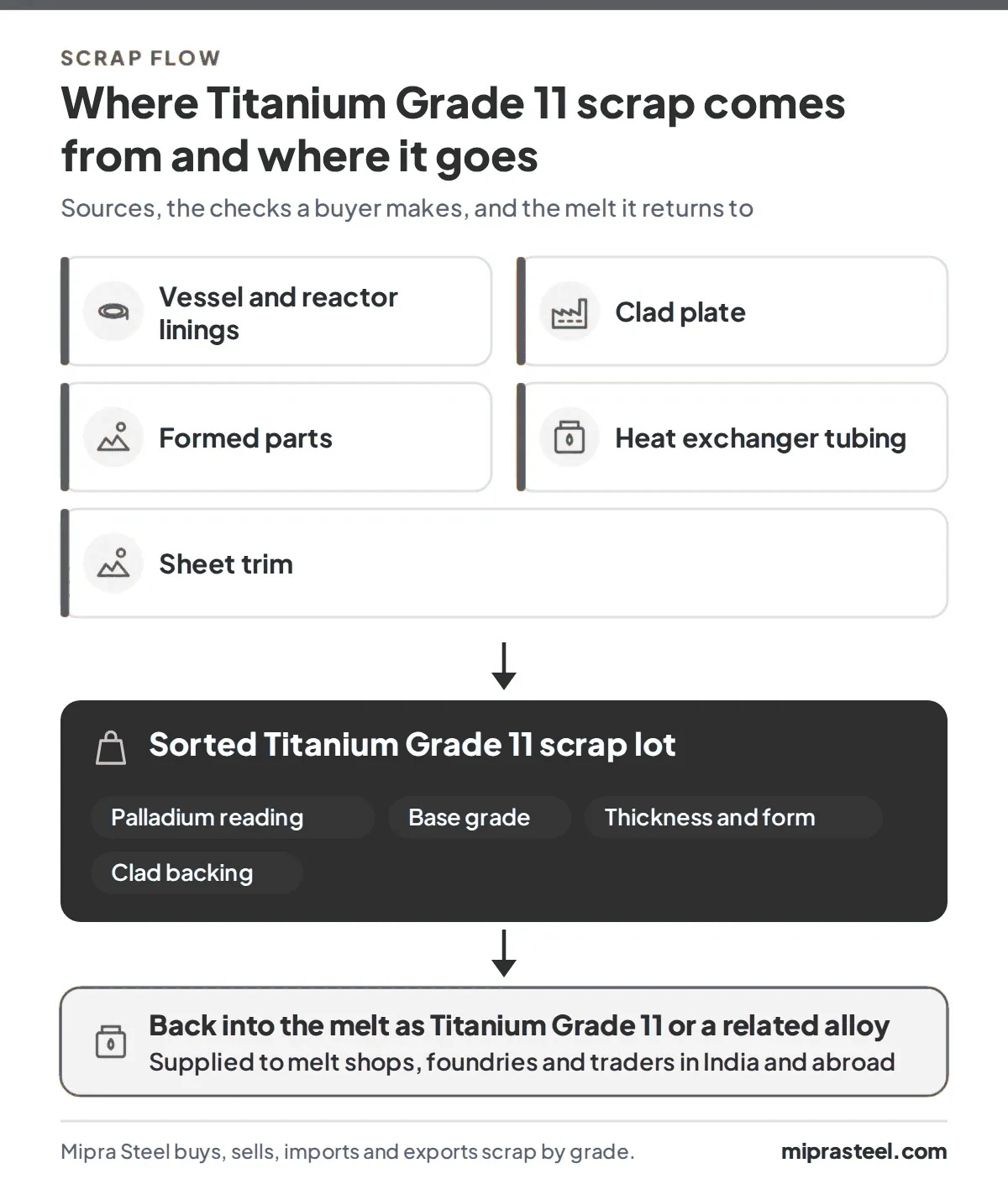
Grade 11 scrap is almost always tied to chemical equipment built to be formed rather than machined.
Vessel and Reactor Linings
Loose or welded titanium linings removed during relining of units in reducing-acid service. See chemical processing scrap.
Clad Plate
Titanium-clad steel where the Grade 11 layer is bonded to a steel backing. It is valued on the titanium layer only and must be declared as clad.
Formed Parts
Dished heads, spun components and pressed shapes made from ASTM B265 Grade 11 sheet, rejected in fabrication or removed in service.
Heat Exchanger Tubing
Thin-wall tube to ASTM B338 from units where forming or flaring of tube ends was demanding.
Sheet Trim
Edge trim and cut-outs from fabricators of linings and formed equipment, usually the cleanest and most traceable Grade 11.
Titanium Grade 11 Scrap Specification Chart
| Grade | Titanium Grade 11 |
|---|---|
| UNS | R52250 |
| W.Nr. / EN | 3.7225 |
| Also known as | Ti-0.15Pd (Grade 1 base) |
| Alloy type | Commercially pure titanium with palladium |
| Density | 4.51 g/cm³ (0.163 lb/in³) |
| Magnetic | Non-magnetic. |
| HS code (customs heading) | 8108.30 (titanium waste and scrap) |
Titanium Grade 11 Chemical Composition
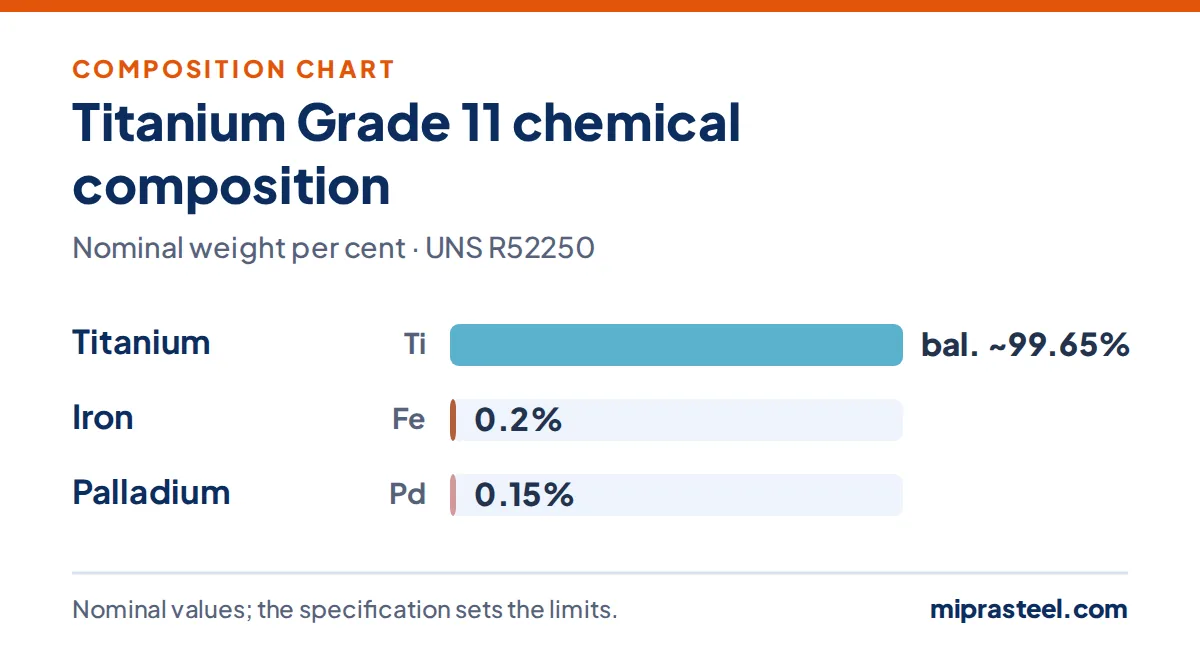
Nominal composition in weight per cent, used to describe and identify the grade. The governing specification sets the limits for each product.
| Element | Symbol | Nominal wt% | |
|---|---|---|---|
| Titanium | Ti | Balance (about 99.7) | |
| Iron | Fe | 0.2 | |
| Palladium | Pd | 0.15 |
Titanium Grade 11 Equivalent Grades and Other Names
| Designation | Value |
|---|---|
| Trade name | Titanium Grade 11 |
| UNS | R52250 |
| W.Nr. / EN | 3.7225 |
| Other names in the trade | Ti-0.15Pd (Grade 1 base) |
Look up any designation in the grade name converter or the equivalent grade chart.
Titanium Grade 11 Standards and Specifications
Titanium Grade 11 Applications
- Formed chemical equipment in reducing media
- Linings and cladding
Source industries: chemical processing.
How Titanium Grade 11 Scrap Is Identified
Expect XRF to confirm palladium and rule out alloyed titanium, then rely on documents to separate Grade 11 from Grade 7.
| Check | What it shows for Titanium Grade 11 |
|---|---|
| Palladium reading | About 0.12% to 0.25% palladium on XRF confirms a Ti-Pd grade and rules out plain Grade 1 or Grade 2. |
| Base grade | XRF cannot measure oxygen. Grade 11 versus Grade 7 is settled by mill certificates or, failing that, hardness testing, since the Grade 1 base is softer. |
| Thickness and form | Thin, heavily formed sheet with no machining marks fits the Grade 11 profile, but is a hint only, not proof. |
| Clad backing | Check the back face with a magnet. A magnetic steel backing means clad plate, which is described and valued separately. |
| Markings | Sheet is often ink-stamped with grade, R52250 and heat number. Photograph markings before cutting. |
Grades Most Often Confused with Titanium Grade 11
- Titanium Grade 7: has the same palladium, but on the Grade 2 base with higher oxygen and iron limits.
- Titanium Grade 1: is the same soft base with no palladium.
- Grade 17: is Grade 1 with a reduced palladium content, roughly 0.04% to 0.08%.
Nominal values for Titanium Grade 11 against its closest grades on this site.
Preparing Titanium Grade 11 Scrap for Sale
- Separate clad plate from solid Grade 11 sheet before anything else.
- Strip welded steel studs, nozzles and gasket material off lining sections.
- Flatten or cut formed shapes to a size that packs densely.
- Read each piece for palladium and keep any piece without it out of the lot.
- Store the certificates naming R52250 with the material; they carry the grade.
Titanium Grade 11 Scrap Price per Kg: What Decides It
For a grade this specialised, the offer depends less on titanium generally and more on how well the lot's identity is documented.
- Proof of palladium, from readings on each piece or from certificates.
- Proof of the Grade 1 base: without certificates, Ti-Pd scrap is normally described as Grade 7 or simply as palladium-bearing titanium.
- Clad versus solid: clad plate is valued on the titanium layer, and the steel backing is a deduction.
- Weld seams and attachments: lining scrap often carries welded steel studs, nozzles or gasket residue that must be removed.
- Surface condition after acid service, including scale and deposits that need cleaning.
- Small lot size and handling of thin, bulky shapes, plus the titanium and palladium markets on the day.
A titanium Grade 11 scrap price per kg is always quoted against a specific, dated description. For how different titanium grades compare, start at titanium scrap.
Titanium Grade 11 Scrap Import and Export
Importing Titanium Grade 11 Scrap into India
Grade 11 lots reaching India are usually small and come from chemical plant relining in Europe, the Gulf or East Asia. Titanium scrap is typically declared under HS 8108.30; the importer's customs broker confirms the full line. The usual pre-shipment inspection certificate, commercial invoice, packing list and bill of lading apply. Because thin formed scrap is bulky, flattening or cutting before shipment improves container loading. The paperwork route is covered in importing scrap into India, and reading mill test certificates helps confirm the grade.
Exporting Titanium Grade 11 Scrap from India
When Indian chemical and pharmaceutical plants reline titanium equipment, Grade 11 sheet and formed parts become available for export to Ti-Pd melters and traders. Lots are described as Titanium Grade 11, UNS R52250, on the invoice and packing list, with clad material declared separately, and shipped in crates or bags from Nhava Sheva or Mundra. Our offices serve South Korea and the UAE, and we also ship to Italy and Japan.
Customs heading: 8108.30 (titanium waste and scrap). The HS code is the international tariff heading the scrap is declared under; national tariff lines add further digits, so confirm the full line with your customs broker.
Other Titanium Scrap Grades
Related Reading
Titanium Grade 11 Scrap FAQ
How is titanium Grade 11 different from Grade 7?
Both contain 0.12% to 0.25% palladium. Grade 11 is built on Grade 1, with oxygen limited to 0.18% and iron to 0.20%, which makes it softer and easier to form. Grade 7 uses the stronger Grade 2 base.
Can XRF tell Grade 11 apart from Grade 7?
No, not reliably. XRF shows the palladium in both but cannot measure the oxygen that separates their base grades. Mill certificates are the usual proof, and hardness testing can support them because Grade 11 is softer.
Why would a plant use Grade 11 instead of Grade 7?
For parts that must be heavily formed, such as linings, dished heads and spun shapes. Grade 11 keeps the palladium's resistance to reducing acids while giving the extra ductility of the Grade 1 base.
Is titanium-clad steel plate sold as Grade 11 scrap?
Not as solid Grade 11. Clad plate has a titanium layer bonded to steel and is valued on that titanium layer, with the steel treated as a deduction. It should be declared as clad and kept apart.
Does Mipra Steel deal in small lots of Grade 11?
Yes. Grade 11 rarely comes in large tonnages, and small documented lots are normal. Send the weight, form, location, photos and any certificates so the lot can be described properly.
Under which tariff heading does Grade 11 scrap travel?
Titanium waste and scrap, typically HS 8108.30. The palladium content does not change the heading, but the national line should still be confirmed with a customs broker before shipping.
What is Titanium Grade 11 made of?
Nominally 99.7% titanium, 0.2% iron, 0.15% palladium. Specification ranges vary by product form and standard.
Published by Mipra Steel, Khetwadi, Mumbai · Updated