Incoloy 925 Scrap Buyer, Importer and Exporter in India
Mipra Steel buys and sells Incoloy 925 turnings, bar ends and oilfield parts, working from Mumbai with offices in Dubai and South Korea.
Sell Incoloy 925 Scrap
Machining 925 for oilfield customers, or clearing retired completion equipment? Let us know the form, weight and location, whether turnings come from machines that also cut 718 or 825, and send photographs. Certificates, part numbers or readings showing titanium and copper make it simpler to describe the lot. We review incoming enquiries and respond with relevant next steps.
Buy Incoloy 925 Scrap
Need Incoloy 925 scrap? Tell us the form (turnings, bar ends, solid parts), your tolerance for oil in swarf, the quantity, destination port and timing. We describe lots as Incoloy 925, UNS N09925, and can discuss the analysis supplied with each one.
Where Does Incoloy 925 Come from, and How Does Its Scrap Behave?
Take Incoloy 825, add enough titanium and a little aluminium to make it respond to age-hardening, and you have 925. The extra strength lets it carry load in parts that 825 could not, while keeping the corrosion resistance that sour wells demand. Its producer describes resistance to sulphide stress cracking and stress-corrosion cracking in crude oil and gas containing hydrogen sulphide, with mechanical properties that meet NACE MR0175. In practice that means tubing hangers, landing nipples, packers, tool joints, valve stems and bodies, fasteners and pump shafts.
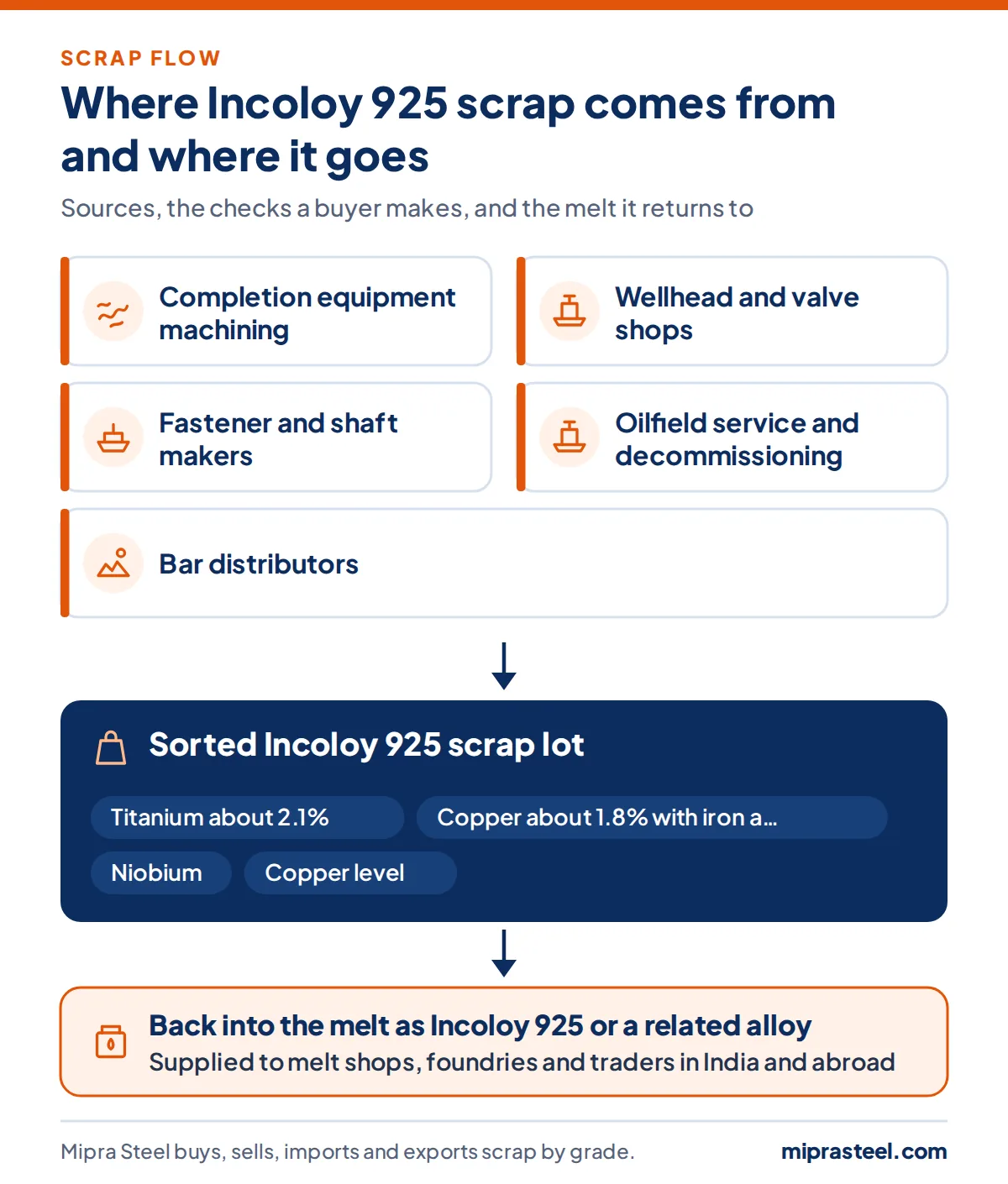
The scrap is therefore an oilfield product. Almost none of it comes from chemical plants or aerospace. It comes from shops that machine 925 bar to ASTM B805 or to API 6ACRA for completion and wellhead equipment, and from operators and service companies retiring that equipment. Turnings and bar ends make up most of the volume.
The trap is the name. Sellers often call it "Inconel 925", and on a shop floor it sits beside Inconel 718, Incoloy 825 and Monel K-500, all used for similar parts. Each has a different value to a melter. A 925 lot is only worth its full grade description if titanium, copper and niobium readings show nothing else has crept in.
Incoloy 925 belongs to the Incoloy family, part of nickel alloy scrap.
Typical Sources of Incoloy 925 Scrap
If a part was made for a sour well, it may be 925. These are the places the scrap actually collects.
Completion Equipment Machining
Tubing hangers, landing nipples, packers and seal bores machined from heavy 925 bar leave long runs of turnings and short bar crops.
Wellhead and Valve Shops
Valve stems, bonnets and bodies for sour service, plus rejected parts that failed inspection. See oil and gas scrap.
Fastener and Shaft Makers
Studs, bolts, pump and marine shafting cut from 925 bar and wire, with short ends and rejects.
Oilfield Service and Decommissioning
Retired downhole tools, hangers and valve internals pulled from wells or written off from inventory. These need a reading on each piece.
Bar Distributors
Saw cuts and off-size lengths when 925 bar is cut to customer order.
Incoloy 925 Scrap Specification Chart
| Grade | Incoloy 925 |
|---|---|
| UNS | N09925 |
| W.Nr. / EN | 2.4852 |
| Also known as | Inconel 925, Alloy 925 |
| Alloy type | Precipitation-hardened iron-nickel-chromium |
| Density | 8.08 g/cm³ (0.292 lb/in³) |
| Magnetic | Non-magnetic. |
| HS code (customs heading) | 7503.00 (nickel waste and scrap) |
Incoloy 925 Chemical Composition
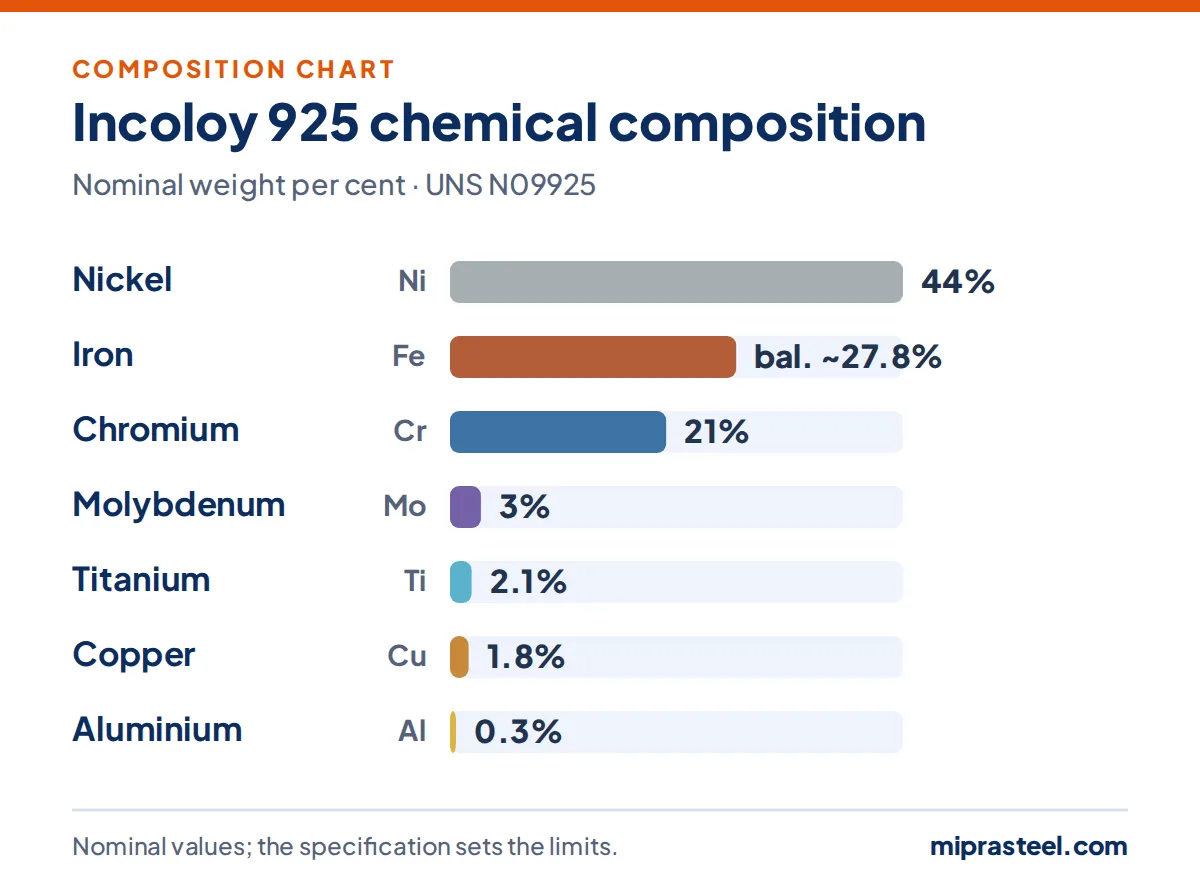
Nominal composition in weight per cent, used to describe and identify the grade. The governing specification sets the limits for each product.
| Element | Symbol | Nominal wt% | |
|---|---|---|---|
| Nickel | Ni | 44 | |
| Iron | Fe | Balance (about 27.8) | |
| Chromium | Cr | 21 | |
| Molybdenum | Mo | 3 | |
| Titanium | Ti | 2.1 | |
| Copper | Cu | 1.8 | |
| Aluminium (aluminum) | Al | 0.3 |
Incoloy 925 Equivalent Grades and Other Names
| Designation | Value |
|---|---|
| Trade name | Incoloy 925 |
| UNS | N09925 |
| W.Nr. / EN | 2.4852 |
| Other names in the trade | Inconel 925, Alloy 925 |
Look up any designation in the grade name converter or the equivalent grade chart.
Incoloy 925 Standards and Specifications
Incoloy 925 Applications
- Downhole tools and tubing hangers
- Valve stems and bodies
- Fasteners and pump shafts in H₂S service
Source industries: oil and gas, marine and shipbuilding.
How Incoloy 925 Scrap Is Identified
925 is identified by titanium, then confirmed by what it does not contain.
| Check | What it shows for Incoloy 925 |
|---|---|
| Titanium about 2.1% | The main tell against Incoloy 825, which reads about 0.9% titanium. |
| Copper about 1.8% with iron about 28% | Confirms the Incoloy family. No Inconel shows both. |
| Niobium | Should be close to zero. About 5% niobium with 18% iron means Inconel 718, the other common oilfield alloy. |
| Copper level | About 30% copper and little iron means Monel K-500, not 925, even though both are age-hardened oilfield alloys. |
| Certificates and part marks | Oilfield parts are usually marked and certified. ASTM B805, API 6ACRA or NACE MR0175 references on paperwork support a 925 description. See NACE MR0175. |
| Swarf condition | Check turnings for cutting oil, water and mixed chips from machines also running 718 or 825. |
Grades Most Often Confused with Incoloy 925
- Incoloy 825: almost the same base chemistry, but about 0.9% titanium and no aluminium.
- Inconel 718: used for the same downhole and wellhead parts, but about 53% nickel, 18.5% iron and 5% niobium, with no copper.
- Monel K-500: also age-hardened and oilfield-based, but about 65% nickel and 30% copper with little iron or chromium.
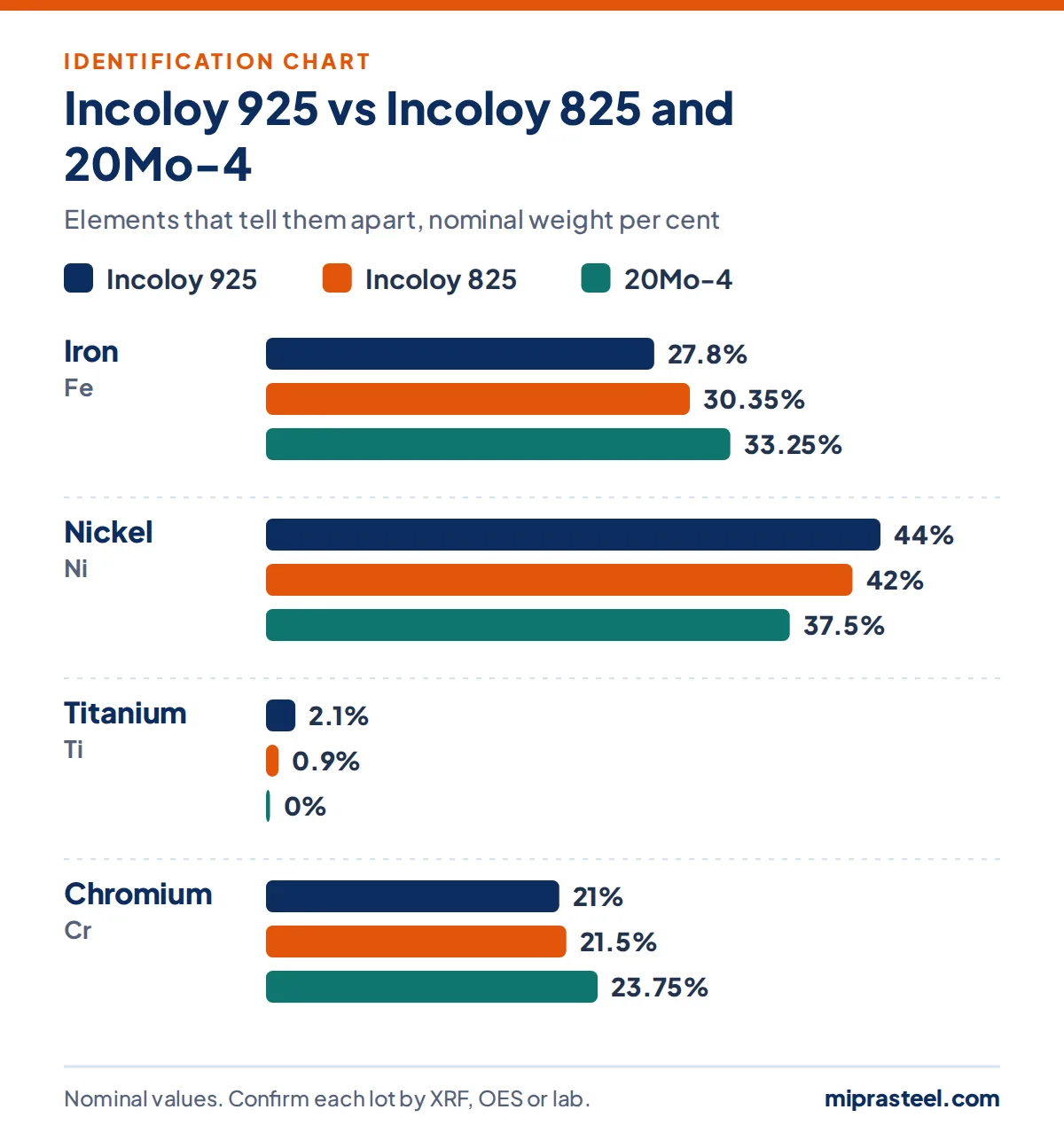
Nominal values for Incoloy 925 against its closest grades on this site.
Preparing Incoloy 925 Scrap for Sale
- Check titanium on every bar and part before it goes into a 925 lot.
- Keep 925, 825, 718 and K-500 swarf in separate, labelled bins at each machine.
- Drain and dry turnings, and remove inserts and tool tips.
- Strip seals, elastomers and steel components from retired downhole parts.
- Keep certificates or part marks with bar ends and rejected parts.
Incoloy 925 Scrap Price per Kg: What Decides It
An Incoloy 925 scrap offer reflects a nickel content close to 825, so presentation and purity count for a lot.
- Contained nickel (about 44%), chromium and molybdenum. Iron and copper add little, titanium adds little to a melter.
- Freedom from 718 and 825: mixed oilfield swarf is common, and any mix forces a lower, blended description.
- Form: bar ends and solid parts are worth more than turnings, which are discounted for oil and fines.
- Retired equipment: downhole parts can carry scale, coatings, elastomer seals and steel components that must be removed.
- Paperwork: certificates with UNS N09925 or API 6ACRA make a lot easier to describe and to sell on.
- Volume: regular monthly turnings from a machining contract can be quoted on a different basis from one-off clearance lots.
Nickel prices move daily, so an Incoloy 925 scrap price per kg is always tied to a date and a lot. For the method, read how nickel alloy scrap is valued.
Incoloy 925 Scrap Import and Export
Importing Incoloy 925 Scrap into India
Oilfield machining hubs in the Gulf, Southeast Asia, Europe and North America generate most of the world's 925 turnings and bar ends, and Gulf service centres release retired equipment. Imports into India travel with a pre-shipment inspection certificate, commercial invoice, packing list and bill of lading, and arrive mostly at Nhava Sheva or Mundra. Retired downhole parts should be free of oil, elastomers and steel components before shipment, so that the inspection matches the description. See the guide to importing nickel alloy scrap into India.
Exporting Incoloy 925 Scrap from India
Indian machine shops that make valve and wellhead parts for sour service release 925 bar ends and turnings. Export lots carry the grade and UNS number on invoice and packing list and are weighed and shipped in drums, bags or loose in containers. Buyers near oilfield activity in Saudi Arabia and the UAE are served through our Dubai office, and Australia has an offshore gas industry that uses the same alloys. See export documents for alloy scrap.
Customs heading: 7503.00 (nickel waste and scrap). The HS code is the international tariff heading the scrap is declared under; national tariff lines add further digits, so confirm the full line with your customs broker.
Comparisons
Other Incoloy Scrap Grades
Related Reading
Incoloy 925 Scrap FAQ
Is Incoloy 925 the same as Inconel 925?
Yes. "Inconel 925" is a widely used trade name, but the alloy is Incoloy 925, UNS N09925, an iron-nickel-chromium alloy with about 28% iron. Scrap invoices should carry the UNS number so that buyers, inspectors and customs all read the same grade.
What is the difference between Incoloy 925 and 825 scrap?
Titanium. 925 carries about 2.1% titanium and a little aluminium, which lets it be age-hardened, while 825 has about 0.9% titanium. Their nickel, iron, chromium, molybdenum and copper are similar, so values are close, but the two are sold as separate grades and should not be mixed.
Why is Incoloy 925 used in sour oil and gas wells?
Because it combines strength with resistance to sulphide stress cracking and stress-corrosion cracking in hydrogen sulphide service. Age-hardening gives it the strength for hangers, valve stems and fasteners, and its properties meet NACE MR0175, which oilfield operators require for sour service.
Can mixed 925 and 718 turnings still be sold?
Yes, but as mixed turnings with a blended description, usually for less than either grade on its own. The chips cannot be separated economically once mixed. Separate bins at each machine are the only reliable answer for shops cutting both alloys.
Is Incoloy 925 the same as Hastelloy C-22?
No. Directory listings sometimes mix them up, but they are unrelated. C-22 is a nickel-chromium-molybdenum alloy with about 58% nickel, 13% molybdenum and 3% tungsten. 925 is an iron-nickel-chromium alloy with about 28% iron and 3% molybdenum.
Under which HS code is Incoloy 925 scrap shipped?
As a nickel-base alloy, 925 scrap is typically shipped under HS 7503.00, nickel waste and scrap, with national tariff digits added by each country. Ask your customs broker to confirm the full line for your shipment.
Will Mipra Steel buy small lots of 925 bar ends?
Yes. Mipra Steel buys 925 bar ends, turnings and oilfield parts in small and large quantities. Send the weight, form, location, photographs and any certificates or readings, and mention if more material will follow regularly.
What is Incoloy 925 made of?
Nominally 44% nickel, 27.8% iron, 21% chromium, 3% molybdenum, 2.1% titanium, 1.8% copper, 0.3% aluminium. Specification ranges vary by product form and standard.
Published by Mipra Steel, Khetwadi, Mumbai · Updated