Monel K-500 Scrap Buyer, Importer and Exporter in India
Mipra Steel buys Monel K-500 bar ends, shafts and turnings from oilfield, marine and machining sources, and supplies described K-500 lots to melters and traders in India and abroad.
Sell Monel K-500 Scrap
If you hold K-500 shafts, collars, bar ends or turnings, give us an approximate tonnage, the shape of the pieces, the city and a few clear photos showing ends, threads and any stamps. Readings help most when they show aluminium and titanium, not just nickel and copper; say which instrument took them. Certificates to B865 or AMS 4676 are worth sending too. We review incoming enquiries and respond with relevant next steps.
Buy Monel K-500 Scrap
Melters making K-500 or other age-hardened nickel-copper products need scrap that is clearly K-500, not mixed nickel-copper. Tell us the quantity, whether you take turnings or only solids, your aluminium and titanium window, and where it should be delivered. Our description reads Monel K-500, UNS N05500, and we agree what supporting readings or certificates travel with them.
What Is Monel K-500 (Monel 500), and Why Keep Its Scrap Apart from Monel 400?
Take the nickel-copper base of Monel 400, add aluminium and a little titanium, and you get an alloy that can be heat-treated to precipitate a fine strengthening phase. That is K-500. After ageing it is far stronger and harder than 400, yet it keeps the same tolerance of seawater. Designers use it where a part must carry load in salt water or sour well fluid: propeller and pump shafts, drill collars and oil-well tools, valve trim, springs and fasteners, and doctor blades in paper mills.
Those uses decide what the scrap looks like. K-500 rarely arrives as plate or sheet. It comes as round bar, shaft lengths, forged collars, bolts and springs, and above all as turnings and bar ends from the machine shops that make oilfield and marine parts. The pieces are usually heavy and solid, which is good news for a buyer, but they look exactly like Monel 400 bar.
The aluminium is why K-500 is sorted on its own. A melter producing Monel 400 or nickel-copper filler wants aluminium kept low; a melter reproducing K-500 needs it. A lot that is half one and half the other suits neither, so it is bought at the lower description. Proving K-500 means proving aluminium, and many handheld XRF guns cannot read it reliably.
The trade uses "Monel 500", "K500" and "K-500" for the same alloy. Monel is a Special Metals trademark, used here only to name the scrap.
Monel K-500 belongs to the Monel family, part of nickel alloy scrap.
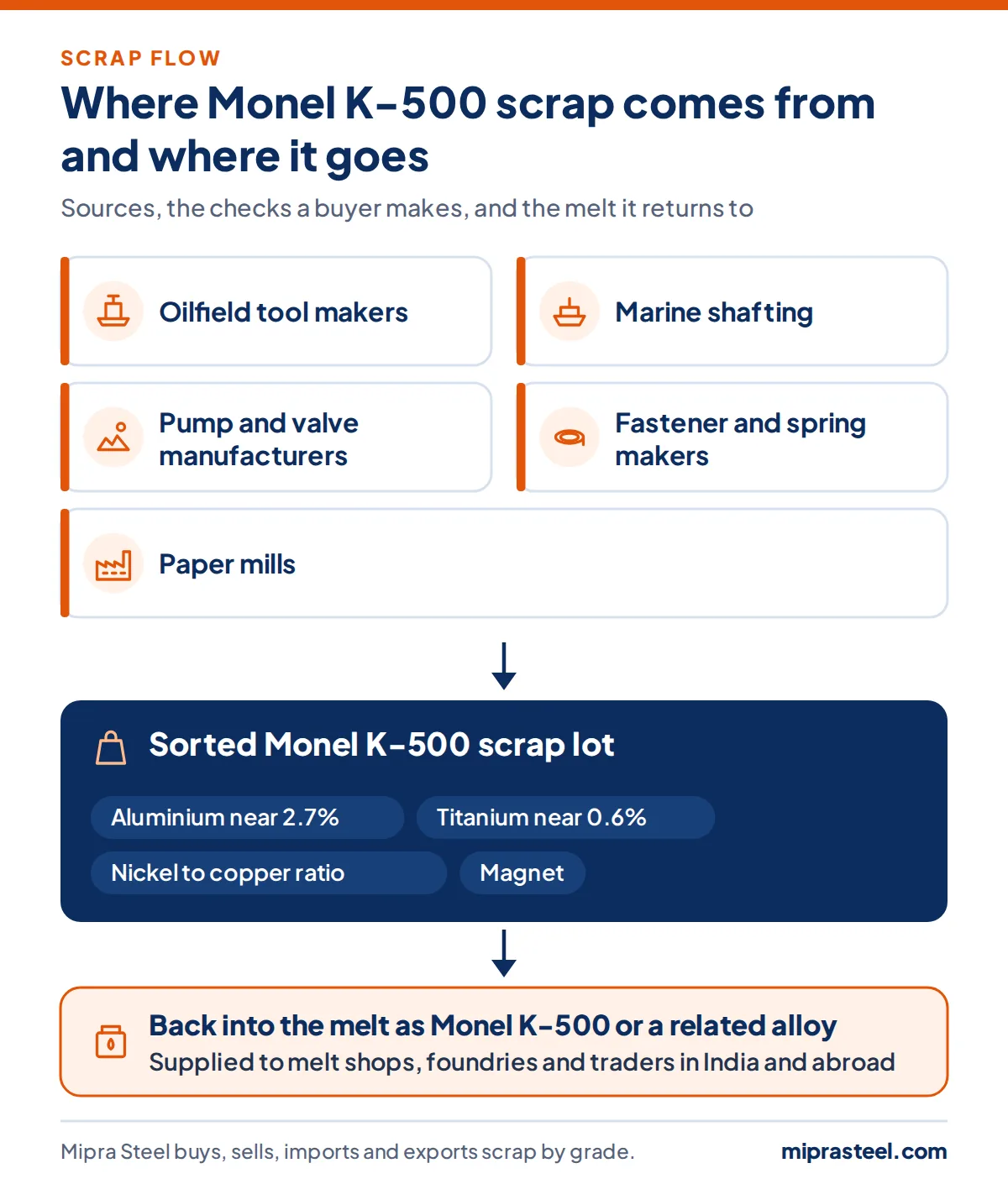
Where Monel K-500 Scrap Is Generated
Most K-500 scrap is generated before a part ever goes into service, at the lathe. The rest comes out of ships and wells.
Oilfield Tool Makers
Drill collars, oil-well tools and downhole components are machined from K-500 bar, producing long, clean turnings and crop ends. See oil and gas scrap.
Marine Shafting
Worn propeller and pump shafts from vessels and naval refits, plus offcuts from shaft manufacture. See marine scrap.
Pump and Valve Manufacturers
Valve stems, trim and impeller shafts that fail inspection, and bar ends from production runs.
Fastener and Spring Makers
Rejected bolts, nuts, springs and wire ends, usually small pieces in mixed lots with other nickel alloys.
Paper Mills
Worn doctor blades and scrapers, thin and sometimes coated, replaced on a routine schedule.
Monel K-500 Scrap Specification Chart
| Grade | Monel K-500 |
|---|---|
| UNS | N05500 |
| W.Nr. / EN | 2.4375 |
| Also known as | Monel 500, Monel K500, Alloy K-500 |
| Alloy type | Precipitation-hardened nickel-copper |
| Density | 8.44 g/cm³ (0.305 lb/in³) |
| Magnetic | Non-magnetic down to about −100 °C (-148 °F), unlike Monel 400. |
| HS code (customs heading) | 7503.00 (nickel waste and scrap) |
Monel K-500 Chemical Composition
Nominal composition in weight per cent, used to describe and identify the grade. The governing specification sets the limits for each product.
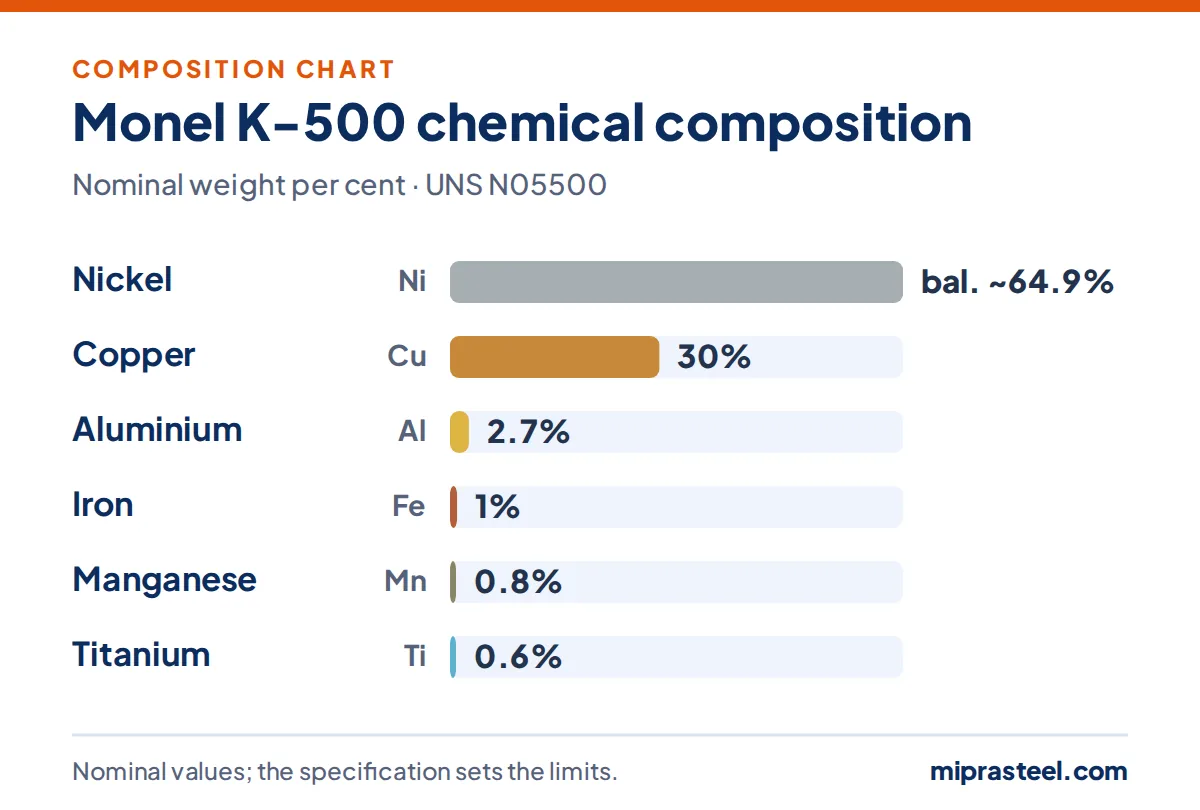
| Element | Symbol | Nominal wt% | |
|---|---|---|---|
| Nickel | Ni | Balance (about 64.9) | |
| Copper | Cu | 30 | |
| Aluminium (aluminum) | Al | 2.7 | |
| Iron | Fe | 1 | |
| Manganese | Mn | 0.8 | |
| Titanium | Ti | 0.6 |
Monel K-500 Equivalent Grades and Other Names
| Designation | Value |
|---|---|
| Trade name | Monel K-500 |
| UNS | N05500 |
| W.Nr. / EN | 2.4375 |
| Other names in the trade | Monel 500, Monel K500, Alloy K-500 |
Look up any designation in the grade name converter or the equivalent grade chart.
Monel K-500 Standards and Specifications
Monel K-500 Applications
- Pump and propeller shafts
- Oil-well tools and drill collars
- Doctor blades and scrapers
- Springs, valve trim and fasteners
Source industries: marine and shipbuilding, oil and gas.
How Monel K-500 Scrap Is Identified
Every check for K-500 comes back to one question: is the aluminium there? These steps answer it.
| Check | What it shows for Monel K-500 |
|---|---|
| Aluminium near 2.7% | The deciding element. Use a light-element XRF (with helium or vacuum) or spark OES. A gun that cannot report aluminium cannot tell K-500 from 400. See XRF vs OES vs lab. |
| Titanium near 0.6% | Visible on most XRF units and a useful first flag. Titanium on a nickel-copper reading points to K-500. |
| Nickel to copper ratio | About 65% nickel and 30% copper, the same family signature as Monel 400. Copper above nickel means cupronickel. |
| Magnet | K-500 stays non-magnetic down to about minus 100 °C (210 °F), whereas 400 may pull weakly. A pull on a piece suggests 400, but the absence of one proves nothing on its own. |
| Shape and hardness | Heavy shafts, collars, threaded bar and springs lean towards K-500. Valve bodies, castings and plate lean towards 400. |
| Paperwork | Certificates to ASTM B865, AMS 4676 or QQ-N-286, or heat numbers on bar, settle the grade. See reading mill test certificates. |
Grades Most Often Confused with Monel K-500
- Monel 400: has the same nickel and copper (about 66% and 31.5%) but almost no aluminium or titanium.
- Nickel-copper weld filler and castings: can carry some titanium and silicon; only a full reading separates them from wrought K-500 bar.
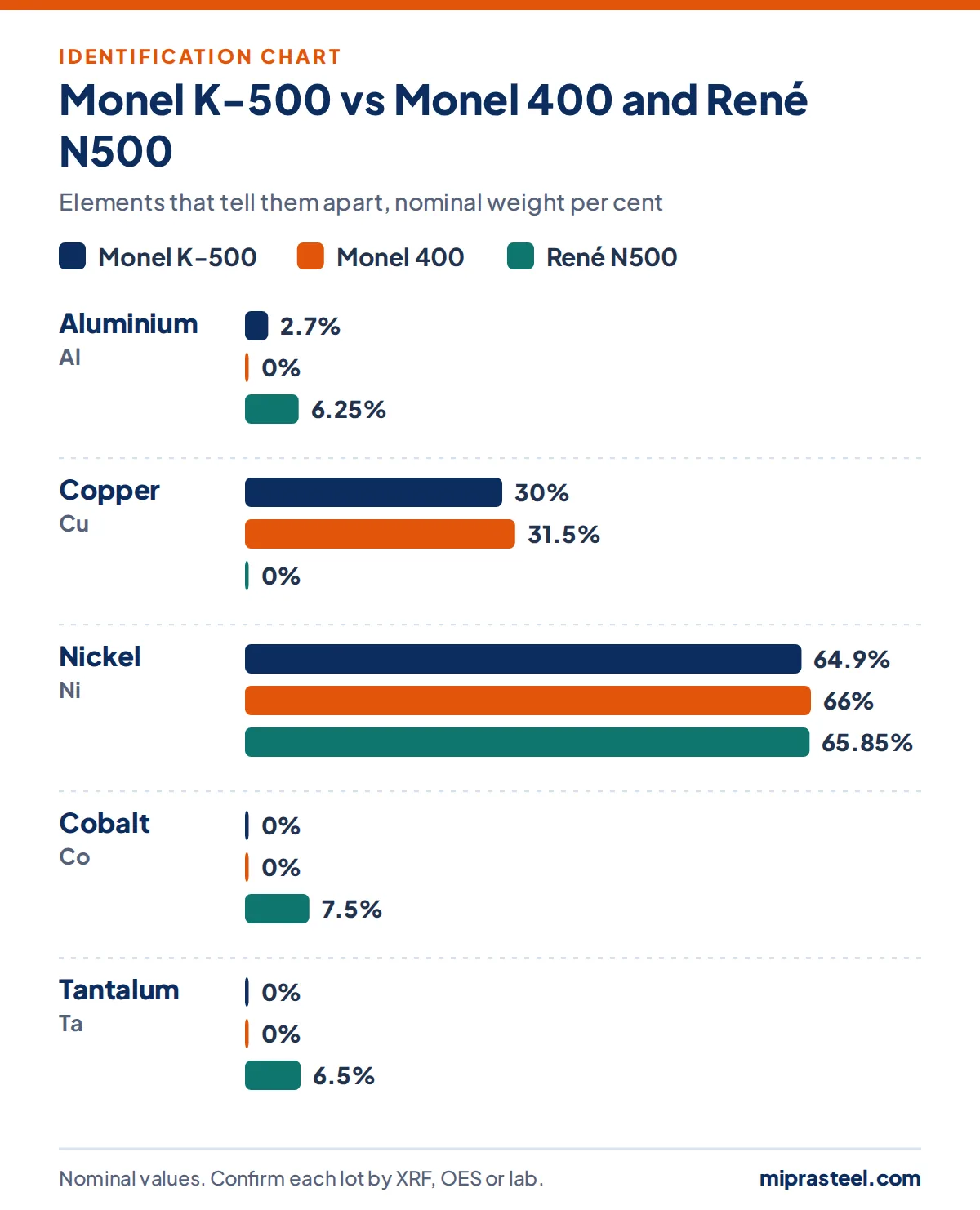
Nominal values for Monel K-500 against its closest grades on this site.
Preparing Monel K-500 Scrap for Sale
- Read aluminium on a sample of every bundle before it is bagged as K-500.
- Stack shafts and collars apart from any Monel 400 valve parts.
- Spin or drain oil from oilfield turnings and remove carbide inserts.
- Tag coated doctor blades and hard-faced shafts as a separate item.
- Keep bar certificates and heat numbers with the matching pieces.
Monel K-500 Scrap Price per Kg: What Decides It
Ask what Monel K-500 scrap is worth per kg and the honest answer starts with nickel and copper, then turns on how well the lot is proven.
- Nickel at about 65% sets the base; copper at about 30% adds to it for nickel-copper melters.
- Proof of aluminium and titanium on representative pieces, which is what lets a lot be sold as K-500 at all.
- No Monel 400 mixed in: a blended lot is offered at whichever description the buyer can defend.
- Turnings condition: long oilfield swarf is often coated in cutting oil and must be drained, dried and free of carbide tool tips.
- Piece weight: heavy shafts and collars melt with less loss than thin doctor blades or fine chips.
- Coatings or hard-facing on shafts and blades, which a buyer will want declared.
Nickel and copper both trade daily, so a K-500 figure holds only for the date quoted. The wider logic is in what sets nickel alloy scrap value.
Monel K-500 Scrap Import and Export
Importing Monel K-500 Scrap into India
Oilfield machining centres and marine repair yards in the Gulf, Europe and East Asia release K-500 bar ends and swarf. For import into India, the shipment needs a pre-shipment inspection certificate from origin and the usual shipping set of invoice, packing list and B/L; Nhava Sheva and Mundra handle most arrivals. Writing "Monel K-500, UNS N05500, nickel-copper alloy scrap" on every document, with aluminium readings attached, stops it being treated as plain Monel or copper scrap. Read the import guide for India.
Exporting Monel K-500 Scrap from India
K-500 bar ends, shafts and turnings from Indian tool shops and marine yards can suit export buyers who reproduce the alloy. Outbound K-500 is weighed, drummed or bagged, and named Monel K-500 / N05500 on both invoice and packing list before it is containerised. Buyers in Europe and East Asia are the usual destinations, and our Dubai and South Korea offices sit near Gulf oilfield suppliers and Korean users. See documents for alloy scrap exports.
Customs heading: 7503.00 (nickel waste and scrap). The HS code is the international tariff heading the scrap is declared under; national tariff lines add further digits, so confirm the full line with your customs broker.
Comparisons
Other Monel Scrap Grades
Related Reading
Monel K-500 Scrap FAQ
Is Monel 500 the same as Monel K-500?
Yes. "Monel 500", "K500", "K-500" and "Alloy K-500" all describe the same age-hardenable nickel-copper alloy, UNS N05500, W.Nr 2.4375. Scrap offered under any of these names should be checked for about 2.7% aluminium and 0.6% titanium before it is accepted as K-500.
Why can my XRF not tell K-500 from Monel 400?
Most standard handheld XRF units cannot measure aluminium reliably, and aluminium is the main difference between the two. Titanium at about 0.6% may show and is a useful flag. For a firm answer, use a light-element XRF or spark OES. The side-by-side figures are on Monel 400 vs K-500.
Is Monel K-500 scrap worth more than Monel 400 scrap?
Not by default. Both are priced mainly on nickel and copper, which are present at similar levels. K-500 is only worth more to a buyer who needs its aluminium and titanium, and only when the lot is proven to be K-500 throughout.
Are drill collar and oil-well tool turnings acceptable?
Yes, if they are single-grade and clean. Oilfield turnings often carry heavy cutting oil and broken carbide inserts. Drain them, keep them dry, pick out tool tips and avoid mixing in stainless or steel swarf from the same machine.
Does K-500 lose its grade once it has been heat-treated?
No. Age hardening changes strength, not chemistry. Aged and unaged K-500 scrap have the same composition and trade under the same description. Only the aluminium, titanium, nickel and copper readings matter to a melter.
What is the HS code for Monel K-500 scrap?
Typically 7503.00, nickel waste and scrap, because nickel outweighs copper in the alloy. Eight-digit national lines vary, so let your broker settle the exact entry.
How do I offer Monel K-500 scrap to Mipra Steel?
Share the tonnage, the shape of the material, where it sits, some photos and whatever readings or certificates exist. Mipra Steel buys and sells K-500 shafts, bar ends and turnings, and handles import and export lots, with a reply on what happens next once the details are looked at.
What is Monel K-500 made of?
Nominally 64.9% nickel, 30% copper, 2.7% aluminium, 1% iron, 0.8% manganese, 0.6% titanium. Specification ranges vary by product form and standard.
Published by Mipra Steel, Khetwadi, Mumbai · Updated