Ni-Resist Type 5 Scrap Buyer, Importer and Exporter in India
Mipra Steel trades Ni-Resist Type 5 scrap from Khetwadi, Mumbai, taking in castings from machine-tool, die and instrument users and offering verified high-nickel iron to foundries and traders.
Sell Ni-Resist Type 5 Scrap
Have castings from precision machines, dies or instruments that read high in nickel? Tell us what equipment they came from, the approximate weight and the location, and send photographs. An XRF reading of nickel, copper and chromium is very helpful, as is mention of any steel parts still bolted on. We review incoming enquiries and respond with relevant next steps.
Buy Ni-Resist Type 5 Scrap
Foundries making low-expansion Ni-Resist can approach us for Type 5 scrap as a high-nickel charge. Share the tonnage you can use, the chromium and copper limits you work to, any piece-size limit and the delivery port. Expect smaller, irregular lots compared with Types 1 and 2.
What Is Ni-Resist Type 5 and Where Does Its Scrap Come from?
Most Ni-Resist is chosen for corrosion. Type 5 is chosen for stability. At about 35% nickel, the iron-nickel matrix expands very little when heated: roughly 5 micrometres per metre per degree Celsius, against about 18.7 for Types 1 and 2 and around 11 for ordinary grey iron. Designers use it for parts that must keep their size as a workshop warms up or as a process heats a tool: machine-tool frames and slides, forming dies, measuring gauges, instrument bases and expansion joints. The principle is the same one behind Invar, but in a castable, machinable iron.
That gives its scrap an unusual profile. Type 5 carries the most nickel of the common flake grades, around 350 kg per tonne, and its chromium is kept to about 0.1% at most. Volumes are small and arrive irregularly, mostly when precision equipment is rebuilt or a die set is retired. A lot is often a few heavy castings rather than a truckload.
There is one trap that catches sellers used to Types 1 and 2. Type 5 can be magnetic at room temperature. Anyone sorting Ni-Resist with a magnet will throw Type 5 into the grey iron pile and sell 35% nickel as plain cast iron. A quick XRF reading on anything that came off a precision machine avoids that. The Ni-Resist scrap guide compares all three types.
Ni-Resist Type 5 belongs to the Ni-Resist family, part of exotic alloy scrap.
Where Ni-Resist Type 5 Scrap Turns Up
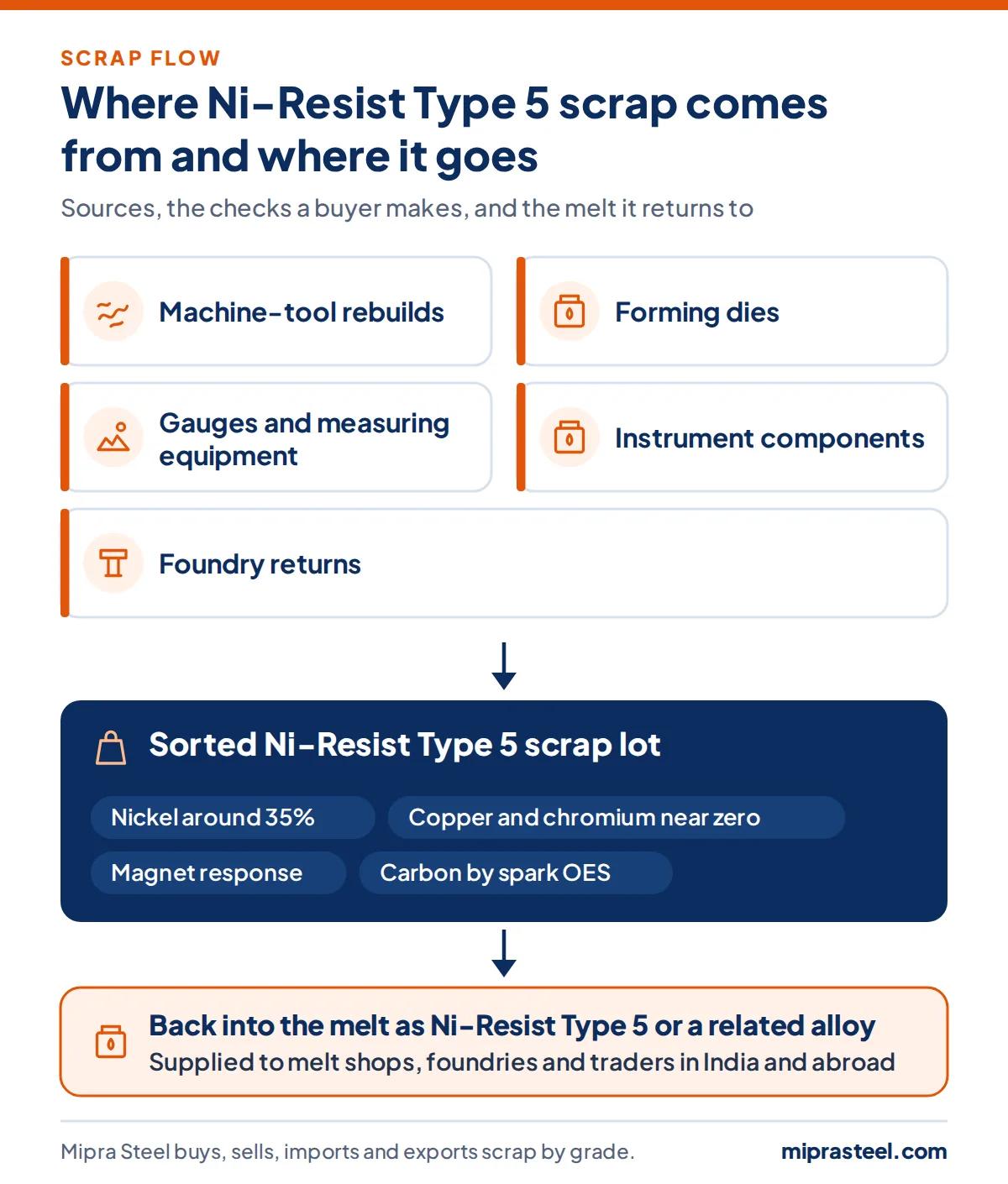
Type 5 comes from equipment where dimensional accuracy mattered more than corrosion, so look in tool rooms and instrument shops rather than pump yards.
Machine-Tool Rebuilds
Beds, slides, spindle housings and structural parts from precision machines replaced or scrapped.
Forming Dies
Die blocks and tooling for forming operations where heating would otherwise change die dimensions.
Gauges and Measuring Equipment
Reference gauges, fixtures and bases retired from inspection rooms.
Instrument Components
Frames and housings from optical, laser and scientific instruments that need low thermal movement.
Foundry Returns
Scrapped low-expansion castings and their feeders from foundries that pour Type 5, normally with a known analysis.
Ni-Resist Type 5 Scrap Specification Chart
| Grade | Ni-Resist Type 5 |
|---|---|
| UNS | F41006 |
| W.Nr. / EN | EN-GJLA-XNi35 |
| Also known as | Ni-Resist 5 |
| Alloy type | Austenitic flake-graphite cast iron |
| Density | 7.6 g/cm³ (0.275 lb/in³) |
| Magnetic | Can be magnetic at room temperature, unlike Types 1 and 2. |
| HS code (customs heading) | 7204.10 (cast iron waste and scrap) |
Ni-Resist Type 5 Chemical Composition
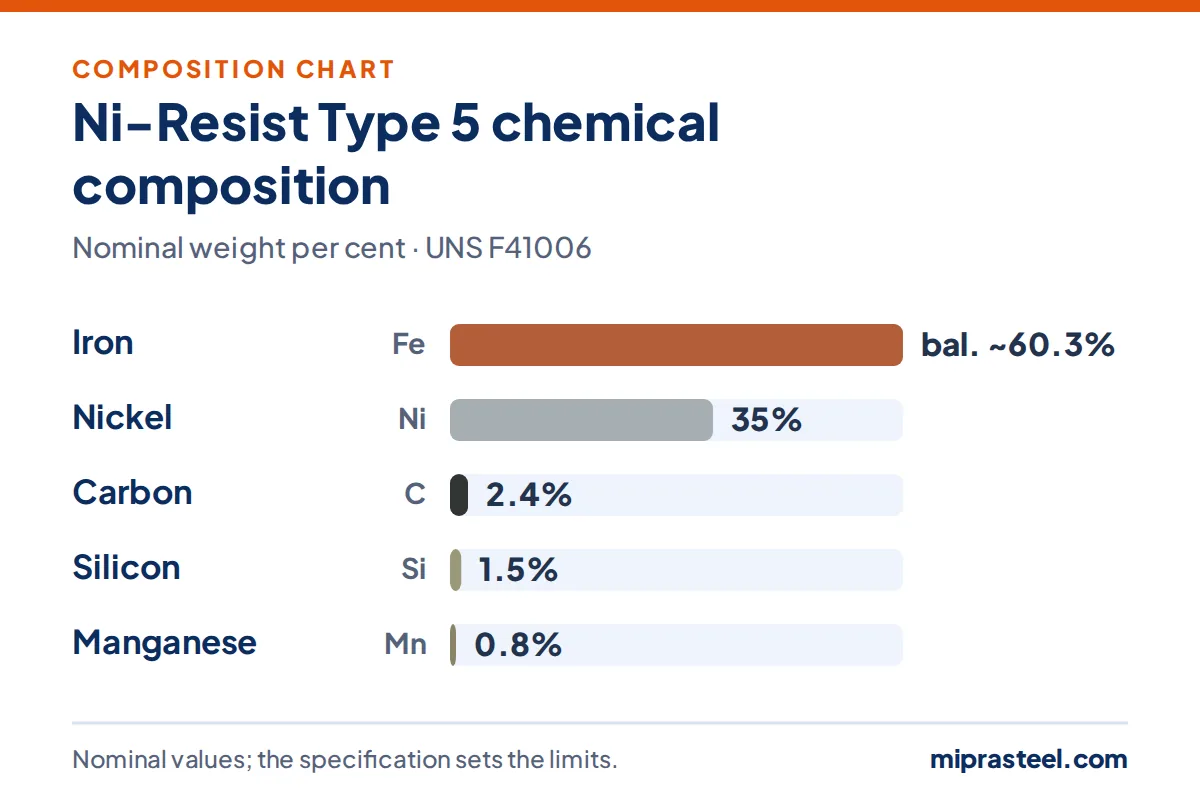
Nominal composition in weight per cent, used to describe and identify the grade. The governing specification sets the limits for each product.
| Element | Symbol | Nominal wt% | |
|---|---|---|---|
| Iron | Fe | Balance (about 60.3) | |
| Nickel | Ni | 35 | |
| Carbon | C | 2.4 | |
| Silicon | Si | 1.5 | |
| Manganese | Mn | 0.8 |
Ni-Resist Type 5 Equivalent Grades and Other Names
| Designation | Value |
|---|---|
| Trade name | Ni-Resist Type 5 |
| UNS | F41006 |
| W.Nr. / EN | EN-GJLA-XNi35 |
| Key specification | ASTM A436 Type 5 |
| Other names in the trade | Ni-Resist 5 |
Look up any designation in the grade name converter or the equivalent grade chart.
Ni-Resist Type 5 Standards and Specifications
| Product form | Standard | ASME equivalent |
|---|---|---|
| Austenitic grey iron castings | ASTM A436 | No ASME edition |
| Austenitic cast iron (Europe) | EN 13835 | No ASME edition |
Ni-Resist Type 5 Applications
- Machine-tool and precision equipment parts
- Forming dies and gauges
- Instrument components
Source industries: heat treatment and furnaces.
How Ni-Resist Type 5 Scrap Is Identified
With Type 5 the magnet misleads, so XRF and the casting's history do the work.
| Check | What it shows for Ni-Resist Type 5 |
|---|---|
| Nickel around 35% | An XRF reading of about 34% to 36% nickel and the rest mostly iron points to Type 5. |
| Copper and chromium near zero | Copper at or under 0.5% and chromium around 0.1% or less separate it from Types 1, 2, 3 and 4. |
| Magnet response | Unlike Types 1 and 2, Type 5 may attract a magnet. Do not use a magnet to reject it. See where magnet sorting fails. |
| Carbon by spark OES | Around 2.4% carbon confirms a cast iron and rules out wrought Invar-type iron-nickel alloys, which read almost the same nickel on XRF. |
| Graphite form | Flake graphite means Type 5; spheroidal graphite at the same nickel means the ductile grade D-5. |
| Equipment origin | Precision machine, die or instrument castings with high nickel readings are very likely Type 5. |
Grades Most Often Confused with Ni-Resist Type 5
- Invar 36 (wrought Fe-36Ni): reads about 36% nickel on XRF but contains almost no carbon; OES separates them.
- Ni-Resist D-5: is the ductile, spheroidal-graphite iron with about 35% nickel.
- Ni-Resist Type 2: has about 20% nickel and 2% chromium and is non-magnetic.
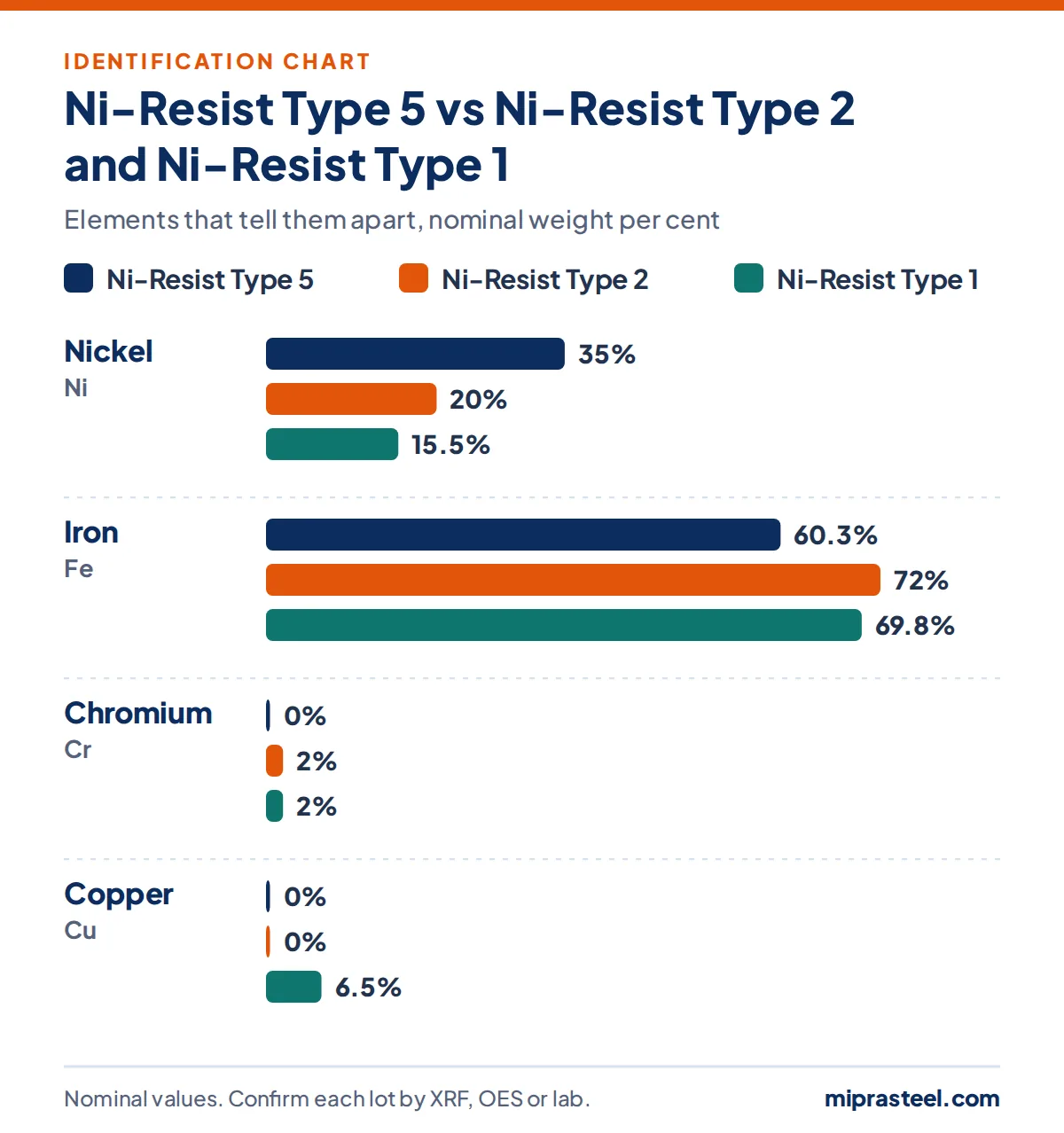
Nominal values for Ni-Resist Type 5 against its closest grades on this site.
Preparing Ni-Resist Type 5 Scrap for Sale
- Do not magnet-sort Ni-Resist that may include Type 5; take XRF readings instead.
- Strip steel slideways, bolts, bearings and inserts from machine castings.
- Keep Type 5 separate from Types 1 and 2 and from grey iron.
- Note the equipment each casting came from.
- Break or cut very large beds if your buyer sets a piece-size limit.
Ni-Resist Type 5 Scrap Price per Kg: What Decides It
Type 5 has the highest contained nickel in the flake Ni-Resist family, and its offer depends on whether the buyer can trust that figure.
- Contained nickel of about 35%, well above Types 1 and 2.
- Confirmed identification: XRF readings plus carbon by OES, so the castings are not mistaken for grey iron or for wrought iron-nickel alloy.
- Low chromium and copper: a lot with readings near zero for both suits foundries making Type 5 again.
- Mixed iron: magnetic sorting errors often leave Type 5 mixed with grey iron, or grey iron in a Type 5 lot; both lower the offer.
- Fitted parts: steel slideways, bolts, bearings and hardened inserts are common on machine-tool castings and must be stripped.
- Piece weight: large machine beds may need breaking before a foundry can charge them.
Because nickel is repriced every trading day, each offer names the date it applies to. The contained metal calculator gives a quick estimate of nickel in a lot.
Ni-Resist Type 5 Scrap Import and Export
Importing Ni-Resist Type 5 Scrap into India
Type 5 scrap reaches India mostly from industrial regions where precision engineering and tooling are concentrated, including Europe, Japan and South Korea. Metal scrap entering India usually ships with a pre-shipment inspection certificate, a commercial invoice, a packing list and a bill of lading. Ni-Resist is iron-base cast iron, so the usual classification is HS 7204.10, cast iron waste and scrap, even at 35% nickel; confirm the full line with your broker. Declaring "Ni-Resist Type 5, ASTM A436, UNS F41006" with nickel and carbon readings explains a high-nickel cast iron cargo at Nhava Sheva, Mundra or Chennai.
Exporting Ni-Resist Type 5 Scrap from India
Indian tool rooms, die shops and machine rebuilders retire Type 5 castings that foundries abroad can use. Export lots are described by type, ASTM grade and UNS number on the invoice and packing list, weighed, and shipped palletised or loose in containers from Nhava Sheva or Mundra. Small Type 5 parcels are sometimes combined with other sorted Ni-Resist types, each packed and declared separately. Our South Korea office and Dubai office support buyers in East Asia and the Gulf; see also the Netherlands.
Customs heading: 7204.10 (cast iron waste and scrap). The HS code is the international tariff heading the scrap is declared under; national tariff lines add further digits, so confirm the full line with your customs broker.
Other Ni-Resist Scrap Grades
Related Reading
Ni-Resist Type 5 Scrap FAQ
Is Ni-Resist Type 5 magnetic?
It can be. Unlike Types 1 and 2, which are non-magnetic, Type 5 at about 35% nickel may attract a magnet at room temperature. That is why magnet sorting alone can misclassify it as ordinary grey iron. Use an XRF reading to confirm the nickel content.
Why is Ni-Resist Type 5 used for machine tools and gauges?
Its thermal expansion is very low, about 5 micrometres per metre per degree Celsius, so parts barely change size as temperature changes. That keeps machine geometry, dies and gauges accurate. Types 1 and 2 expand more than three times as much.
How is Ni-Resist Type 5 different from Invar?
Both are iron with roughly 35% to 36% nickel and low expansion, but Type 5 is a cast iron with about 2.4% carbon present as graphite, while Invar is a wrought alloy with almost no carbon. XRF cannot separate them; spark OES can, by measuring carbon.
How much nickel is in Ni-Resist Type 5 scrap?
About 35% nickel, which works out to roughly 350 kg per tonne of clean castings. That is the highest of the common flake Ni-Resist types and the main reason Type 5 is worth identifying instead of selling with cast iron.
What HS code does Ni-Resist Type 5 scrap use?
Despite its nickel, it is iron-base cast iron and is typically declared under HS 7204.10, waste and scrap of cast iron. Nickel scrap headings are not used for it. Ask your customs broker to confirm the national tariff line.
Is it worth selling a single Type 5 machine casting?
Often yes, because one heavy casting at 35% nickel holds a fair amount of metal. Send its weight, photographs, location and a reading if you have one, and say what machine it came from. Mipra Steel can then advise how it might be traded.
Can Ni-Resist Type 5 be mixed with Type 2 in one lot?
Better not. Type 2 is specified with about 2% chromium and Type 5 with almost none, and their nickel levels differ by about 15 percentage points. A foundry making either type needs predictable chemistry, so mixed lots are valued below sorted ones.
What is Ni-Resist Type 5 made of?
Nominally 60.3% iron, 35% nickel, 2.4% carbon, 1.5% silicon, 0.8% manganese. Specification ranges vary by product form and standard.
Published by Mipra Steel, Khetwadi, Mumbai · Updated