Hastelloy C-22 Scrap Buyer, Importer and Exporter in India
From its Khetwadi office in Mumbai, Mipra Steel buys and supplies Hastelloy C-22 scrap, dealing with process plants, equipment fabricators and traders in India and overseas.
Sell Hastelloy C-22 Scrap
Selling C-22 from a reactor change or plant closure? Send the approximate weight, a list of the main items (shells, heads, agitators, plate offcuts, turnings), the location and photographs. Readings that show the chromium and molybdenum on each item help most, because they rule out C-276 in the same consignment. Mention any linings or residues. We review incoming enquiries and respond with relevant next steps.
Buy Hastelloy C-22 Scrap
Melt shops and wire makers who need C-22 chemistry can ask us for named lots. Give the tonnage, the forms you accept, whether wire ends are welcome, any limits on copper or iron, the delivery port and timing. Lots are described as Hastelloy C-22, UNS N06022, with the supporting readings or certificates available for that parcel.
How Is C-22 Different from C-276 When It Becomes Scrap?
C-22 was developed for the plant that cannot decide whether it is oxidising or reducing. A batch reactor in a drug or fine-chemical plant might see chlorides, nitric acid, ferric ions and wet chlorine within a single week. C-22 raises chromium to about 22% for the oxidising side while keeping 13% molybdenum and 3% tungsten for pitting and crevice resistance in chlorides. In service that balance is its selling point. In scrap, it is the thing that has to be proven.
Put C-22 and C-276 side by side and you cannot tell them apart by eye, by magnet or by weight. Both are non-magnetic, both carry tungsten, and their densities differ only slightly (8.69 against 8.89 g/cm³). What does differ is the proportion: C-22 has more chromium than molybdenum, C-276 the opposite. That single ratio, read on an analyser, decides which lot a piece belongs in.
It matters to the melt shop because each grade has its own specification window. A heat of C-22 made with C-276 in the charge picks up molybdenum and loses chromium; the reverse happens too. So buyers pay for certainty, and a parcel with readings on every piece is easier to place than a heavier one described as "C-grade Hastelloy". Welding wire to ERNiCrMo-10 is C-22 chemistry, so wire ends from fabrication shops normally belong with C-22 rather than with general nickel scrap.
Hastelloy C-22 belongs to the Hastelloy family, part of nickel alloy scrap.
Which Industries Generate C-22 Scrap?
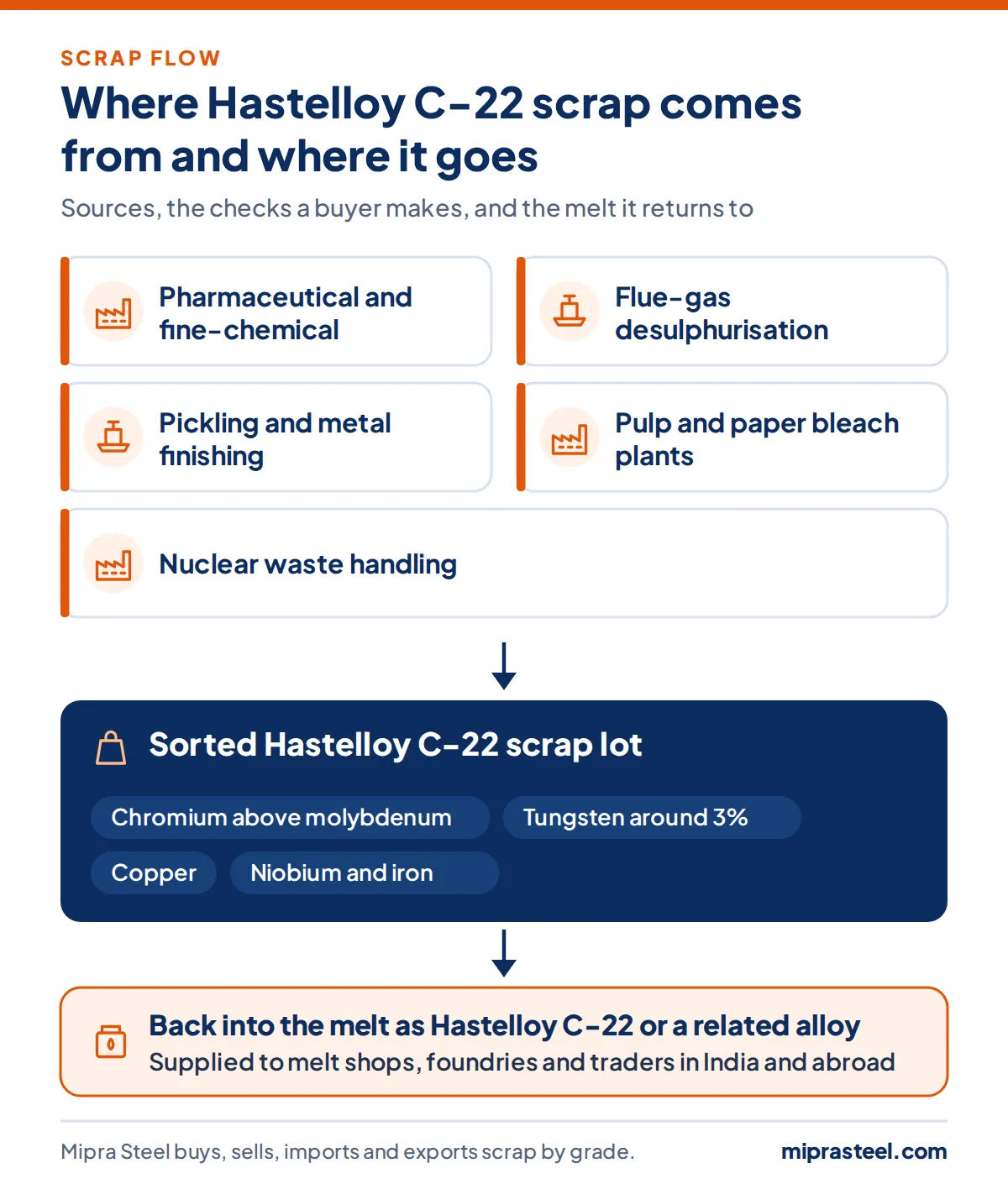
C-22 is concentrated in plants where process conditions change from batch to batch, or where a single stream carries both chlorides and oxidisers.
Pharmaceutical and Fine-Chemical Reactors
Reactor shells, agitators, condensers and dryers in multi-product plants. Upgrades and product changeovers release formed heads, nozzles and machined internals. See nickel alloy scrap in chemical and aerospace use.
Flue-Gas Desulfurization
Some scrubber builders chose C-22 instead of C-276 for absorber and outlet sections. As with any FGD lining, check for steel backing before calling it solid.
Pickling and Metal Finishing
Tanks, heating coils and fume handling equipment from mixed-acid pickling, where oxidising nitric acid sits alongside halides.
Pulp and Paper Bleach Plants
Washer drums, mixers and chlorine dioxide equipment replaced during rebuilds.
Nuclear Waste Handling
Containers and process equipment for waste handling have used C-22 for its long-term corrosion resistance. This material moves under strict controls and is rarely seen on the open scrap market. See nuclear industry scrap.
Hastelloy C-22 Scrap Specification Chart
| Grade | Hastelloy C-22 |
|---|---|
| UNS | N06022 |
| W.Nr. / EN | 2.4602 |
| Also known as | Hastelloy C22, Alloy 22 |
| Alloy type | Solid-solution nickel-chromium-molybdenum-tungsten |
| Density | 8.69 g/cm³ (0.314 lb/in³) |
| Magnetic | Non-magnetic. |
| HS code (customs heading) | 7503.00 (nickel waste and scrap) |
Hastelloy C-22 Chemical Composition
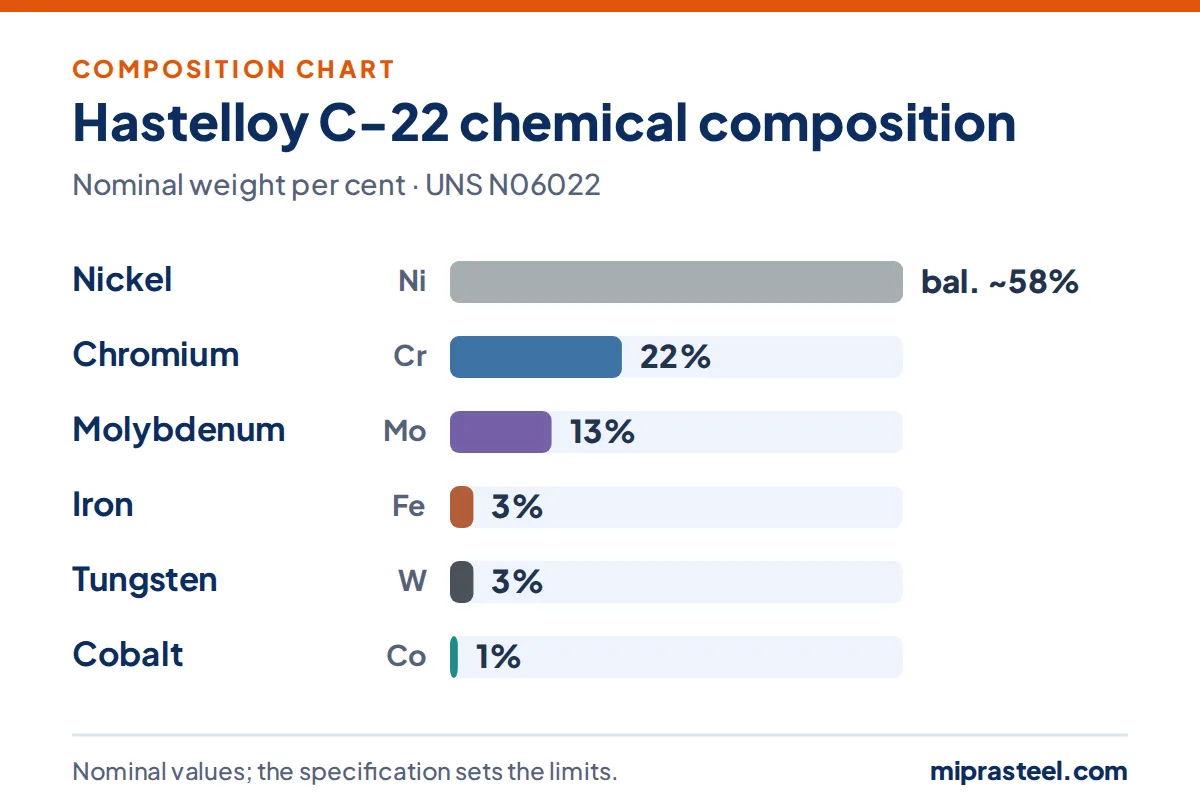
Nominal composition in weight per cent, used to describe and identify the grade. The governing specification sets the limits for each product.
| Element | Symbol | Nominal wt% | |
|---|---|---|---|
| Nickel | Ni | Balance (about 58) | |
| Chromium | Cr | 22 | |
| Molybdenum | Mo | 13 | |
| Iron | Fe | 3 | |
| Tungsten | W | 3 | |
| Cobalt | Co | 1 |
Hastelloy C-22 Equivalent Grades and Other Names
| Designation | Value |
|---|---|
| Trade name | Hastelloy C-22 |
| UNS | N06022 |
| W.Nr. / EN | 2.4602 |
| Other names in the trade | Hastelloy C22, Alloy 22 |
Look up any designation in the grade name converter or the equivalent grade chart.
Hastelloy C-22 Standards and Specifications
Hastelloy C-22 Applications
- Pharmaceutical and fine-chemical reactors
- Flue-gas desulfurization
- Pickling and metal finishing
- Pulp and paper bleach plants
- Nuclear waste handling
Source industries: chemical processing, power generation.
How Hastelloy C-22 Scrap Is Identified
Every check below is aimed at one question: is this C-22, or a close relative that looks identical?
| Check | What it shows for Hastelloy C-22 |
|---|---|
| Chromium above molybdenum | About 22% chromium against 13% molybdenum is the C-22 pattern. If molybdenum reads equal to or above chromium, consider C-276 or C-4. |
| Tungsten around 3% | Confirms a C-family alloy with tungsten. No tungsten, with 23% chromium and 16% molybdenum, suggests C-2000 or a similar grade. |
| Copper | C-22 has no deliberate copper. About 1.6% copper is the marker for Hastelloy C-2000. |
| Niobium and iron | C-22 has no niobium and only about 3% iron. Niobium with 9% molybdenum points to Inconel 625. |
| Wire and electrodes | Filler marked ERNiCrMo-10 is C-22 chemistry. Keep it with C-22 rather than in general wire scrap. |
| Certificates | ASTM B575 plate, B574 bar or B564 forging certificates quoting UNS N06022 or 2.4602. |
Grades Most Often Confused with Hastelloy C-22
- Hastelloy C-276: 15.5% chromium and 16% molybdenum with about 3.75% tungsten and 5.5% iron.
- Hastelloy C-2000 (UNS N06200): 23% chromium and 16% molybdenum with about 1.6% copper and no tungsten. No separate page; it is named on its own when readings show copper.
- Inconel 625: 21.5% chromium, similar to C-22, but only 9% molybdenum and about 3.6% niobium.
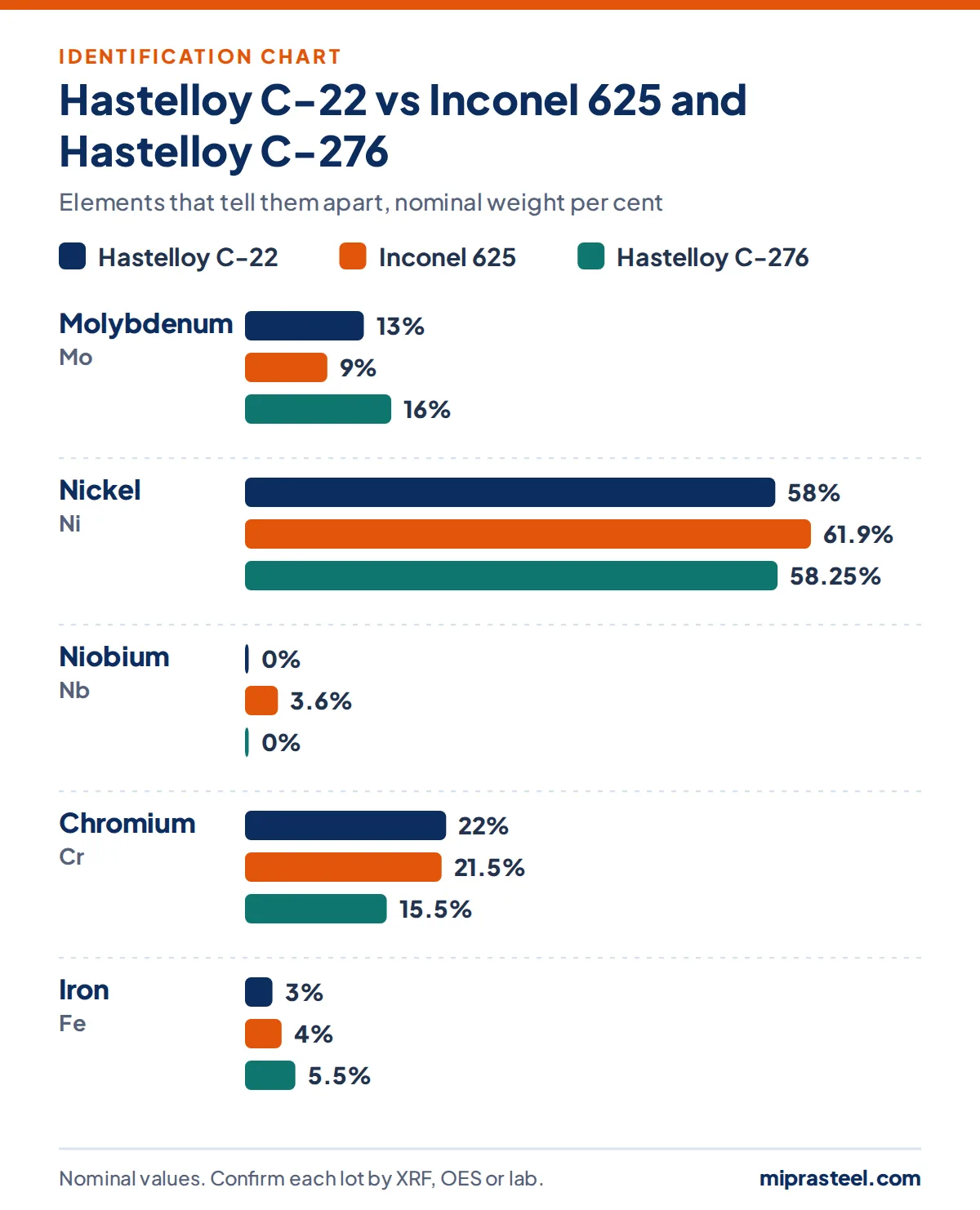
Nominal values for Hastelloy C-22 against its closest grades on this site.
Preparing Hastelloy C-22 Scrap for Sale
- Read chromium and molybdenum on every piece and bag C-22 by itself.
- Strip glass, PTFE and rubber linings, gaskets and product residues.
- Keep ERNiCrMo-10 wire ends in their own labelled bag.
- Separate any steel-backed scrubber material from solid plate.
- Collect turnings at the machine by grade and keep them dry.
- File certificates and heat numbers with the matching bags.
Hastelloy C-22 Scrap Price per Kg: What Decides It
Is C-22 scrap worth more than C-276? Not automatically. C-22 carries less molybdenum and tungsten but more chromium, so the comparison depends on metal prices on the day. What separates one C-22 lot from another is set out below.
- The nickel, molybdenum and tungsten content, which together make up most of the lot's value; chromium adds comparatively little.
- Proof of grade: analysis on each piece, or certificates matched to heat numbers, so the lot is sold as C-22 and not as mixed C-grade.
- Freedom from C-276, C-2000 and 625, which are used in the same plants and are easy to mix up in a clearance.
- Form and cleanliness: reactor heads, plate and forgings rank above turnings; product residues, glass or PTFE linings and gaskets must be removed.
- Steel-backed material from scrubbers, which is valued on its alloy content and offered separately from solids.
Offers are dated because metal markets move every day. The broader method is explained in pricing nickel alloy scrap.
Hastelloy C-22 Scrap Import and Export
Importing Hastelloy C-22 Scrap into India
C-22 imported into India usually comes from process-plant decommissioning and fabrication in Europe, East Asia and the Gulf. Because it shares plants with C-276, ask the shipper to keep and declare the two separately. Every imported metal scrap shipment is inspected before dispatch and carries a pre-shipment inspection certificate, together with the commercial invoice, packing list and bill of lading. Nhava Sheva and Mundra handle most arrivals; Chennai suits buyers in the south. Read the India import steps for nickel alloy scrap.
Exporting Hastelloy C-22 Scrap from India
India's bulk-drug and fine-chemical sector uses C-22 in reactors and associated equipment, and fabricators building that equipment generate offcuts and wire ends. These are offered for export with grade and UNS number on the invoice and packing list, weighed and packed in bags or drums. Buyers in Italy, the Netherlands and East Asia often ask for readings before booking. Our Dubai and South Korea offices are close to buyers in the Gulf and East Asia; documents are covered in alloy scrap export paperwork.
Customs heading: 7503.00 (nickel waste and scrap). The HS code is the international tariff heading the scrap is declared under; national tariff lines add further digits, so confirm the full line with your customs broker.
Comparisons
Other Hastelloy Scrap Grades
Related Reading
Hastelloy C-22 Scrap FAQ
Is Alloy 22 the same as Hastelloy C-22?
Yes. Alloy 22, Hastelloy C-22, UNS N06022 and W.Nr 2.4602 all describe the same nickel-chromium-molybdenum-tungsten chemistry. Different producers use different names, but for scrap purposes they are one grade and belong in one lot.
Why do pharmaceutical plants use C-22?
Because a multi-product plant meets both oxidising and reducing chemicals, often with chlorides present. C-22's 22% chromium handles the oxidising side and its 13% molybdenum and 3% tungsten handle chlorides, so one alloy covers a wide range of batches.
How can I tell C-22 from C-2000 scrap?
Look for copper and tungsten. C-2000 carries about 1.6% copper and no tungsten, with roughly 23% chromium and 16% molybdenum. C-22 has about 3% tungsten, 13% molybdenum and no deliberate copper. A handheld XRF reading shows the difference quickly.
Should C-22 weld wire go in with C-22 plate?
Usually, yes. Wire classified ERNiCrMo-10 is C-22 chemistry, so clean, dry wire ends can join a C-22 lot. Wire of another classification, such as ERNiCrMo-4 for C-276, belongs with its own grade. Label wire bags so the buyer can see what they contain.
Which HS code is used to ship Hastelloy C-22 scrap?
C-22 scrap is nickel-base, so it typically goes under HS 7503.00 for nickel waste and scrap, with national digits added by each country. Ask your customs broker to confirm the exact line before booking freight.
Can I sell a small quantity of C-22 scrap to Mipra Steel?
Yes. C-22 often comes out of a plant a few items at a time, and Mipra Steel deals with small parcels as well as larger ones. Share the weight, form, location, photographs and any readings, and say whether more material is expected from the same site.
Is Hastelloy C-22 magnetic?
No, it is non-magnetic in normal condition, like the other C-grades. A magnet will not separate it from C-276 but will catch carbon-steel attachments. For more on what a magnet can and cannot show, see magnet testing in scrap sorting.
What is Hastelloy C-22 made of?
Nominally 58% nickel, 22% chromium, 13% molybdenum, 3% iron, 3% tungsten, 1% cobalt. Specification ranges vary by product form and standard.
Published by Mipra Steel, Khetwadi, Mumbai · Updated