How Do the Nimonic Grades Differ, and Which Mixes Cost Money?
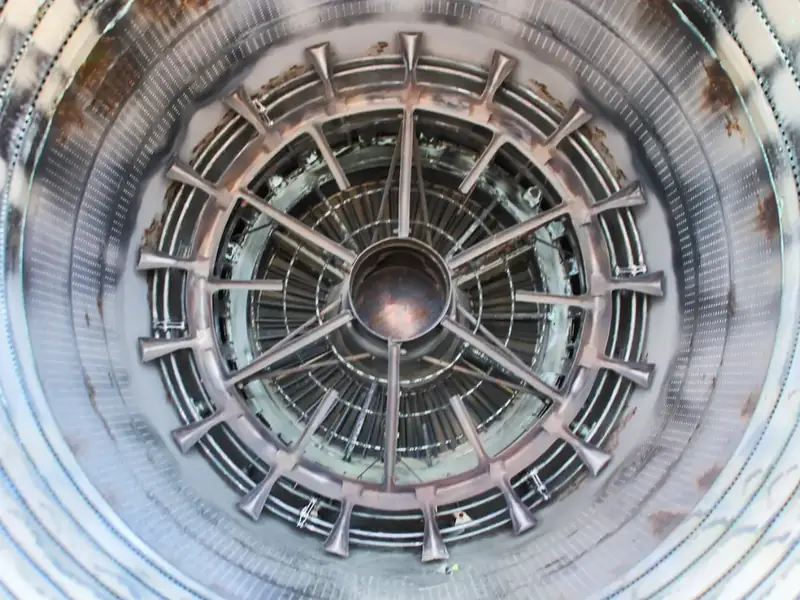
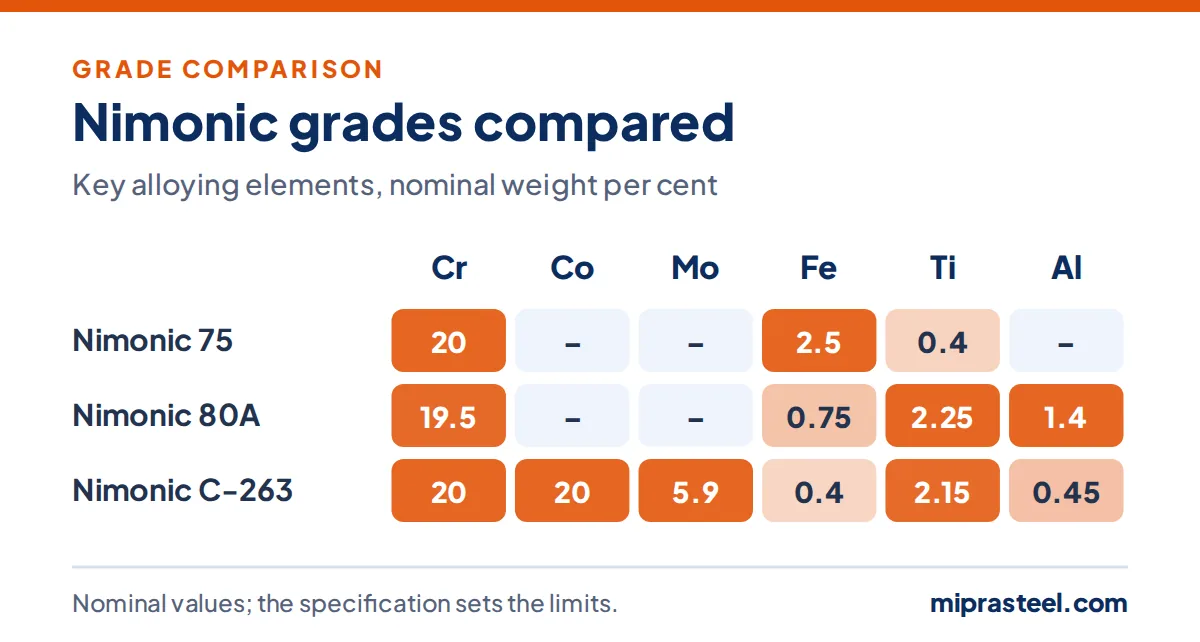
The Nimonic alloys came out of the early British jet engine programmes, and all three on this site share the same starting point: roughly four parts nickel to one part chromium, with very little iron. What changes from grade to grade is how far the alloy has been pushed beyond that base. Nimonic 75 adds almost nothing, about 0.4% titanium, and is used as oxidation-resistant sheet and wire. Nimonic 80A adds about 2.25% titanium and 1.4% aluminium so that it can be precipitation-hardened, which is why engine exhaust valves, turbine rings and hot bolting are made from it. Nimonic C-263 goes further, replacing part of the nickel with 20% cobalt and adding about 6% molybdenum, to give a weldable sheet alloy for combustors.
In scrap terms that gives two easy groups and one awkward pair. C-263 stands alone because of its cobalt: it is the grade with the most payable alloying content, and it suffers most when diluted with plain 80/20 material. 75 and 80A are the awkward pair. Their nickel and chromium are almost identical, so a melter making 75 does not want the titanium and aluminium that 80A brings, and a melter making 80A cannot count on a lot that might be half 75.
Names cause their own problems. Material sold as "Nimonic 80" is normally 80A, since 80A superseded the original grade, but the certificate should confirm it. "Nimonic 263" and "C-263" mean the same alloy. And Nimonic is often lumped with Inconel scrap simply because both are nickel-chromium families from the same producer group; Inconel grades usually carry more iron, which a reading shows at once.
The Nimonic name belongs to Special Metals as a registered trademark; we use it only to label scrap of these three chemistries, regardless of which mill rolled or forged the original metal.
Nimonic Scrap Grades We Buy and Sell
Nimonic Chemical Composition
| Grade | Ni | Cr | Co | Mo | Fe | Ti | Al |
|---|---|---|---|---|---|---|---|
| Nimonic 75 | 77.1 | 20 | – | – | 2.5 | 0.4 | – |
| Nimonic 80A | 76.1 | 19.5 | – | – | 0.75 | 2.3 | 1.4 |
| Nimonic C-263 | 51.1 | 20 | 20 | 5.9 | 0.4 | 2.2 | 0.45 |
Nominal weight per cent. Specification ranges vary by product form and standard.
How to Tell Nimonic Grades Apart
All three grades sit on a nickel-chromium base, so identification is about the small additions on top of it. Titanium and cobalt read well on handheld XRF; aluminium needs a light-element method.
| Check | What it shows for Nimonic |
|---|---|
| Cobalt | About 20% cobalt, with roughly 6% molybdenum, means C-263. Neither 75 nor 80A carries cobalt as an addition. |
| Titanium | About 2.25% titanium on a 20% chromium base points to 80A; around 0.4% points to 75. |
| Aluminium | 80A carries about 1.4%, 75 effectively none. Confirm by OES or a light-element XRF setup when titanium alone leaves doubt. |
| Iron | Every Nimonic grade here reads under about 3% iron. A reading near 8% iron with 15.5% chromium is more likely Inconel 600. |
| Product form | Valve stems and heads, bolts and springs suggest 80A; thin combustor sheet suggests C-263 or 75; sheaths and fixtures suggest 75. |
| Markings and certificates | BS HR, AMS or EN specification numbers on certificates often identify the grade directly. See EN, DIN, BS and Werkstoff numbers. |
Grades Most Often Confused with Nimonic
- Inconel 600: also high in nickel, but about 15.5% chromium and 8% iron against roughly 20% chromium and under 3% iron in the Nimonic grades.
- Haynes 282: close to C-263 in titanium and molybdenum, but with about 10% cobalt and 8.5% molybdenum instead of 20% and 6%.
- Udimet 500: carries 18.5% cobalt like C-263, but with about 2.9% each of titanium and aluminium and only 4% molybdenum.
Cobalt Identifies C-263
About 20% cobalt; neither 75 nor 80A carries any.
Titanium Separates 80a from 75
About 2.25% titanium in 80A against 0.4% in 75.
"Nimonic 80" Usually Means 80a
The original Nimonic 80 was superseded by 80A. Material sold as "80" is normally 80A, but check the paperwork.
Where Nimonic Scrap Comes From
Most Nimonic scrap is new production waste rather than worn-out parts, which makes it easier to document than many superalloy streams.
Engine Valve Manufacture
Exhaust valve makers for diesel and gas engines forge and machine 80A, producing bar crops, forging flash and turnings, usually traceable to a heat.
Fastener and Spring Makers
High-temperature bolts, studs and springs in 80A leave bar ends, wire offcuts and rejected parts.
Combustor and Casing Fabrication
Sheet trim, blanking skeletons and rejected liners in C-263, plus 75 sheet from older designs, from aerospace and power turbine fabricators. See aerospace scrap.
Turbine Overhauls
Retired combustion chambers, transition liners, rings and turbine casings from aero and land turbines. See power generation scrap.
Furnaces and Instruments
Nimonic 75 fixtures, heat-treat parts and thermocouple sheaths replaced during maintenance. See furnace scrap.
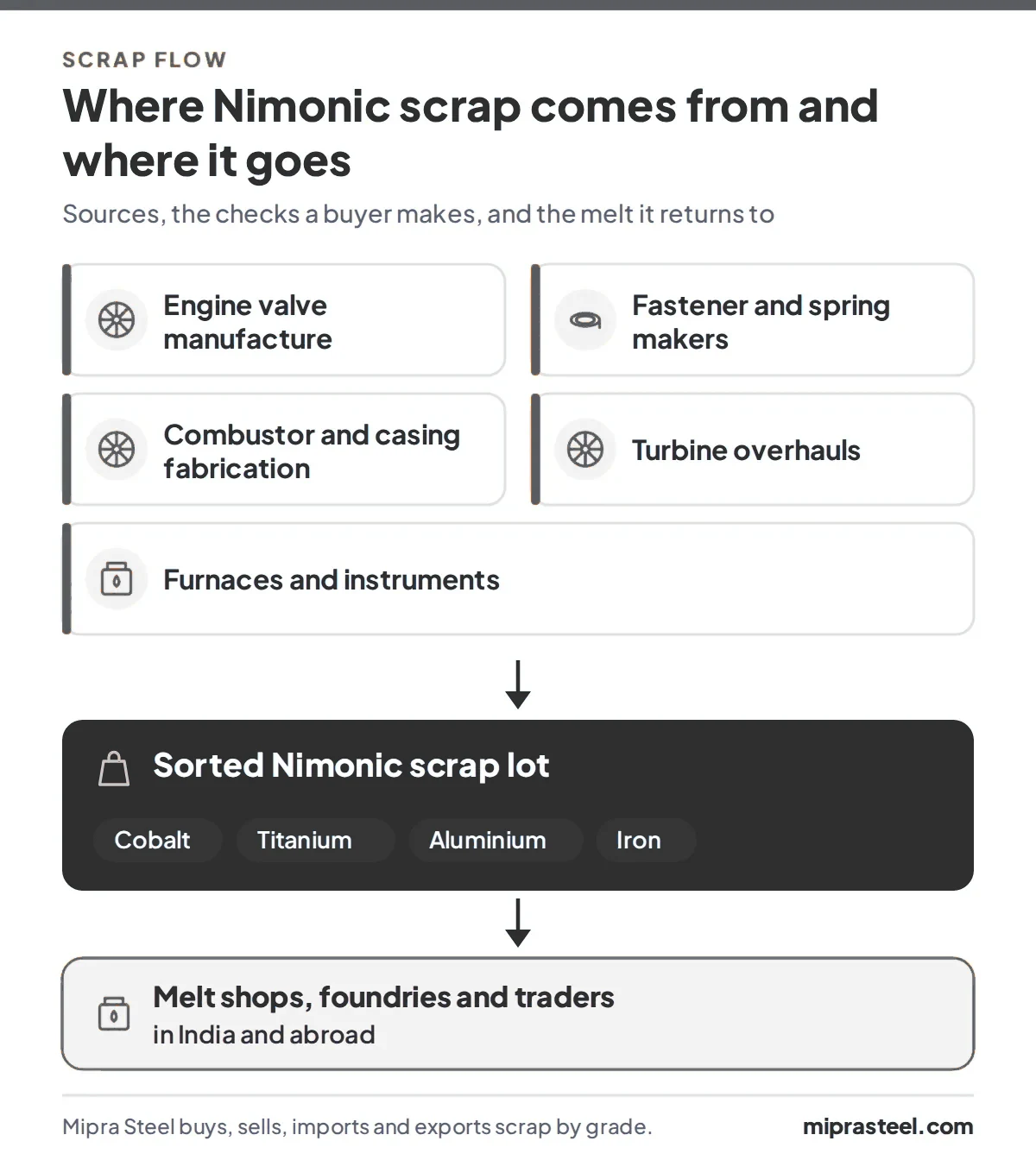
Source industries: aerospace, heat treatment and furnaces, power generation.
Nimonic Scrap Buyer, Importer and Exporter in India
Mipra Steel buys and sells Nimonic 75, 80A and C-263 scrap from Mumbai, working with Indian valve and fabrication shops and with overhaul and production sources abroad.
Sell Nimonic Scrap
When you offer Nimonic scrap, name the grade and how you know it: certificate, heat number, drawing or reading. Give the weight and form for each grade, for example 80A bar crops, C-263 sheet trim or 75 sheaths, and where the material sits. Tell us whether valve scrap includes hard-faced seats, plated stems or welded steel ends. Photos help. We review incoming enquiries and respond with relevant next steps.
Buy Nimonic Scrap
Melters and traders sourcing Nimonic scrap should specify the grade, the forms their furnace can take, the quantity, the port and when they need it. Valve and fastener makers buying revert to remelt into the same grade usually want heat-traceable 80A; makers of cobalt-bearing alloys usually ask for C-263. We describe each lot by grade and UNS number and say which documents go with it.
Preparing Nimonic Scrap for Sale
- Keep 75 and 80A apart even when they come from the same shop, and label both.
- Bag C-263 on its own and never mix it with the cobalt-free grades.
- Cut hard-faced seats and welded steel ends off scrapped valves, or declare them.
- Keep certificates or heat numbers with each bag of valve and fastener scrap.
- Drain and dry turnings and keep them separate from solids.
- Move anything that reads 8% iron or more to the Inconel lot.
Nimonic Scrap Price per Kg: What Decides It
A Nimonic scrap price per kg depends first on which of the three grades is in the bag, then on how well it can be proved.
- Cobalt content: C-263 carries about 20% cobalt and normally sits apart from the other two on that basis.
- Clean separation of 75 from 80A. A lot confirmed as one or the other is priced as that grade; an uncertain mix is priced on the base metals only.
- Traceability. Valve-shop and fastener scrap with heat numbers is easier to place with a melter making the same grade.
- Form: solids and bar ends ahead of sheet trim, sheet ahead of turnings, and turnings ahead of oily or mixed swarf.
- Contamination from valve production: hard-facing on valve seats, chrome plating on stems and steel welded to bimetallic valves.
- Nickel and cobalt markets, lot size and distance from port.
For the general method behind alloy scrap offers, read how nickel alloy scrap is valued.
Nimonic Scrap Import and Export
Importing Nimonic Scrap into India
Nimonic scrap comes into India from Europe, the UK supply chain, the Gulf and East Asia, where aerospace and engine component makers and turbine overhaul shops generate it. Each consignment should travel with a pre-shipment inspection certificate, commercial invoice, packing list and bill of lading, and is cleared at Nhava Sheva, Mundra or Chennai. Listing 75, 80A and C-263 on separate lines of the packing list, with UNS numbers, saves questions at the port and at the receiving melt shop. See importing nickel alloy scrap into India.
Exporting Nimonic Scrap from India
India has a sizeable engine valve and fastener industry, and its 80A production scrap, along with C-263 and 75 from fabrication and maintenance, is in demand with melters abroad. Export lots are described by grade and UNS number on the invoice and packing list, weighed, and shipped bagged, in drums or loose in containers. We work with buyers in Japan, South Korea, Italy and Spain, with our Dubai and South Korea offices supporting Gulf and East Asian customers.
Customs heading: 7503.00 (nickel waste and scrap). The HS code is the international tariff heading the scrap is declared under; national tariff lines add further digits, so confirm the full line with your customs broker.
Related Reading
Nimonic Scrap FAQ
Is Nimonic the same as Inconel?
No. Both are nickel-chromium alloy families from the same producer group, but the Nimonic grades here are built on an 80/20 nickel-chromium base with very little iron and were developed for jet engine hot sections. Most Inconel grades carry more iron or other additions such as niobium. On a reading, iron is the quickest separator.
Why is Nimonic C-263 scrap kept apart from 75 and 80A?
Because of its 20% cobalt and about 6% molybdenum. Those additions are what a buyer pays for, and they are wasted if C-263 is mixed into plain 80/20 scrap. Equally, a melter making 75 or 80A does not want cobalt in the charge. Keep C-263 in its own bags.
Can mixed Nimonic 75 and 80A be sold as one lot?
It can be offered, but it will be priced as generic nickel-chromium scrap because no buyer can use it as either grade without knowing the split. Titanium readings usually separate the two quickly, and the sorted lots are easier to place. See Nimonic 75 vs Nimonic 80A.
Are scrapped engine exhaust valves worth selling as Nimonic?
Often yes, as many are made of 80A. The catch is that valves may carry hard-facing on the seat, plating on the stem or a steel end friction-welded on. Those parts change the chemistry, so either remove them or tell the buyer they are present.
What paperwork proves a Nimonic grade?
Mill certificates listing UNS numbers or BS HR, AMS or EN specifications, heat numbers stamped on bar, and part drawings from the manufacturer. Readings from a handheld XRF support them. See reading mill test certificates.
Which customs heading covers Nimonic scrap shipments?
Nimonic grades are nickel-predominant, so the scrap is typically declared under HS 7503.00, nickel waste and scrap. That applies to C-263 too, despite its cobalt. Check the full national tariff line with your customs broker.
Does Mipra Steel deal in Nimonic scrap from valve and fastener plants?
Yes. We buy and sell Nimonic production scrap from Indian plants and from suppliers abroad, and arrange import and export. Send the grade, forms, weights, photos and any certificates so we can look at the lot properly.
Published by Mipra Steel, Khetwadi, Mumbai · Updated