GTD-241 Scrap Buyer, Importer and Exporter in India
From Khetwadi, Mumbai, Mipra Steel handles GTD-241 nozzle scrap and casting revert for sellers and melters in India, the Gulf and East Asia.
Sell GTD-241 Scrap
Want to sell GTD-241 scrap? Send the segment count and weight, location, photographs that show part numbers, and any readings that report tantalum. If you hold repair or casting records naming GTD-241, include them, because they decide whether the lot can carry its own name. We review incoming enquiries and respond with relevant next steps.
Buy GTD-241 Scrap
Melters sourcing GTD-241 revert should say whether a confirmed tantalum-free lot is required or whether mixed 222-family nozzle revert is acceptable. Add the tonnage, the condition you can take (engine-run, coated or foundry revert), your analysis expectations and the delivery port, and we can match the description to the lot.
What Is GTD-241, and How Is It Different from GTD-222?
Think of GTD-241 as GTD-222 with one expensive ingredient taken out. A GE patent describing a castable nozzle alloy on the GTD-222 base, with the tantalum removed and the niobium raised to about 1.3%, gives two reasons: tantalum is costly, and the leaner alloy proved easier to weld while holding creep resistance. Nozzles are repaired by welding again and again, so weldability is worth paying attention to.
Everything else stays close to its parent. By weight GTD-241 is roughly 51.65% nickel with 22.5% chromium and 19% cobalt, then titanium at 2.3%, tungsten at 2%, niobium at 1.35% and aluminium at 1.2%. It is non-magnetic, carries no international standard designation and is cast to turbine OEM specifications.
For anyone handling the scrap, the missing tantalum is the whole story. A GTD-241 segment and a GTD-222 segment can look identical, come off the same frame of machine and land in the same outage skip. The only quick chemical difference is roughly one percentage point of tantalum and about half a point of niobium. A revert melter making a tantalum-free heat does not want tantalum walking in with a mislabelled segment, and a melter making 222 needs to know how much tantalum it is actually receiving.
So the honest description of a GTD-241 lot depends on two things: readings that show tantalum absent, and records (part numbers, repair reports or foundry papers) that say the segments were cast in 241. Without both, mixed 222 and 241 nozzles are normally offered together as GTD nozzle revert.
GTD-241 belongs to the GTD family, part of superalloy scrap.
Where GTD-241 Scrap Is Generated
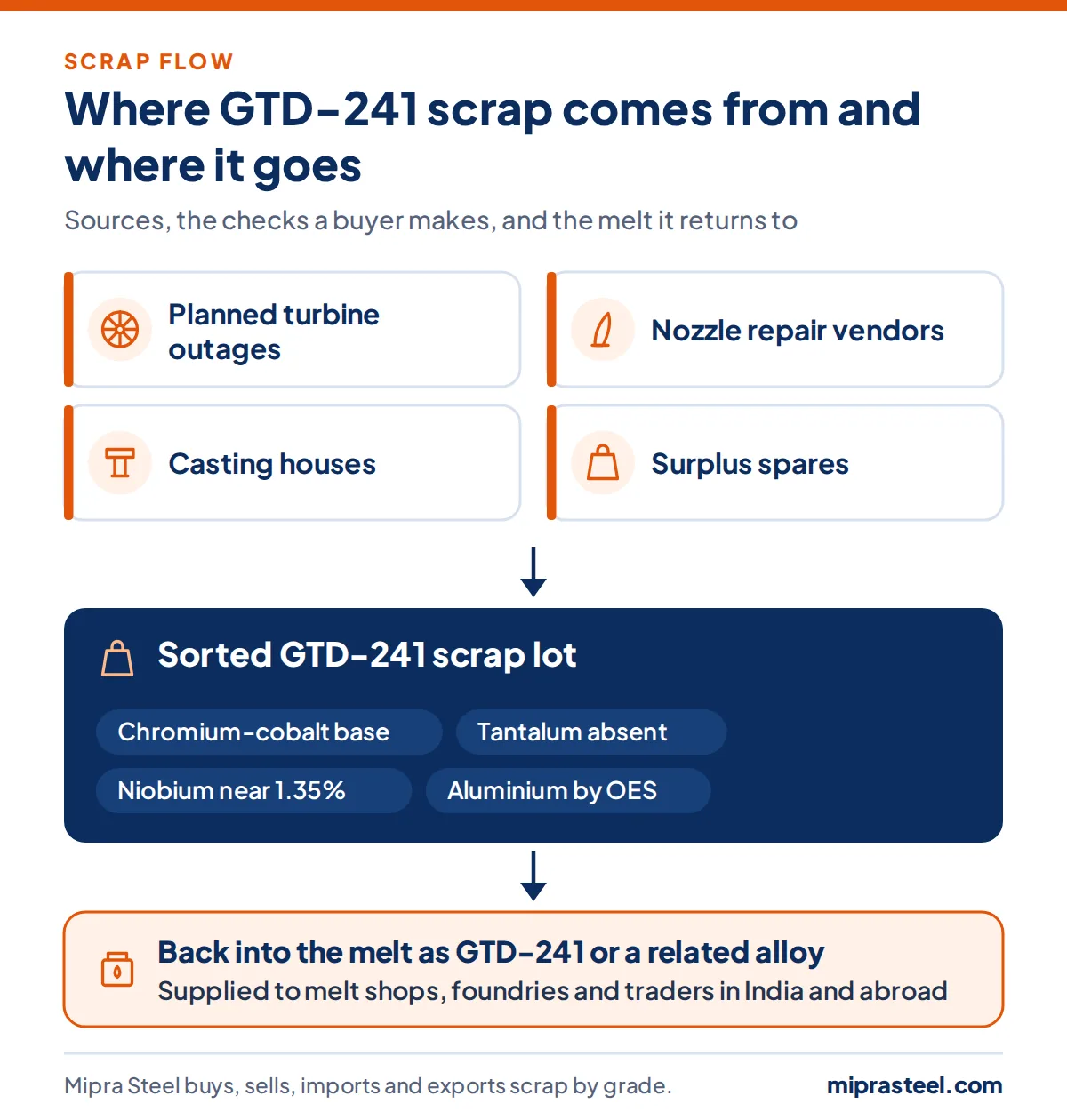
GTD-241 is a niche alloy, and its scrap follows the same routes as other heavy-duty turbine nozzles, just in smaller volumes.
Planned Turbine Outages
Nozzle segments condemned at hot-gas-path inspections or major overhauls at gas-fired and combined-cycle stations. See power generation scrap.
Nozzle Repair Vendors
Segments rejected after cracking, erosion or excess wall loss during repair assessment, plus cut-outs and trial weld coupons.
Casting Houses
Gating, risers and dimensionally rejected castings from nozzle production. This revert has no service exposure and no coating.
Surplus Spares
Unused or refurbished segments released by operators or traders who no longer run a matching unit.
GTD-241 Scrap Specification Chart
| Grade | GTD-241 |
|---|---|
| UNS | Not assigned (proprietary GE alloy) |
| W.Nr. / EN | Not assigned |
| Identified by | GE Power specification, part records and analysis |
| Also known as | GTD 241 |
| Alloy type | Cast γ′ superalloy |
| Density | Not published |
| Magnetic | Non-magnetic. |
| HS code (customs heading) | 7503.00 (nickel waste and scrap) |
GTD-241 Chemical Composition
Nominal composition in weight per cent, used to describe and identify the grade. The governing specification sets the limits for each product.
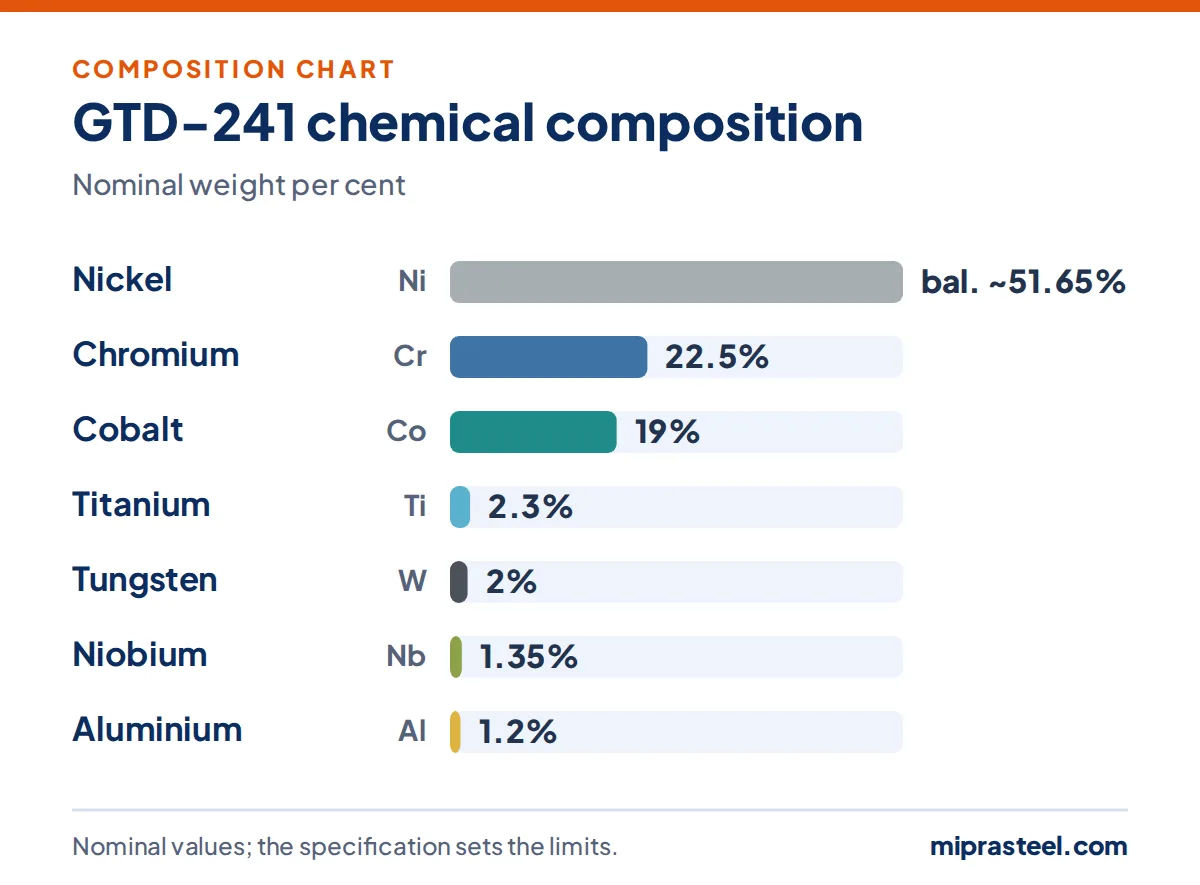
| Element | Symbol | Nominal wt% | |
|---|---|---|---|
| Nickel | Ni | Balance (about 51.7) | |
| Chromium | Cr | 22.5 | |
| Cobalt | Co | 19 | |
| Titanium | Ti | 2.3 | |
| Tungsten | W | 2 | |
| Niobium | Nb | 1.4 | |
| Aluminium (aluminum) | Al | 1.2 |
GTD-241 Equivalent Grades and Other Names
| Designation | Value |
|---|---|
| Trade name | GTD-241 |
| UNS | Not assigned (proprietary GE alloy) |
| W.Nr. / EN | Not assigned |
| Other names in the trade | GTD 241 |
Look up any designation in the grade name converter or the equivalent grade chart.
GTD-241 Standards and Specifications
Supplied to turbine OEM specifications.
GTD-241 Applications
- Turbine nozzles (vanes) in heavy-duty gas turbines
Source industries: power generation.
How GTD-241 Scrap Is Identified
GTD-241 identification is mostly an exercise in proving a negative: showing that tantalum is not there.
| Check | What it shows for GTD-241 |
|---|---|
| Chromium-cobalt base | About 22.5% chromium and 19% cobalt confirms the 222-type nozzle family and rules out bucket alloys. |
| Tantalum absent | A reliable zero for tantalum is what separates GTD-241 from GTD-222, which carries about 1%. Use enough measurement time for the analyser to resolve it. |
| Niobium near 1.35% | Higher than the roughly 0.8% in GTD-222. Read it together with tantalum, never alone. |
| Aluminium by OES | GTD-241 sits near 1.2% aluminium against about 1.7% in GTD-262. A spark OES or light-element XRF setup is needed to see that gap. |
| Surface condition | Grind through coatings, oxide and repair welds before reading. Repair filler can carry elements that the base alloy does not. |
Grades Most Often Confused with GTD-241
- GTD-222: is the parent alloy: same chromium and cobalt, but about 1% tantalum and only 0.8% niobium.
- GTD-262: matches GTD-241 on tantalum and niobium; the difference is aluminium, about 1.7% against 1.2%.
- IN-939: reads similar chromium and cobalt but about 3.7% titanium and 1.4% tantalum.
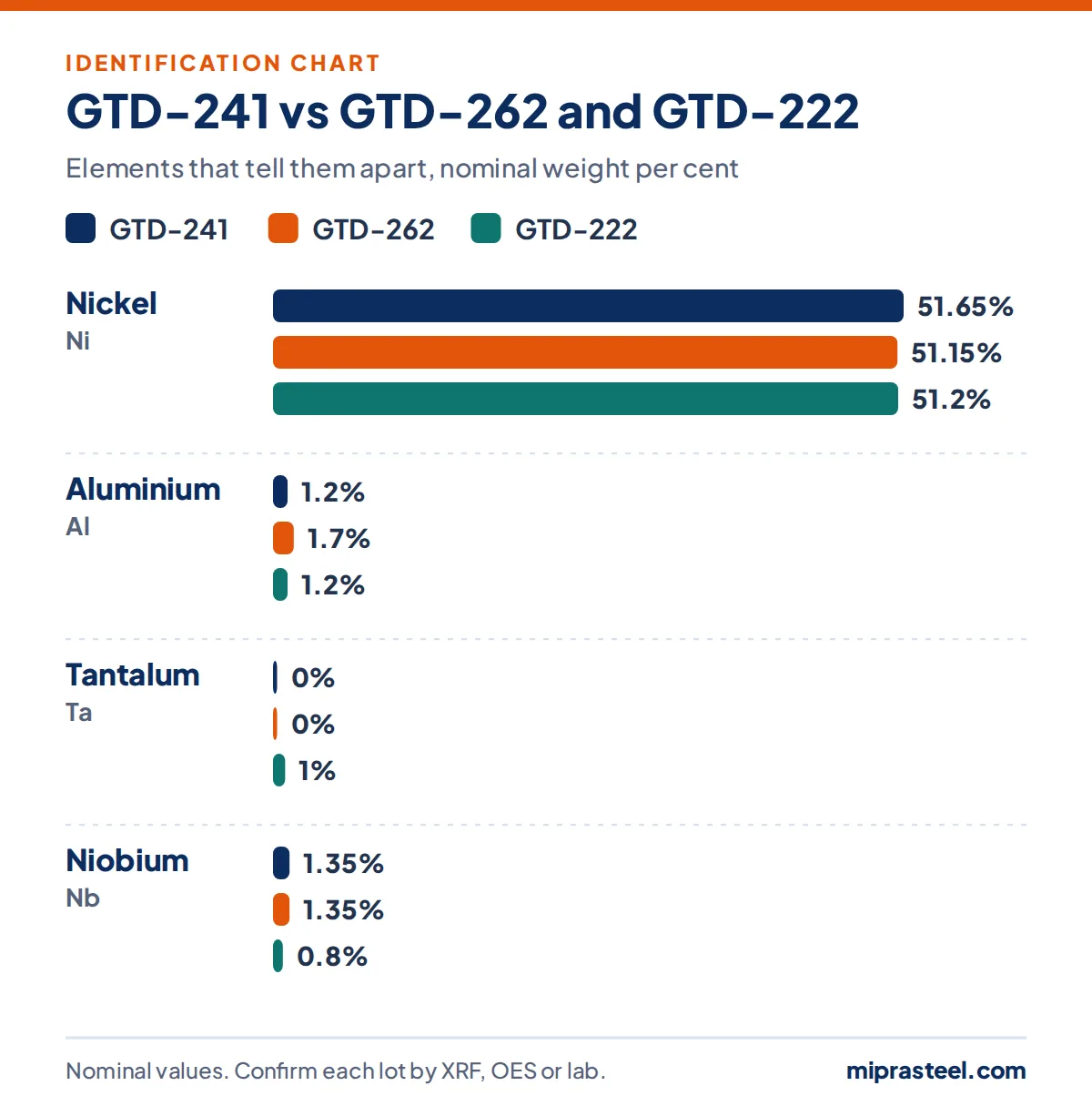
Nominal values for GTD-241 against its closest grades on this site.
Preparing GTD-241 Scrap for Sale
- Run a tantalum check on every segment and set aside any piece that shows tantalum.
- Store GTD-241 apart from GTD-222 and GTD-262 even when the segments look the same.
- Strip inserts, seals and any bolted steel hardware before weighing.
- Note which segments are engine-run and which are new castings, and bag them separately.
- Keep part-number photographs and repair or casting records with the lot.
GTD-241 Scrap Price per Kg: What Decides It
A GTD-241 offer rests on contained nickel and cobalt, then on how firmly the tantalum-free description can be stood behind.
- Nickel at about 52% and cobalt at about 19%: the two metals that set the base of any 222-family revert offer.
- No tantalum: for a melter producing tantalum-free nozzle heats, a confirmed 241 lot avoids an unwanted addition.
- Documentary support: part numbers, repair reports or foundry certificates naming GTD-241 let the lot be sold under its own name.
- Segregation from GTD-222 and GTD-262: a mixed nozzle lot is priced as family revert, not as 241.
- Coatings, braze and weld repairs on engine-run segments, which add surface elements and analysis work.
- Attached hardware such as inserts or seals in another alloy, which must be removed before weighing.
Any number quoted for GTD-241 is tied to that day's nickel and cobalt markets. The reasoning behind an offer is laid out in our nickel alloy scrap valuation guide.
GTD-241 Scrap Import and Export
Importing GTD-241 Scrap into India
GTD-241 scrap reaching India is often imported from heavy-duty turbine fleets abroad, for example in the Gulf and East Asia. Shipments follow the usual metal scrap process: an inspection at the loading end, whose certificate travels with the bill of lading, invoice and packing list. Declaring the material as GTD-241 nickel-base superalloy nozzle scrap, with tantalum readings attached, helps the importer and the end buyer agree on what has arrived. Nhava Sheva, Mundra and Chennai are the usual entry ports. More in importing nickel alloy scrap into India.
Exporting GTD-241 Scrap from India
When GTD-241 leaves India, the invoice and packing list should name the grade, the segment count and the net weight, and the analysis should travel with the documents. Segments are commonly packed in drums or wooden crates inside containers. Melters in Japan and Korea, and Gulf traders near our UAE office often ask for readings before confirming. Our export documents guide covers the paperwork.
Customs heading: 7503.00 (nickel waste and scrap). The HS code is the international tariff heading the scrap is declared under; national tariff lines add further digits, so confirm the full line with your customs broker.
Other GTD Scrap Grades
Related Reading
GTD-241 Scrap FAQ
What is GTD-241 used for?
GTD-241 is cast into nozzles, the stationary vanes of heavy-duty, land-based gas turbines. It was derived from GTD-222 for the same duty, with tantalum removed and niobium increased. It is not used for rotating buckets, which are made from alloys such as GTD-111.
Why is there no tantalum in GTD-241?
A GE patent for a tantalum-free alloy on the GTD-222 base cites tantalum's high cost and reports easier welding without a loss of creep resistance. Niobium was raised to about 1.3% to compensate. For scrap buyers, the absence of tantalum is also the main way to tell 241 from 222.
Can GTD-241 and GTD-222 be sold in the same lot?
They can be sold together, but then the lot is described as mixed GTD nozzle revert rather than as either grade. Buyers who need a specific chemistry will usually value a segregated, documented lot higher than a blend, so it pays to keep them apart if records allow it.
Can a handheld XRF tell GTD-262 from GTD-241?
Not reliably on its own. The two differ mainly in aluminium, about 1.7% against 1.2%, and standard handheld XRF struggles with light elements. Spark OES or a light-element XRF configuration is needed, ideally backed by part numbers or casting papers.
Who buys GTD-241 scrap in India?
Mipra Steel in Mumbai buys GTD-241 nozzle scrap and casting revert, both engine-run and new. Send the weight, location, photographs of part numbers and any tantalum readings so the lot can be described properly before an offer is made.
What HS heading is used when shipping GTD-241 scrap?
Most shipments of GTD-241 go under 7503.00, the heading for nickel waste and scrap, since nickel is its largest element. Countries add their own subheading digits, so the importer's or exporter's customs broker should confirm the national line.
What is GTD-241 made of?
Nominally 51.7% nickel, 22.5% chromium, 19% cobalt, 2.3% titanium, 2% tungsten, 1.4% niobium, 1.2% aluminium. Specification ranges vary by product form and standard.
Published by Mipra Steel, Khetwadi, Mumbai · Updated