René N500 Scrap Buyer, Importer and Exporter in India
Mipra Steel handles René N500 revert and blades from Mumbai as a rhenium-free single-crystal grade, kept and described apart from N5 and other rhenium-bearing alloys.
Sell René N500 Scrap
If you hold N500, tell us where it came from (casting returns, rejected castings or service blades), its weight, whether it is coated, and how it has been stored relative to any rhenium-bearing alloys. A lab sheet showing rhenium below detection makes a big difference. Photographs of part markings help. We review incoming enquiries and respond with relevant next steps.
Buy René N500 Scrap
Melters of rhenium-free single crystals and traders who supply them can ask us for N500 revert. State the quantity, whether you accept coated or core-bearing material, the analysis you need before shipment (including a rhenium figure), and the port of delivery. Small lots can sometimes be combined if every part carries the same analysis.
What Is René N500, and How Is It Different from René N5?
Think of N500 as the rhenium-free counterpart to René N5. Both are single-crystal alloys for gas turbine blades and both rely on tantalum, tungsten and a high aluminium content for strength at temperature. Where N5 adds about 3% rhenium, N500 leaves it out and adjusts the rest: chromium drops from 7% to about 6% and tungsten rises from 5% to about 6.25%. Rhenium is scarce and its price has swung widely, so turbine makers have looked at blade alloys that use less of it or none. Trade commentary on rhenium describes N500 as one of GE's rhenium-reduction routes, alongside a low-rhenium sibling, N515.
For a scrap buyer, the useful fact about N500 is what it does not contain. A melt shop casting rhenium-free single crystals needs revert that is free of rhenium, and N500 revert from a controlled foundry is exactly that. The danger is that N500 and N5 look the same on the shelf, share most of their elements and come out of the same kind of casting cell. One misplaced box of N5 brings rhenium into a lot sold as rhenium-free.
Published compositions for N500 differ by a few tenths of a percent between sources, mainly in molybdenum and tungsten, so lots are described from their own analysis rather than from a nominal table. The name appears in enquiries as René N500, Rene N500 or just N500.
René N500 belongs to the René family, part of superalloy scrap.
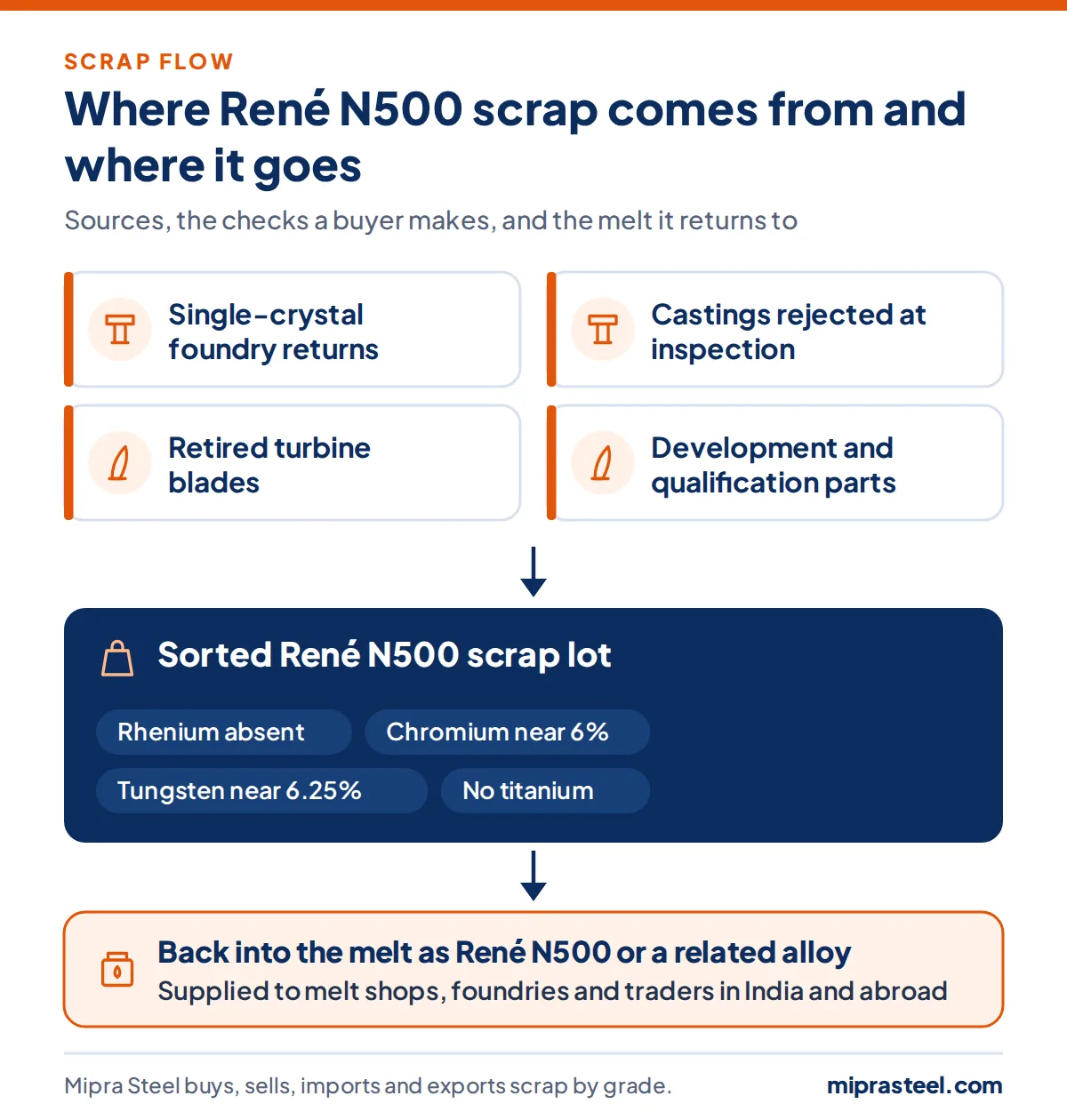
Where René N500 Scrap Comes From
N500 is a newer, narrower alloy than the classic René grades, so volumes are modest and most material can be traced back to a specific casting programme.
Single-Crystal Foundry Returns
Starter sections, helix or grain-selector pieces, pour cups and gating cut from blade moulds. This revert is uncoated and is the material rhenium-free melts want most.
Castings Rejected at Inspection
Blades failed for stray grains, recrystallisation or wall-thickness faults. The alloy is correct even though the part is not, so these return as good revert once any ceramic core is leached out.
Retired Turbine Blades
Blades removed at overhaul from engines and from power generation turbines. These are usually coated and may share a container with N5 or other alloys from the same rotor.
Development and Qualification Parts
Test bars, trial castings and sectioned blades from aerospace qualification work. Small in weight, but normally very well documented.
René N500 Scrap Specification Chart
| Grade | René N500 |
|---|---|
| UNS | Not assigned (proprietary GE alloy) |
| W.Nr. / EN | Not assigned |
| Identified by | GE material specification, casting records and analysis |
| Also known as | Rene N500, N500 |
| Alloy type | Single-crystal nickel superalloy (rhenium-free) |
| Density | Not published |
| Magnetic | Non-magnetic. |
| HS code (customs heading) | 7503.00 (nickel waste and scrap) |
René N500 Chemical Composition
Nominal composition in weight per cent, used to describe and identify the grade. The governing specification sets the limits for each product.
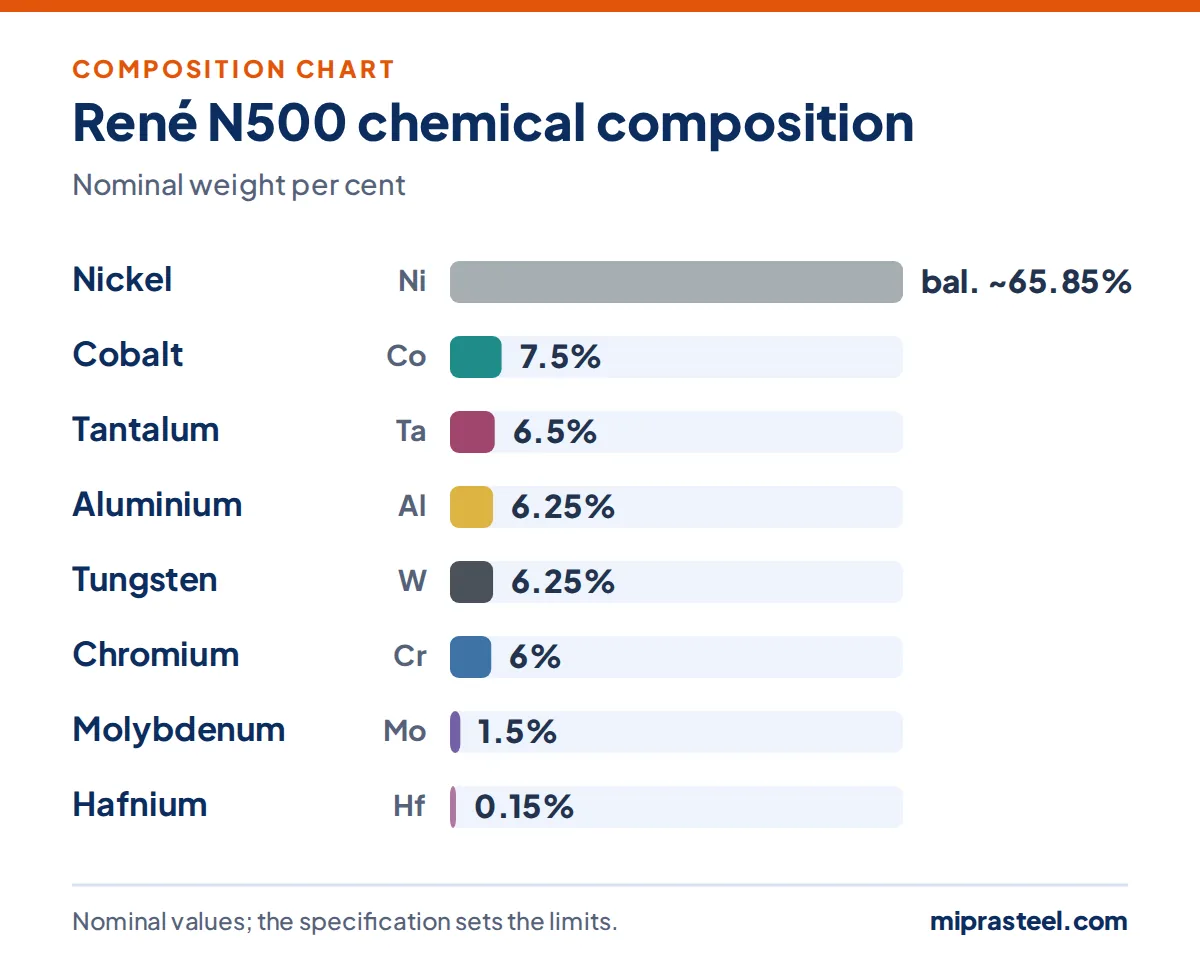
| Element | Symbol | Nominal wt% | |
|---|---|---|---|
| Nickel | Ni | Balance (about 65.9) | |
| Cobalt | Co | 7.5 | |
| Tantalum | Ta | 6.5 | |
| Aluminium (aluminum) | Al | 6.3 | |
| Tungsten | W | 6.3 | |
| Chromium | Cr | 6 | |
| Molybdenum | Mo | 1.5 | |
| Hafnium | Hf | 0.15 |
René N500 Equivalent Grades and Other Names
| Designation | Value |
|---|---|
| Trade name | René N500 |
| UNS | Not assigned (proprietary GE alloy) |
| W.Nr. / EN | Not assigned |
| Other names in the trade | Rene N500, N500 |
Look up any designation in the grade name converter or the equivalent grade chart.
René N500 Standards and Specifications
GE proprietary specification.
René N500 Applications
- Single-crystal gas turbine blades
Source industries: aerospace, power generation.
How René N500 Scrap Is Identified
Proving N500 is mostly a matter of proving a negative: the lot must show the N500 balance of elements and no rhenium. A handheld reading on a cleaned surface sorts the family; a lab result settles the rhenium question.
| Check | What it shows for René N500 |
|---|---|
| Rhenium absent | N500 should show no rhenium. Because rhenium lines overlap with tantalum and tungsten, a handheld "zero" is not proof; buyers look for a lab analysis (OES, ICP or prepared-sample XRF) confirming it. |
| Chromium near 6% | N5 reads about 7% chromium. The difference is small, so it only supports, and never replaces, the rhenium result. |
| Tungsten near 6.25% | A little higher than N5 at 5%. Together with low chromium and no rhenium, it is the N500 pattern. |
| No titanium | N500 carries none. A single-crystal reading with about 4% titanium and 12% chromium is PWA 1483. |
| Hafnium trace | About 0.15%, much lower than the 1.5% found in DS alloys such as MAR-M 247 and René 108. |
| Clean surface | Coated blades must be ground to base metal at the root, or the aluminium, platinum and zirconium of the coating distort the reading. |
Grades Most Often Confused with René N500
- René N5: same family, but with about 3% rhenium, 7% chromium and 5% tungsten.
- PWA 1483: also rhenium-free single crystal, but with about 12.2% chromium, 4.1% titanium and 5% tantalum.
- MAR-M 247: no rhenium either, but 10% tungsten, 8.25% chromium, 1.5% hafnium and some titanium.
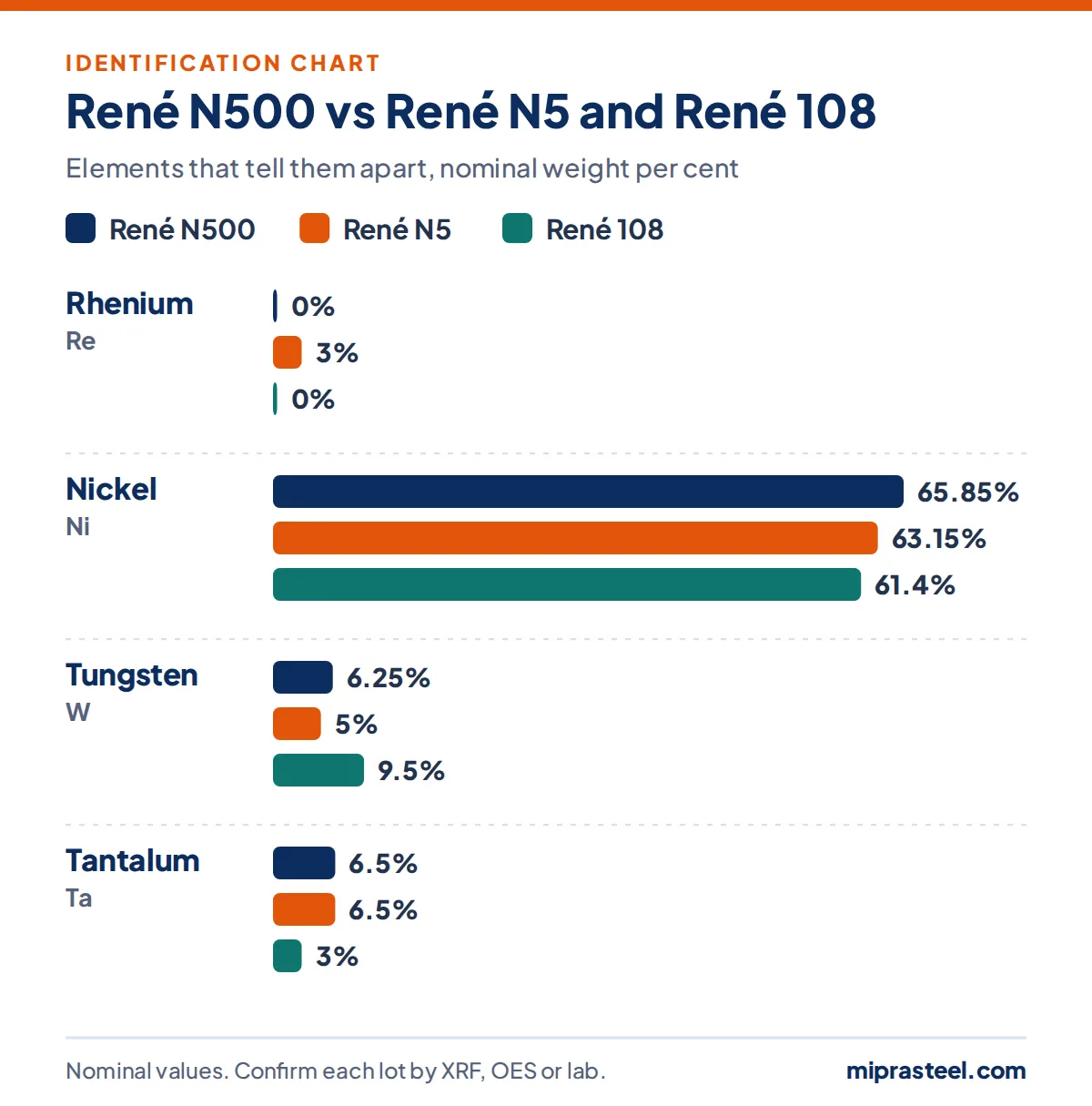
Nominal values for René N500 against its closest grades on this site.
Preparing René N500 Scrap for Sale
- Store N500 in a separate, sealed and labelled container from the day it is generated.
- Never share bins, bags or benches with N5 or any other rhenium-bearing alloy.
- Leach or knock out ceramic core where possible, and say if some remains.
- Separate uncoated revert from coated service blades.
- Have a sample analysed for rhenium and keep the report with the lot.
René N500 Scrap Price per Kg: What Decides It
With no rhenium to pay for, an N500 offer depends on its tantalum, tungsten and nickel, and on how confidently the lot can be called rhenium-free.
- Certified absence of rhenium: a lab result showing no rhenium is what lets the lot be sold to a rhenium-free melt as direct revert.
- Tantalum at about 6.5% and tungsten at about 6.25%, both refractory metals that add to the value of the alloy.
- Foundry origin: uncoated revert traceable to N500 heats is worth more than mixed overhaul scrap.
- Coatings and core: coated blades and castings with retained silica core are discounted for the work and loss involved.
- Volume: N500 lots tend to be small, so a buyer weighs the cost of handling a separate grade against the quantity offered.
If a lot cannot be proven free of rhenium, it may be worth more sold on its tested rhenium figure than forced into a rhenium-free description. The arithmetic is set out in nickel alloy scrap value, and the contained-metal calculator helps estimate tantalum and tungsten content.
René N500 Scrap Import and Export
Importing René N500 Scrap into India
N500 enters India in small, well-documented parcels, usually from casting and overhaul centres in Europe, North America or East Asia. As with all metal scrap imports, the cargo is inspected at origin and arrives with a pre-shipment inspection certificate, commercial invoice, packing list and bill of lading. The invoice should read "René N500 single-crystal nickel superalloy revert, rhenium-free" and carry the analysis, which protects the importer if a sample is drawn at Nhava Sheva, Mundra or Chennai. See the India import guide for nickel alloy scrap.
Exporting René N500 Scrap from India
Rhenium-free single-crystal revert is wanted by foundries casting the same family of blade alloys, chiefly in Europe, the United States and East Asia. From India, N500 is shipped in sealed, labelled drums with the grade and the rhenium result on the packing list, so the receiving melter can trace each drum. Our South Korea office is close to East Asian casting and recovery buyers, and our Dubai office to Gulf overhaul shops. Paperwork is covered in alloy scrap export documents.
Customs heading: 7503.00 (nickel waste and scrap). The HS code is the international tariff heading the scrap is declared under; national tariff lines add further digits, so confirm the full line with your customs broker.
Other René Scrap Grades
Related Reading
René N500 Scrap FAQ
Does René N500 contain any rhenium?
No. N500 was designed without rhenium, which is the main thing that separates it from René N5 at about 3%. In scrap, though, "no rhenium" has to be proven, because N500 and N5 are easily confused. Buyers rely on a laboratory analysis rather than a handheld reading to confirm it.
Is René N500 scrap worth less than René N5 scrap?
Generally, yes, because it carries no rhenium, and rhenium is the element that sets N5's value. N500 is still a valuable superalloy: it carries about 6.5% tantalum and 6.25% tungsten in a nickel base. Its worth depends heavily on being clean, rhenium-free revert that a melter can reuse directly.
Why would a turbine maker develop a blade alloy without rhenium?
To reduce dependence on a scarce element. Rhenium supply is small and its price has moved sharply in the past, so turbine makers have explored alloys with less or no rhenium. N500 keeps the single-crystal design and leans on tantalum, tungsten and aluminium for strength instead.
Can N500 revert go into an N5 melt?
Only under the melter's control. Adding rhenium-free N500 to an N5 charge lowers the rhenium content, so the foundry would have to make that up with fresh rhenium. In practice, revert buyers want each alloy kept in its own lot and decide any blending themselves, based on analysis.
How should I describe N500 on a sales enquiry to Mipra Steel?
Name the alloy, its form (casting returns, rejected castings or service blades), the weight and whether it is coated. Mention any rhenium analysis and how the material has been stored. Mipra Steel buys and sells N500 and will respond with next steps once it has these details.
What tariff heading applies to N500 blade scrap?
As a nickel-base alloy, N500 is typically declared under HS 7503.00, nickel waste and scrap. The national digits that follow differ between countries, so ask your customs broker to confirm the exact line before the shipment is booked.
Is René N500 the same as PWA 1483?
No. Both are rhenium-free single-crystal alloys, but PWA 1483 is a Pratt & Whitney grade with about 12.2% chromium and 4.1% titanium for hot-corrosion resistance. N500 has about 6% chromium, no titanium and more tantalum and tungsten. A reading on chromium and titanium separates them.
What is René N500 made of?
Nominally 65.9% nickel, 7.5% cobalt, 6.5% tantalum, 6.3% aluminium, 6.3% tungsten, 6% chromium, 1.5% molybdenum, 0.15% hafnium. Specification ranges vary by product form and standard.
Published by Mipra Steel, Khetwadi, Mumbai · Updated