ECY-768 Scrap Buyer, Importer and Exporter in India
Mipra Steel trades ECY-768 scrap from Mumbai, and through its Dubai office for Gulf power-generation material, together with MAR-M 509 and other cobalt grades.
Sell ECY-768 Scrap
Selling ECY-768 vane segments after an outage? Send the number of segments, total weight, location, photographs and any readings. Tell us whether the parts are ex-service, repair rejects or foundry revert, and whether any analysis covers zirconium. If you are unsure whether the lot is ECY-768 or MAR-M 509, say so: the readings decide the description, not the label.
Buy ECY-768 Scrap
Cobalt alloy producers and vane foundries can ask us for ECY-768 or for "ECY768 or MarM509" lots. Tell us the quantity, form, your zirconium limit if any, destination and timing. Every lot is described by grade and analysis, and we can discuss which readings or certificates accompany it.
What Is ECY-768, and Why Is It Listed as "ECY768 or MarM509"?
Put an ECY-768 vane segment and a MAR-M 509 segment side by side on a handheld analyser and the two readings will look almost the same: cobalt as the base, chromium in the low twenties, about 10% nickel, 7% tungsten and 3.5% tantalum. That is why many buyers and sellers write "ECY768 or MarM509" on an enquiry. For a cobalt alloy melt that can accept either, they are interchangeable inputs.
The one deliberate difference is zirconium. ECY-768 was developed by Westinghouse for combustion turbine vanes, and the patent literature describes it as a response to surface integrity and mould-metal reaction problems seen when casting MAR-M 509. The fix was to take zirconium almost out: 0.05% or less in ECY-768, against roughly 0.5% in MAR-M 509. Everything else stays close.
So the scrap question is simple to state and harder to answer: does this lot have zirconium or not? Many handheld XRF setups struggle at the low end of the zirconium scale on rough, oxidised vane surfaces. A buyer who must have ECY-768 specifically will want OES or a laboratory result; a buyer who takes either will be satisfied by a reading that confirms the cobalt vane chemistry.
ECY-768 is a proprietary specification and the alloy is far less familiar than MAR-M 509 outside power generation. Most of what appears for sale is from industrial gas turbines, which ties it closely to overhaul cycles at power plants. See power generation scrap.
ECY-768 belongs to the Cobalt alloy family, part of superalloy scrap.
Where ECY-768 Scrap Is Found
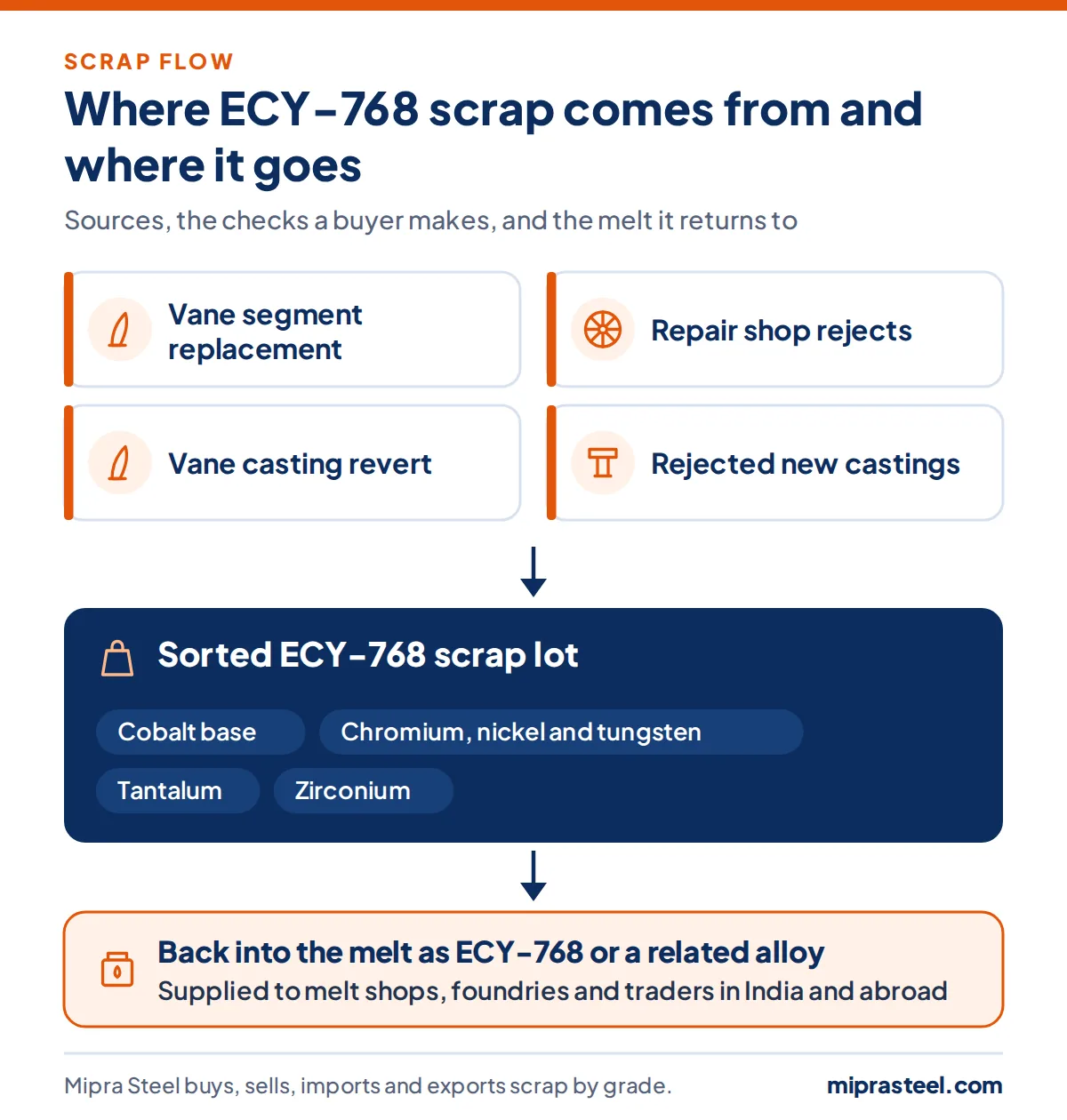
ECY-768 follows the overhaul calendar of large land-based gas turbines. These are the usual points of release.
Vane Segment Replacement
Ex-service vane segments removed at planned turbine overhauls, often several from the same machine. They carry coatings, oxide and sometimes braze or weld repair.
Repair Shop Rejects
Segments judged beyond repair after inspection at a turbine component repair shop.
Vane Casting Revert
Gates, runners and risers from investment foundries pouring ECY-768 vanes. Clean, single-grade and usually traceable.
Rejected New Castings
Segments failing radiography or dimensional checks before service.
ECY-768 Scrap Specification Chart
| Grade | ECY-768 |
|---|---|
| UNS | Not assigned (proprietary OEM alloy) |
| W.Nr. / EN | Not assigned |
| Identified by | OEM vane specification, part records and analysis |
| Also known as | ECY768, ECY 768 |
| Alloy type | Cast cobalt-base superalloy (vane alloy) |
| Density | Not published |
| Magnetic | Not a reliable test for this grade; confirm by XRF. |
| HS code (customs heading) | 8105.30 (cobalt waste and scrap) |
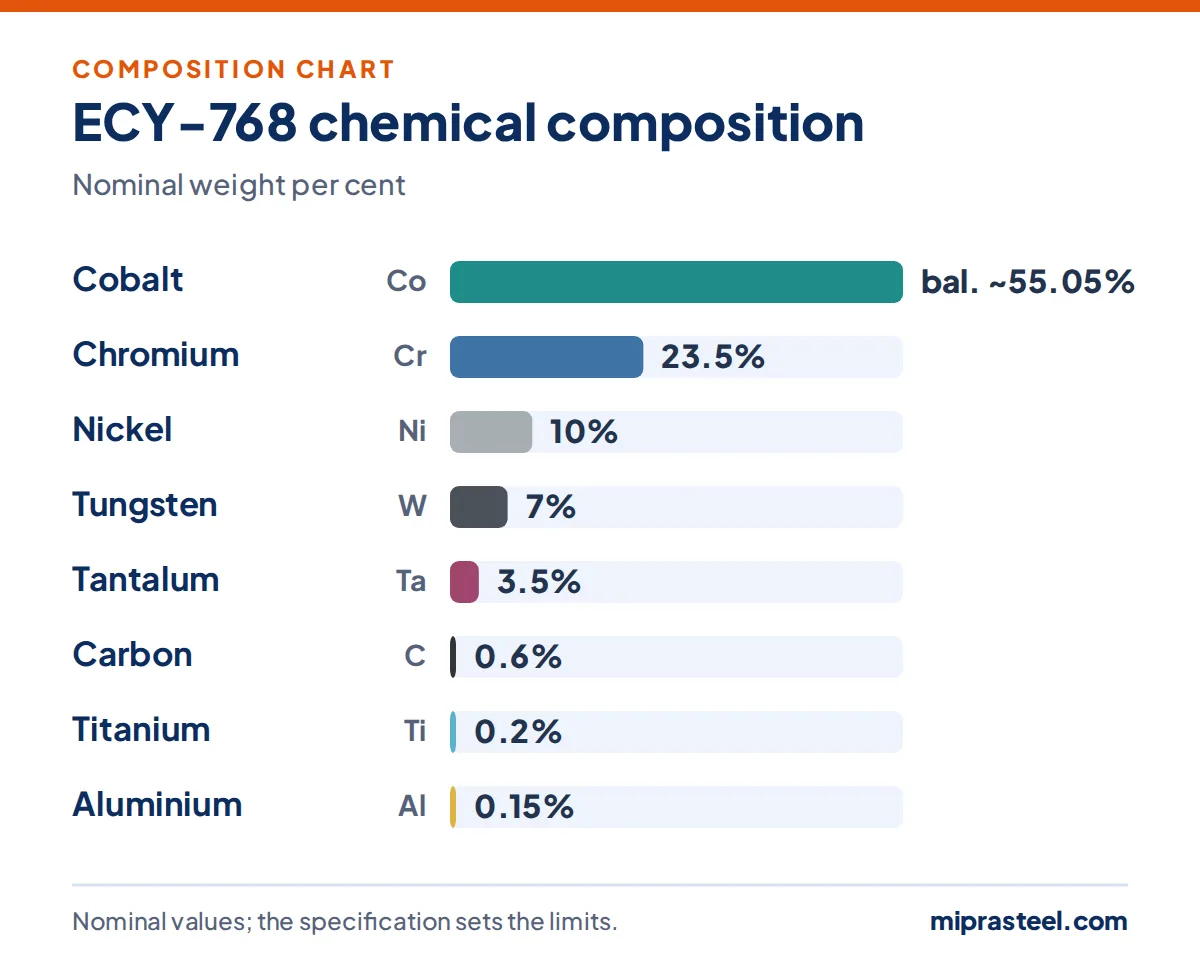
ECY-768 Chemical Composition
Nominal composition in weight per cent, used to describe and identify the grade. The governing specification sets the limits for each product.
| Element | Symbol | Nominal wt% | |
|---|---|---|---|
| Cobalt | Co | Balance (about 55.1) | |
| Chromium | Cr | 23.5 | |
| Nickel | Ni | 10 | |
| Tungsten | W | 7 | |
| Tantalum | Ta | 3.5 | |
| Carbon | C | 0.6 | |
| Titanium | Ti | 0.2 | |
| Aluminium (aluminum) | Al | 0.15 |
ECY-768 Equivalent Grades and Other Names
| Designation | Value |
|---|---|
| Trade name | ECY-768 |
| UNS | Not assigned (proprietary OEM alloy) |
| W.Nr. / EN | Not assigned |
| Other names in the trade | ECY768, ECY 768 |
Look up any designation in the grade name converter or the equivalent grade chart.
ECY-768 Standards and Specifications
Proprietary specification.
ECY-768 Applications
- Industrial gas turbine vanes and nozzle segments
Source industries: power generation.
How ECY-768 Scrap Is Identified
Identifying ECY-768 is mostly a matter of proving what is not there. Work through the readings in this order.
| Check | What it shows for ECY-768 |
|---|---|
| Cobalt base | Cobalt should be the largest element, around 55%. A nickel-led reading rules ECY-768 out immediately. |
| Chromium, nickel and tungsten | Roughly 22.5 to 24.25% chromium, 9 to 11% nickel and 6.5 to 7.5% tungsten fit the alloy's published ranges. |
| Tantalum | About 3 to 4% tantalum. Cobalt vane alloys without tantalum, such as X-40 and FSX-414, separate here. |
| Zirconium | The deciding element: 0.05% or less for ECY-768. Confirm with OES or laboratory analysis on a ground surface. See XRF versus OES versus lab. |
| Chromium ceiling | FSX-414 reads about 29.5% chromium. A reading above the mid-twenties points away from ECY-768. |
| Surface preparation | Grind through coatings and oxide before any reading. Surface layers on ex-service vanes give misleading minor-element results. See PMI testing. |
Grades Most Often Confused with ECY-768
- MAR-M 509: almost identical apart from zirconium, which runs at about 0.5% in 509 against 0.05% or less in ECY-768.
- F75 Co-Cr-Mo: also cobalt-base, but carries about 6% molybdenum and around 28% chromium, with very little nickel or tungsten.
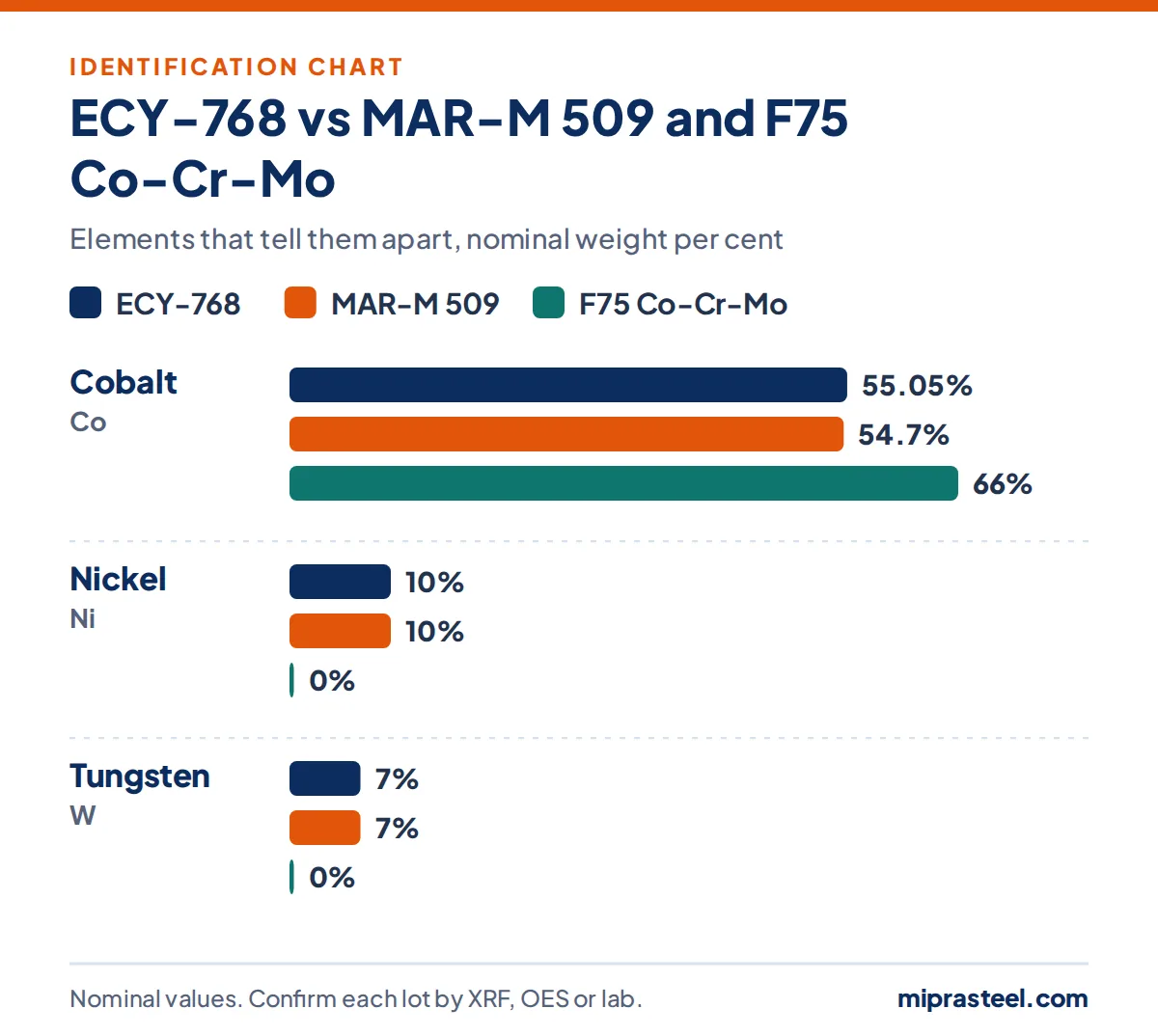
Nominal values for ECY-768 against its closest grades on this site.
Preparing ECY-768 Scrap for Sale
- Keep ECY-768 segments apart from nickel-base blades and vanes removed in the same outage.
- Label each bag with the turbine stage or source if known.
- Get a zirconium result on a ground surface before calling a lot ECY-768 rather than MAR-M 509.
- Remove bolts, seals and any steel fittings from vane assemblies.
- Keep repair-shop rejects and foundry revert in separate lots.
ECY-768 Scrap Price per Kg: What Decides It
An ECY-768 scrap price per kg rests on the same metals as MAR-M 509, mainly cobalt, so what moves the offer is mostly about condition and proof.
- Cobalt at around 55% of the weight, priced on its own market.
- Tungsten near 7% and tantalum around 3.5%, which a cobalt alloy melter recovers.
- Zirconium proof. A lot confirmed low in zirconium can go to buyers who specify ECY-768; without that proof it is offered as cobalt vane alloy.
- Coatings, braze and weld repairs on ex-service segments, which a buyer allows for in yield.
- Whether segments are complete sets from one overhaul or a mixed collection from several turbines.
- Separation from nickel superalloy vanes and blades removed at the same outage.
Cobalt prices can move quickly, so offers are dated. The cobalt alloy scrap page explains how the family is priced and sorted.
ECY-768 Scrap Import and Export
Importing ECY-768 Scrap into India
Industrial gas turbine overhauls abroad, including in the Gulf, release cobalt vane segments, and some of these parcels reach India through traders and repair shops. Cobalt-base scrap is typically declared under HS 8105.30; ask your customs broker to confirm the national tariff line. Imported metal scrap is inspected before shipment and travels with a pre-shipment inspection certificate, commercial invoice, packing list and bill of lading. Describing the goods as ECY-768 cobalt-base vane alloy scrap, with readings, keeps paperwork and contents in line. Read the guide to importing alloy scrap.
Exporting ECY-768 Scrap from India
From India, ECY-768 and related cobalt vane scrap is exported to cobalt alloy melters and traders, typically in bags or drums inside containers from Nhava Sheva or Mundra, with grade and weight on the invoice and packing list. Our UAE office works close to Gulf power-plant overhaul activity, including Saudi Arabia, and our South Korea office supports East Asian buyers. See alloy scrap export documents.
Customs heading: 8105.30 (cobalt waste and scrap). The HS code is the international tariff heading the scrap is declared under; national tariff lines add further digits, so confirm the full line with your customs broker.
Other Cobalt Alloy Scrap Grades
Related Reading
ECY-768 Scrap FAQ
Is ECY-768 the same as MAR-M 509?
Not quite. The chemistry is almost the same, but ECY-768 holds zirconium at 0.05% or less while MAR-M 509 carries about 0.5%. That difference was introduced to reduce casting surface problems. For a melter who accepts both, they are often traded together as "ECY768 or MarM509".
Can a handheld XRF tell ECY-768 from MAR-M 509?
Sometimes, but it should not be relied on alone. Zirconium at the levels involved is hard to read accurately on rough, coated vane surfaces. OES or a laboratory analysis on a prepared sample is the safer basis for describing a lot as one or the other.
Where does ECY-768 scrap come from?
Mainly from industrial gas turbine overhauls, when vane segments are replaced or rejected by repair shops, and from investment foundries that cast the vanes. The alloy was developed for land-based combustion turbines, so aero-engine parcels are a less likely place to find it.
What HS code should be used for ECY-768 scrap?
Being a cobalt-base alloy, its scrap is typically entered under HS 8105.30, cobalt waste and scrap, not the nickel scrap heading. National tariff lines differ, so confirm the full code with a customs broker before shipping.
Is ECY-768 scrap worth the same as MAR-M 509 scrap?
Close to it, since both are about 55% cobalt with similar tungsten and tantalum. Differences come from condition, documentation and whether a buyer specifically needs low zirconium. A lot with proven low zirconium can find buyers that a lot without analysis cannot.
How do I offer ECY-768 vanes to Mipra Steel?
Send photographs, piece count, weight, location and any readings or outage records. Mention whether the segments are coated or repaired. We review incoming enquiries and respond with relevant next steps.
Is ECY-768 related to X-40 or FSX-414?
They belong to the same broad group of cobalt-chromium-nickel-tungsten vane alloys, but they are separate grades. X-40 and FSX-414 carry no tantalum, and FSX-414 runs about 29.5% chromium, so a reading of tantalum and chromium separates them from ECY-768.
What is ECY-768 made of?
Nominally 55.1% cobalt, 23.5% chromium, 10% nickel, 7% tungsten, 3.5% tantalum, 0.6% carbon, 0.2% titanium, 0.15% aluminium. Specification ranges vary by product form and standard.
Published by Mipra Steel, Khetwadi, Mumbai · Updated