Haynes 230 Scrap Buyer, Importer and Exporter in India
From Khetwadi in Mumbai, Mipra Steel buys Haynes 230 scrap from turbine overhaul shops, chemical plants, furnace users and fabricators, and supplies single-grade 230 lots to melters and traders at home and abroad.
Sell Haynes 230 Scrap
Selling 230 from a combustor overhaul or a furnace rebuild? Send us a parts list or description, approximate weight, location and photographs. Tell us whether parts are coated, and include XRF readings that show tungsten and iron if you have them, since they separate 230 from Hastelloy X at a glance. We review incoming enquiries and respond with relevant next steps.
Buy Haynes 230 Scrap
If you melt tungsten-bearing nickel alloys or trade hot-section scrap, give us your target quantity, accepted forms (sheet, plate, solids, decoated parts, turnings), destination and timing. Lots are described as Haynes 230, UNS N06230, with readings, and we can discuss the documents you need.
What Makes Haynes 230 Scrap Different from Other Combustor Alloys?
Pick up a piece of 230 and it feels heavier than it looks. At about 8.97 g/cm³ it is denser than most nickel sheet alloys, and the reason is tungsten: roughly 14% of it, held in solid solution with 22% chromium and a small amount of molybdenum. Few wrought alloys carry that much tungsten, which is why a single XRF reading usually identifies 230 straight away.
Designers chose it for parts that stay hot for years: combustion cans, transition ducts, flame holders, radiant tubes, furnace retorts and the grids that support catalyst gauze in ammonia burners. The producer's data show it oxidises and picks up nitrogen more slowly than Hastelloy X, and that it stays free of the brittle phases that form in many older alloys after long service. Trace lanthanum in the analysis helps the oxide stick.
That history matters for scrap. Hastelloy X and 230 often do the same job in the same engine or furnace, so overhaul bins mix them. They are not interchangeable in a melt: X brings about 18.5% iron and 9% molybdenum, while 230 brings tungsten and very little iron. A melter making 230, or a tungsten-bearing nickel alloy, wants 230 kept clean. One bin of X sorted into it turns a tungsten-rich lot into an analysis problem. Compare the two on our Hastelloy X vs Haynes 230 page.
The cobalt-base alloy Haynes 188 also carries about 14% tungsten and turns up in the same combustor sections. It is cobalt-base, not nickel-base, and belongs with cobalt alloy scrap.
Haynes 230 belongs to the Haynes family, part of nickel alloy scrap.
Where Haynes 230 Scrap Comes From
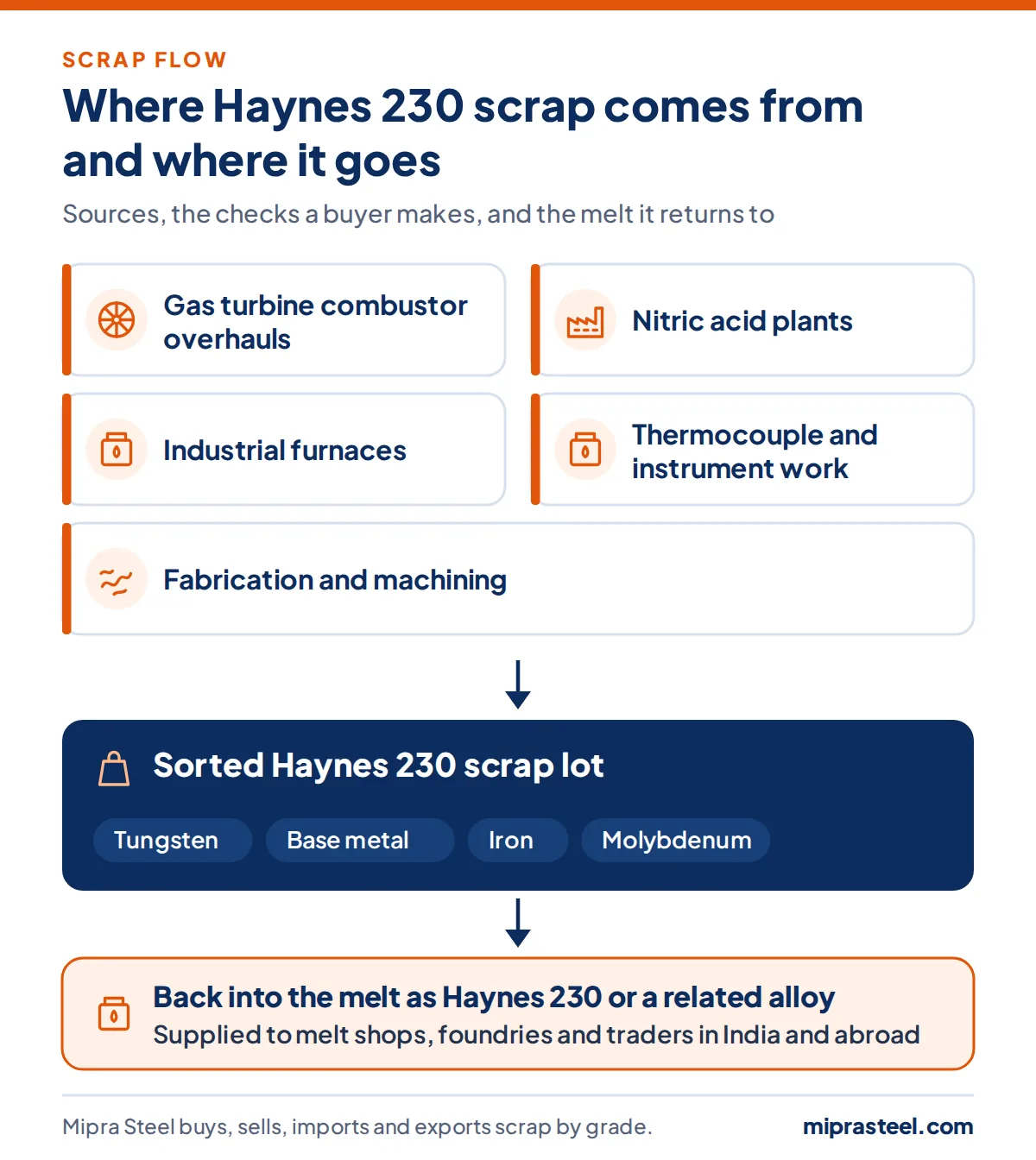
Most 230 reaches the scrap market from hot-section repair and from furnace and chemical plant rebuilds, with a smaller flow of new fabrication offcuts.
Gas Turbine Combustor Overhauls
Liners, transition pieces and flame holders replaced at hot-gas-path inspections on land and aero engines. Many carry a ceramic thermal barrier coating over a metallic bond coat. See power generation scrap.
Nitric Acid Plants
Catalyst grid supports from ammonia oxidation burners. These are usually clean, but platinum-group gauze must be removed and accounted for separately before the grid is sold as 230. See chemical processing scrap.
Industrial Furnaces
Radiant tubes, retorts, muffles, baskets, trays and chains from heat-treating and nitriding furnaces. Service pieces carry scale and sometimes distortion.
Thermocouple and Instrument Work
Protection tubes and sheaths, small in weight but easy to keep single-grade.
Fabrication and Machining
Sheet and plate trim, bar ends, welding wire spools and turnings from shops building the parts above.
Haynes 230 Scrap Specification Chart
| Grade | Haynes 230 |
|---|---|
| UNS | N06230 |
| W.Nr. / EN | 2.4733 |
| Also known as | Alloy 230 |
| Alloy type | Solid-solution nickel-chromium-tungsten-molybdenum |
| Density | 8.97 g/cm³ (0.324 lb/in³) |
| Magnetic | Non-magnetic. |
| HS code (customs heading) | 7503.00 (nickel waste and scrap) |
Haynes 230 Chemical Composition
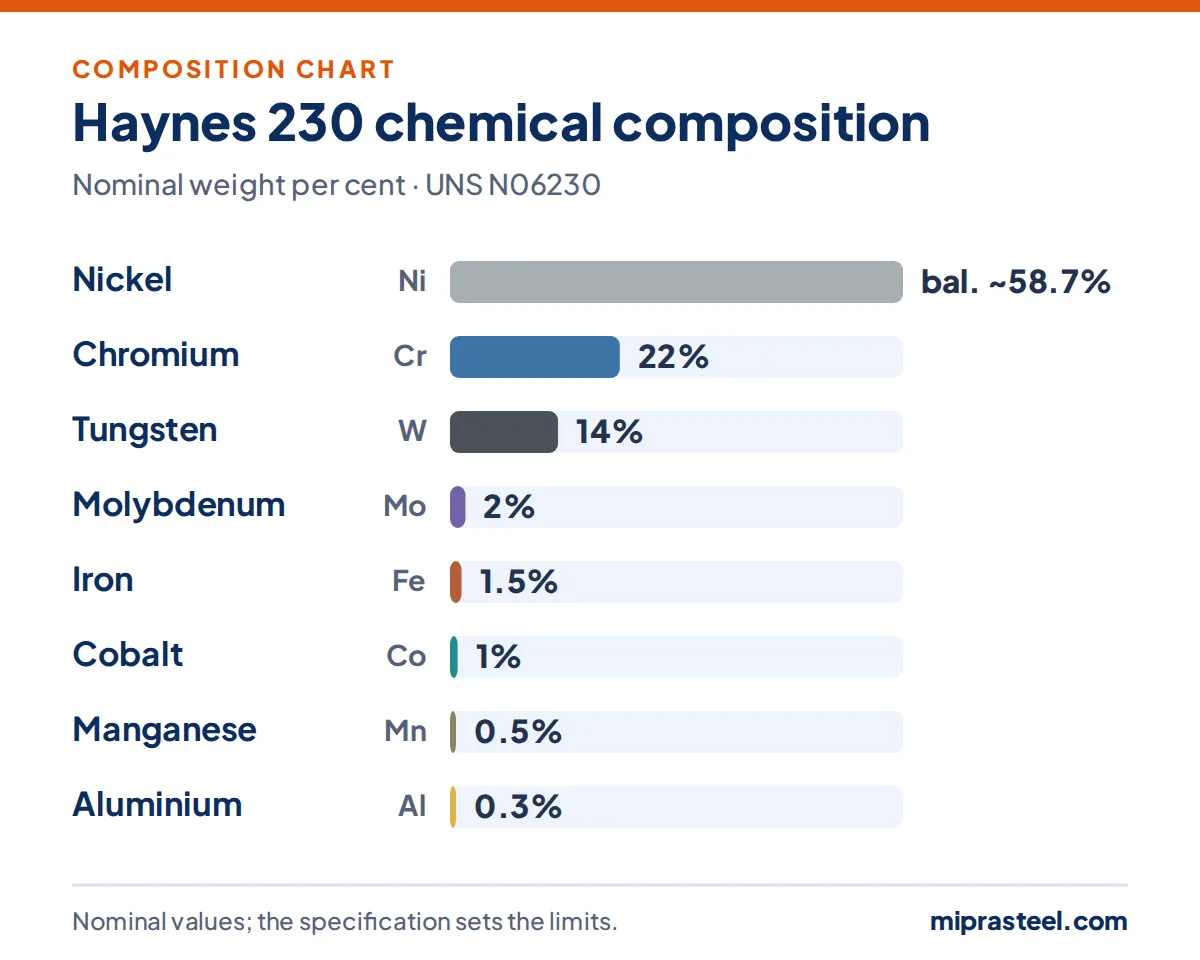
Nominal composition in weight per cent, used to describe and identify the grade. The governing specification sets the limits for each product.
| Element | Symbol | Nominal wt% | |
|---|---|---|---|
| Nickel | Ni | Balance (about 58.7) | |
| Chromium | Cr | 22 | |
| Tungsten | W | 14 | |
| Molybdenum | Mo | 2 | |
| Iron | Fe | 1.5 | |
| Cobalt | Co | 1 | |
| Manganese | Mn | 0.5 | |
| Aluminium (aluminum) | Al | 0.3 |
Haynes 230 Equivalent Grades and Other Names
| Designation | Value |
|---|---|
| Trade name | Haynes 230 |
| UNS | N06230 |
| W.Nr. / EN | 2.4733 |
| Other names in the trade | Alloy 230 |
Look up any designation in the grade name converter or the equivalent grade chart.
Haynes 230 Standards and Specifications
| Product form | Standard | ASME equivalent |
|---|---|---|
| Plate, sheet and strip | ASTM B435 | ASME SB-435 |
| Rod and bar | ASTM B572 | ASME SB-572 |
| Seamless pipe and tube | ASTM B622 | ASME SB-622 |
| Welded pipe | ASTM B619 | ASME SB-619 |
| Welded tube | ASTM B626 | ASME SB-626 |
| Forgings | ASTM B564 | ASME SB-564 |
| Butt-weld fittings | ASTM B366 | ASME SB-366 |
| Plate, sheet and strip | AMS 5878 | No ASME edition |
| Bar and forgings | AMS 5891 | No ASME edition |
| Welding wire | AMS 5839 | No ASME edition |
Haynes 230 Applications
- Gas turbine combustors and transition ducts
- Industrial furnace parts and radiant tubes
- Nitric acid catalyst grids
- Thermocouple protection tubes
Source industries: power generation, aerospace, heat treatment and furnaces.
How Haynes 230 Scrap Is Identified
Tungsten makes 230 one of the easier nickel alloys to confirm. The care goes into what else might be sitting in the same bin.
| Check | What it shows for Haynes 230 |
|---|---|
| Tungsten | About 14% is the signature. A nickel alloy reading under 1% tungsten is not 230, whatever the label says. |
| Base metal | Nickel near 57% to 59%. If cobalt reads as the base with 22% nickel and 14% tungsten, it is Haynes 188, a cobalt alloy. |
| Iron | Should be low, around 1.5% and not above about 3%. Iron near 18% means Hastelloy X. |
| Molybdenum | About 2%. A reading near 9% suggests Hastelloy X or Inconel 617. |
| Coatings | Grind a small window on coated combustor parts before testing. A ceramic topcoat or bond coat on the surface gives a misleading reading. |
| Paperwork | Mill certificates citing UNS N06230, ASTM B435 or AMS 5878 let sheet and plate be described without doubt. See reading mill test certificates. |
Grades Most Often Confused with Haynes 230
- Hastelloy X: sits in the same combustors but reads about 18.5% iron, 9% molybdenum and well under 1% tungsten.
- Inconel 617: also has 22% chromium, but carries 12.5% cobalt and 9% molybdenum with no significant tungsten.
- Haynes 188: matches 230 on chromium and tungsten (22% and 14%) but is cobalt-base with 22% nickel, so it is traded as cobalt alloy scrap.
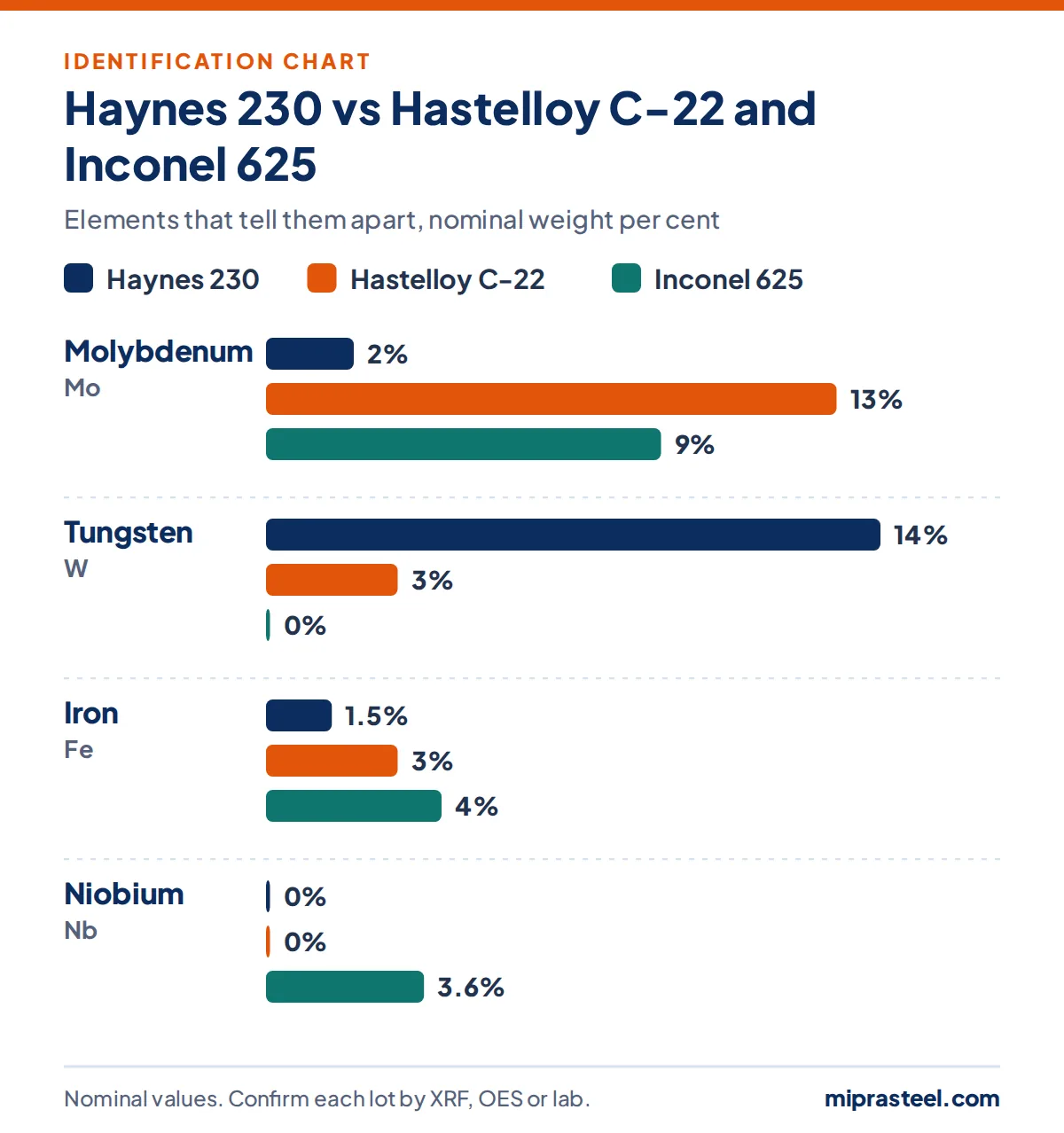
Nominal values for Haynes 230 against its closest grades on this site.
Preparing Haynes 230 Scrap for Sale
- Read every combustor piece for tungsten and iron, and split Haynes 230 from Hastelloy X before anything is bagged.
- Pull out cobalt-base Haynes 188 parts and lot them with cobalt alloy scrap.
- Strip or declare thermal barrier coatings, and remove bolts, brackets and seals of other alloys.
- Recover any platinum gauze from catalyst grids separately before the grid metal is sold.
- Bag sheet trim, bar ends and turnings separately, and keep turnings dry.
Haynes 230 Scrap Price per Kg: What Decides It
The tungsten is what separates a 230 offer from a plain nickel-chromium offer. Everything else is about how much of that tungsten the buyer can trust and recover.
- Tungsten at about 14%, alongside nickel near 57%, chromium at 22% and 2% molybdenum.
- Single-grade certainty: a lot free of Hastelloy X and Haynes 188 can go to a buyer who uses the tungsten; a mixed lot is priced on its worst likely analysis.
- Coating load: combustor parts with thermal barrier and bond coats carry ceramic and other elements that reduce yield unless removed.
- Form: plate, sheet trim and bar ends sit above service parts, which sit above oily turnings.
- Condition of service parts: heavy scale, cracked and distorted liners and attached hardware of other alloys all cut the recoverable metal.
- Lot size and documents: containers of certified 230 offcuts are simpler to place than mixed overhaul returns.
Nickel prices move every day and tungsten has its own market, so a 230 offer is always dated. Try the contained metal calculator to see how much tungsten a lot carries.
Haynes 230 Scrap Import and Export
Importing Haynes 230 Scrap into India
Combustor and transition-duct scrap is released wherever large gas turbine fleets are overhauled, which puts the Gulf, Europe and East Asia high on the list of origins for 230 coming into India. Ask the seller to separate 230 from Hastelloy X and Haynes 188 before loading, and to state whether parts are coated. Imported scrap normally needs a pre-shipment inspection certificate along with the commercial invoice, packing list and bill of lading, and entry is mostly through Nhava Sheva, Mundra or Chennai. See importing nickel alloy scrap into India.
Exporting Haynes 230 Scrap from India
Indian power stations, fertiliser plants and heat-treatment shops release 230 parts during shutdowns, and fabricators produce offcuts. For export, each lot is declared as Haynes 230 with its UNS number on the invoice and packing list, weighed, and shipped in bags, drums or loose in containers. Overseas melters often ask for readings on coated parts. Our Dubai office follows enquiries from the UAE and Saudi Arabia, and our Korea office covers East Asian buyers. See alloy scrap export documents.
Customs heading: 7503.00 (nickel waste and scrap). The HS code is the international tariff heading the scrap is declared under; national tariff lines add further digits, so confirm the full line with your customs broker.
Comparisons
Other Haynes Scrap Grades
Related Reading
Haynes 230 Scrap FAQ
How do I tell Haynes 230 from Hastelloy X scrap?
Check tungsten and iron. Haynes 230 reads about 14% tungsten and under 3% iron. Hastelloy X reads about 18.5% iron, 9% molybdenum and less than 1% tungsten. Any handheld XRF shows both elements, so the split can be made piece by piece on the shop floor.
Why is Haynes 230 scrap priced above ordinary nickel-chromium scrap?
Because it carries about 14% tungsten in addition to roughly 57% nickel and 22% chromium. Melters making tungsten-bearing alloys can use that tungsten directly. The premium only holds if the lot is clean 230; mixing in Hastelloy X or coated parts without declaring them pulls the offer back down.
Do coated Haynes 230 combustor liners lose value?
They are worth less per kg than clean sheet. Thermal barrier coatings are ceramic, and bond coats bring other elements, so a buyer has to allow for metal lost or contaminated in melting. Liners that have been decoated, or lots where the coating is declared with photographs, are easier to price.
Is Haynes 188 the same as Haynes 230?
No. Both contain about 22% chromium and 14% tungsten and are used in similar combustor parts, but 188 is a cobalt-base alloy with about 22% nickel. Haynes 230 is nickel-base. They are sorted and sold separately, 188 as cobalt alloy scrap and 230 as nickel alloy scrap.
What customs code applies when exporting Haynes 230 scrap?
As a nickel-base alloy, 230 scrap is typically declared under HS 7503.00, nickel waste and scrap. Importing countries add their own subheadings, so ask your customs broker to confirm the full national line before the shipping documents are prepared.
Will Mipra Steel take mixed combustor scrap that includes 230?
We can discuss it. Send photographs, a rough parts list, weight, location and any readings. A lot where 230, Hastelloy X and cobalt alloys are already separated is described and placed more easily than a mixed bin, so sorting before you send details usually helps.
Can Haynes 230 turnings be sold?
Yes. Turnings from machining 230 bar and plate are traded, though below solids because of oil, moisture and the chance of tool-tip contamination. Keep them single-grade, drained and dry. See common nickel alloy scrap mistakes.
What is Haynes 230 made of?
Nominally 58.7% nickel, 22% chromium, 14% tungsten, 2% molybdenum, 1.5% iron, 1% cobalt, 0.5% manganese, 0.3% aluminium. Specification ranges vary by product form and standard.
Published by Mipra Steel, Khetwadi, Mumbai · Updated