What Is Ferro Vanadium, and Why Do FeV80 and FeV50 Trade Apart?
A rebar mill that wants higher yield strength without more carbon reaches for vanadium. A few hundredths of a per cent, dissolved in the melt, comes out as very fine vanadium carbonitrides that pin grain boundaries and stiffen the steel. Tool and high-speed steels use far more, to form hard carbides that resist wear at the cutting edge. Almost none of it goes in as pure vanadium. It arrives as ferro vanadium, a lumpy grey alloy that dissolves readily in liquid steel.
Two production routes explain the two families of grade. Reducing vanadium pentoxide with aluminium gives the rich end of the range, roughly 70 to 85% vanadium, which is where FeV80 sits. Reducing it with ferrosilicon in an arc furnace gives leaner alloy, roughly 35 to 60% vanadium, the home of FeV40, FeV50 and FeV60. The routes leave different residues behind: aluminium-reduced alloy tends to carry more aluminium, silicon-reduced alloy more silicon. Commercial specifications such as ASTM A102 set the vanadium band and cap carbon, silicon, aluminium, phosphorus and sulfur for each grade.
So the label on a bag is only a starting point. What a buyer pays for is the vanadium actually in the lot, delivered within limits his melt can tolerate. An FeV80 lump and an FeV50 lump look the same, yet one carries far more of the paying element, and an aluminium-killed steel shop may refuse a lot whose aluminium is high even if the vanadium is fine. That is why the trade in ferro alloy off-grade works on analysis and sizing rather than on names.
Lots that reach the market are rarely scrap in the old-metal sense. They are fines and screenings from crushing, surplus left after a plant changes its product mix, material that missed a size or chemistry clause, and opened bags left at the end of a campaign. Our ferro vanadium scrap guide goes further into grade history and handling.
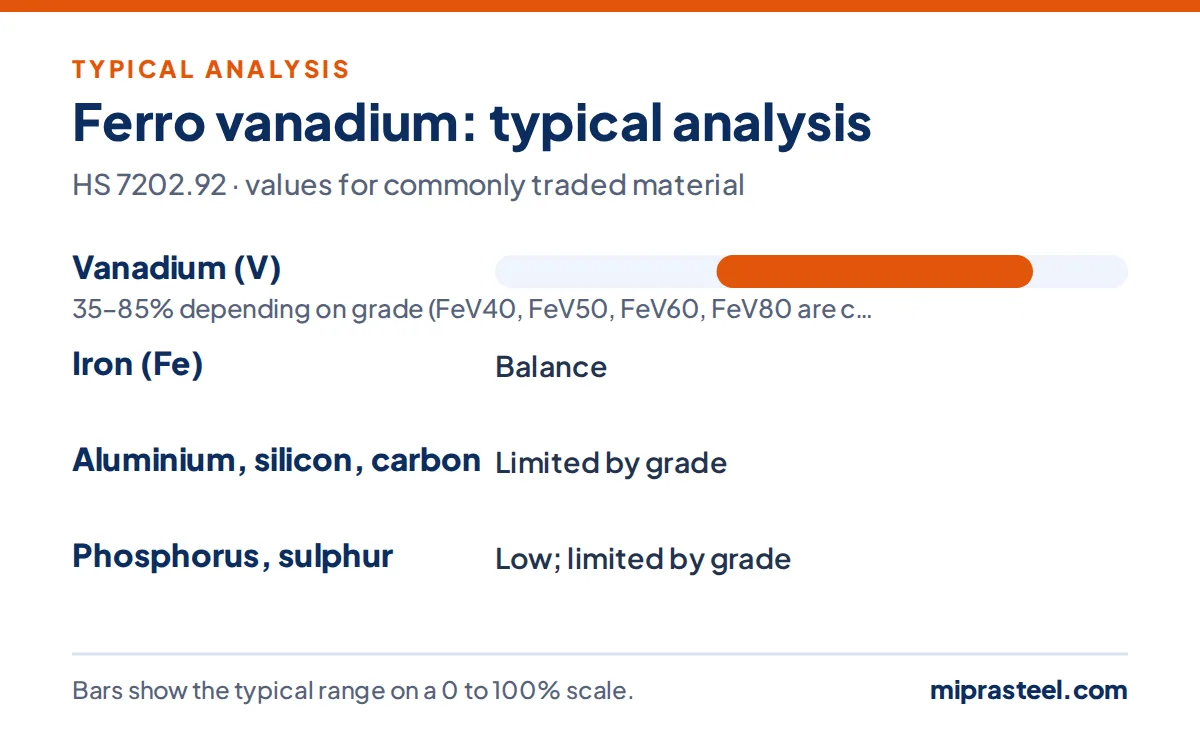
Typical Composition
| Element or property | Typical value |
|---|---|
| Vanadium (V) | 35–85% depending on grade (FeV40, FeV50, FeV60, FeV80 are common) |
| Iron (Fe) | Balance |
| Aluminium, silicon, carbon | Limited by grade |
| Phosphorus, sulfur | Low; limited by grade |
Typical values for commonly traded material. The certificate or analysis of each lot governs.
Forms Ferro Vanadium Scrap Comes In
- Lumps
- Crushed sizes
- Fines
- Off-grade lots
- Part-used bags and drums
Where Ferro Vanadium Is Used
- High-strength low-alloy steels
- Reinforcing bar
- Tool steels and high-speed steels
- Rail and forging steels
What Buyers Check in a Lot
Grade and Vanadium Content
Vanadium content varies widely between grades, so the measured figure is the first thing a buyer looks for.
Aluminium and Silicon
These are limited by grade and can affect which steelmakers can use the lot.
Carbon, Phosphorus and Sulfur
These are restricted in steel specifications and need laboratory analysis for accurate values.
Size and Fines
Lots are described by size range and the share of fines.
Mixed Grades
Bags of different grades stored together should be kept separate or described as mixed.
Sampling and Analysis
A representative sample analysed by XRF or a laboratory supports the lot description.
How to Recognise Ferro Vanadium
Ferro vanadium cannot be graded by eye. A buyer wants a representative sample and an analysis, and checks the paperwork against the material.
| Check | What it shows for Ferro vanadium |
|---|---|
| Vanadium by XRF or wet chemistry | The headline figure. A reading near 80% places the lot as FeV80; around 50% as FeV50. Borderline results go to a laboratory. |
| Aluminium | Higher in aluminothermic grades. Some steelmakers set a ceiling, so a high aluminium result narrows who can take the lot. |
| Silicon and carbon | Silicon follows the silicothermic route; carbon is capped by grade and needs combustion analysis, not XRF. |
| Phosphorus and sulfur | Restricted in rebar and plate specifications and reported by laboratory analysis. |
| Size distribution | A sieve test gives the lump range and the share of minus-10 mm fines, which decides whether the lot goes to ladle addition or to wire and briquette makers. |
| Sampling method | A grab sample from the top of one bag proves little. Buyers ask how many bags were sampled and how the sample was split. |
Grades Most Often Confused with Ferro Vanadium
- Ferro niobium: Similar grey crushed lumps, but around 60 to 70% niobium with no vanadium; XRF separates them in seconds.
- Ferro tungsten: Roughly 75 to 85% tungsten and noticeably heavier in the hand than FeV of the same size; it belongs to a different buyer group.
- LC ferro chrome: Another steelmaking addition kept in bags on the same floor; 60 to 70% chromium and no vanadium, so a mixed bag shows up at once on analysis.
Grades Look the Same
FeV50 and FeV80 have a similar grey appearance, so only analysis confirms the grade.
Not Ferro Niobium or Ferro Molybdenum
Several ferro alloys used in steelmaking look alike as crushed lumps; XRF separates them quickly.
Check the Bag Against the Lump
Bag markings can be wrong after repacking, so a test of the material itself is more reliable than the label.
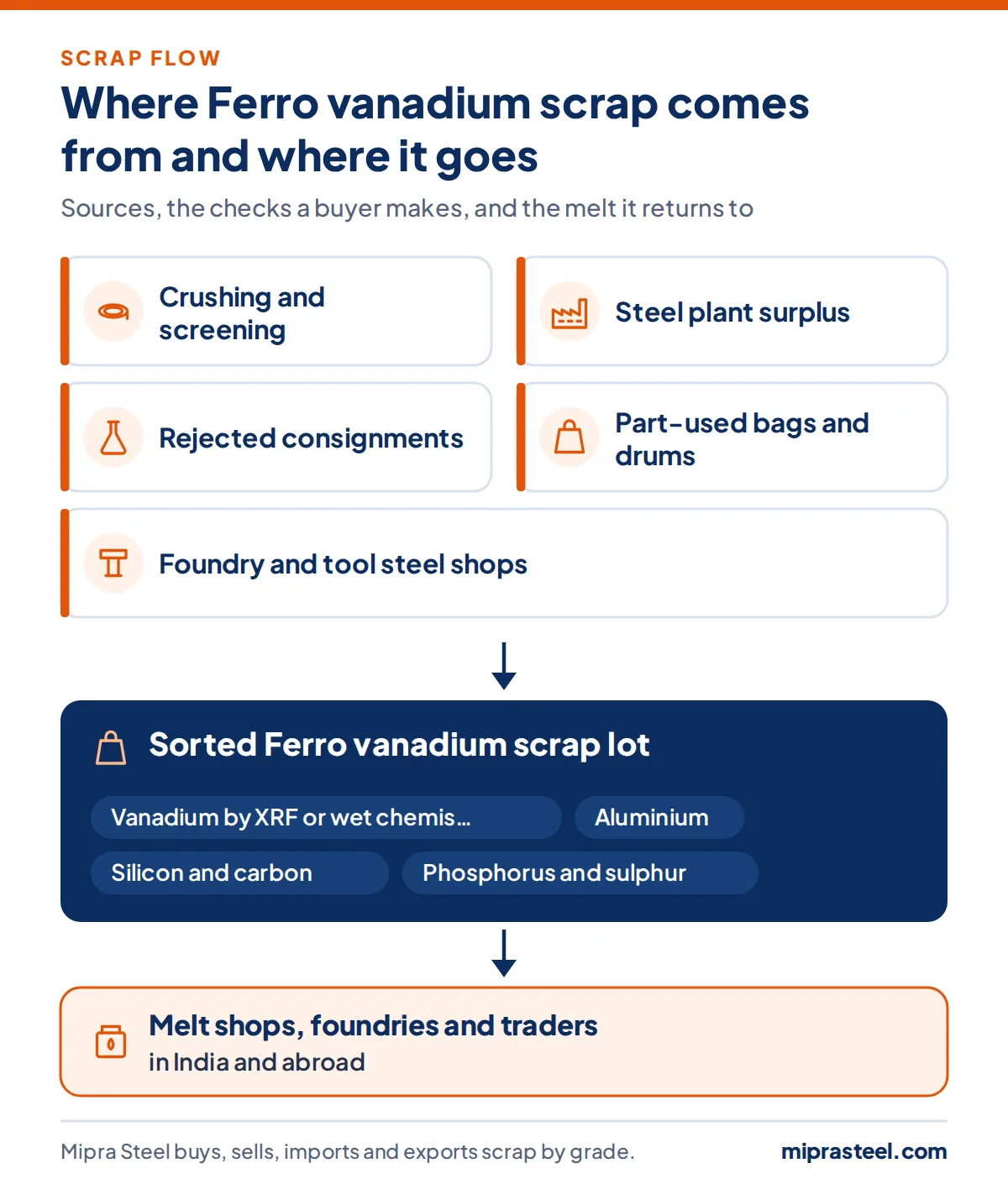
Where Ferro Vanadium Scrap Comes From
Most ferro vanadium that changes hands outside a producer contract has a short, traceable history. These are the usual starting points.
Crushing and Screening
Producers and processors crush ingots to a contract size, commonly something like 10 to 50 mm. Undersize from the screens collects as fines that a melt shop may not want to charge but a cored-wire or briquette maker can use.
Steel Plant Surplus
A rebar or plate mill that changes its alloy design, closes a line or over-orders can be left with sealed bags of FeV it no longer needs. These lots usually carry the original certificate.
Rejected Consignments
Material that missed a buyer clause on vanadium band, aluminium, size or packing comes back on the market with a known analysis and a known reason for rejection.
Part-Used Bags and Drums
Ladle additions rarely use a whole big bag. Opened bags left on the shop floor pick up dust, moisture and other alloys, so they need resampling.
Foundry and Tool Steel Shops
Smaller melters of tool and die steels buy FeV in drums and sometimes release the remainder when a grade is discontinued. See furnace and heat-treatment users for related sources.
Ferro Vanadium Scrap Buyer, Importer and Exporter in India
Mipra Steel trades ferro vanadium surplus, fines and off-grade lots from Khetwadi, Mumbai, between steel plants, foundries, cored-wire makers and traders in India and overseas.
Sell Ferro Vanadium Scrap
Holding surplus FeV80 or FeV50, screening fines or a returned consignment? Tell us the grade on the bags, the approximate tonnage, the size range and where the material sits. Send photographs of the bags, their labels and an opened sample, and attach the producer certificate or any analysis you hold. If bags have been opened or stored next to other ferro alloys, say so. We review incoming enquiries and respond with relevant next steps.
Buy Ferro Vanadium Scrap
Need ferro vanadium for ladle additions, cored wire or briquetting? Send the vanadium band you work to, your limits on aluminium, silicon, carbon, phosphorus and sulfur, the size range, the quantity and the delivery point. Off-grade and fines lots can suit users whose specification is wider than a rebar mill's, and each lot is offered with the analysis and certificate that came with it.
Preparing Ferro Vanadium Scrap for Sale
- Keep each grade in its own bags and never top up an FeV80 bag with leaner material.
- Separate screening fines from lumps and weigh them as a distinct line.
- Sample several bags across the lot, not one bag from the top of the stack.
- Reseal opened bags and keep them dry and off the floor.
- Photograph every bag label and match it to the certificate number.
- Remove broken pallets, wire, slag pieces and floor sweepings before weighing.
Ferro Vanadium Scrap Price per Kg: What Decides It
Anyone asking a ferro vanadium price per kg should expect the answer to start with contained vanadium, then adjust for everything that makes the lot harder to use.
- Vanadium content: offers are often built on the vanadium units in the lot, so an FeV80 lot and an FeV50 lot of equal weight are worth very different amounts.
- Distance from a standard grade: material that sits inside a recognised specification needs no explanation; off-band chemistry has to find a melt that can take it.
- Aluminium, silicon and carbon: each limits the users, and a high reading in any of them narrows the market.
- Phosphorus and sulfur: residuals above common rebar and plate limits push the lot toward less demanding users.
- Sizing and fines share: lumps in the contract range move easily; dusty fines cost more to handle and suit fewer buyers.
- Paperwork and packing: an original producer certificate and intact, labelled big bags reduce the sampling a buyer must do.
Vanadium is a volatile market that tracks steel output and pentoxide supply, so every offer is dated. The ferro alloy scrap value guide sets out the method, and the contained metal calculator helps estimate vanadium units in a lot.
Ferro Vanadium Scrap Import and Export
Importing Ferro Vanadium Scrap into India
Most of the world's ferro vanadium is made in China, Russia and South Africa, with further output in Europe, and off-grade lots reach India from producers and traders in those regions and from Gulf stockholders. Imported consignments travel with a commercial invoice, packing list, bill of lading and the producer's analysis; scrap-designated shipments also carry a pre-shipment inspection certificate. The invoice should give the grade and measured vanadium so customs and commercial descriptions match. Most containers clear at Nhava Sheva (JNPT) or Mundra, with Chennai serving southern mills. Read importing alloy scrap into India for the general document set.
Exporting Ferro Vanadium Scrap from India
Indian steel plants and foundries release surplus and off-grade FeV that tool steel melters and cored-wire makers abroad can use. Export lots are described on the invoice and packing list by grade, vanadium content and size, weighed, and shipped in big bags or steel drums inside containers from Nhava Sheva or Mundra. Our offices in the UAE and South Korea keep us in contact with buyers in the Gulf and East Asia, and we also work with Italy and Spain. See export documents for alloy scrap.
Customs heading: 7202.92. The HS code is the international tariff heading the scrap is declared under; national tariff lines add further digits, so confirm the full line with your customs broker.
Related Reading
Ferro Vanadium Scrap FAQ
Which customs heading does ferro vanadium fall under?
Ferro vanadium, including off-grade and remnant lots, is typically declared under HS 7202.92 among the ferro alloys. Each country adds digits for its national line, so have your customs broker confirm the full code before the invoice and bill of lading are drawn up.
What is the difference between FeV80 and FeV50?
The number is the nominal vanadium content. FeV80 is made by aluminium reduction and sits roughly in the 75 to 85% vanadium band; FeV50 is usually made by silicon reduction and sits near 50%. A steel shop needs less FeV80 for the same addition, and its residuals differ, so the two are priced and sold separately.
Is ferro vanadium fines worth less than lump?
Usually yes for ladle addition, because fines blow away in the furnace draught and oxidise. Cored-wire and briquette makers can use fines, though, so a clean, analysed lot of fines still has a market. Keep them separate from lumps.
Why do steel plants care about aluminium in FeV?
Aluminium enters the steel with the vanadium. In plants that control aluminium closely for castability or inclusion reasons, a high-aluminium lot complicates the heat. That is why aluminium is reported alongside vanadium on every analysis.
How much vanadium does rebar actually contain?
Very little. Microalloyed rebar and HSLA plate typically carry well under a quarter of a per cent vanadium, enough to form fine carbonitrides that raise strength. Tool and high-speed steels use several per cent, which is why their makers buy FeV in larger proportion to steel weight.
Can opened bags of ferro vanadium still be sold?
Yes, if they are kept dry and not mixed with other alloys. Buyers will want a fresh sample, because opened bags can collect dust, moisture or stray lumps from neighbouring bags. Photograph the bags and say how long they have been open.
How do I offer an FeV lot to Mipra Steel?
Share the grade, tonnage, size range, location, photographs and any certificate through our sell scrap page or contact form. Mipra Steel both buys and supplies ferro vanadium, so the same details help whether you are selling a surplus or looking for material, and a buyer can send a specification in the same way.
Published by Mipra Steel, Khetwadi, Mumbai · Updated