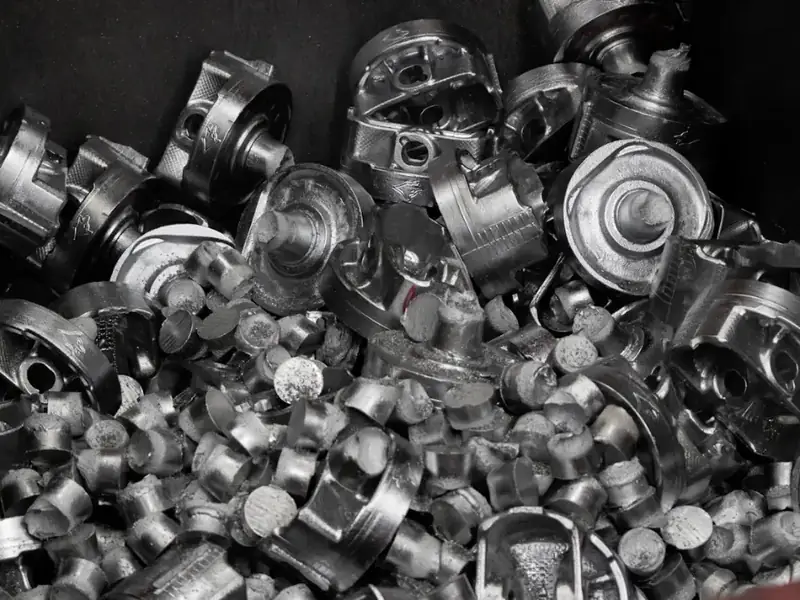
How Do MGA 1400, MGA 1400 DS and MGA 2400 Differ as Scrap?
The three MGA grades map onto two jobs inside a heavy-duty turbine. The blade alloy, MGA 1400, is a conventionally cast γ′ superalloy. Its make-up centres on 14% chromium and 10% cobalt, strengthened by roughly 4% aluminium, a little under 3% titanium, and refractory additions of tantalum (4.7%) and tungsten (4.3%). MGA 1400 DS is the same base alloy cast with columnar grains, with hafnium added to help the directionally solidified casting; the hafnium level has not been published. The vane alloy, MGA 2400, sits on a different base altogether: about 19% each of chromium and cobalt, 6% tungsten, 3.7% titanium and smaller amounts of tantalum and niobium.
So the first split in any MGA lot is blade against vane, exactly as it is for other land-turbine fleets. Blade material carries roughly half the cobalt and much more tantalum than vane material, and a melter charging one does not want the other. The second split, between 1400 and 1400 DS, is less about chemistry than description. The nominal metal is the same apart from hafnium, but buyers want to know which casting route they are receiving, and the hafnium in DS material is an element a conventionally cast 1400 heat may not be specified to carry.
MGA scrap also gets confused with alloys from other turbine makers. MGA 1400 and GTD-111 share 14% chromium. MGA 2400 is very close to IN-939 and sits near the GTD nozzle alloys. Parts from different makers' turbines therefore belong in separate lots even when a reading looks similar, and the origin of a set, its turbine model, stage and part numbers, carries real weight in its description.
MGA is a Mitsubishi Heavy Industries designation. These alloys are handled like other cast superalloy revert, and related fleets are covered under GTD alloy scrap.
MGA Scrap Grades We Buy and Sell
MGA Chemical Composition
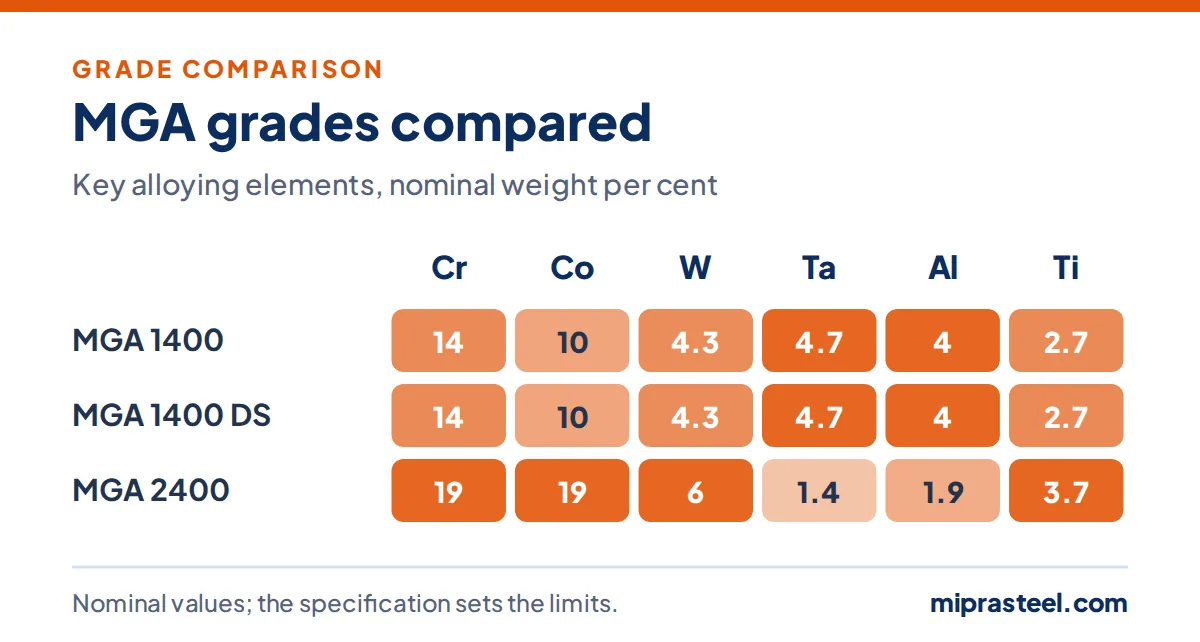
| Grade | Ni | Cr | Co | W | Ta | Al | Ti | Mo | Nb |
|---|---|---|---|---|---|---|---|---|---|
| MGA 1400 | 58.7 | 14 | 10 | 4.3 | 4.7 | 4 | 2.7 | 1.5 | – |
| MGA 1400 DS | 58.7 | 14 | 10 | 4.3 | 4.7 | 4 | 2.7 | 1.5 | – |
| MGA 2400 | 47.9 | 19 | 19 | 6 | 1.4 | 1.9 | 3.7 | – | 1 |
Nominal weight per cent. Specification ranges vary by product form and standard.
MGA Grades We Trade
| Grade | Description |
|---|---|
| MGA 1400 | Cast nickel-base superalloy; gas turbine blades |
| MGA 1400DS | Directionally solidified form of MGA 1400 |
| MGA 2400 | Cast nickel-base superalloy; gas turbine vanes |
Forms MGA Scrap Comes In
- Turbine blades
- Turbine vanes and segments
- Casting rejects
- Machining offcuts and grindings
- Mixed hot-section parts from overhauls
Where MGA Is Used
- Heavy-duty gas turbine blades
- Heavy-duty gas turbine vanes
- Hot-section parts in power generation turbines
- Turbine overhaul and repair, which releases replaced parts
What Buyers Check in a Lot
Part Origin
The turbine model, stage and part type are the main evidence of which MGA alloy a part is made from.
Documentation
OEM, repair shop or mill documents support the identification and stay with the lot.
Coatings
Service blades and vanes may carry protective or thermal barrier coatings, which are stated in the description.
Attachments and Mixing
Parts from other alloys, steel fixtures and ceramic material should be removed or declared.
Consistency by XRF
XRF readings confirm that pieces in a lot match each other, rather than naming a proprietary alloy on their own.
How to Tell MGA Grades Apart
With compositions known, MGA scrap can be checked against its nominal chemistry, but the overlaps with other turbine alloys mean origin records still decide a lot. Which instrument answers which question is covered in XRF, OES or a lab?.
| Check | What it shows for MGA |
|---|---|
| Chromium and cobalt | About 14% chromium with 10% cobalt is MGA 1400 or 1400 DS. About 19% of each is MGA 2400. |
| Tantalum | Close to 4.7% tantalum is characteristic of the 1400 alloys; MGA 2400 carries about 1.4%. |
| Tungsten and niobium | About 6% tungsten with 1% niobium supports MGA 2400. The 1400 alloys carry about 4.3% tungsten and no niobium. |
| Hafnium and grain structure | Hafnium on an OES or lab result, together with long columnar grains on an etched section, marks 1400 DS. Conventionally cast 1400 shows equiaxed grains. |
| Coatings | Ex-service parts carry protective coatings and sometimes thermal barrier layers. Read a ground root or platform, never the coated airfoil. |
| Origin records | Unit type, row, drawing or part numbers and refurbishment reports tie a set to MGA more firmly than any single reading. |
Grades Most Often Confused with MGA
- GTD-111: same 14% chromium as MGA 1400, but about 4.9% titanium and 2.8% tantalum against 2.7% and 4.7%.
- IN-939: very close to MGA 2400, separated by chromium (about 22.4% against 19%) and tungsten (about 2% against 6%).
- PWA 1483: another tantalum-bearing land-turbine blade alloy; it reads lower in chromium (around 12%) and higher in titanium (just over 4%) than MGA 1400.
Identified by Origin
MGA alloys are proprietary, so the part and its documents identify the alloy more reliably than a spectrum alone.
DS Grain Structure
Directionally solidified parts can show long, parallel grains running along the blade when the surface is etched or the coating is removed.
Not the Same as Other Turbine Alloys
Blades and vanes from other turbine makers use different alloys, so parts from different sources are kept apart.
Where MGA Scrap Comes From
MGA alloys turn up wherever heavy-duty Mitsubishi-design turbines run, and the scrap follows each plant's inspection and overhaul calendar.
Combustion and Hot-Gas-Path Inspections
Blade and vane rows removed for repair or replacement; whatever cannot be restored within limits is scrapped. More on this stream under power plant scrap.
Major Overhauls and Upgrades
Whole stages are changed when a unit is overhauled or uprated, which can release conventionally cast and DS blades from the same machine.
Repair-Shop Rejects
Blades and vane segments stripped of coating and found cracked, burnt or undersize, often with repair records attached.
Casting Revert
Gates, risers and rejected castings from blade and vane production: uncoated material with heat traceability.
Surplus Spares
Unused blades and vanes written off when a plant retires a unit or changes its parts strategy.
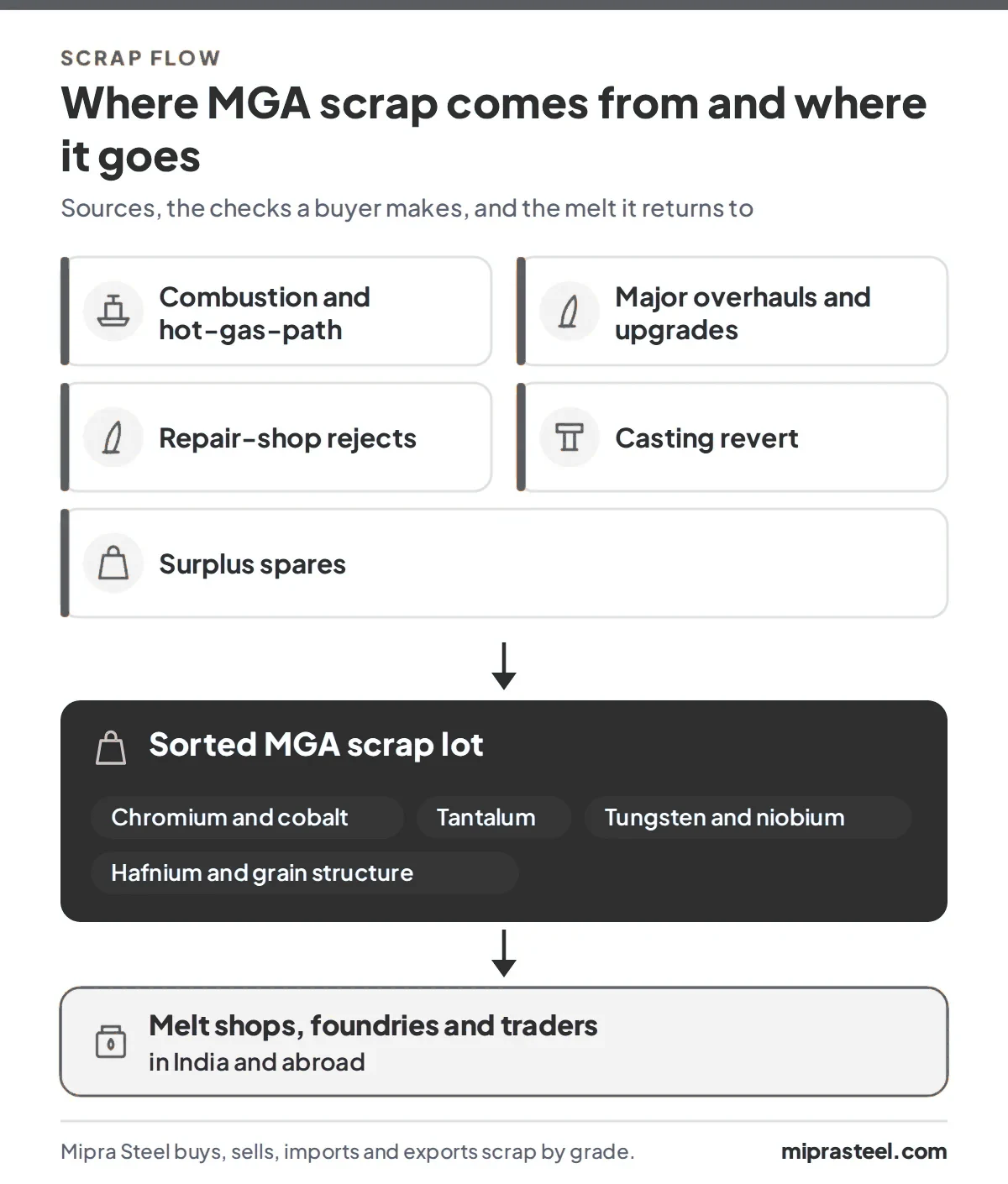
Source industries: power generation.
MGA Superalloy Scrap Buyer, Importer and Exporter in India
Mipra Steel deals in MGA blade, vane and revert lots from Mumbai, with Dubai and South Korea offices close to Mitsubishi-design fleets in the Gulf and East Asia.
Sell MGA Scrap
To offer MGA scrap, keep blades and vanes apart and tell us for each set: the turbine model and stage, the alloy if your records show it, piece count and weight, and whether parts are coated, stripped or repaired. For 1400 blades, say whether they are conventionally cast or DS. Photos of roots, platforms and part numbers, plus any readings or repair reports, help. We review incoming enquiries and respond with relevant next steps.
Buy MGA Scrap
Melt shops wanting MGA material can name the alloy, the part type (blades, vane segments or revert), coating limits, quantity and delivery port. Buyers of MGA 1400 should say whether DS material is acceptable, as its hafnium may not suit every heat. Lots are described by alloy, casting route and origin, with the supporting records listed.
Preparing MGA Scrap for Sale
- Crate blades and vane segments separately as they come out of the turbine.
- Keep conventionally cast and DS MGA 1400 blades apart and label each.
- Do not pack MGA parts with GTD, IN-939 or other makers' hardware.
- Record turbine model, stage, part numbers and piece count on each crate.
- Remove seal pins, shims and loose fittings, and note any braze or repair welds.
MGA Scrap Price per Kg: What Decides It
There is no single MGA scrap price per kg. Blade and vane alloys are priced on different contents, and the quality of the description matters as much as the metal.
- Blade or vane: the 1400 alloys bring tantalum near 4.7% on a 10% cobalt base, while MGA 2400 brings 19% cobalt and 6% tungsten with less tantalum.
- Separation of blade sets from vane sets removed in the same outage.
- A clear statement of conventionally cast or DS for 1400 material, with any hafnium result.
- Proof of origin: turbine model, stage and part numbers, which let a buyer place the lot without doubt.
- Coatings, braze, repair welds and fitted parts such as seal pins, which a buyer allows for in yield.
- Foundry revert against engine-run parts, and set size.
- Nickel, cobalt, tantalum and tungsten markets on the day.
The general approach to alloy scrap offers is set out on valuing nickel alloy scrap.
MGA Scrap Import and Export
Importing MGA Scrap into India
MGA scrap reaches India mainly from the Gulf, Japan, South Korea and South-East Asia, where heavy-duty Mitsubishi-design turbines are common in utility and industrial power plants. Imported lots come with a pre-shipment inspection certificate, commercial invoice, packing list and bill of lading, and usually enter at Nhava Sheva or Mundra, with Chennai for southern buyers. Show blades and vanes on separate lines, name the stage, and state DS where it applies. See importing nickel alloy scrap into India.
Exporting MGA Scrap from India
Where Indian plants run Mitsubishi-design machines, their outages release MGA blades and vanes that specialist melters overseas can place. Outgoing sets go in crates or drums once weighed, with the alloy, whether blade or vane, and the row written on both the invoice and the packing list. Buyers in Japan, South Korea, Saudi Arabia and the UAE commonly ask for part records with the documents. Our Dubai and South Korea offices work directly with buyers and sellers in those regions.
Customs heading: 7503.00 (nickel waste and scrap). The HS code is the international tariff heading the scrap is declared under; national tariff lines add further digits, so confirm the full line with your customs broker.
Related Reading
MGA Superalloy Scrap FAQ
What are MGA alloys?
They are cast nickel-base superalloys developed by Mitsubishi Heavy Industries for its heavy-duty gas turbines. MGA 1400 is the blade alloy, MGA 1400 DS its directionally solidified version, and MGA 2400 the vane alloy. All three reach the scrap market from power plant outages and casting revert.
Why are MGA blades and vanes sold as separate lots?
Because they are different alloys. Blade material in the 1400 family has about 14% chromium, 10% cobalt and 4.7% tantalum; MGA 2400 vane material has about 19% chromium, 19% cobalt and 6% tungsten. A melt planned for one cannot take the other.
Can MGA scrap be identified without paperwork?
A good reading will tell blade alloy from vane alloy and point to MGA, but it can be confused with GTD-111, IN-939 or other turbine alloys that sit close by. Turbine model, stage and part numbers make the description firm, so send whatever records exist.
Is MGA 2400 the same as IN-939?
No, although they are close. Both carry about 19% cobalt, 3.7% titanium and 1.9% aluminium, but IN-939 runs some three points higher in chromium and has roughly a third of the tungsten in MGA 2400. Two lots, not one.
Which countries generate the most MGA scrap?
MGA material comes from wherever heavy-duty Mitsubishi-design turbines operate, which includes Japan, South Korea, the Gulf states and parts of South-East Asia. India also has such machines. We work with sellers in these regions through our Mumbai, Dubai and South Korea offices.
What HS code is used for MGA superalloy scrap?
MGA alloys are nickel-base, so their scrap is typically entered under HS 7503.00, nickel waste and scrap, for blades, vanes and revert alike. National tariffs add further digits; your broker can confirm the exact line for the destination.
How can I get Mipra Steel to look at an MGA lot?
Share the unit type, row, alloy name if your records give it, count, weight, coating state and photos through the sell scrap page or contact. We buy and sell MGA scrap in India and abroad and arrange import and export.
Published by Mipra Steel, Khetwadi, Mumbai · Updated