Nimonic C-263 Scrap Buyer, Importer and Exporter in India
Mipra Steel buys C-263 sheet trim, ex-service combustor parts and machining scrap, and supplies sorted, described C-263 lots to melters and traders.
Sell Nimonic C-263 Scrap
Got C-263 trim or used liners? Send a rough weight for each form, the location and photos of both faces of a few pieces. Mention coatings, weld repairs and whether the material came from fabrication or overhaul. Readings that show cobalt, molybdenum and titanium, or AMS and HR certificates, shorten the back-and-forth. We review incoming enquiries and respond with relevant next steps.
Buy Nimonic C-263 Scrap
Producers of C-263 or other cobalt-bearing nickel alloys, and the traders who feed them, can source C-263 scrap through us. Give us the tonnage, say whether coated overhaul parts are acceptable or only clean fabrication trim, any limits on iron and aluminium, and your port. Each lot is named Nimonic C-263, UNS N07263, and we can discuss what readings and documents accompany them.
What Is Nimonic 263 Scrap, and Why Does the Cobalt Matter?
C-263 was designed for fabricators. Combustion chambers, transition ducts and casings are built from formed sheet that has to be welded, often in awkward shapes, and then has to hold its strength in the hot section of a gas turbine. Many strong age-hardened alloys crack when welded; C-263 was formulated with modest aluminium and titanium so that it welds and forms readily and is then hardened afterwards. Its strength comes from molybdenum in solution plus that precipitation step.
For a scrap buyer the headline is the cobalt. One fifth of every kilogram of C-263 is cobalt, and roughly 6% is molybdenum. That puts it in a different value bracket from plain nickel-chromium alloys such as Nimonic 80A or Inconel 600, and it is the reason a melter wants it sorted and proven rather than buried in a mixed superalloy heap. A lot of clean C-263 sheet is a ready-made input for anyone producing the alloy, or other cobalt-bearing nickel grades.
Most C-263 scrap is thin. Sheet trim from laser and waterjet cutting, rejected formed parts and ex-service liners make up the bulk, with some bar and ring material from casings. Ex-service combustor parts often carry ceramic thermal barrier coatings and scale on the hot face, and liners are frequently repaired with weld filler that may be a different alloy. Each of these has to be considered when the lot is described.
The Nimonic name is owned by Special Metals. On this page it simply identifies which alloy the scrap is.
Nimonic C-263 belongs to the Nimonic family, part of nickel alloy scrap.
Where C-263 Scrap Is Released
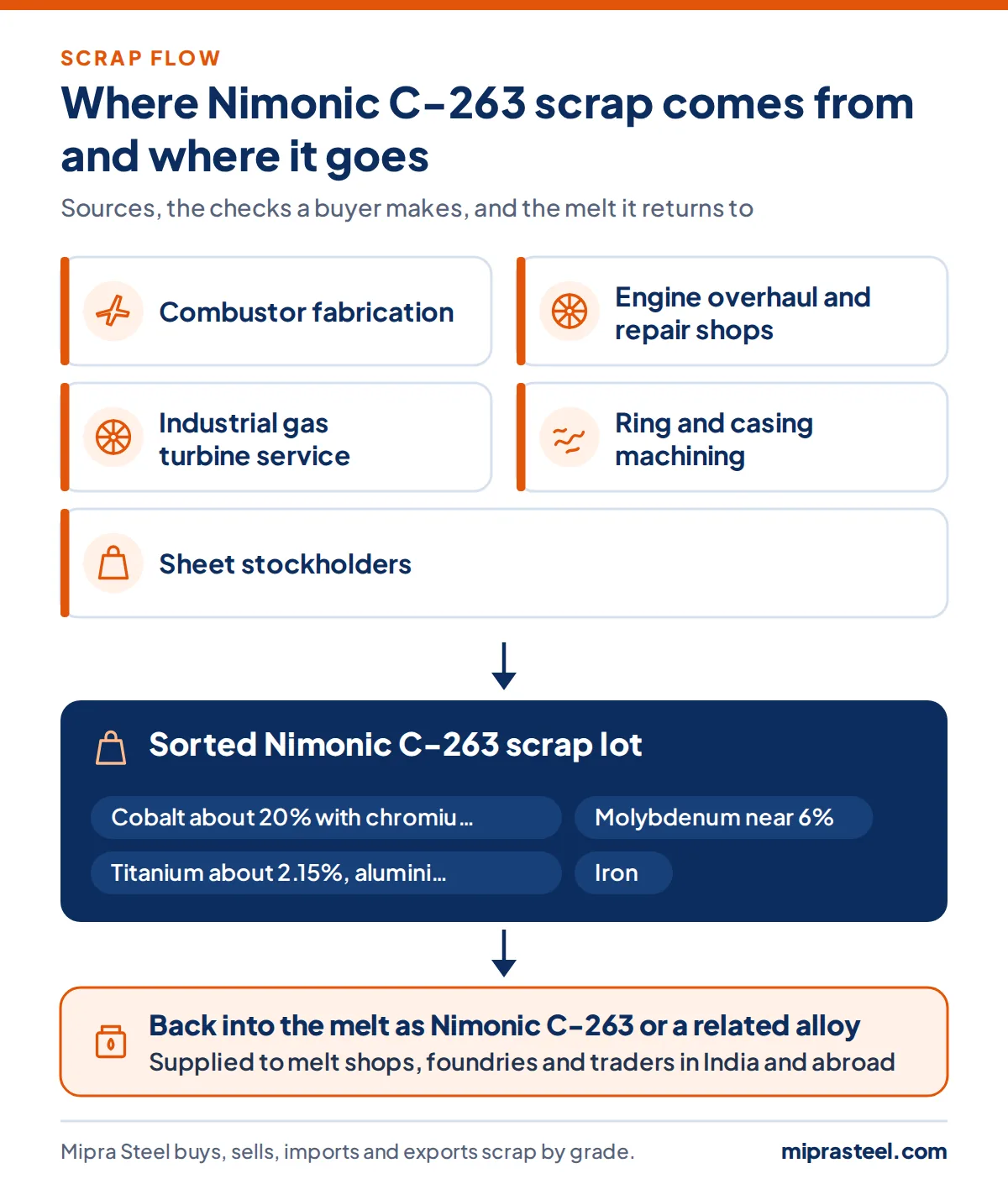
C-263 sits in the combustion end of the engine, so its scrap comes from the people who build and repair that section.
Combustor Fabrication
Sheet trim, nest skeletons, punchings and rejected formed sections from making liners, transition pieces and heat shields. Usually clean and traceable. See aerospace scrap.
Engine Overhaul and Repair Shops
Ex-service combustion liners and transition ducts too damaged to repair, often coated and oxidised on the hot face.
Industrial Gas Turbine Service
Transition pieces, casings and exhaust parts from power plant outages. See power generation scrap.
Ring and Casing Machining
Rolled rings and bar to AMS 5886 or BS HR 10 leave turnings and crop ends.
Sheet Stockholders
Offcuts and short lengths cut to AMS 5872 or BS HR 206, with mill paperwork.
Nimonic C-263 Scrap Specification Chart
| Grade | Nimonic C-263 |
|---|---|
| UNS | N07263 |
| W.Nr. / EN | 2.4650 |
| Also known as | Nimonic C263, Alloy 263 |
| Alloy type | Precipitation-hardened nickel-cobalt-chromium-molybdenum |
| Density | 8.36 g/cm³ (0.302 lb/in³) |
| Magnetic | Non-magnetic. |
| HS code (customs heading) | 7503.00 (nickel waste and scrap) |
Nimonic C-263 Chemical Composition
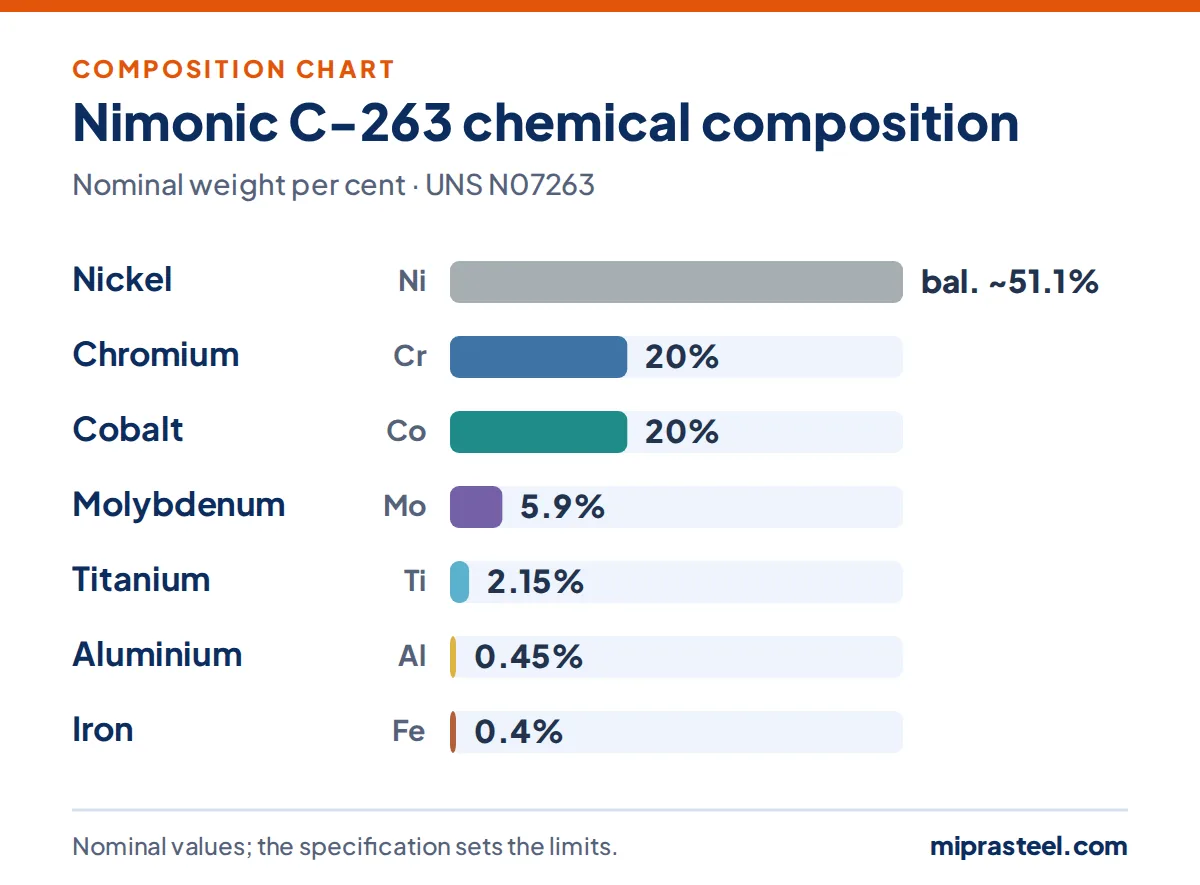
Nominal composition in weight per cent, used to describe and identify the grade. The governing specification sets the limits for each product.
| Element | Symbol | Nominal wt% | |
|---|---|---|---|
| Nickel | Ni | Balance (about 51.1) | |
| Chromium | Cr | 20 | |
| Cobalt | Co | 20 | |
| Molybdenum | Mo | 5.9 | |
| Titanium | Ti | 2.2 | |
| Aluminium (aluminum) | Al | 0.45 | |
| Iron | Fe | 0.4 |
Nimonic C-263 Equivalent Grades and Other Names
| Designation | Value |
|---|---|
| Trade name | Nimonic C-263 |
| UNS | N07263 |
| W.Nr. / EN | 2.4650 |
| Other names in the trade | Nimonic C263, Alloy 263 |
Look up any designation in the grade name converter or the equivalent grade chart.
Nimonic C-263 Standards and Specifications
Nimonic C-263 Applications
- Combustion chambers and transition liners
- Turbine casings
- Exhaust components
Source industries: aerospace, power generation.
How Nimonic C-263 Scrap Is Identified
Cobalt is what most buyers look at first on a C-263 reading, but cobalt alone does not close the question. Run through these points.
| Check | What it shows for Nimonic C-263 |
|---|---|
| Cobalt about 20% with chromium about 20% | The pairing that marks C-263 among sheet alloys. A cobalt reading near 10% points elsewhere. |
| Molybdenum near 6% | Separates C-263 from cobalt-bearing alloys with less molybdenum, and from Inconel 617, which reads about 9%. |
| Titanium about 2.15%, aluminium about 0.45% | Titanium shows on most guns. Low aluminium (confirmed by OES or light-element XRF) separates C-263 from higher-aluminium grades. |
| Iron | Should be well under 1%. A reading of 18% iron with 9% molybdenum is Hastelloy X, a common neighbour in combustor work. |
| Coatings and repairs | Grind through any ceramic topcoat and test away from weld repairs. Read identifying nickel alloy scrap for technique. |
| Documents | AMS 5872, AMS 5886 or BS HR 10, HR 206 and HR 404 certificates and part numbers. |
Grades Most Often Confused with Nimonic C-263
- Haynes 282: is also a weldable combustor alloy but reads about 10% cobalt and 8.5% molybdenum.
- Inconel 617: has 22% chromium, 12.5% cobalt, 9% molybdenum and about 1.2% aluminium.
- Hastelloy X: shares the combustor but carries about 18.5% iron and only around 1.5% cobalt.
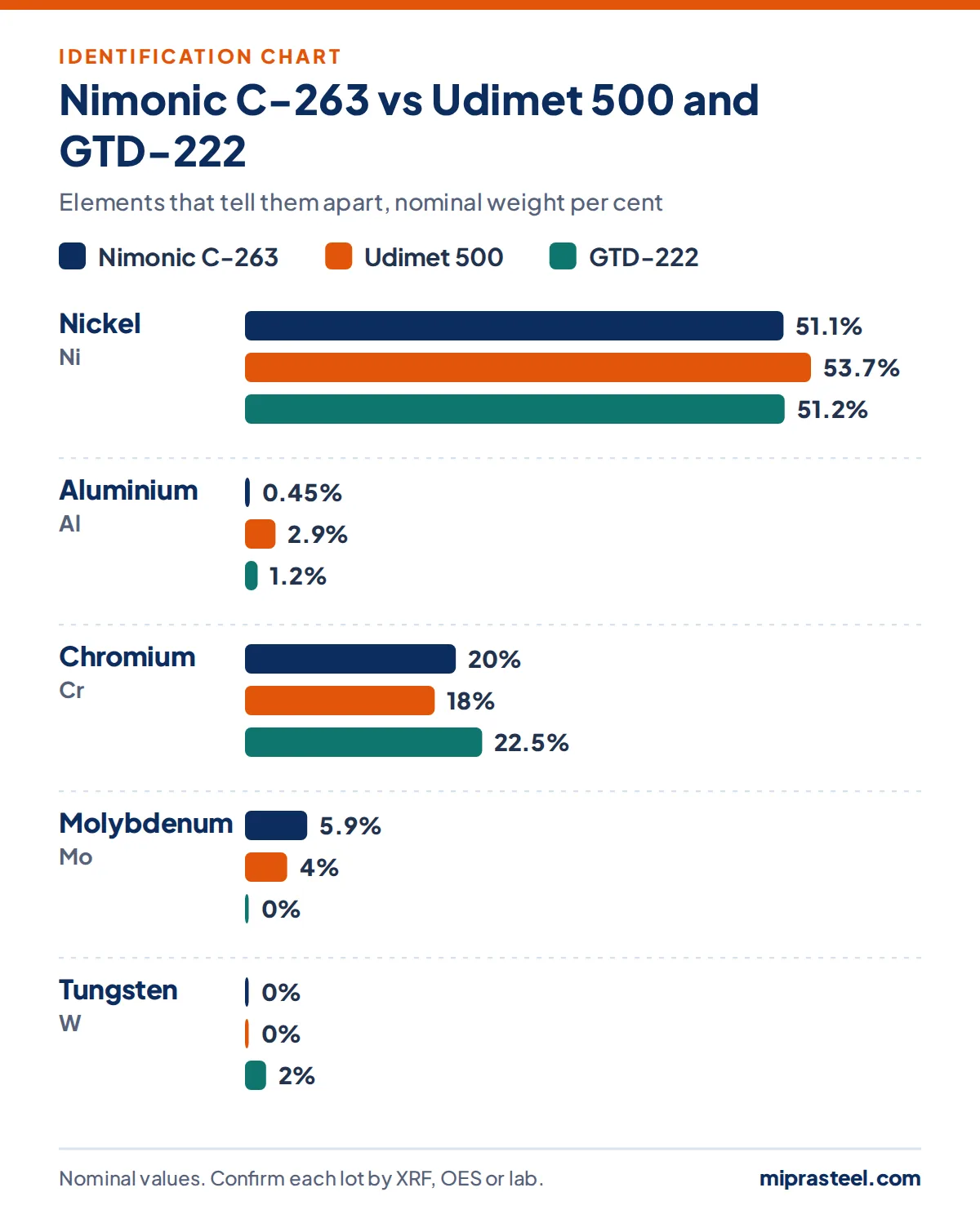
Nominal values for Nimonic C-263 against its closest grades on this site.
Preparing Nimonic C-263 Scrap for Sale
- Bag fabrication trim apart from ex-service liners.
- Keep Hastelloy X, 617 and 282 offcuts out, even if they share a cutting table.
- Mark coated or weld-repaired parts as a separate line.
- Bale or box thin punchings so they are not lost or mixed in transit.
- Keep AMS or HR certificates and part numbers with each bag.
Nimonic C-263 Scrap Price per Kg: What Decides It
Of the Nimonic family, C-263 usually has the richest scrap value on paper, because of the cobalt and molybdenum. Whether a lot earns that depends on these points.
- Cobalt at about 20%, which carries real weight in the offer alongside nickel.
- Molybdenum at about 6%, a further credit for melters who use it.
- Proof that the lot is C-263 throughout, and not blended with Haynes 282, 617 or Hastelloy X sheet from the same shop.
- Coatings, oxide and scale on ex-service liners, which reduce yield and need to be declared.
- Thickness: thin trim and punchings lose more metal to oxidation in melting than rings and heavy sections.
- Traceability from fabrication scrap, which supports a firmer description than mixed overhaul material.
Nickel, cobalt and molybdenum each move on their own markets, so a C-263 quote expires with the trading day it was issued on. The general logic is in nickel alloy scrap value.
Nimonic C-263 Scrap Import and Export
Importing Nimonic C-263 Scrap into India
C-263 is generated wherever combustors are built or rebuilt abroad, notably European, Gulf and East Asian repair and fabrication shops. Bringing it into India requires an inspection certificate issued before shipment, along with the invoice, packing list and B/L, with most cargo entering at Nhava Sheva or Mundra. Because cobalt-bearing nickel scrap is sometimes queried, describe it as "Nimonic C-263, UNS N07263, nickel alloy scrap" and attach readings that show nickel as the main element. See the India import guide.
Exporting Nimonic C-263 Scrap from India
Aerospace and power-turbine fabrication in India produces C-263 trim that overseas melters reproduce into the alloy. Lots leaving India are weighed, packed in bags or boxes for container loading, and named as Nimonic C-263, N07263 throughout the paperwork. Destinations include Europe, Japan and South Korea, and our offices in the UAE and Korea are close to Gulf turbine service work and East Asian buyers. See export documentation.
Customs heading: 7503.00 (nickel waste and scrap). The HS code is the international tariff heading the scrap is declared under; national tariff lines add further digits, so confirm the full line with your customs broker.
Other Nimonic Scrap Grades
Related Reading
Nimonic C-263 Scrap FAQ
Is Nimonic 263 the same as Nimonic C-263?
Yes. Nimonic 263, Nimonic C-263, C263 and Alloy 263 are trade names for one alloy, UNS N07263, W.Nr 2.4650. Whatever name is used on a scrap offer, a reading of about 20% cobalt, 20% chromium and 6% molybdenum is what confirms it.
Why is C-263 scrap worth sorting separately from other Nimonic grades?
Because it carries about 20% cobalt and 6% molybdenum, which Nimonic 75 and 80A do not. Mixed into a nickel-chromium lot, that value is lost and the lot may also become unsuitable for buyers who need low cobalt. Sorted, it suits melters who want both elements.
Can coated combustion liners be sold as C-263 scrap?
Yes, if the coating is declared. Ceramic thermal barrier coatings and hot-face oxide reduce the metal yield, so coated liners are described and valued apart from clean sheet trim. Test the base metal by grinding through the coating.
How do I tell C-263 from Haynes 282 sheet?
Look at cobalt and molybdenum. C-263 reads about 20% cobalt and 5.9% molybdenum; Haynes 282 reads about 10% cobalt and 8.5% molybdenum. Both contain about 2% titanium, so titanium does not separate them.
Does Mipra Steel buy Nimonic 263 trim from fabricators?
Yes. Mipra Steel buys and sells C-263 sheet trim, punchings, rings and ex-service parts. Clean fabrication trim with certificates is the easiest to describe. Send weights, location and photographs, and say whether you can supply material regularly.
Is C-263 scrap classed under the cobalt or nickel tariff heading?
Under nickel, typically. Nickel is the largest element at about 51%, so C-263 scrap usually goes under 7503.00, the nickel waste heading, not the cobalt line 8105.30. Get the full code checked by a broker.
What is Nimonic C-263 made of?
Nominally 51.1% nickel, 20% chromium, 20% cobalt, 5.9% molybdenum, 2.2% titanium, 0.45% aluminium, 0.4% iron. Specification ranges vary by product form and standard.
Published by Mipra Steel, Khetwadi, Mumbai · Updated