Titanium Grade 5 Scrap Buyer, Importer and Exporter in India
Mipra Steel trades Ti-6Al-4V scrap as its own line, separate from nickel alloys, buying from machine shops, forgers and traders and supplying described Grade 5 lots to melt shops and traders.
Sell Titanium Grade 5 Scrap
To sell Ti64 scrap, tell us whether it is turnings, solids or both, the approximate weight and where it is. Photographs of the chips or pieces, any vanadium and aluminium readings, and material certificates help a lot. For turnings, say how they were collected and whether broken tooling was kept out. We review incoming enquiries and respond with relevant next steps.
Buy Titanium Grade 5 Scrap
Melt shops and ferro-titanium producers sourcing Grade 5 can send the tonnage, the form they accept (solids only, or turnings too), their carbide and oxygen acceptance terms, and the discharge port. Lots are described as Ti-6Al-4V, UNS R56400, with the readings and certificates the seller can supply.
What Counts as Titanium Grade 5 Scrap?
Ti-6Al-4V is the workhorse of aircraft titanium. Fan and compressor discs, landing-gear and wing fittings, fasteners and drilling components are machined from it, and on many aerospace parts a large share of the bar or forging leaves the machine as chips. That is why Grade 5 makes up the bulk of the titanium turnings on the market, and why solid Grade 5 shows up as bar crops, forging flash, plate skeletons and rejected parts.
Aluminium stabilises the alpha phase and vanadium the beta phase, which is where the "alpha-beta" label comes from. For a remelter, those 6% and 4% additions are what a Grade 5 lot is worth: clean Ti64 scrap can go back into Ti64 ingot with the alloying already in place. Put commercially pure Grade 2 into the same bag and the lot no longer fits either recipe.
The biggest risk in Grade 5 scrap is not chemistry at all. Tungsten-carbide tool tips break off during machining and hide in the chips. They do not melt in a titanium furnace, and they end up as high-density inclusions in the next ingot. Aerospace-bound melts reject lots for this, so how turnings were collected matters as much as what alloy they are.
Medical implants usually use the extra-low-interstitial version, Grade 23, which has the same aluminium and vanadium but tighter oxygen and iron. For the family as a whole, see titanium scrap.
Titanium Grade 5 belongs to the Titanium family, part of exotic alloy scrap.
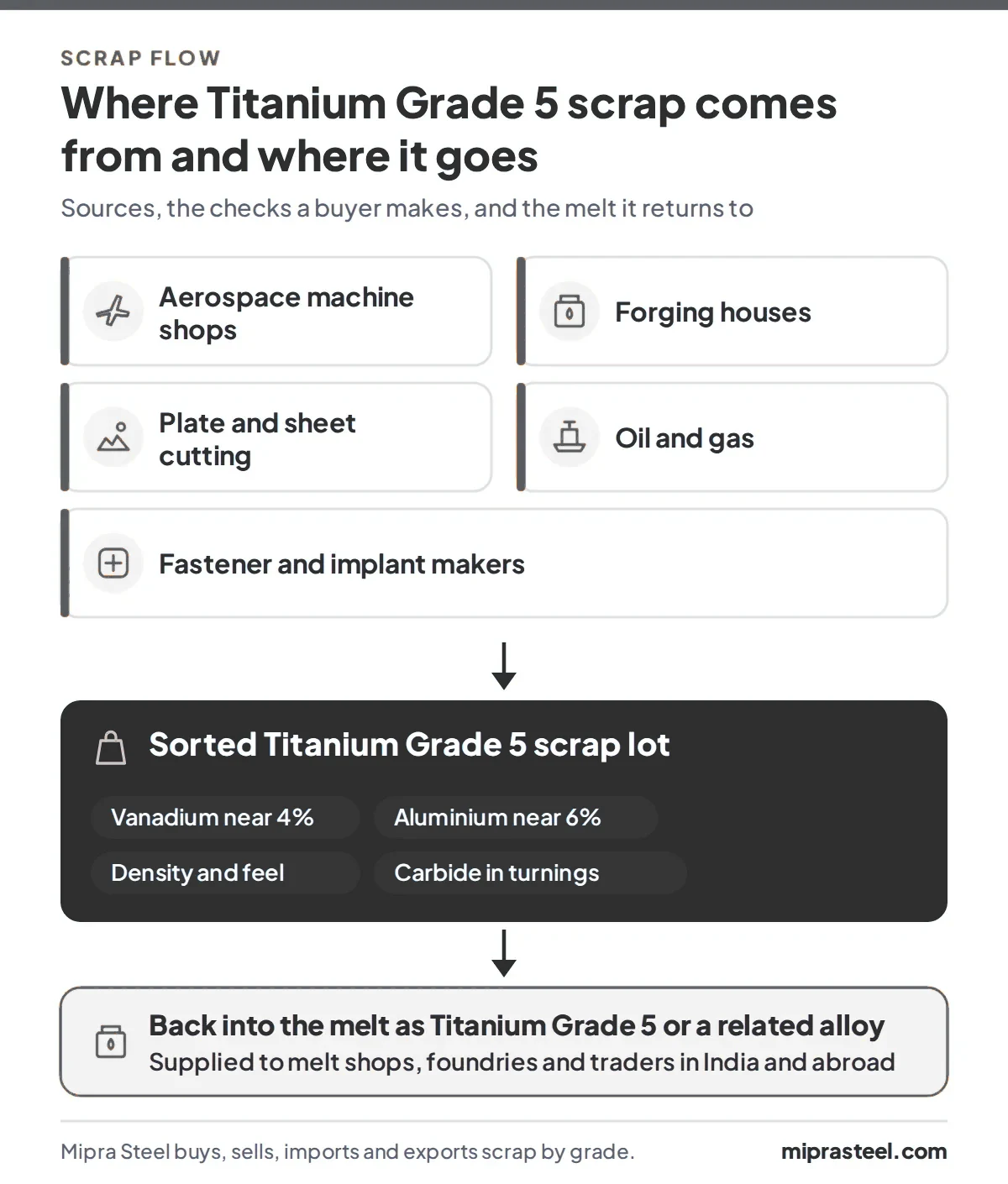
Where Ti-6Al-4V Scrap Is Generated
Grade 5 scrap follows the aerospace supply chain closely, with smaller streams from energy and medical work.
Aerospace Machine Shops
Bar and forging stock turned into structural fittings, engine parts and fasteners. Chips are the main output, with bar ends and rejected parts alongside. See aerospace scrap.
Forging Houses
Flash, trimmings and test coupons from closed-die forgings of Ti64. These solids usually have heat traceability.
Plate and Sheet Cutting
Skeletons and crops left after profiling Ti64 plate to AMS 4911 or ASTM B265.
Oil and Gas
Riser joints, stress joints and drilling components replaced or rejected in fabrication. See oil and gas scrap.
Fastener and Implant Makers
Headed blanks, rejected fasteners and implant machining offcuts. Implant scrap is usually Grade 23 and is worth describing as such.
Titanium Grade 5 Scrap Specification Chart
| Grade | Titanium Grade 5 |
|---|---|
| UNS | R56400 |
| W.Nr. / EN | 3.7165 |
| Also known as | Ti-6Al-4V, Ti 6-4 |
| Alloy type | Alpha-beta titanium alloy |
| Density | 4.43 g/cm³ (0.16 lb/in³) |
| Magnetic | Non-magnetic. |
| HS code (customs heading) | 8108.30 (titanium waste and scrap) |
Titanium Grade 5 Chemical Composition
Nominal composition in weight per cent, used to describe and identify the grade. The governing specification sets the limits for each product.
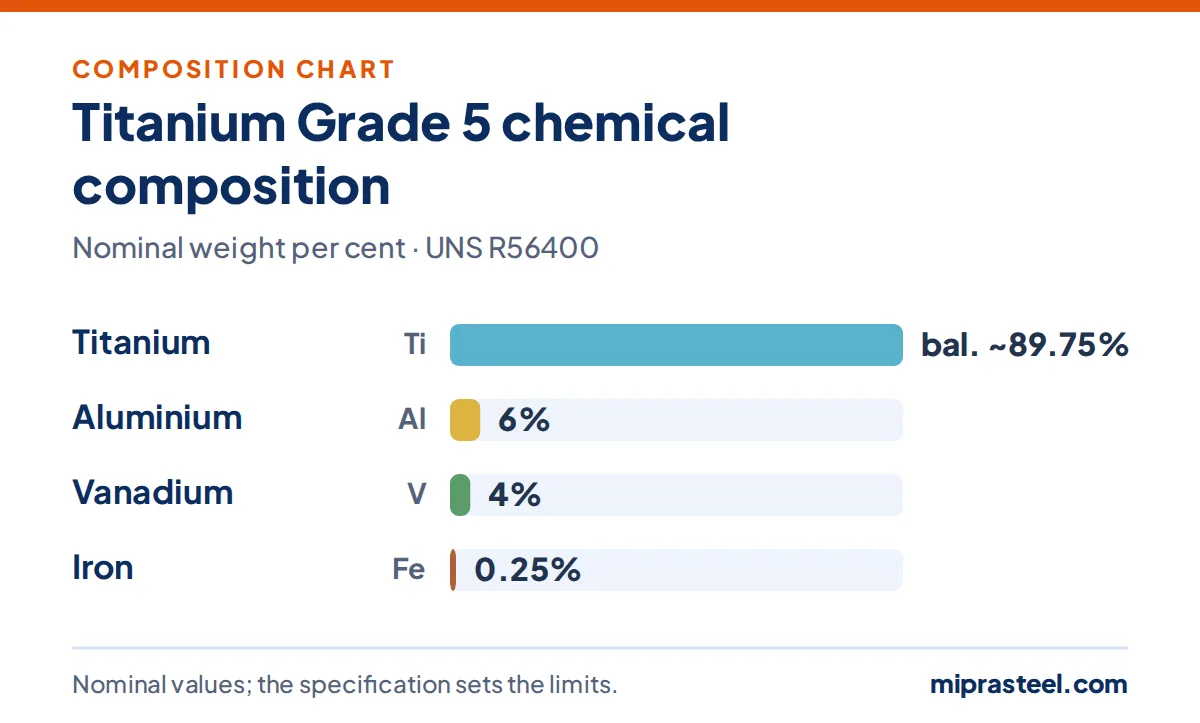
| Element | Symbol | Nominal wt% | |
|---|---|---|---|
| Titanium | Ti | Balance (about 89.8) | |
| Aluminium (aluminum) | Al | 6 | |
| Vanadium | V | 4 | |
| Iron | Fe | 0.25 |
Titanium Grade 5 Equivalent Grades and Other Names
| Designation | Value |
|---|---|
| Trade name | Titanium Grade 5 |
| UNS | R56400 |
| W.Nr. / EN | 3.7165 |
| Other names in the trade | Ti-6Al-4V, Ti 6-4 |
Look up any designation in the grade name converter or the equivalent grade chart.
Titanium Grade 5 Standards and Specifications
| Product form | Standard | ASME equivalent |
|---|---|---|
| Plate, sheet and strip | ASTM B265 | ASME SB-265 |
| Bar and billet | ASTM B348 | ASME SB-348 |
| Forgings | ASTM B381 | ASME SB-381 |
| Seamless pipe | ASTM B861 | ASME SB-861 |
| Welded pipe | ASTM B862 | ASME SB-862 |
| Plate, sheet and strip | AMS 4911 | No ASME edition |
| Bar and forgings | AMS 4928 | No ASME edition |
| Bar, solution treated and aged | AMS 4965 | No ASME edition |
Titanium Grade 5 Applications
- Aircraft structures and engine fan and compressor parts
- Fasteners
- Oil and gas risers and drilling components
- Medical implants (usually the ELI version, Grade 23)
Source industries: aerospace, oil and gas.
How Titanium Grade 5 Scrap Is Identified
XRF reads vanadium easily, which makes Grade 5 one of the simpler titanium grades to confirm. Aluminium is harder and needs the right instrument set-up.
| Check | What it shows for Titanium Grade 5 |
|---|---|
| Vanadium near 4% | The quickest Grade 5 signal on a handheld XRF. Commercially pure grades show no vanadium. |
| Aluminium near 6% | Light elements need a vacuum or helium-purged XRF, or OES. A lot sold as Grade 5 should have this reading on record. |
| Density and feel | Titanium at about 4.4 g/cm³ is clearly lighter than steel or nickel alloy pieces of the same size, which helps catch intruders in a mixed bin. |
| Carbide in turnings | A magnet will not find tungsten carbide. Buyers look for chip colour, tool marks and the shop's collection practice, and may ask for X-ray or density screening of turnings. |
| Oxidation colour | Heavily discoloured chips, blue-grey to white, point to overheating and oxygen pickup, and are graded below bright turnings. |
| Paperwork | Certificates to AMS 4911, AMS 4928 or ASTM B348 and heat numbers let the lot be sold as Grade 5 rather than "titanium alloy". |
Grades Most Often Confused with Titanium Grade 5
- Titanium Grade 2: is commercially pure: no vanadium, no aluminium, so XRF separates it immediately.
- Grade 23 (Ti-6Al-4V ELI): reads the same 6% aluminium and 4% vanadium; only certificates showing the lower oxygen and iron limits tell it apart.
- Grade 9 (Ti-3Al-2.5V): looks like a weak Grade 5 reading, with about 2.5% vanadium and 3% aluminium. It is common in tubing and must not be blended in.
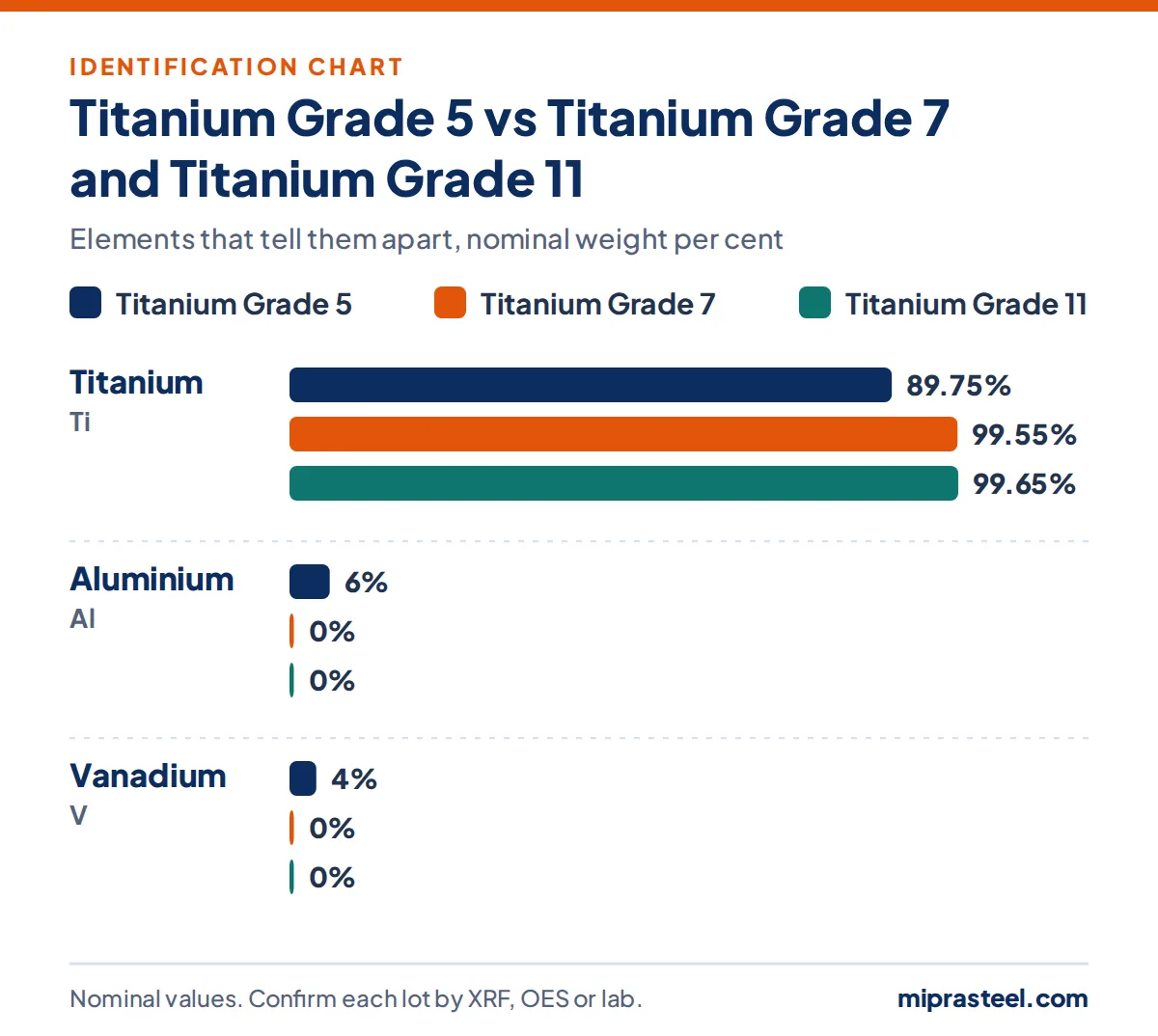
Nominal values for Titanium Grade 5 against its closest grades on this site.
Preparing Titanium Grade 5 Scrap for Sale
- Bag Grade 5 separately from Grade 2, Grade 9 and any nickel alloy or steel.
- Pull broken carbide inserts out of the chip bins at the machine, not later.
- Centrifuge or drain turnings and store them dry, away from ignition sources.
- Keep Grade 23 implant scrap with its certificates in its own lot.
- Keep forging trim and bar crops with heat numbers or tags attached.
- Photograph a representative sample of each bag for the enquiry.
Titanium Grade 5 Scrap Price per Kg: What Decides It
A Grade 5 offer starts from what a remelter can use without extra work, and much of that comes down to cleanliness rather than chemistry.
- Form: solids with traceability (bar crops, forging trim, plate) rank above turnings, which carry oil, moisture and oxygen pickup.
- Carbide risk: turnings from a shop that segregates broken tooling are worth more than chips of unknown history.
- Grade purity: no Grade 2, Grade 9 or other alloys in the lot. One mixed bag pulls the whole lot down to mixed titanium.
- Oxidation and contamination: discoloured, burnt or painted material, and pieces with weld spatter or embedded grit, lose value.
- Grade 23 traceability: ELI scrap with certificates can be described separately from standard Grade 5.
- Vanadium and aluminium content, together with how titanium and vanadium markets stand on the day.
Because there is no published Ti-6Al-4V scrap price per kg that fits every lot, offers are dated and tied to the description agreed. The guide to tramp elements in remelting explains why contamination costs so much more than it weighs.
Titanium Grade 5 Scrap Import and Export
Importing Titanium Grade 5 Scrap into India
Grade 5 scrap reaches India mainly from regions with large aerospace machining activity, often consolidated through traders in the Gulf. Titanium scrap is typically declared under HS 8108.30; confirm the full national line with your customs broker. The shipment travels with a pre-shipment inspection certificate, commercial invoice, packing list and bill of lading, and arrives through Nhava Sheva, Mundra or Chennai. Turnings must be packed dry, because wet or oily titanium chips are both a fire concern and a quality problem on arrival. See the import process, which applies to titanium paperwork too.
Exporting Titanium Grade 5 Scrap from India
Indian aerospace and defence machine shops generate Grade 5 solids and turnings that suit titanium remelters and ferro-titanium producers abroad. Exported lots are described by grade and UNS number on the invoice and packing list, weighed and shipped in sealed drums or bags inside containers. East Asia is a natural market, and our South Korea office and Japan buyers sit close to titanium users there, while the Dubai office handles Gulf flows. Read alloy scrap export documents.
Customs heading: 8108.30 (titanium waste and scrap). The HS code is the international tariff heading the scrap is declared under; national tariff lines add further digits, so confirm the full line with your customs broker.
Comparisons
Other Titanium Scrap Grades
Related Reading
Titanium Grade 5 Scrap FAQ
Why are Ti64 turnings worth less than Ti64 solids?
Turnings carry oil, moisture, surface oxygen and the chance of hidden carbide tool fragments, and each needs cleaning or screening before a remelter can use them. Solids with certificates can often go into the melt with little more than a surface clean, so they command a better offer for the same alloy.
How do I tell titanium Grade 5 from Grade 2 scrap?
Read vanadium on an XRF. Grade 5 shows about 4% vanadium, while Grade 2 is commercially pure titanium and shows none. Aluminium at about 6% confirms Grade 5, but needs an instrument set up for light elements.
Is Ti-6Al-4V ELI scrap the same as Grade 5 scrap?
Chemically it is very close, with the same 6% aluminium and 4% vanadium, but ELI (Grade 23) has lower oxygen and iron limits. Without certificates it trades as Grade 5; with them it can be described separately.
Can titanium Grade 5 turnings be exported from India?
Yes. Grade 5 turnings and solids are exported from India in sealed drums or bags inside containers, described by grade and UNS number. They should be dry and free of carbide, and the buyer's acceptance terms agreed before loading.
What HS code applies to Ti-6Al-4V scrap?
Titanium waste and scrap is typically declared under HS 8108.30, whatever the grade. National tariffs extend this with extra digits, so the importer's customs broker should confirm the exact line.
What does a buyer want to see before quoting for Grade 5 scrap?
Clear photos, the form and weight, the location, and vanadium and aluminium readings. Mipra Steel also asks how turnings were collected, since that decides how much screening the lot needs before a remelter will accept it.
Why does carbide matter so much in titanium scrap?
Tungsten carbide melts far above titanium, so fragments survive remelting and stay in the ingot as dense inclusions. In aerospace parts those inclusions are a failure risk, which is why melt shops screen titanium scrap for them and reject contaminated lots.
What is Titanium Grade 5 made of?
Nominally 89.8% titanium, 6% aluminium, 4% vanadium, 0.25% iron. Specification ranges vary by product form and standard.
Published by Mipra Steel, Khetwadi, Mumbai · Updated