Inconel 713C Scrap Buyer, Importer and Exporter in India
Mipra Steel deals in IN-713C revert and turbocharger wheel scrap from Mumbai, buying from foundries, turbo rebuilders and traders, and supplying described lots to melt shops.
Sell Inconel 713C Scrap
Selling turbocharger wheels or 713C foundry revert? Tell us whether the wheels still have shafts attached, roughly how many pieces and what total weight, the engine types they came from if known, and where the material sits. Photographs of the wheels and of any cut faces help. Foundries should mention whether the revert is 713C or 713LC and send heat analyses. We review incoming enquiries and respond with relevant next steps.
Buy Inconel 713C Scrap
Melting nickel superalloy and need a cobalt-free input? Tell us whether you want 713C revert, de-shafted wheels or both, the quantity, and the analysis you need with each lot. If your melt requires lots traded as "713 low Fe", say so up front so the documentation can be matched to it. Give the destination port and timing as well.
What Is IN-713C Scrap, and Why Do Turbo Wheels Matter So Much?
Pick up the hot-side wheel from a diesel truck turbocharger and there is a fair chance you are holding Inconel 713C. The alloy was built for investment casting: it pours well into thin, curved blade shapes, and its high aluminium content forms a large volume of gamma prime, the precipitate that keeps a spinning wheel from creeping at red heat. Small gas turbines use it for integrally cast wheels, and some blades and vanes are cast from it too. The AMS specification for 713C investment castings is AMS 5391.
For a scrap buyer, two things set 713C apart from its neighbours in the superalloy scrap market. First, it carries essentially no cobalt and no tungsten, so a melt shop gets nickel, chromium, molybdenum and niobium without paying for elements it may not want. Second, the aluminium is high enough that a careless sort can mistake other aluminium-bearing alloys for it, or miss it altogether, because ordinary handheld XRF does not read aluminium well.
Turbocharger wheels add a practical wrinkle. On most assemblies the cast wheel is welded to an alloy-steel shaft, so a used wheel arrives with a steel stub attached. That stub is not 713C, and the way it is handled changes how the lot is described.
You will also hear "713 low Fe". There is no published definition for it. It is a name the trade uses for 713 lots offered with iron kept low, documented by analysis. The low-carbon variant, 713LC, is a separate casting chemistry, and lots should say which one they are.
Inconel 713C belongs to the Inconel family, part of nickel alloy scrap.
Where IN-713C Scrap Is Generated
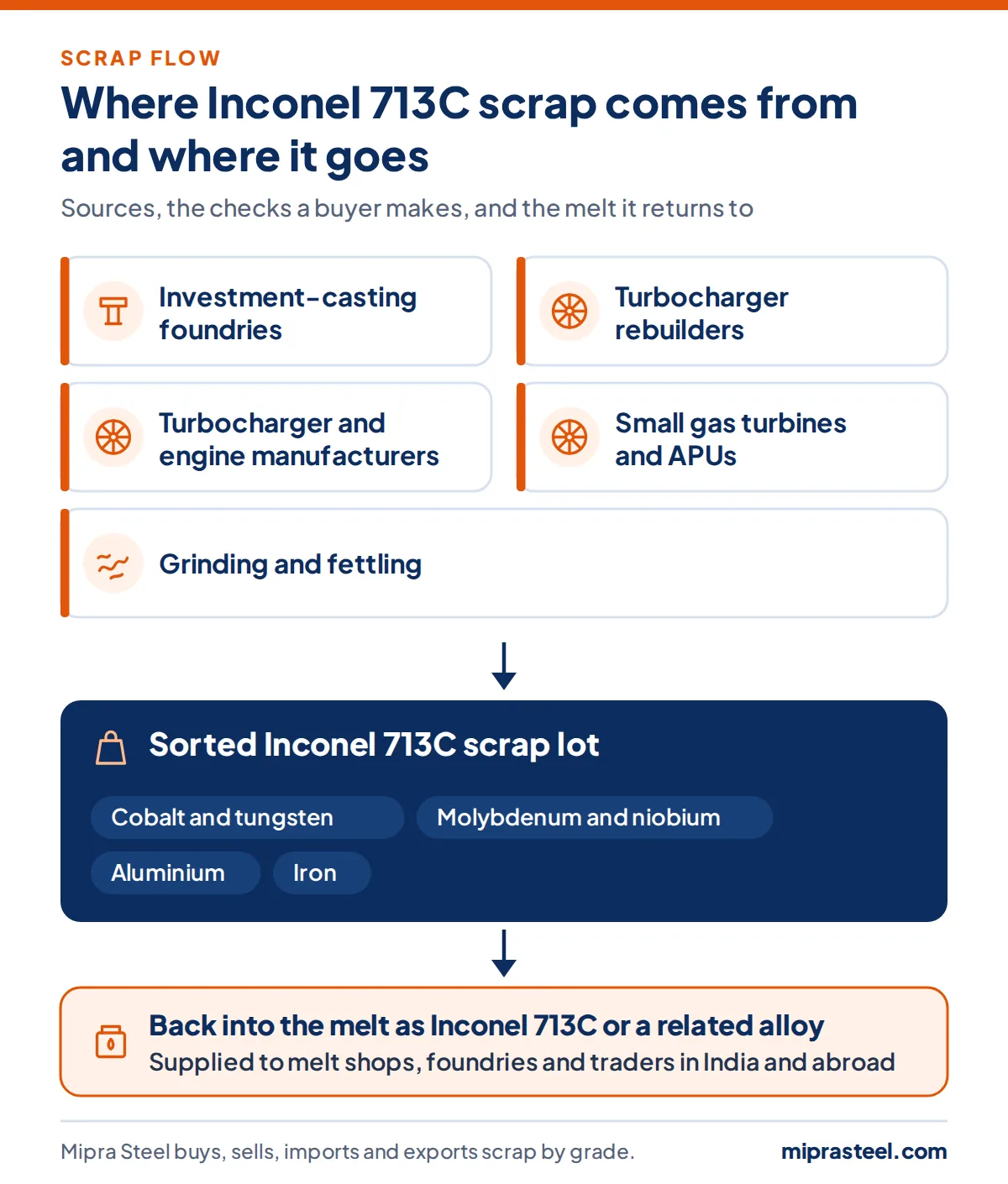
Almost every kilo of 713C started life in an investment-casting foundry, so the scrap streams follow the casting and the part.
Investment-Casting Foundries
Gates, risers, sprues and runners cut from 713C wheel and blade castings, plus castings rejected at X-ray or dimensional inspection. This is clean, known-chemistry revert.
Turbocharger Rebuilders
Worn, cracked or rubbed turbine wheels removed when diesel truck, locomotive, marine and generator-set turbos are overhauled. Usually with a steel shaft stub still welded on.
Turbocharger and Engine Manufacturers
Wheel-and-shaft assemblies that failed balancing or weld inspection, and obsolete spare wheels written off from inventory.
Small Gas Turbines and APUs
Integrally cast turbine wheels and nozzle pieces from auxiliary power units and small industrial turbines at overhaul. See aerospace scrap.
Grinding and Fettling
Cut-off and grinding residue from foundry finishing. Fine and often mixed with abrasive, so it is traded apart from solid revert, if at all.
Inconel 713C Scrap Specification Chart
| Grade | Inconel 713C |
|---|---|
| UNS | N07713 |
| W.Nr. / EN | Not assigned; specified by UNS N07713 and AMS 5391 |
| Also known as | Inconel 713, Alloy 713C, 713 low Fe, 713LC (low-carbon variant) |
| Alloy type | Cast precipitation-hardened superalloy |
| Density | 7.91 g/cm³ (0.286 lb/in³) |
| Magnetic | Non-magnetic. |
| HS code (customs heading) | 7503.00 (nickel waste and scrap) |
Inconel 713C Chemical Composition
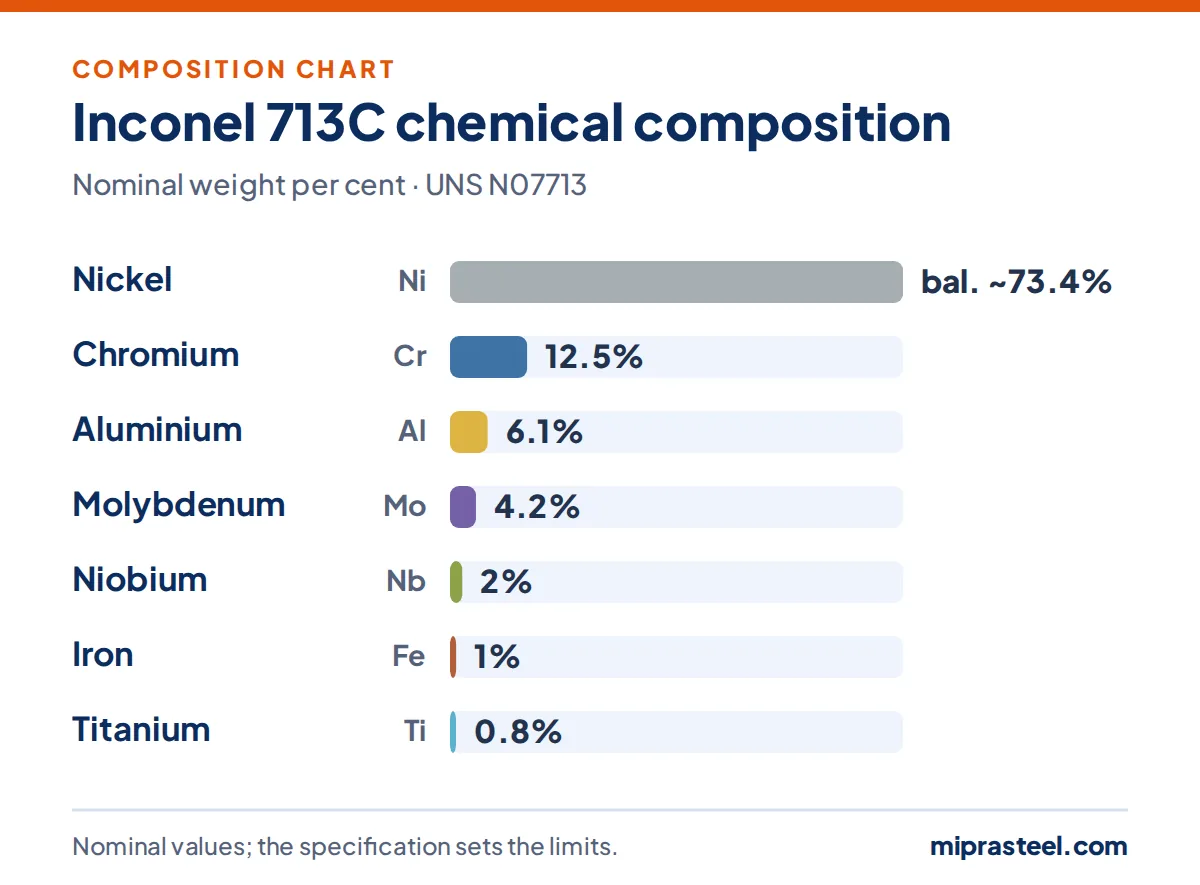
Nominal composition in weight per cent, used to describe and identify the grade. The governing specification sets the limits for each product.
| Element | Symbol | Nominal wt% | |
|---|---|---|---|
| Nickel | Ni | Balance (about 73.4) | |
| Chromium | Cr | 12.5 | |
| Aluminium (aluminum) | Al | 6.1 | |
| Molybdenum | Mo | 4.2 | |
| Niobium | Nb | 2 | |
| Iron | Fe | 1 | |
| Titanium | Ti | 0.8 |
Inconel 713C Equivalent Grades and Other Names
| Designation | Value |
|---|---|
| Trade name | Inconel 713C |
| UNS | N07713 |
| W.Nr. / EN | Not assigned; specified by UNS N07713 and AMS 5391 |
| Key specification | AMS 5391 |
| Other names in the trade | Inconel 713, Alloy 713C, 713 low Fe, 713LC (low-carbon variant) |
Look up any designation in the grade name converter or the equivalent grade chart.
Inconel 713C Standards and Specifications
| Product form | Standard | ASME equivalent |
|---|---|---|
| Investment castings | AMS 5391 | No ASME edition |
Inconel 713C Applications
- Turbocharger turbine wheels
- Integrally cast turbine wheels in small gas turbines
- Blades and vanes
Source industries: aerospace, power generation.
How Inconel 713C Scrap Is Identified
713C is easy to confirm once you know its gaps: what it lacks is as telling as what it contains.
| Check | What it shows for Inconel 713C |
|---|---|
| Cobalt and tungsten | Both should read near zero. Around 10% cobalt with 10% tungsten points to MAR-M 247, a common upgrade for hotter wheels. |
| Molybdenum and niobium | About 4% molybdenum with about 2% niobium, and chromium near 12% to 13%, is the 713C pattern on a standard XRF. |
| Aluminium | About 6%. Most handheld XRF units cannot read it reliably in the field; a light-element setup or spark OES is needed. See XRF vs OES vs lab. |
| Iron | Low. A higher iron reading on a wheel usually means the gun was pointed at the weld zone or the steel shaft, not that the casting is off-grade. |
| Shaft and weld | Check with a magnet. The alloy-steel shaft is magnetic; the 713C wheel is not. Anything magnetic still attached is steel, not superalloy. |
| Part form | Radial-inflow wheel shapes from diesel turbos are typical 713C. Petrol-engine wheels and wheels from high-output engines need a reading before they go into the lot. |
Grades Most Often Confused with Inconel 713C
- MAR-M 247: also cast into turbo and small-turbine wheels, but carries about 10% cobalt, 10% tungsten, 3% tantalum and 1.5% hafnium.
- René 80: is another cast blade alloy, with 14% chromium, but adds 9.5% cobalt, 5% titanium and 4% tungsten, and no niobium.
- Haynes 214: also high in aluminium (about 4.5%), but is a wrought sheet alloy with 16% chromium and no molybdenum or niobium.
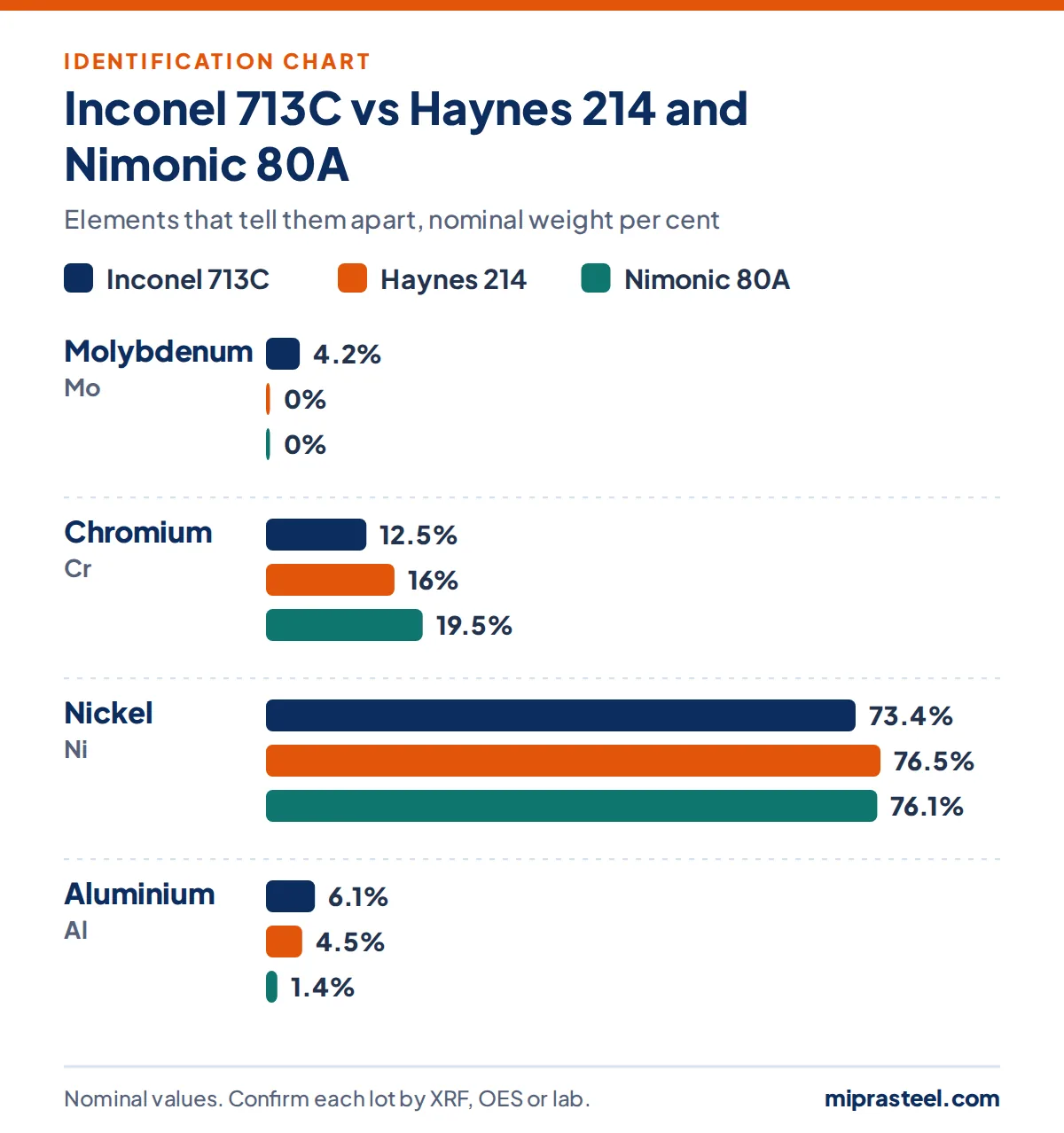
Nominal values for Inconel 713C against its closest grades on this site.
Preparing Inconel 713C Scrap for Sale
- Cut the steel shaft off at the weld and keep shafts in a separate magnetic-steel pile.
- Read every wheel for cobalt and tungsten; move any MAR-M 247 wheels to their own drum.
- Keep 713C and 713LC revert apart and label each with its heat analysis.
- Knock off loose carbon and oil deposits from ex-service wheels before weighing.
- Keep grinding residue and cut-off swarf out of solid revert lots.
- Pack in drums or bulk bags with a tag showing grade, piece count and net weight.
Inconel 713C Scrap Price per Kg: What Decides It
A buyer pricing 713C starts from the nickel, molybdenum and niobium it contains, then works out how much of what you are selling is actually 713C.
- Contained nickel, around 73%, which is higher than in most wrought Inconel grades, plus roughly 4% molybdenum and 2% niobium.
- Steel content: wheels sold with shafts attached are valued on the superalloy portion only, so the shaft weight is deducted or the lot is priced lower.
- Revert versus ex-service: foundry gates and risers with heat records are easier to remelt than used wheels with oil, carbon deposits and oxide.
- Cobalt-free confirmation: if a lot is described as 713C, any MAR-M 247 or cobalt-bearing wheels mixed in change what a buyer will pay.
- Whether the lot is 713C, 713LC or traded as "713 low Fe", and whether analysis is attached to back that up.
- Volume and packing: turbo wheels are bulky for their weight, so drum or bulk-bag packing and full container loads affect handling cost.
There is no fixed IN-713C scrap price per kg; offers move with nickel and molybdenum markets and are dated. Our guide on nickel alloy scrap value shows how the parts of an offer fit together.
Inconel 713C Scrap Import and Export
Importing Inconel 713C Scrap into India
Most 713C wheel scrap comes from countries with large truck, rail, marine and generator fleets, and revert comes from countries with investment-casting foundries making turbo wheels. Importers into India normally ship through Nhava Sheva or Mundra, or Chennai for southern buyers. Each consignment travels with a pre-shipment inspection certificate, commercial invoice, packing list and bill of lading. Describing the goods as "Inconel 713C scrap, UNS N07713" and stating whether steel shafts are included keeps the declaration consistent with what the inspector sees. Read importing nickel alloy scrap into India for the full process.
Exporting Inconel 713C Scrap from India
India rebuilds a great many diesel turbochargers for trucks, locomotives, ships and generator sets, so de-shafted 713C wheels accumulate steadily at rebuild workshops. Export lots are described by grade and UNS number, weighed, and shipped in drums or bulk bags inside containers. Buyers in Japan and South Korea, where turbocharger and casting industries are large, are natural destinations, and our South Korea office keeps us in contact with them. See export documents for alloy scrap.
Customs heading: 7503.00 (nickel waste and scrap). The HS code is the international tariff heading the scrap is declared under; national tariff lines add further digits, so confirm the full line with your customs broker.
Other Inconel Scrap Grades
Related Reading
Inconel 713C Scrap FAQ
Are turbocharger turbine wheels made of Inconel 713C?
Many are, particularly on diesel engines for trucks, locomotives, ships and generators. Some wheels for hotter-running petrol engines and high-output engines are cast in MAR-M 247 instead, which carries about 10% cobalt and 10% tungsten. A quick XRF reading for cobalt and tungsten tells the two apart before the wheels are put into one lot.
Should I cut the shaft off before selling turbo wheels?
It usually pays to. The shaft is alloy steel welded to the wheel, so it adds weight that a superalloy buyer will not pay superalloy rates for. Cutting just on the steel side of the weld leaves a clean wheel that can be described as 713C. If you cannot cut them, say so and give a piece count so the steel can be estimated.
What does "713 low Fe" mean in a scrap offer?
It is a trade description, not a published alloy designation. Sellers use it for 713 lots offered with low iron, and the claim should be backed by analysis supplied with the lot. Buyers who need it should ask for those readings rather than rely on the label. It is not the same thing as 713LC.
What is the difference between 713C and 713LC scrap?
713LC is the low-carbon version of the casting alloy, with slightly lower chromium, molybdenum and aluminium than 713C and less carbon. Both are traded as nickel superalloy revert, but foundries keep them apart because each casting specification has its own limits. A lot should say which one it is and carry heat analyses where available.
Why can a handheld XRF not confirm 713C on its own?
Because aluminium, at about 6% in 713C, is a light element that many handheld units read poorly or not at all in the field. Molybdenum, niobium and chromium readings, together with no cobalt or tungsten, point strongly to 713C. A light-element XRF method, spark OES or a lab analysis confirms the aluminium when a buyer needs it.
Which HS code covers IN-713C scrap shipments?
Being nickel-base, 713C scrap is typically declared under HS 7503.00, nickel waste and scrap. India and other importing countries add their own national digits under that heading. Check the exact line with your customs broker before the documents are prepared.
Can I sell a few hundred turbocharger wheels to Mipra Steel?
Yes. Mipra Steel buys turbo wheel scrap in lots of many sizes from rebuilders, fleet workshops and traders. Send the piece count, approximate weight, whether shafts are attached, the location and some photographs, and the enquiry can be assessed quickly.
Is IN-713C magnetic?
No. Cast 713C is non-magnetic. If a magnet sticks to a turbo wheel assembly, it is picking up the steel shaft or a steel fragment, which is a useful way to check that a wheel has been cleanly de-shafted. A magnet alone cannot tell 713C from other nickel superalloys.
What is Inconel 713C made of?
Nominally 73.4% nickel, 12.5% chromium, 6.1% aluminium, 4.2% molybdenum, 2% niobium, 1% iron, 0.8% titanium. Specification ranges vary by product form and standard.
Published by Mipra Steel, Khetwadi, Mumbai · Updated