Inconel 601 Scrap Buyer, Importer and Exporter in India
Mipra Steel trades Inconel 601 scrap out of Khetwadi, Mumbai, with heat-treatment shops, furnace builders, refineries and scrap traders in India and abroad.
Sell Inconel 601 Scrap
Selling a batch of retired radiant tubes, baskets or retorts? Tell us what the pieces were, roughly how many tonnes there are, and where they are. Photographs should show how much scale and distortion there is and whether frames or refractory are still attached. If anyone has run OES or a light-element XRF on the parts, send those readings, since aluminium is what confirms 601. We review incoming enquiries and respond with relevant next steps.
Buy Inconel 601 Scrap
Buyers sourcing 601 for remelting or for re-use as furnace alloy feed should tell us the quantity, whether scaled furnace returns are acceptable or only clean fabrication offcuts, the analysis they need with each lot, and the destination port. Clean 601 offcuts from furnace builders are scarcer than furnace returns, so say early which you need.
Why Is Inconel 601 Scrap Nearly Always Furnace Scrap?
Think of 601 as 600 rebuilt for the inside of a furnace. Chromium goes up to about 23%, iron to about 14%, and roughly 1.4% aluminium joins the mix. Under heat, that aluminium helps form an oxide layer that clings to the metal through repeated heating and cooling instead of flaking off. Datasheets rate its oxidation resistance to around 1,200 °C (2,190 °F), and it also holds up well against carburisation. Heat treaters, brazing furnace builders and petrochemical heater designers specify it for exactly that reason.
The consequence for anyone selling 601 is that the scrap has usually lived a hard life. Radiant tubes come out sagged. Trays and baskets come back warped from thousands of quench cycles. Retorts carry years of scale on the inside face. None of that changes the alloy underneath, but it does change what a melt shop recovers per tonne delivered, and it hides the surface a reading needs. Grinding a small window to bright metal before testing is normal practice.
Confirming the grade has one extra wrinkle. A standard handheld XRF sees the chromium, iron and nickel clearly, which is enough to separate 601 from Inconel 600. The 1.4% aluminium, the element that makes 601 what it is, needs a light-element XRF setting or an OES spark test to measure. Buyers who pay for 601 rather than for a generic nickel-chromium-iron mix will ask for that confirmation. See XRF, OES and lab analysis compared.
In the US, "601 solids" has long been one of the handful of nickel alloy scrap descriptions with its own named market assessment, a sign of how steadily the grade moves between dealers and melters.
Inconel 601 belongs to the Inconel family, part of nickel alloy scrap.
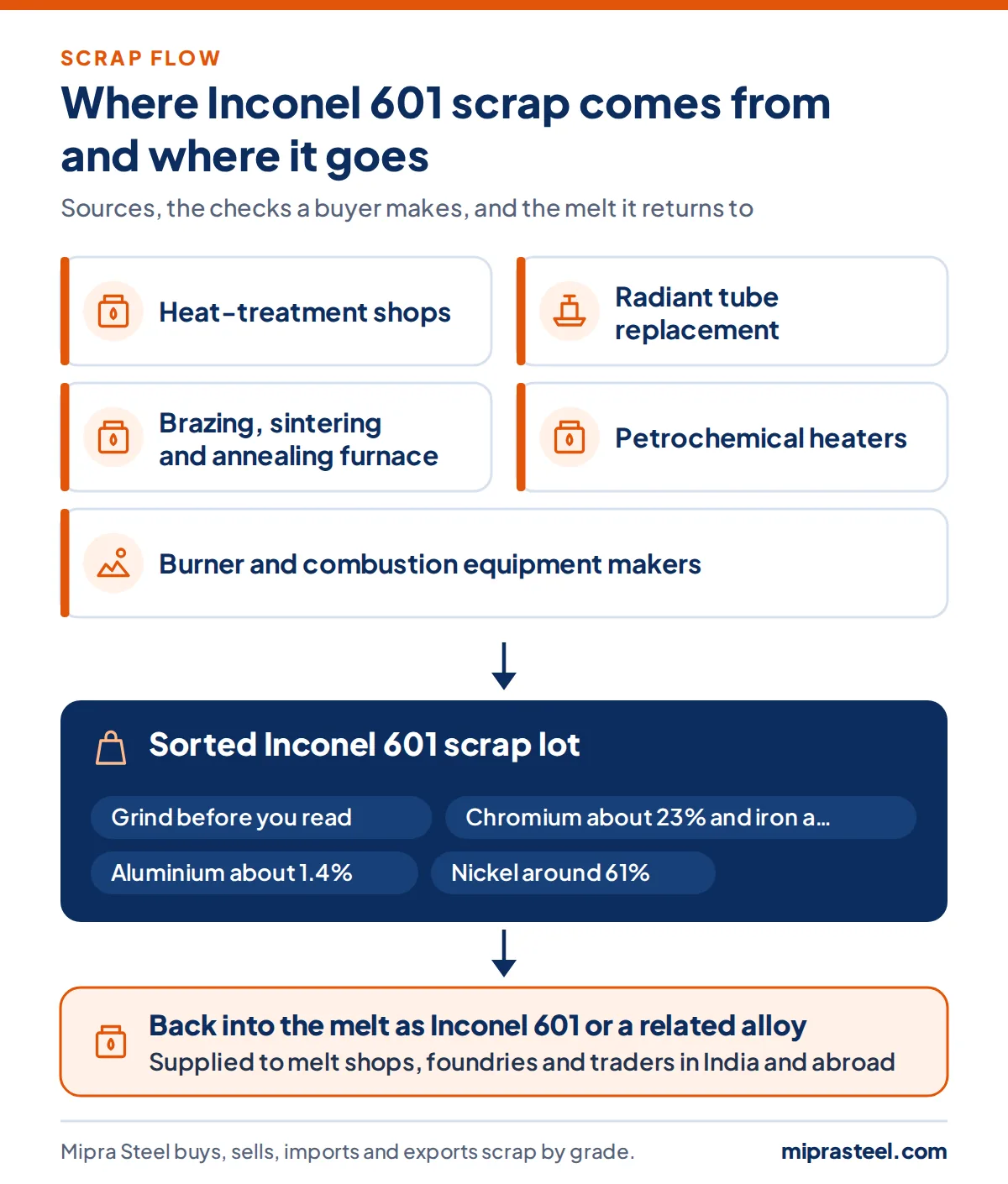
Which Plants Release Inconel 601 Scrap
Look for 601 wherever metal sits in a hot, oxidising or carburising atmosphere for a living.
Heat-Treatment Shops
Carburising, hardening and annealing lines retire baskets, trays, fixtures and conveyor parts on a regular cycle as they distort. See heat-treatment and furnace scrap.
Radiant Tube Replacement
Gas-fired furnaces use 601 radiant tubes and recuperator parts. Replacements are often scheduled in batches, which produces sizeable single-grade lots.
Brazing, Sintering and Annealing Furnace Builders
Muffles and retorts for copper brazing, sintering and strand annealing are commonly 601. Fabrication offcuts from new builds are clean and easy to document.
Petrochemical Heaters
Tube supports, hangers and combustion hardware from refinery and petrochemical heaters are replaced at turnarounds. See oil and gas scrap.
Burner and Combustion Equipment Makers
Flame shields, burner cones and thermocouple protection tubes generate sheet trim and rejects.
Inconel 601 Scrap Specification Chart
| Grade | Inconel 601 |
|---|---|
| UNS | N06601 |
| W.Nr. / EN | 2.4851 |
| Also known as | Alloy 601 |
| Alloy type | Solid-solution nickel-chromium-iron-aluminium |
| Density | 8.11 g/cm³ (0.293 lb/in³) |
| Magnetic | Non-magnetic. |
| HS code (customs heading) | 7503.00 (nickel waste and scrap) |
Inconel 601 Chemical Composition
Nominal composition in weight per cent, used to describe and identify the grade. The governing specification sets the limits for each product.
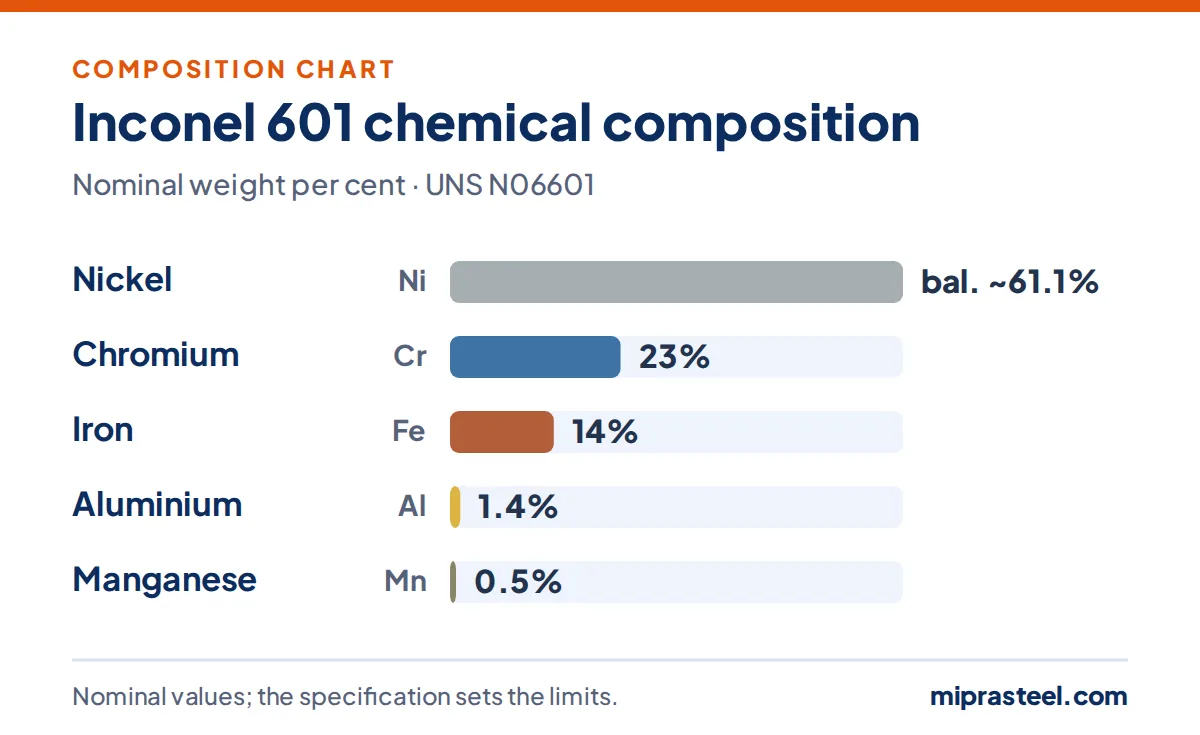
| Element | Symbol | Nominal wt% | |
|---|---|---|---|
| Nickel | Ni | Balance (about 61.1) | |
| Chromium | Cr | 23 | |
| Iron | Fe | 14 | |
| Aluminium (aluminum) | Al | 1.4 | |
| Manganese | Mn | 0.5 |
Inconel 601 Equivalent Grades and Other Names
| Designation | Value |
|---|---|
| Trade name | Inconel 601 |
| UNS | N06601 |
| W.Nr. / EN | 2.4851 |
| Other names in the trade | Alloy 601 |
Look up any designation in the grade name converter or the equivalent grade chart.
Inconel 601 Standards and Specifications
Inconel 601 Applications
- Radiant tubes, muffles and retorts
- Furnace baskets, trays and conveyor parts
- Petrochemical heater components
- Combustion equipment and flame shields
- Thermal-processing fixtures
Source industries: heat treatment and furnaces, chemical processing.
How Inconel 601 Scrap Is Identified
Most mistakes with 601 come from reading scale instead of metal, or from accepting a nickel-chromium-iron reading without checking the aluminium. These checks avoid both.
| Check | What it shows for Inconel 601 |
|---|---|
| Grind before you read | Scale and carburised skin distort the numbers. A small ground patch gives a reading that reflects the alloy itself. |
| Chromium about 23% and iron about 14% | That pair is the first signal of 601. 600 reads about 15.5% chromium and 8% iron. |
| Aluminium about 1.4% | Needs a light-element XRF mode or OES. Without it, a buyer can only call the lot "601 type". |
| Nickel around 61% | Nickel near 30% to 35% with iron over 40% points to an Incoloy 800-type alloy, a common neighbour in furnace scrap. |
| Heat-resistant stainless | Cast or wrought stainless furnace grades read over 40% iron and under 40% nickel. They are kept out of a 601 lot completely. |
| Fasteners and welds | Furnace fixtures are often joined with different filler or bolted with other alloys. Check welds and fasteners separately before calling the whole piece 601. |
Grades Most Often Confused with Inconel 601
- Inconel 600: has about 15.5% chromium, 8% iron, no aluminium and roughly 76% nickel.
- Haynes 214: is another aluminium-bearing furnace alloy, but with about 4.5% aluminium, 16% chromium and only around 3% iron.
- Inconel 690: reads higher chromium (about 29%) with around 9% iron and no aluminium.
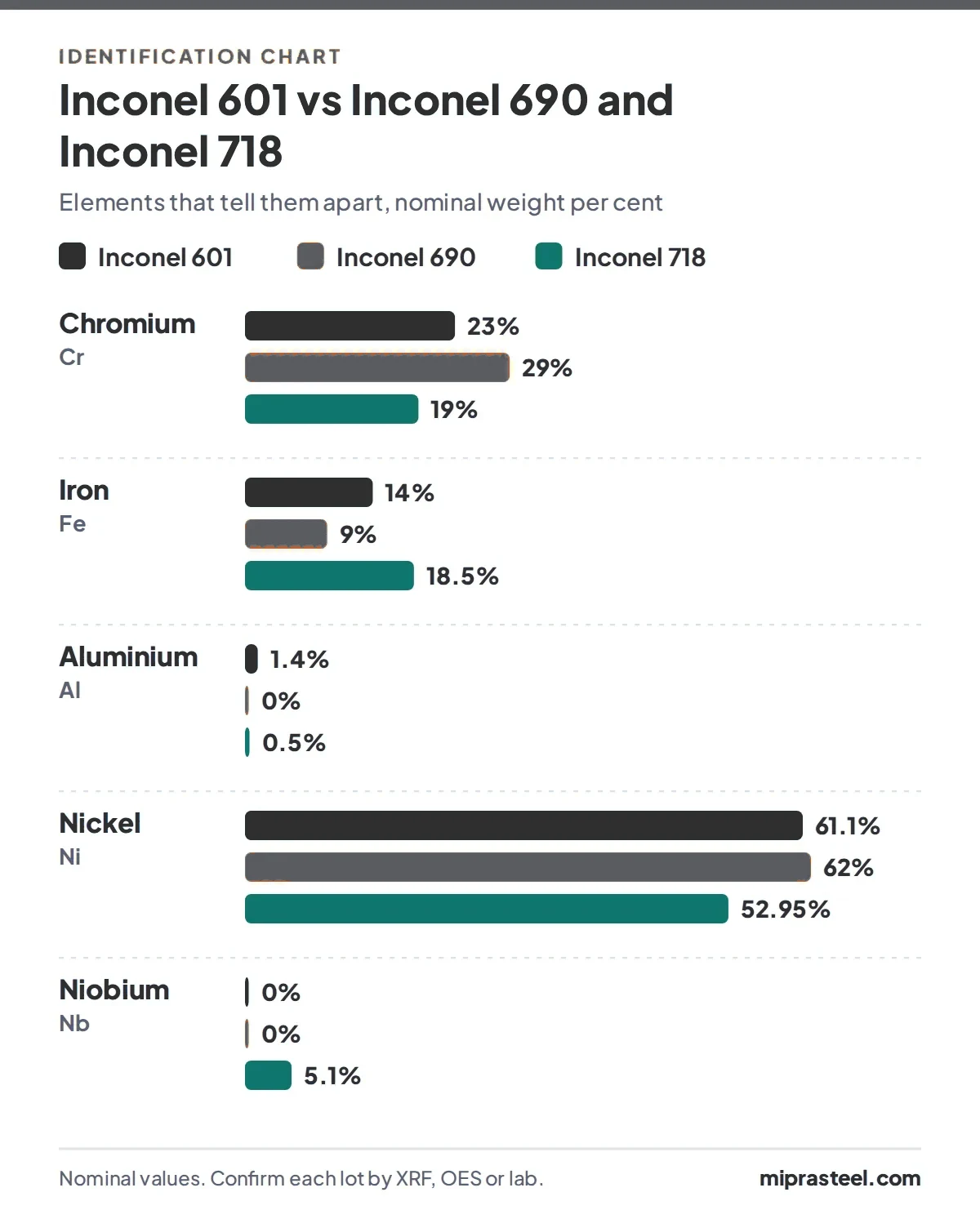
Nominal values for Inconel 601 against its closest grades on this site.
Preparing Inconel 601 Scrap for Sale
- Strip ceramic supports, refractory and mesh belts from furnace parts.
- Cut long radiant tubes and large retorts into lengths that stack tightly.
- Grind a window and record a reading on representative pieces, including aluminium where possible.
- Keep 601 apart from 600, Incoloy-type and heat-resistant stainless parts from the same furnace.
- Separate clean fabrication offcuts from scaled furnace returns.
Inconel 601 Scrap Price per Kg: What Decides It
Two 601 lots of the same weight can draw quite different offers. The difference is rarely the alloy itself; it is how much metal the buyer actually gets and how sure they are of it.
- Metal yield: heavily scaled radiant tubes and retorts lose weight in the melt, so a buyer allows for it.
- Carburisation: parts from carburising furnaces pick up carbon in service, which a melt shop has to deal with.
- Aluminium confirmed or not: a lot shown by OES or light-element XRF to carry 601 aluminium can be sold as 601; an unconfirmed lot is priced as a nickel-chromium-iron mix.
- Contamination from stainless and Incoloy-type neighbours, which share the same furnaces and often the same scrap bin.
- Attachments: ceramic, refractory, mesh belts and steel bolts must come off or are deducted.
- Contained nickel at about 61%, which sets the starting point before all of the above.
Offers are dated because nickel moves daily. The broader method is set out in nickel alloy scrap value.
Inconel 601 Scrap Import and Export
Importing Inconel 601 Scrap into India
Industrial heat treatment in Europe, Japan and South Korea retires 601 hardware on steady replacement cycles, and some of it is offered to Indian buyers. Ask the seller to state whether the lot is furnace return or fabrication offcut, how heavily scaled it is, and whether aluminium has been confirmed. Imported scrap is inspected before loading and travels with a pre-shipment inspection certificate, commercial invoice, packing list and bill of lading. Bulky radiant tubes and retorts are usually cut to fit containers before shipment. See how nickel alloy scrap is imported into India.
Exporting Inconel 601 Scrap from India
Indian heat-treatment clusters and refinery turnarounds produce 601 that overseas melters can use. Export lots are described as Inconel 601, UNS N06601, on the invoice and packing list, cut to a size that loads efficiently, weighed, and shipped loose or in bags in containers from Nhava Sheva or Mundra. Gulf buyers can work through our UAE office, and we also serve the Netherlands and Spain. See export documents for alloy scrap.
Customs heading: 7503.00 (nickel waste and scrap). The HS code is the international tariff heading the scrap is declared under; national tariff lines add further digits, so confirm the full line with your customs broker.
Comparisons
Other Inconel Scrap Grades
Related Reading
Inconel 601 Scrap FAQ
Why does Inconel 601 contain aluminium?
The aluminium, about 1.4%, works with chromium to form a dense, tightly adherent oxide scale at high temperature. That scale resists spalling during heating and cooling cycles, which is why 601 outlasts 600 in many furnace jobs. It is also why confirming aluminium matters when selling the scrap.
Can a normal XRF gun identify Inconel 601?
Partly. A standard XRF reads the 23% chromium and 14% iron that separate 601 from 600, but aluminium is a light element that needs a special setting or an OES spark test. Without the aluminium figure, the lot is better described as 601 type than as confirmed 601.
Do warped and scaled furnace parts still sell as 601 scrap?
Yes. Distortion does not change the alloy, and scaled furnace returns are the normal form of 601 scrap. The offer reflects the oxide weight and any carburisation, so stripping loose scale and attachments improves what you are paid.
Is Inconel 601 worth more than 600 as scrap?
Usually not. 601 contains roughly 61% nickel against 76% for 600, and its extra chromium and aluminium add little value in most melts. Furnace returns also lose more weight to scale. Clean 601 offcuts can still compete well when a melt shop needs that chemistry.
How should I pack 601 radiant tubes for shipping?
Cut them to lengths that stack flat in a container, remove any end fittings of a different alloy, and band them into bundles that a forklift can handle. Record the weight of each bundle on the packing list.
What tariff heading do customs use for Inconel 601 scrap?
Nickel predominates in 601, so its scrap is typically declared under HS 7503.00, nickel waste and scrap. National lines add extra digits; confirm the exact line with a customs broker in both countries.
Who can I contact to buy or sell Inconel 601 scrap in Mumbai?
Mipra Steel in Khetwadi, Mumbai, buys and sells 601 and arranges import and export lots. Use the contact page with the quantity, form, location or destination port, and any readings you have.
What is Inconel 601 made of?
Nominally 61.1% nickel, 23% chromium, 14% iron, 1.4% aluminium, 0.5% manganese. Specification ranges vary by product form and standard.
Published by Mipra Steel, Khetwadi, Mumbai · Updated