MAR-M 246 Scrap Buyer, Importer and Exporter in India
Mipra Steel trades MAR-M 246 scrap from Mumbai, buying single-grade parcels and supplying described lots to foundries and traders.
Sell MAR-M 246 Scrap
Have MAR-M 246 wheels, blades or revert? Send the weight, the form, where the parcel sits and photographs that show the parts clearly. An analyser reading that includes hafnium, molybdenum and tantalum is the most useful thing you can attach, because it answers the 246 or 247 question before anyone asks. Mention it if the lot is called 246C or 246 LC. We review incoming enquiries and respond with relevant next steps.
Buy MAR-M 246 Scrap
Foundries that still pour MAR-M 246, and remelters building superalloy charges, can ask us for 246 lots. Tell us the quantity, whether you need revert only or will take ex-service parts, your hafnium tolerance, the destination port and timing. Each lot is described by grade and by its analysis.
How Is MAR-M 246 Different from MAR-M 247?
The short answer is hafnium. MAR-M 246 is the older of the two: a dense (8.44 g/cm³), heavily tungsten-loaded casting alloy for turbine blades, vanes and wheels cast in one piece with their blading. MAR-M 247 was later developed from it by adding about 1.5% hafnium and moving the balance from molybdenum towards tantalum. The two look identical as revert and as finished parts, which is why the most common problem with a 246 lot is not quality but identity.
On an XRF reading, 246 shows roughly 2.5% molybdenum against 0.7% in 247, about 1.5% tantalum against 3%, and slightly more titanium. Hafnium is the clean break: it should read close to nothing in genuine 246. When a seller says a bag is 246 and the analyser shows hafnium in the 1.5% range, the bag is almost certainly MAR-M 247, or a mixture of the two.
Why does that matter if both alloys are about 60% nickel with 10% tungsten and 10% cobalt? Because a foundry pouring 246 cannot simply accept hafnium it did not specify, and a foundry pouring 247 needs its hafnium and tantalum to be there. A mixed lot satisfies neither, so it is usually sold as general superalloy scrap and loses the premium that a single-grade revert lot earns.
In trade descriptions you will see 246C and 246 LC alongside plain MAR-M 246. Neither name has a published definition. They are labels sellers and buyers use for particular lots, and those lots are described and accepted on the strength of the analysis that comes with them.
MAR-M 246 belongs to the MAR-M family, part of superalloy scrap.
Where MAR-M 246 Scrap Turns Up
MAR-M 246 appears in smaller, more scattered parcels than its successor, so knowing where to look matters.
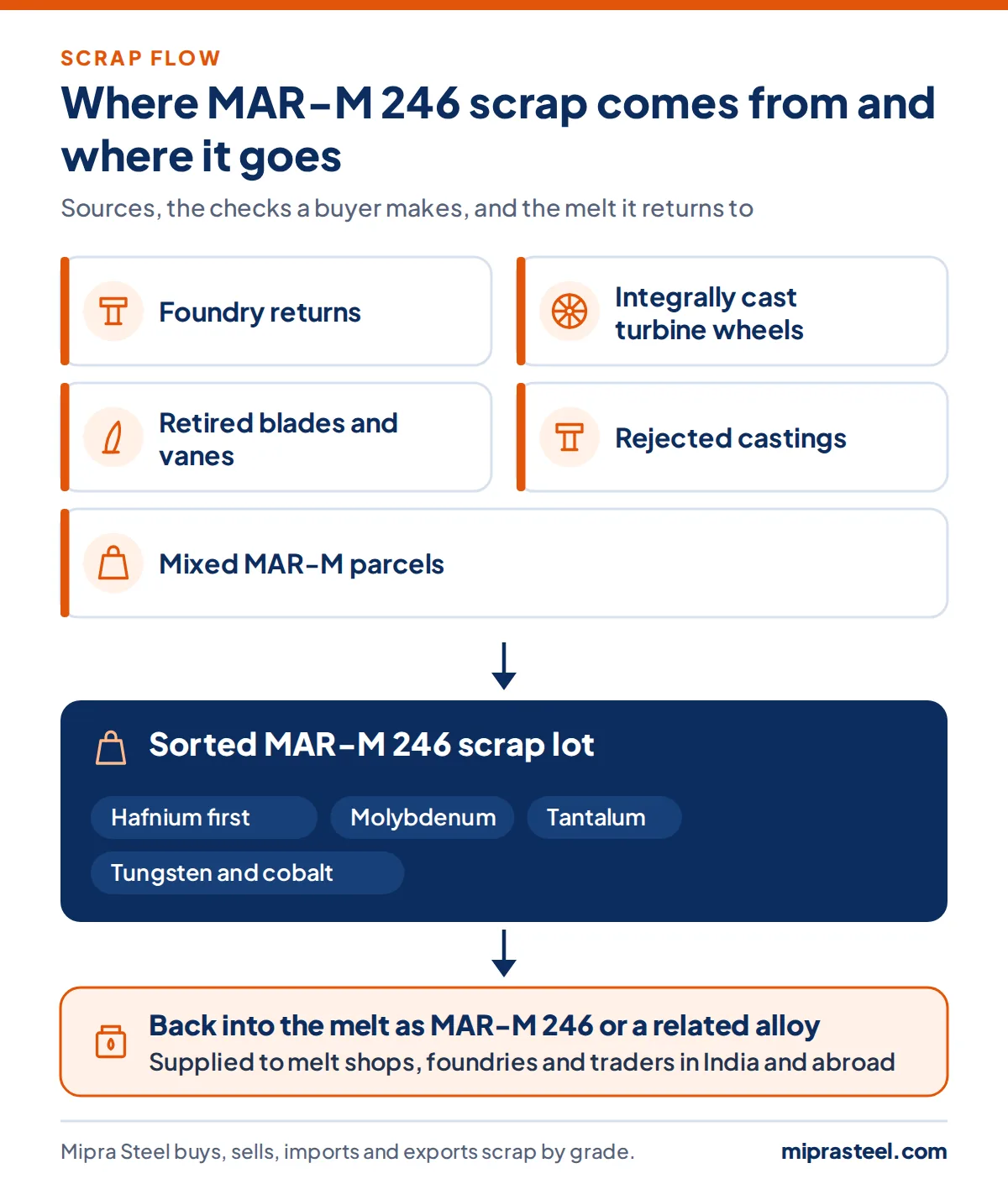
Foundry Returns
Gating, risers and runners from vacuum investment castings of blades, vanes and wheels. Usually the safest 246 to describe, because it comes with a known pour.
Integrally Cast Turbine Wheels
Small gas turbine wheels cast with their blades in one piece, scrapped after damage, overspeed or at life limit. A single wheel can be a heavy, dense item.
Retired Blades and Vanes
Parts removed during engine overhaul. Expect coatings and oxidation on airfoil surfaces.
Rejected Castings
Parts that failed inspection at the foundry. Chemistry is fine; the reject reason was dimensional or internal soundness.
Mixed MAR-M Parcels
Older traders' stock often holds 246 and 247 together. Such parcels need piece-by-piece readings before either name can be used. See MAR-M alloy scrap for the family.
MAR-M 246 Scrap Specification Chart
| Grade | MAR-M 246 |
|---|---|
| UNS | Not assigned (proprietary MAR-M trade-name alloy) |
| W.Nr. / EN | Not assigned |
| Identified by | Customer or OEM specification, heat certificate and analysis |
| Also known as | Mar-M246, MM246, MAR-M 246C, MAR-M 246 LC |
| Alloy type | Cast γ′ superalloy |
| Density | 8.44 g/cm³ (0.305 lb/in³) |
| Magnetic | Non-magnetic. |
| HS code (customs heading) | 7503.00 (nickel waste and scrap) |
MAR-M 246 Chemical Composition
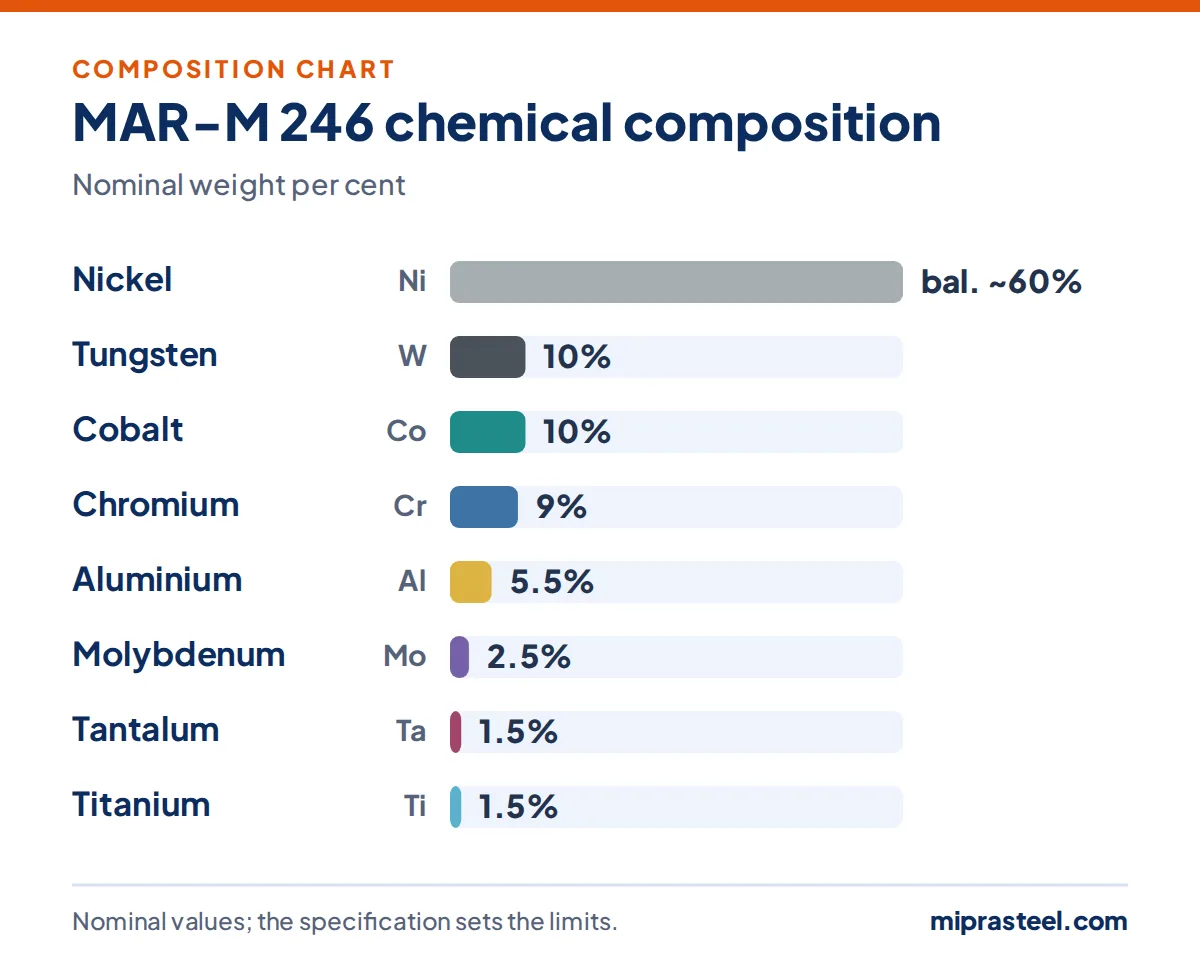
Nominal composition in weight per cent, used to describe and identify the grade. The governing specification sets the limits for each product.
| Element | Symbol | Nominal wt% | |
|---|---|---|---|
| Nickel | Ni | Balance (about 60) | |
| Tungsten | W | 10 | |
| Cobalt | Co | 10 | |
| Chromium | Cr | 9 | |
| Aluminium (aluminum) | Al | 5.5 | |
| Molybdenum | Mo | 2.5 | |
| Tantalum | Ta | 1.5 | |
| Titanium | Ti | 1.5 |
MAR-M 246 Equivalent Grades and Other Names
| Designation | Value |
|---|---|
| Trade name | MAR-M 246 |
| UNS | Not assigned (proprietary MAR-M trade-name alloy) |
| W.Nr. / EN | Not assigned |
| Other names in the trade | Mar-M246, MM246, MAR-M 246C, MAR-M 246 LC |
Look up any designation in the grade name converter or the equivalent grade chart.
MAR-M 246 Standards and Specifications
Supplied to AMS and OEM specifications.
MAR-M 246 Applications
- Turbine blades and vanes
- Integrally cast turbine wheels
Source industries: aerospace, power generation.
How MAR-M 246 Scrap Is Identified
Because 246 and 247 share their headline elements, identification rests on three minor ones. Here is the order most buyers work in.
| Check | What it shows for MAR-M 246 |
|---|---|
| Hafnium first | Near zero means a 246 candidate. Around 1.5% rules 246 out. |
| Molybdenum | Should read about 2.5%. Below 1% points towards 247 or René 108. |
| Tantalum | About 1.5% in 246, roughly double that in 247. |
| Tungsten and cobalt | Both around 10%. Readings well below that, such as 4% tungsten, mean a different alloy family altogether, for example René 80. |
| Surface condition | Grind off coatings and oxide before reading ex-service parts; surface layers distort minor-element results. See XRF testing of nickel alloys. |
| Light elements | Aluminium and carbon need OES or a light-element method. A lot offered as 246 LC should come with the result that supports the name. See XRF, OES and lab methods. |
Grades Most Often Confused with MAR-M 246
- MAR-M 247: about 1.5% hafnium, 3% tantalum and only 0.7% molybdenum on the same tungsten-cobalt base.
- René 108: carries 1.5% hafnium and 0.5% molybdenum with about 9.5% tungsten, so it reads closer to 247 than to 246.
- René 80: only about 4% tungsten and 4% molybdenum, with 14% chromium and 5% titanium.
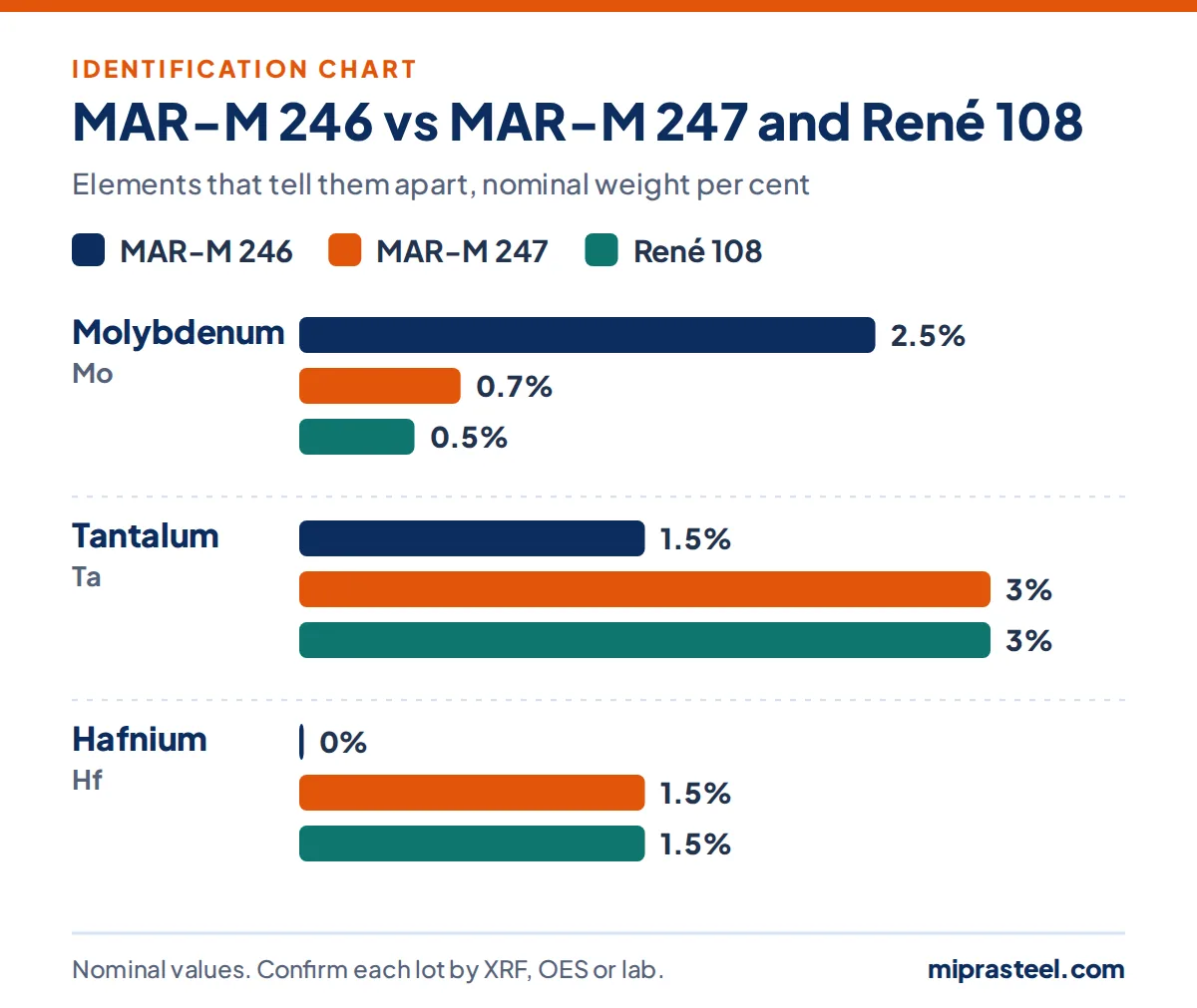
Nominal values for MAR-M 246 against its closest grades on this site.
Preparing MAR-M 246 Scrap for Sale
- Read every piece for hafnium and pull out anything that shows it.
- Keep wheels, blades and revert in separate labelled bags.
- Remove bolts, retainers and any steel hardware from wheels and assemblies.
- Do not let 246 share a drum with René alloys or MAR-M 247.
- Record the readings against bag numbers and send them with the photos.
MAR-M 246 Scrap Price per Kg: What Decides It
A MAR-M 246 scrap price per kg starts from contained tungsten, cobalt, nickel and tantalum. Everything after that is about confidence and condition.
- Proof that the lot is 246 only, with no hafnium-bearing pieces. This single point moves the offer more than any other.
- Tungsten and cobalt content, both around 10%, priced on their own markets rather than with nickel.
- Molybdenum and tantalum at 2.5% and 1.5%: modest amounts, but they matter to a foundry matching a 246 melt.
- Revert or engine-run: foundry returns go back into a melt with little work, while coated, oxidised parts carry a deduction.
- Parcel size. 246 tends to come in smaller lots, and consolidating small parcels adds handling cost.
- Supporting paperwork such as foundry certificates or part numbers that tie the parts to 246.
Use the contained metal calculator to see what a lot holds, and remember that every offer is tied to the day's metal prices.
MAR-M 246 Scrap Import and Export
Importing MAR-M 246 Scrap into India
MAR-M 246 tends to arrive in India in small parcels, often inside larger superalloy consignments from traders in the Gulf, Europe and East Asia. Ask for readings on every piece before it ships, because a parcel that turns out to be partly 247 is hard to re-describe after it lands. Imported metal scrap travels with a pre-shipment inspection certificate, commercial invoice, packing list and bill of lading, and nickel-base superalloy scrap is typically declared under HS 7503.00, subject to your broker confirming the national line. See alloy scrap imports into India.
Exporting MAR-M 246 Scrap from India
Indian sellers of 246 usually hold too little for a container on its own, so it is commonly shipped as a clearly separated, labelled lot within a mixed superalloy consignment. Each grade gets its own line on the invoice and packing list with its weight. Buyers abroad include investment foundries and remelt houses in markets such as South Korea, Japan and Italy; our Dubai and South Korea offices help with Gulf and East Asian buyers. Read alloy scrap export documents.
Customs heading: 7503.00 (nickel waste and scrap). The HS code is the international tariff heading the scrap is declared under; national tariff lines add further digits, so confirm the full line with your customs broker.
Other MAR-M Scrap Grades
Related Reading
MAR-M 246 Scrap FAQ
Does MAR-M 246 contain hafnium?
No. Standard MAR-M 246 carries no hafnium, and that is how it is separated from MAR-M 247, which has about 1.5%. If an analyser shows hafnium on a piece sold as 246, treat the piece as 247 or a related alloy until proven otherwise.
What are 246C and 246 LC?
They are names the scrap trade uses for certain MAR-M 246 lots, but no published standard defines either of them. A buyer will accept such a lot on the analysis that comes with it, not on the suffix. Ask for the readings or laboratory result behind the name.
Can MAR-M 246 and MAR-M 247 scrap be sold together?
They can, but the mixture is then neither grade, and it usually sells as general superalloy scrap at a lower figure than either single-grade lot. Sorting by hafnium with an analyser before sale normally recovers more than it costs.
Why do buyers ask about molybdenum in a 246 lot?
Because molybdenum is one of the two minor elements that separate it from 247. Genuine 246 reads about 2.5% molybdenum; a reading under 1% suggests 247 or René 108 has found its way into the parcel.
How do I sell MAR-M 246 turbine wheels to Mipra Steel?
Send photographs of the wheels, the number of pieces and total weight, their location and any part numbers or readings. Remove steel hardware first if you can, and say whether the wheels are new rejects or ex-service, since that changes how they are described.
What HS code applies to MAR-M 246 scrap?
It is a nickel-base alloy, so its scrap is typically entered under HS 7503.00, nickel waste and scrap. Countries add their own digits to that heading, which your customs broker should confirm for the specific shipment.
Is MAR-M 246 scrap magnetic?
No. MAR-M 246 is non-magnetic, as are most nickel superalloys, so a magnet cannot separate it from 247, René alloys or IN-713C. Only an analyser or laboratory result can do that. See what the magnet test can and cannot show.
What is MAR-M 246 made of?
Nominally 60% nickel, 10% tungsten, 10% cobalt, 9% chromium, 5.5% aluminium, 2.5% molybdenum, 1.5% tantalum, 1.5% titanium. Specification ranges vary by product form and standard.
Published by Mipra Steel, Khetwadi, Mumbai · Updated