MGA 1400 Scrap Buyer, Importer and Exporter in India
Mipra Steel trades MGA 1400 as a conventionally cast blade grade, separate from its DS sibling and from other 14% chromium blade alloys.
Sell MGA 1400 Scrap
If you hold MGA 1400 blades or revert, tell us how many pieces and how much weight, the turbine model and stage they came from, whether they are coated, and where they are. Photographs of the blade roots, part numbers and any readings help us describe the lot properly. We review incoming enquiries and respond with relevant next steps.
Buy MGA 1400 Scrap
Melt shops and master-alloy producers looking for MGA 1400 can tell us the tonnage, whether coated blades are acceptable or only stripped blades and revert, any limits on hafnium, and the destination port. We describe each lot as MGA 1400 by casting route and discuss the papers that support it.
What Is MGA 1400 and Why Is Its Scrap Traded as a Named Grade?
Mitsubishi Heavy Industries developed MGA 1400 for the moving blades of its large industrial gas turbines, working with Mitsubishi Materials. The comparison point in MHI's own published work was IN-738LC, which runs at about 16% chromium. MGA 1400 trims chromium to about 14% and leans harder on tantalum and tungsten, aiming for more creep strength at blade temperatures while keeping enough chromium for the oxidising, corrosive gas path of a power-station turbine.
"Conventionally cast" means equiaxed: the blade freezes with many small, randomly oriented grains, just as most investment castings do. That is the main thing separating MGA 1400 from its sibling MGA 1400 DS, which is cast with columnar grains and carries a hafnium addition. On a composition table the two look almost identical, so in the scrap trade the casting route, the documents and the part origin carry real weight.
For a melt shop, MGA 1400 is an attractive input because about one-fifth of its weight is cobalt, tantalum and tungsten, with no rhenium and no niobium. The catch is that several industrial blade alloys share its 14% chromium. A lot that is half MGA 1400 and half GTD-111 has titanium and tantalum levels matching neither, and the melter has to correct it or reject it. A named, single-grade lot avoids that problem.
MGA designations belong to Mitsubishi, and this page describes scrap of the alloy, not new parts. The MGA alloy scrap page compares all three MGA grades.
MGA 1400 belongs to the MGA family, part of superalloy scrap.
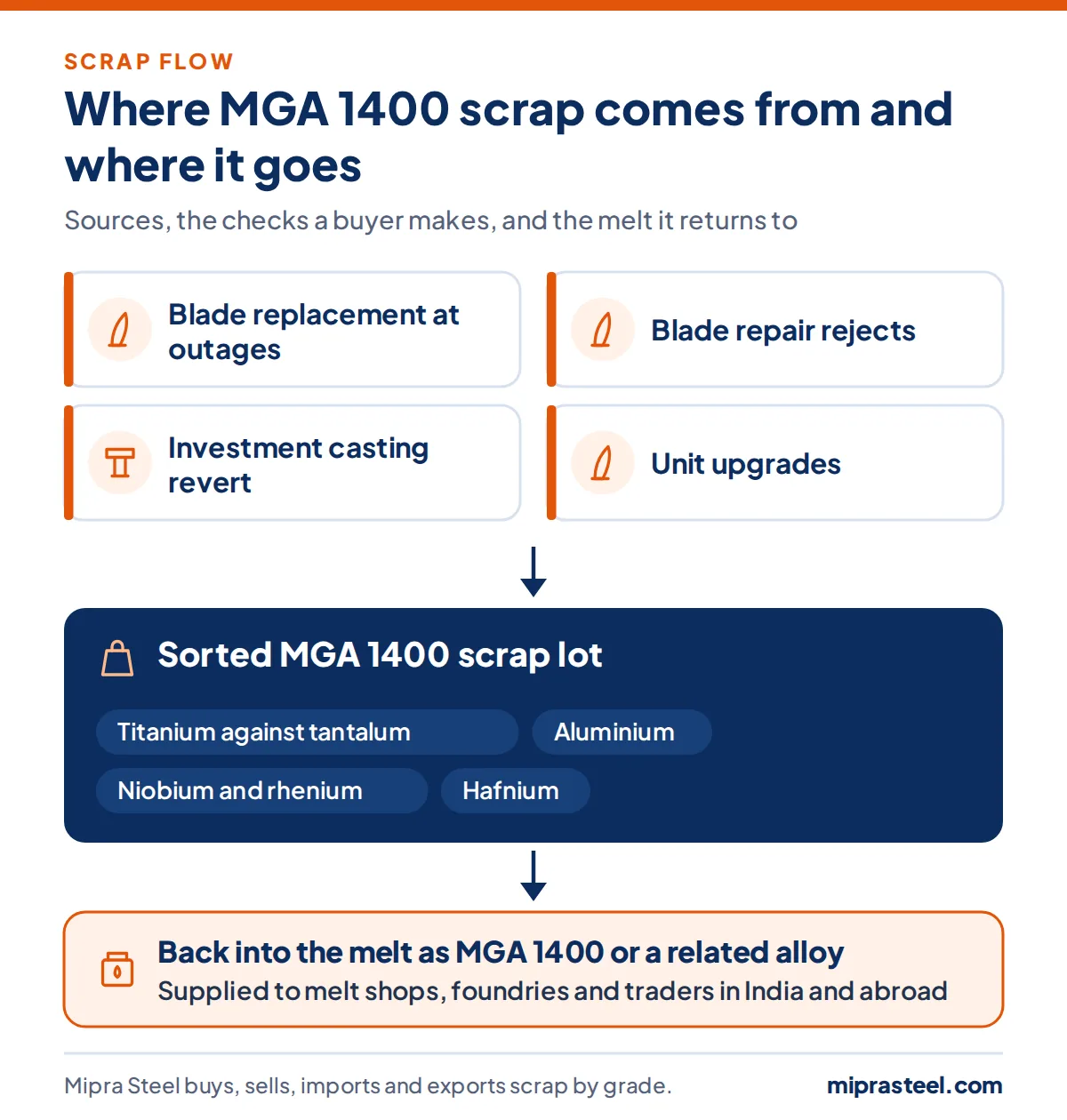
Which Parts and Processes Release MGA 1400 Scrap?
MGA 1400 is a blade alloy for Mitsubishi heavy-duty turbines, so its scrap tracks the maintenance of those machines and the casting of their blades.
Blade Replacement at Outages
Rotating blades removed at scheduled inspections once they reach their life limit, usually coated and sometimes with tip rub or oxidation damage.
Blade Repair Rejects
Blades judged beyond repair after stripping and inspection, which often come uncoated and with repair shop paperwork.
Investment Casting Revert
Gates, risers and rejected blade castings from conventionally cast production, with heat records.
Unit Upgrades
When an operator upgrades a turbine, older blade sets can be released early, sometimes in near-new condition. See power generation scrap.
MGA 1400 Scrap Specification Chart
| Grade | MGA 1400 |
|---|---|
| UNS | Not assigned (proprietary Mitsubishi Heavy Industries alloy) |
| W.Nr. / EN | Not assigned |
| Identified by | Mitsubishi specification, turbine part records and analysis |
| Also known as | MGA1400 |
| Alloy type | Cast nickel superalloy (gas turbine blade alloy) |
| Density | Not published |
| Magnetic | Non-magnetic. |
| HS code (customs heading) | 7503.00 (nickel waste and scrap) |
MGA 1400 Chemical Composition
Nominal composition in weight per cent, used to describe and identify the grade. The governing specification sets the limits for each product.
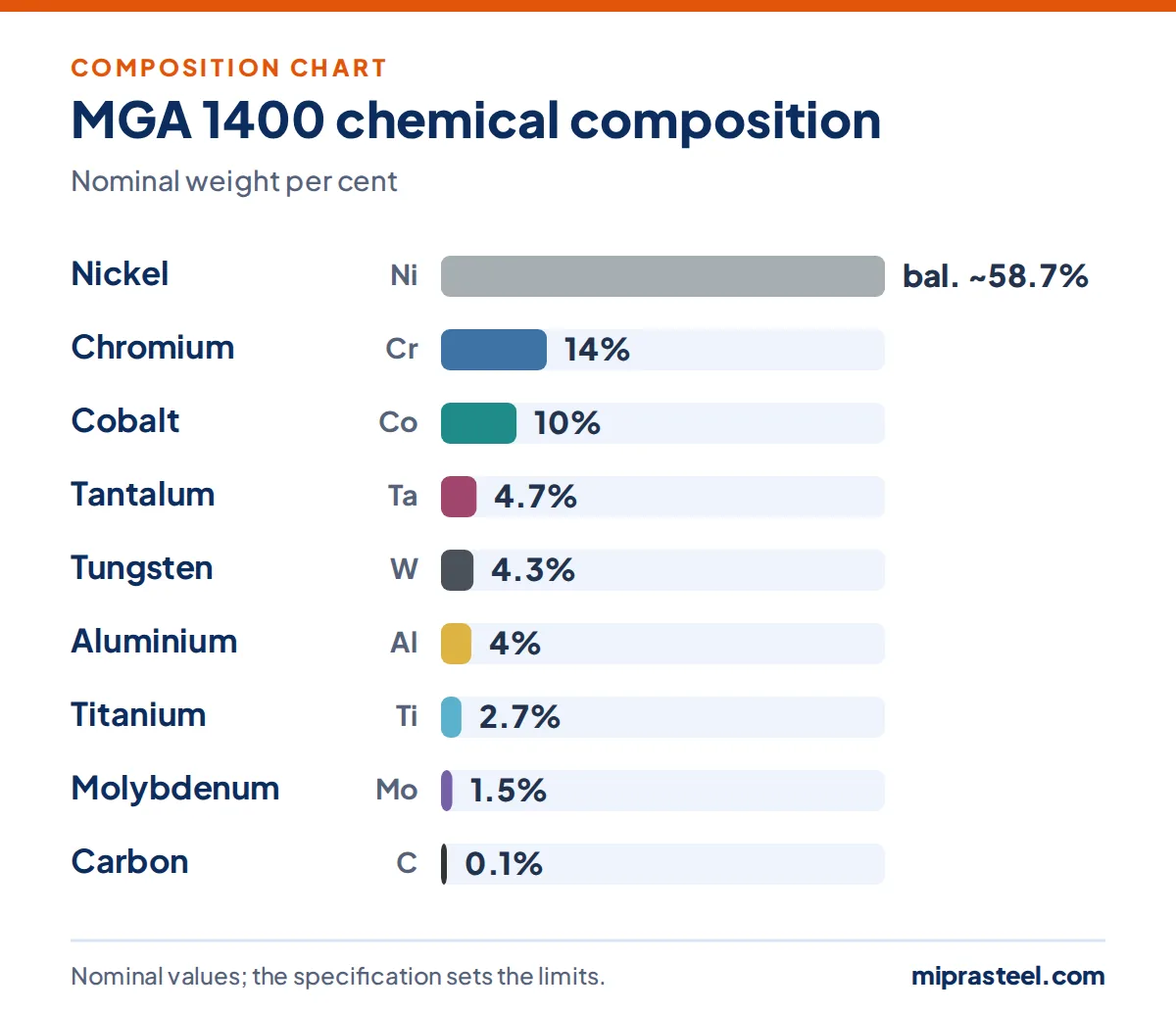
| Element | Symbol | Nominal wt% | |
|---|---|---|---|
| Nickel | Ni | Balance (about 58.7) | |
| Chromium | Cr | 14 | |
| Cobalt | Co | 10 | |
| Tantalum | Ta | 4.7 | |
| Tungsten | W | 4.3 | |
| Aluminium (aluminum) | Al | 4 | |
| Titanium | Ti | 2.7 | |
| Molybdenum | Mo | 1.5 | |
| Carbon | C | 0.1 |
MGA 1400 Equivalent Grades and Other Names
| Designation | Value |
|---|---|
| Trade name | MGA 1400 |
| UNS | Not assigned (proprietary Mitsubishi Heavy Industries alloy) |
| W.Nr. / EN | Not assigned |
| Other names in the trade | MGA1400 |
Look up any designation in the grade name converter or the equivalent grade chart.
MGA 1400 Standards and Specifications
Mitsubishi Heavy Industries specification.
MGA 1400 Applications
- Industrial gas turbine rotating blades
Source industries: power generation.
How MGA 1400 Scrap Is Identified
Chemistry narrows MGA 1400 down to a short list of 14% chromium blade alloys. Grain structure and records do the rest.
| Check | What it shows for MGA 1400 |
|---|---|
| Titanium against tantalum | About 2.7% titanium with 4.7% tantalum is the MGA 1400 signature. GTD-111 reverses it, with more titanium than tantalum. |
| Aluminium | About 4%, higher than the 3% in GTD-111. A light-element capable XRF or OES is needed to read it reliably. |
| Niobium and rhenium | Both should be absent. Niobium points towards a vane alloy such as MGA 2400; rhenium points to an aero single-crystal alloy. |
| Hafnium | A clear hafnium reading on a blade otherwise matching MGA 1400 suggests the DS version. |
| Grain structure | Equiaxed grains after a light etch or grit blast confirm conventional casting. Long grains along the airfoil indicate DS. |
| Origin | The turbine model, the stage and the blade part number are what let a buyer accept the description. Readings alone cannot separate CC from DS. See XRF testing of nickel alloys. |
Grades Most Often Confused with MGA 1400
- GTD-111: same 14% chromium, but about 4.9% titanium, 2.8% tantalum and 3% aluminium.
- MGA 1400 DS: the same base chemistry with a hafnium addition, cast with columnar grains.
- PWA 1483: grown as a single crystal, lower in chromium (12.2%) and higher in titanium (4.1%), with 5% tantalum.
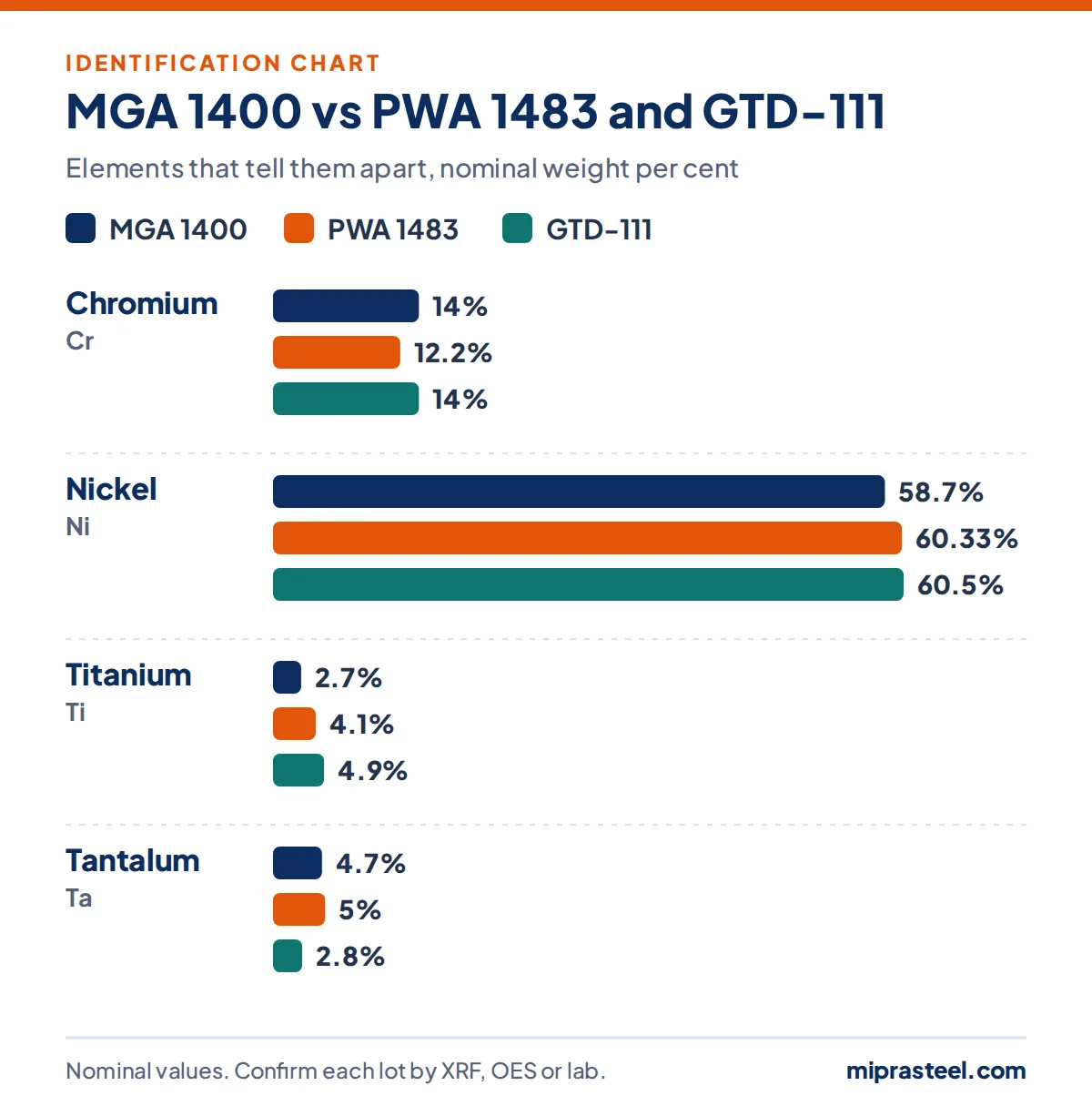
Nominal values for MGA 1400 against its closest grades on this site.
Preparing MGA 1400 Scrap for Sale
- Keep MGA 1400 blades apart from MGA 1400 DS blades, even if they came off the same turbine.
- Label each package with the turbine model and stage where known.
- Pull out seal pins, shims and locking pieces from the roots.
- Keep revert, stripped blades and coated blades in separate packages.
- Photograph part numbers before packing.
MGA 1400 Scrap Price per Kg: What Decides It
There is no fixed MGA 1400 scrap price per kg. Offers are built on the metals inside, then adjusted for certainty and condition.
- Nickel and about 10% cobalt as the base of the offer.
- Tantalum at about 4.7% and tungsten at about 4.3%, which together give MGA 1400 more refractory content than many equiaxed blade alloys.
- Clear separation from GTD-111, MGA 1400 DS and the vane alloys removed in the same outage.
- Origin evidence: turbine model, stage and part numbers that confirm conventionally cast material.
- Coating condition, dovetail attachments and oxidation damage on ex-service blades.
Nickel, cobalt and tantalum prices move independently, so every offer carries a date. See the factors behind alloy scrap value.
MGA 1400 Scrap Import and Export
Importing MGA 1400 Scrap into India
Mitsubishi heavy-duty turbines are installed in many countries, and MGA 1400 blades leave those fleets when sets are replaced. Indian buyers import them through traders and overhaul channels. Each consignment is inspected before loading and travels with the pre-shipment inspection certificate, commercial invoice, packing list and bill of lading, arriving at Nhava Sheva, Mundra or Chennai. Insist that conventionally cast and DS blades travel in separate, labelled packages. Read more on importing nickel alloy scrap.
Exporting MGA 1400 Scrap from India
From India, MGA 1400 lots are exported by grade and casting route, named on the invoice and packing list, weighed, and packed in drums or crates inside containers from Nhava Sheva or Mundra. We serve buyers in Japan, South Korea and Saudi Arabia, and our offices in Dubai and South Korea keep us close to the East Asian and Gulf trade in turbine blade scrap. See documents for exporting alloy scrap.
Customs heading: 7503.00 (nickel waste and scrap). The HS code is the international tariff heading the scrap is declared under; national tariff lines add further digits, so confirm the full line with your customs broker.
Other MGA Scrap Grades
Related Reading
MGA 1400 Scrap FAQ
What is the difference between MGA 1400 and MGA 1400 DS?
The casting route and hafnium. MGA 1400 is conventionally cast with equiaxed grains. MGA 1400 DS is directionally solidified with columnar grains and carries a hafnium addition whose level is not published. Otherwise the base chemistry is the same, so documents and grain structure decide the description.
Who developed MGA 1400?
Mitsubishi Heavy Industries, together with Mitsubishi Materials, for the rotating blades of its industrial gas turbines. Published MHI work compared it with IN-738LC and reduced chromium from about 16% to 14%, with more tantalum and tungsten carrying the strength.
How do I tell MGA 1400 from GTD-111 on a reading?
Compare titanium and tantalum. MGA 1400 reads about 2.7% titanium and 4.7% tantalum. GTD-111 reads about 4.9% titanium and 2.8% tantalum. Aluminium also differs, about 4% against 3%, but needs OES or a light-element XRF setup.
Is MGA 1400 scrap the same as MGA 2400 scrap?
No. MGA 2400 is the vane alloy, with about 19% chromium, 19% cobalt, 6% tungsten and 1% niobium. MGA 1400 is the blade alloy with 14% chromium and 10% cobalt. Blades and vanes from one turbine should never share a container.
What customs code covers MGA 1400 scrap?
As a nickel-base alloy, MGA 1400 scrap is typically declared under HS 7503.00, nickel waste and scrap. Each country adds its own digits, so confirm the full code with your broker.
Can I send Mipra Steel an enquiry for a part set of MGA 1400 blades?
Yes. Part sets, single stages and revert are all welcome. Share the piece count, weight, turbine model, stage, coating condition and photographs, and any readings you have.
What is MGA 1400 made of?
Nominally 58.7% nickel, 14% chromium, 10% cobalt, 4.7% tantalum, 4.3% tungsten, 4% aluminium, 2.7% titanium, 1.5% molybdenum, 0.1% carbon. Specification ranges vary by product form and standard.
Published by Mipra Steel, Khetwadi, Mumbai · Updated