Haynes 214 Scrap Buyer, Importer and Exporter in India
Mipra Steel handles Haynes 214 scrap as a separate grade from its Khetwadi, Mumbai office, buying from furnace users, turbine overhaul shops and fabricators, and supplying documented lots to melters and traders.
Sell Haynes 214 Scrap
Replacing furnace belts or turbine seals made of 214? Tell us what the parts are, roughly how much they weigh, where they are and send clear photographs, including close-ups of any honeycomb backing. An OES or light-element XRF reading showing aluminium is the most useful thing you can add. We review incoming enquiries and respond with relevant next steps.
Buy Haynes 214 Scrap
Melt shops and traders looking for Alloy 214 can tell us the quantity, the forms they accept (sheet trim, belts, foil, solids) and whether they need aluminium confirmed by OES on every batch. Lots are described as Haynes 214, UNS N07214, and we can discuss which readings and photographs travel with them.
Why Does Haynes 214 Scrap Need Its Own Lot?
Most heat-resistant nickel alloys rely on a chromium oxide skin. Alloy 214 does something different: at around 950 °C (1,740 °F) and above its 4.5% aluminium grows a thin, tight layer of alumina, which holds up in hot air and combustion gas far longer than chromia does. That one trick explains where the alloy is used. Belts that carry ceramics and electronics through firing furnaces, honeycomb seals in gas turbines, flame hoods and burner cups all sit in oxidising heat for thousands of hours with little load on them.
For a scrap buyer, the same aluminium is the headache. A handheld XRF without light-element capability will show nickel, chromium and a little iron and stop there, so a 214 lot can be mistaken for Inconel 600 or a plain nickel-chromium alloy. The aluminium has to be confirmed by spark OES or an XRF set up for light elements. Until it is, the lot cannot honestly be called 214. See XRF, OES and lab analysis compared.
Whether that aluminium is welcome depends on the melt. A vacuum melter making 214 or another aluminium-bearing grade can use it. An air-melt foundry will see much of it go to slag, and will price the lot more like a nickel-chromium alloy. Knowing which buyer the lot suits is half the work of selling it.
Producer literature also lists a trace of yttrium and notes that the alloy age-hardens through gamma prime between about 595 °C (1,105 °F) and 925 °C (1,695 °F). Neither changes the scrap description, but the second explains why old belts and fixtures can be brittle and break up when handled.
Haynes 214 belongs to the Haynes family, part of nickel alloy scrap.
Where Haynes 214 Scrap Turns Up
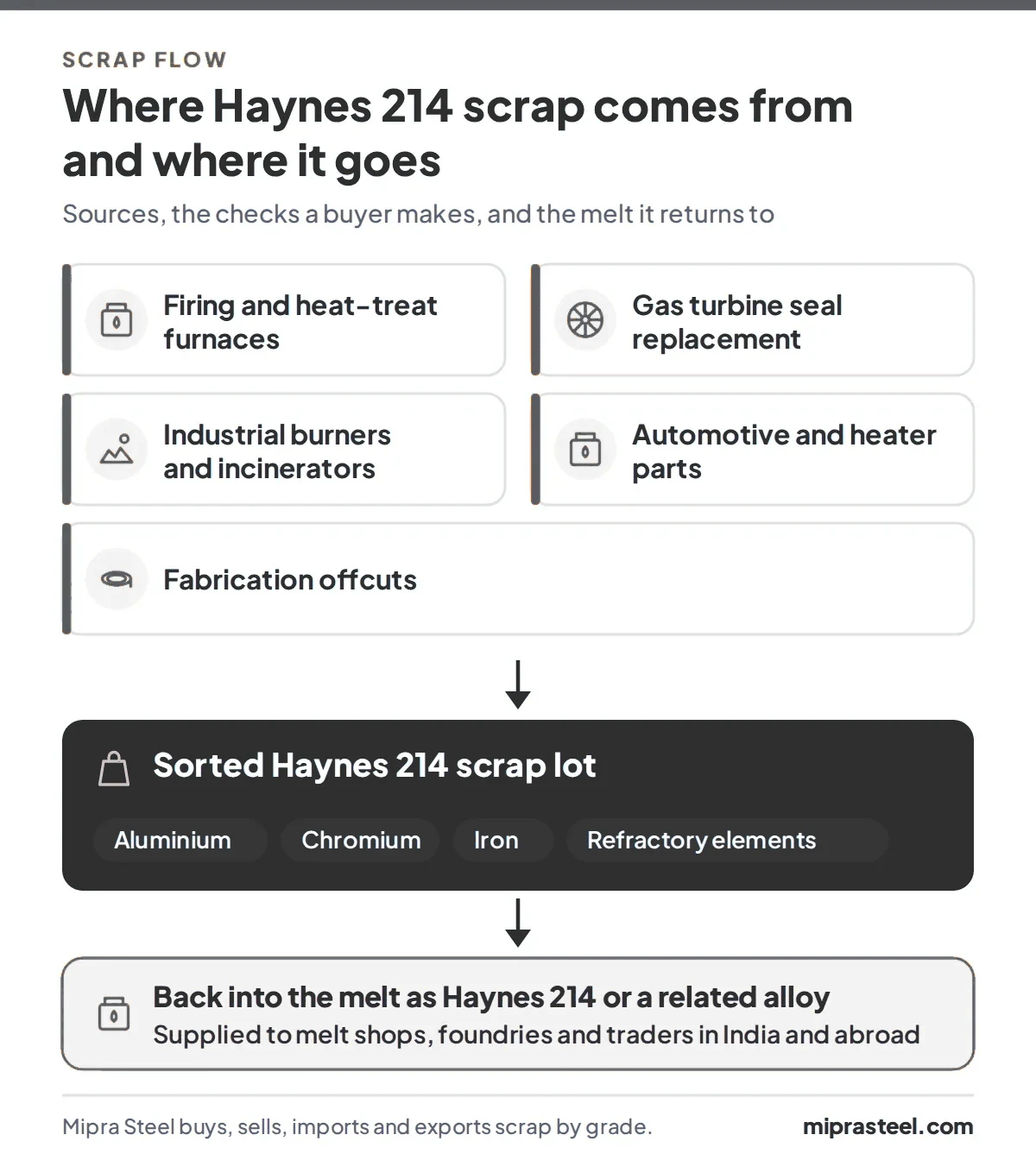
Alloy 214 is a niche grade, so it rarely appears in large tonnages. It comes out in small, recognisable batches when furnace kit or seals are replaced.
Firing and Heat-Treat Furnaces
Worn woven mesh belts, trays and fixtures from ceramic, electronics and technical-ceramic firing lines. Belts are long, tangled and often carry glaze or ceramic dust. See furnace and heat-treatment scrap.
Gas Turbine Seal Replacement
Foil honeycomb seals and combustor splash plates removed at overhaul. Honeycomb is usually brazed to a backing that may be a different alloy, so it is a mixed item until proven otherwise. See power generation scrap.
Industrial Burners and Incinerators
Flame hoods, burner cups, refractory anchors and internals from waste incinerators and chloride calciners. Service pieces are scaled and sometimes thinned.
Automotive and Heater Parts
Catalytic converter internals and burner cups for auxiliary heaters. Any ceramic or catalyst coating should be declared, not hidden.
Fabrication Offcuts
Sheet and plate trim and wire ends from shops making the parts above. These are the cleanest 214 a buyer will see.
Haynes 214 Scrap Specification Chart
| Grade | Haynes 214 |
|---|---|
| UNS | N07214 |
| W.Nr. / EN | Not assigned; specified by UNS N07214 |
| Also known as | Alloy 214 |
| Alloy type | Nickel-chromium-aluminium, alumina-forming |
| Density | 8.05 g/cm³ (0.291 lb/in³) |
| Magnetic | Non-magnetic. |
| HS code (customs heading) | 7503.00 (nickel waste and scrap) |
Haynes 214 Chemical Composition
Nominal values used on this site, checked against the published composition of HAYNES 214 from Haynes International. The right-hand column gives the published values; "max" marks a maximum. The specification on a mill certificate governs any particular product.
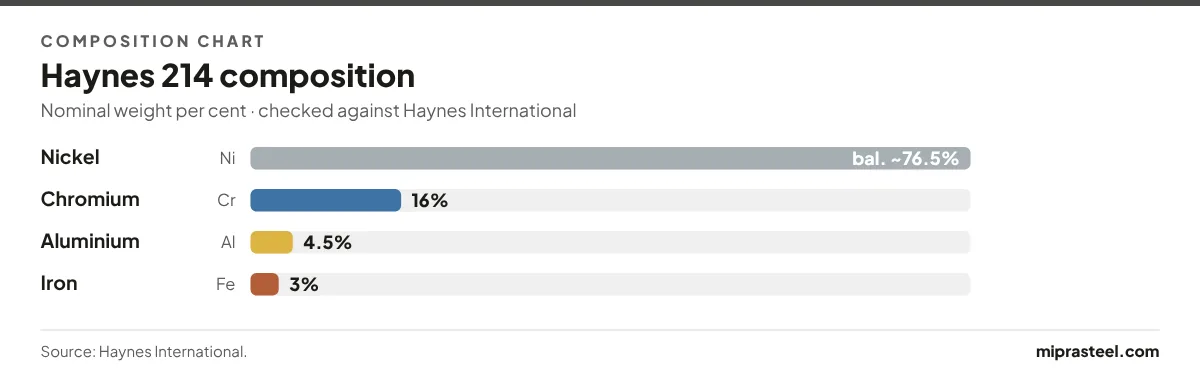
| Element | Symbol | Nominal wt% (this site) | Source value, wt% |
|---|---|---|---|
| Nickel | Ni | Balance (about 76.5) | Balance |
| Chromium | Cr | 16 | 16 |
| Aluminium (aluminum) | Al | 4.5 | 4.5 |
| Iron | Fe | 3 | 3 |
| Cobalt | Co | – | 2 max |
| Molybdenum | Mo | – | 0.5 max |
| Tungsten | W | – | 0.5 max |
| Manganese | Mn | – | 0.5 max |
| Silicon | Si | – | 0.2 max |
| Carbon | C | – | 0.04 |
Haynes 214 Equivalent Grades and Other Names
| Designation | Value |
|---|---|
| Trade name | Haynes 214 |
| UNS | N07214 |
| W.Nr. / EN | Not assigned; specified by UNS N07214 |
| Other names in the trade | Alloy 214 |
Look up any designation in the grade name converter or the equivalent grade chart.
Haynes 214 Standards and Specifications
Supplied to producer and AMS specifications.
Haynes 214 Applications
- Furnace mesh belts and heat-treat fixtures
- Honeycomb seals in gas turbines
- Catalytic converter internals
- Flame hoods and burner parts
Source industries: heat treatment and furnaces, aerospace.
How Haynes 214 Scrap Is Identified
Because the useful element is a light one, identification of 214 is a two-step job: a quick screen for the heavy elements, then a method that sees aluminium.
| Check | What it shows for Haynes 214 |
|---|---|
| Aluminium | About 4.5% aluminium is the signature. It must be read by spark OES or a light-element XRF; a standard handheld reading that omits aluminium proves nothing. |
| Chromium | Around 16%, lower than most heat-resistant sheet alloys, which usually sit at 20% to 23%. |
| Iron | About 3%. A reading near 8% points to Inconel 600, and 14% to Inconel 601. |
| Refractory elements | Molybdenum, tungsten and niobium should be close to zero. Several percent of any of them means a different alloy. |
| Magnet | Non-magnetic. A belt that grabs a magnet is a steel or a different alloy, or has been carburised badly enough to need a second look. |
| Construction | On honeycomb seals, test the honeycomb and the backing separately. The braze joint and backing are often not 214. |
Grades Most Often Confused with Haynes 214
- Inconel 601: also carries aluminium, but only about 1.4%, with 23% chromium and 14% iron.
- Inconel 600: has similar nickel and 15.5% chromium, but about 8% iron and no aluminium.
- Inconel 713C: is a cast alloy with even more aluminium (about 6.1%), plus 4.2% molybdenum and 2% niobium.
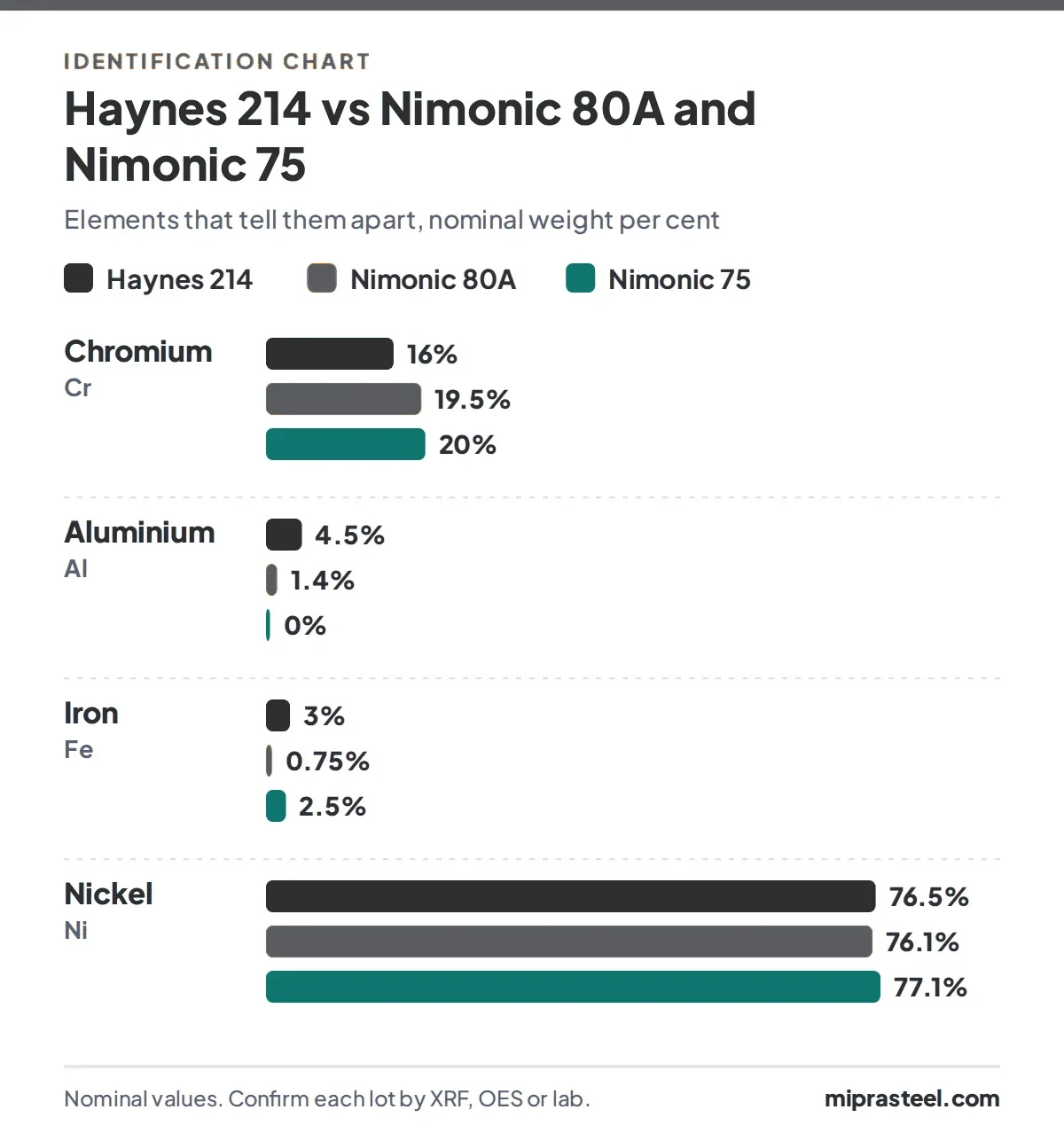
Nominal values for Haynes 214 against its closest grades on this site.
Preparing Haynes 214 Scrap for Sale
- Cut long mesh belts into manageable lengths and bale or bag them, so they can be weighed and inspected.
- Separate honeycomb seals from their backing rings where possible, or bag them as a declared mixed item.
- Knock off loose ceramic, glaze and scale before weighing.
- Get an OES or light-element XRF reading for aluminium on each batch.
- Keep 214 away from Inconel 600, 601 and stainless steel parts from the same furnace.
Haynes 214 Scrap Price per Kg: What Decides It
Alloy 214 carries no molybdenum, cobalt or tungsten, so its price per kg rests on nickel and on how well the lot is documented and prepared.
- Contained nickel, around three quarters of the weight, with chromium adding modest value.
- Proof of aluminium: a lot confirmed as 214 by OES can go to a buyer who wants the aluminium; an unconfirmed lot is offered as nickel-chromium scrap.
- The buyer's melting route, since aluminium is useful in a vacuum melt and largely lost in an air melt.
- Service condition: scaled, embrittled or thinned belts and fixtures yield less metal per kg than clean offcuts.
- Foreign material: brazed backings, ceramic residue, glaze or catalyst coatings must be removed or declared, and they reduce the offer.
- Volume: 214 arrives in small batches, so combining several into one documented lot makes it easier to place.
Each offer is tied to the nickel market on the day it is made. For the general method, read how nickel alloy scrap is valued.
Haynes 214 Scrap Import and Export
Importing Haynes 214 Scrap into India
Alloy 214 reaches India in small parcels, mostly as part of mixed heat-resistant consignments from Europe, East Asia and the Gulf, where turbine overhaul shops and furnace operators replace seals and belts. Because the grade depends on aluminium, ask the shipper for OES results rather than a standard XRF printout before the lot is described as 214. Imported scrap normally travels with a pre-shipment inspection certificate, commercial invoice, packing list and bill of lading. Read how nickel alloy scrap is imported into India. We buy as a nickel alloy scrap importer and buyer in India.
Exporting Haynes 214 Scrap from India
Indian ceramic, electronics and heat-treatment plants generate worn 214 belts and fixtures, but in quantities too small for most overseas melters on their own. Grouping them into one described lot, with aluminium readings, makes export practical. Lots are declared by grade and UNS number, weighed and shipped in bags or bins inside containers from Nhava Sheva or Mundra. Buyers in Japan and South Korea can be reached through our Korea office. See export documents for alloy scrap. Lots leaving India go through our nickel alloy scrap exporter desk.
Customs heading: 7503.00 (nickel waste and scrap). Confirm the full national tariff line with your customs broker.
Other Haynes Scrap Grades
Related Reading
Haynes 214 Scrap FAQ
Why does my XRF reading not show Haynes 214 correctly?
Most basic handheld XRF guns cannot measure aluminium, which is the element that defines 214. The reading shows mainly nickel, chromium and a little iron, so the grade library may match it to Inconel 600 or a nickel-chromium alloy. Spark OES or an XRF configured for light elements will show the 4.5% aluminium and settle it.
Are old Haynes 214 furnace belts worth selling?
Yes, they are still around three quarters nickel. Service belts carry scale, ceramic dust and sometimes embrittlement, so they yield less metal than new offcuts and are priced on that basis. Cutting them into lengths, cleaning off loose debris and confirming aluminium by OES all help a buyer make a firmer offer.
Is Haynes 214 the same as Inconel 601?
No. Both use aluminium for oxidation resistance, but 601 has only about 1.4% aluminium with 23% chromium and 14% iron. Haynes 214 has about 4.5% aluminium, 16% chromium and only 3% iron. The iron difference shows up on any XRF, which makes the two easy to separate.
What do I do with honeycomb seals that contain 214?
Declare them as a seal assembly rather than solid 214. The foil honeycomb may be 214, but it is brazed to a backing that is often another alloy, and the braze adds its own elements. Either separate the honeycomb from the backing or sell the assemblies as a described mixed lot with readings from both parts.
Which HS code covers Haynes 214 scrap?
Alloy 214 is nickel-base, so its scrap is typically declared under HS 7503.00, nickel waste and scrap. The digits after the six-digit heading vary by country, so check the exact tariff line with your customs broker before booking the shipment.
Can Mipra Steel buy a small lot of 214 belts?
Yes, small lots can be discussed. Send the weight, the location, photographs and any aluminium readings. Small batches of 214 are often combined with similar material to make a lot that a melter will take, so clear documentation matters more than size.
Does Haynes 214 rust or pick up a magnet?
It does neither. Alloy 214 is non-magnetic and contains only about 3% iron, so it will not rust like steel. A strongly magnetic piece in a 214 lot is almost certainly a steel fixture or a different alloy and should be pulled out. See magnet testing for scrap sorting.
What is Haynes 214 made of?
Nominally 76.5% nickel, 16% chromium, 4.5% aluminium, 3% iron. Specification ranges vary by product form and standard.
Sources and Review
Figures are quoted as published in these sources; any value we could not confirm has been left out.
- Haynes International, alloy nominal compositions table: HAYNES 214.
- Values for other grades named in comparisons and identification charts are taken from those grades' own pages on this site, where each source is listed.
Published by Mipra Steel, Khetwadi, Mumbai · Last updated