Hastelloy C-276 Scrap Buyer, Importer and Exporter in India
Mipra Steel buys and sells Hastelloy C-276 scrap from Mumbai, working with plants, fabricators, machine shops and traders in India and abroad, and supplying graded lots to melt shops and consumable makers.
Sell Hastelloy C-276 Scrap
To sell C-276 scrap, send the weight, the form (plate, sheet, forgings, turnings or scrubber lining) and the location, with photographs that show both faces of any lining material. Say whether turnings are dry and how they were collected. Readings or mill certificates shorten the conversation considerably. We review incoming enquiries and respond with relevant next steps.
Buy Hastelloy C-276 Scrap
Buying C-276 for remelting or for consumable production? Give us the quantity, the forms your process accepts, any limits on iron or cobalt, the destination port and the delivery window. Solid lots and turnings are offered separately and described by grade and UNS N10276. If you can use composite scrubber material, say so, because it is offered as its own category.
What Makes C-276 Scrap Worth Keeping as a Single Grade?
Ask a corrosion engineer for one alloy that will survive wet chlorine, hypochlorite, chloride-contaminated mineral acids and seawater in the same plant, and C-276 is the usual answer. It handles both oxidising and reducing chemistry better than grades built mainly on chromium or mainly on molybdenum, and it can go into service as welded. That flexibility put it into scrubbers, bleach plants, pickling lines and reactors around the world, so C-276 turns up in the scrap trade far more regularly than the narrower B-2 or X grades.
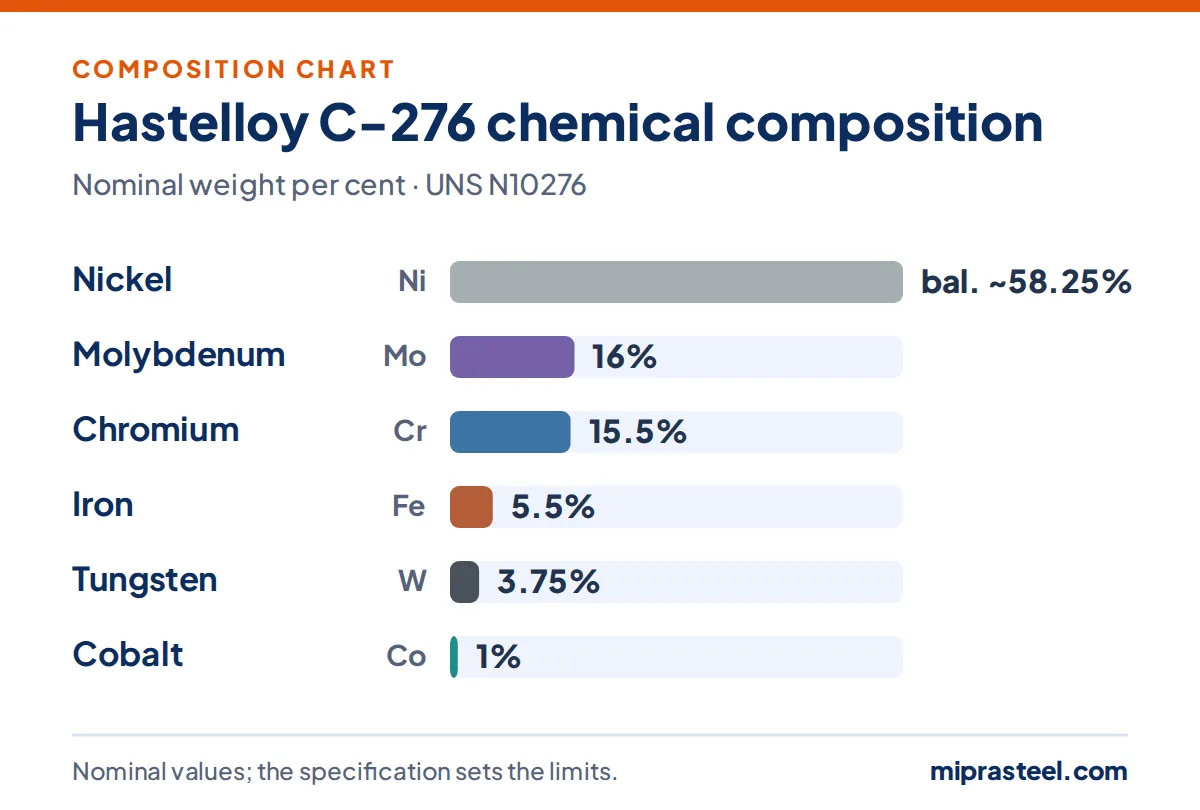
Its chemistry is three alloying metals deep. Roughly 16% molybdenum and 15.5% chromium do the corrosion work, and about 3.75% tungsten adds to it. Iron is held near 5.5%, cobalt around 1%. For a melt shop making C-276, or making welding consumables to ERNiCrMo-4, which is C-276 chemistry, a single-grade lot drops straight into the charge. That is what a buyer is paying for, and why a lot sorted to grade is worth more than "mixed Hastelloy".
The difficulty is that C-276 shares a plant, a pipe rack and sometimes a scrap bin with Inconel 625, Hastelloy C-22 and C-4. All four are non-magnetic, silvery and heavy. Only an analyser separates them reliably, and the deciding element is often tungsten.
A second complication is specific to flue-gas desulfurization. Many scrubber ducts and stacks were lined by welding thin C-276 sheet over carbon steel, a method known as wallpapering. When that lining comes out, the scrap is a composite, and it is traded very differently from solid plate.
Hastelloy C-276 belongs to the Hastelloy family, part of nickel alloy scrap.
Where Does C-276 Scrap Actually Come from?
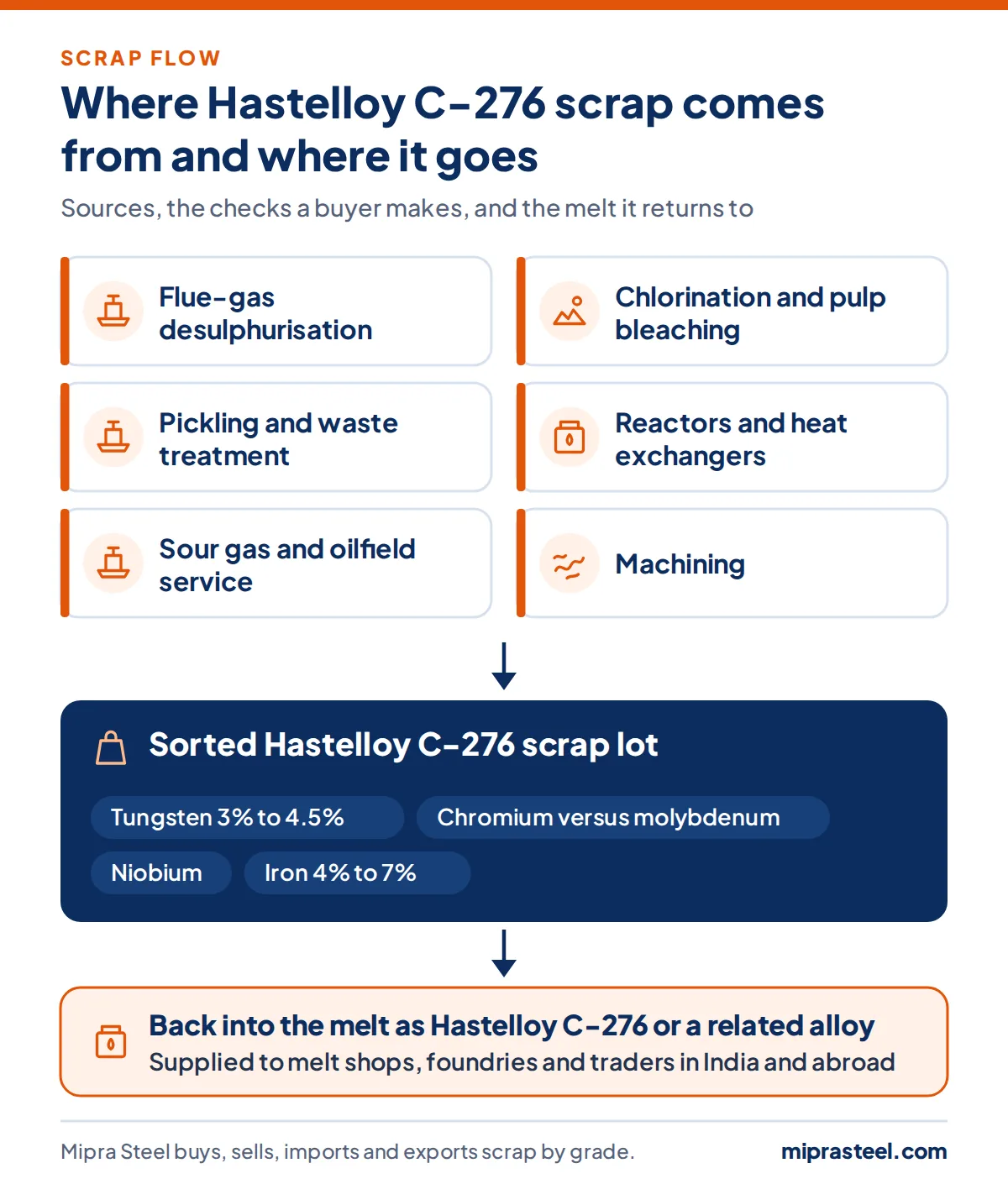
C-276 arrives from many directions. Each source leaves a different kind of lot, and knowing which one you have tells a buyer most of what to expect.
Flue-Gas Desulfurization
Absorber outlets, ducts, dampers and chimney flues on coal-fired units. Relining yields wallpaper sheet still welded to steel, plus solid trim and fasteners. See power generation scrap.
Chlorination and Pulp Bleaching
Bleach towers, mixers, washers and chlorine dioxide equipment. These parts are often solid C-276 plate and formed heads, released during capacity upgrades.
Pickling and Waste Treatment
Acid tanks, heating coils, fan housings and agitators from steel pickling and effluent plants, frequently with heavy scale that should be cleaned before sale.
Reactors and Heat Exchangers
Tube sheets, channels, shells and baffles from chemical reactors and exchangers. Exchanger tubes are part of the equipment, not a separate lot type, and are cut and bagged with the rest of the solid C-276.
Sour Gas and Oilfield Service
Valve trim, downhole and wellhead components chosen for hydrogen sulphide environments under NACE MR0175 / ISO 15156 rules.
Machining
Flanges, fittings and valve bodies machined from B574 bar and B564 forgings leave C-276 turnings, a common form of the alloy in the scrap trade.
Hastelloy C-276 Scrap Specification Chart
| Grade | Hastelloy C-276 |
|---|---|
| UNS | N10276 |
| W.Nr. / EN | 2.4819 |
| Also known as | Hastelloy C276, Alloy C-276 |
| Alloy type | Solid-solution nickel-molybdenum-chromium-tungsten |
| Density | 8.89 g/cm³ (0.321 lb/in³) |
| Magnetic | Non-magnetic. |
| HS code (customs heading) | 7503.00 (nickel waste and scrap) |
Hastelloy C-276 Chemical Composition
Nominal composition in weight per cent, used to describe and identify the grade. The governing specification sets the limits for each product.
| Element | Symbol | Nominal wt% | |
|---|---|---|---|
| Nickel | Ni | Balance (about 58.3) | |
| Molybdenum | Mo | 16 | |
| Chromium | Cr | 15.5 | |
| Iron | Fe | 5.5 | |
| Tungsten | W | 3.8 | |
| Cobalt | Co | 1 |
Hastelloy C-276 Equivalent Grades and Other Names
| Designation | Value |
|---|---|
| Trade name | Hastelloy C-276 |
| UNS | N10276 |
| W.Nr. / EN | 2.4819 |
| Other names in the trade | Hastelloy C276, Alloy C-276 |
Look up any designation in the grade name converter or the equivalent grade chart.
Hastelloy C-276 Standards and Specifications
Hastelloy C-276 Applications
- Flue-gas desulfurization scrubbers
- Chlorination and pulp-bleach equipment
- Pickling and waste-treatment plant
- Reactors and heat exchangers
- Sour gas components
Source industries: chemical processing, oil and gas, power generation.
How Hastelloy C-276 Scrap Is Identified
With C-276, identification is less about proving the grade and more about proving that nothing else crept in. A reading on each piece answers both questions.
| Check | What it shows for Hastelloy C-276 |
|---|---|
| Tungsten 3% to 4.5% | The fingerprint. Inconel 625 and C-4 carry essentially none, so tungsten in that band with 16% molybdenum points to C-276. |
| Chromium versus molybdenum | In C-276 the two sit close together, about 15.5% and 16%. If chromium clearly leads, at about 22% against 13% molybdenum, it is C-22. |
| Niobium | Should be absent. About 3.6% niobium with 9% molybdenum is Inconel 625. |
| Iron 4% to 7% | A useful cross-check: B-2 is far lower, and Hastelloy X is far higher at about 18.5%. |
| Steel backing | On scrubber parts, check the back face. A carbon-steel substrate under the alloy means wallpaper, which is weighed and described as composite material. |
| Certificates and filler | Mill certificates to ASTM B575 or B574 quoting N10276 or 2.4819. Filler wire marked ERNiCrMo-4 is C-276 chemistry and can sort with it. |
Grades Most Often Confused with Hastelloy C-276
- Hastelloy C-22: 22% chromium, 13% molybdenum and about 3% tungsten, so the chromium-to-molybdenum balance is reversed.
- Inconel 625: about 9% molybdenum and 3.6% niobium with no tungsten.
- Hastelloy C-4 (UNS N06455): 16% chromium and 16% molybdenum, like C-276, but without tungsten and with iron held to 3% or less. No separate page; named on its own when readings show it.
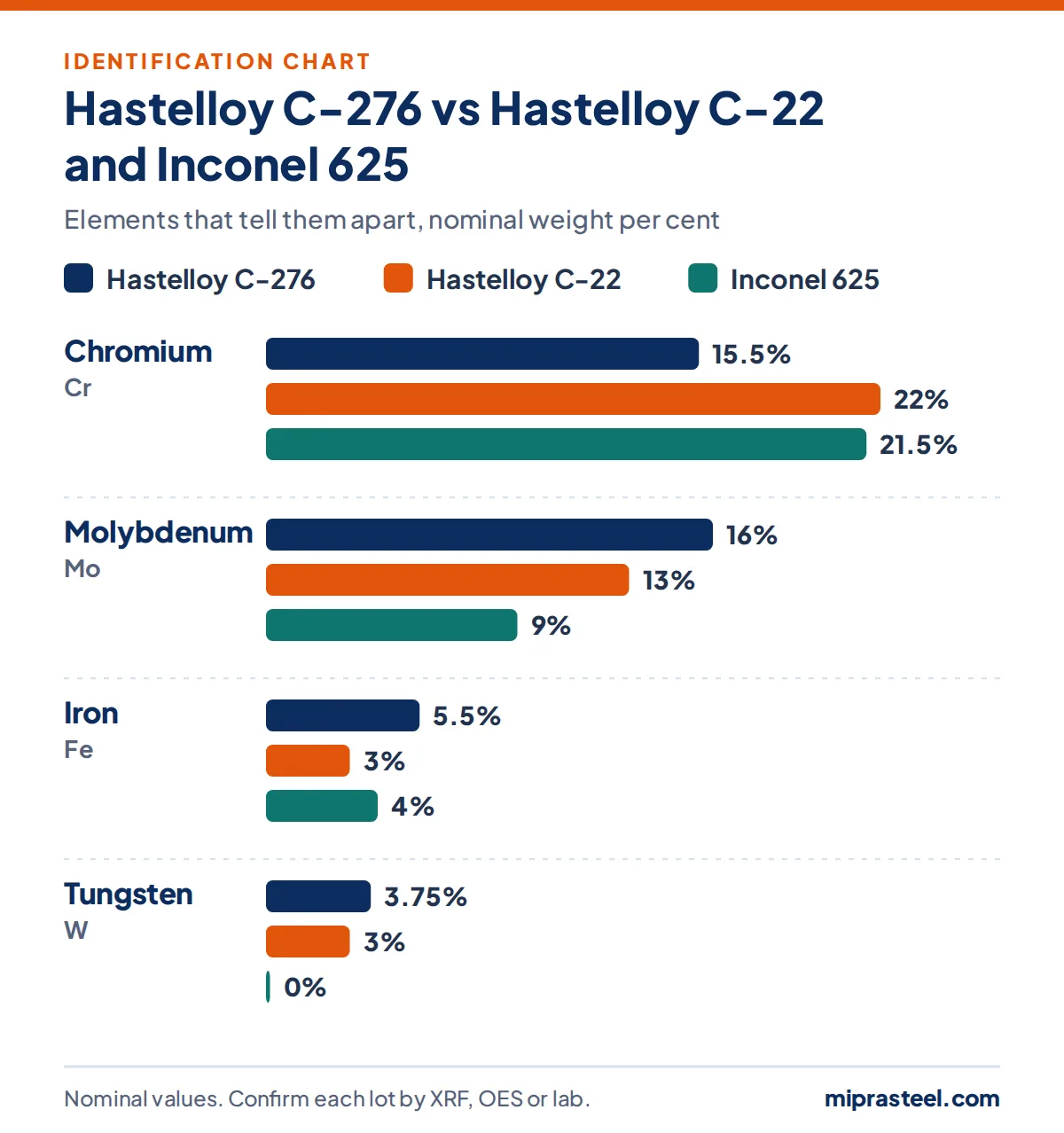
Nominal values for Hastelloy C-276 against its closest grades on this site.
Preparing Hastelloy C-276 Scrap for Sale
- Read every piece for tungsten and set aside anything without it.
- Keep wallpaper and other steel-backed lining in a separate, labelled lot.
- Knock off scale, gypsum and process deposits before weighing.
- Collect turnings by grade at the machine and drain them of coolant.
- Remove carbon-steel bolts, brackets and stainless fittings.
- Keep certificates or heat numbers with the bags they belong to.
Hastelloy C-276 Scrap Price per Kg: What Decides It
Searches for a C-276 scrap price per kg in India return asking prices with no basis. A real offer is built from the lot itself, and for C-276 these are the points that move it.
- Contained nickel, molybdenum and tungsten: three priced metals, so the offer tracks more than one market.
- Purity against neighbouring grades: a few pieces of 625 or C-22 in a C-276 lot lower confidence in the whole parcel.
- Solid or composite: wallpaper still bonded to carbon steel is valued on the alloy it carries, which is a small fraction of the weight.
- Turnings condition: dry, oil-free, single-grade turnings with no carbide tips are worth a good deal more than wet, mixed swarf.
- Scale and residue: pickling and scrubber parts carry deposits and gypsum that add weight but no metal.
- Documentation: certificates or heat numbers matched to the material let a buyer accept the lot without re-checking every piece.
Nickel and molybdenum prices are quoted daily, so offers carry a date. See the factors behind nickel alloy scrap value and common recycling mistakes.
Hastelloy C-276 Scrap Import and Export
Importing Hastelloy C-276 Scrap into India
C-276 reaching India can come from Gulf petrochemical and desalination maintenance, European chemical and power plant rebuilds, and East Asian fabrication. Imported metal scrap is inspected at origin and shipped with a pre-shipment inspection certificate, commercial invoice, packing list and bill of lading, usually into Nhava Sheva, Mundra or, for southern buyers, Chennai. Ask for C-276 to be packed and declared on its own rather than inside a general nickel alloy container; it keeps the customs description and the assay aligned. Read importing nickel alloy scrap into India.
Exporting Hastelloy C-276 Scrap from India
India has a large base of chemical, pharmaceutical and power plants, and C-276 from their maintenance and from fabrication shops is offered for export. Lots are described on invoice and packing list as Hastelloy C-276, UNS N10276, weighed and shipped in bags, drums or loose in containers. Our offices in the UAE and South Korea are near buyers in the Gulf and East Asia. The paperwork is set out in export documents for alloy scrap.
Customs heading: 7503.00 (nickel waste and scrap). The HS code is the international tariff heading the scrap is declared under; national tariff lines add further digits, so confirm the full line with your customs broker.
Comparisons
Other Hastelloy Scrap Grades
Related Reading
Hastelloy C-276 Scrap FAQ
What is the difference between C-276 and C-22 scrap?
Chromium and molybdenum swap places. C-276 has about 15.5% chromium and 16% molybdenum; C-22 has about 22% chromium and 13% molybdenum. Both carry tungsten, so tungsten alone will not separate them. Buyers want them in separate lots. A fuller comparison is on C-22 vs C-276.
Does Hastelloy C-276 contain tungsten?
Yes, between 3% and 4.5% by specification, nominally about 3.75%. It is the element that most quickly separates C-276 from Inconel 625 and Hastelloy C-4 on an XRF reading, since neither of those carries a meaningful amount.
Can scrubber wallpaper be sold as C-276 scrap?
It can be sold, but as composite material rather than solid C-276. Wallpaper is thin alloy sheet welded over carbon steel, so most of the weight is steel. It is valued on the C-276 it carries, and it must be kept out of solid lots or the whole lot is marked down.
Are C-276 turnings worth buying?
Yes, when they are single-grade, dry and clean. Turnings are a common form of C-276 scrap because many flanges and fittings are machined from it. Oil, moisture and carbide tool tips reduce their value, so buyers ask how they were collected.
Is C-276 scrap magnetic?
No. C-276 is non-magnetic, like 625, C-22 and B-2, so a magnet cannot separate it from them. A magnet does pick out carbon-steel backing and attachments. For grade, use analysis; see XRF sorting of nickel alloys.
What tariff code covers Hastelloy C-276 scrap?
C-276 is a nickel-base alloy, so its scrap is typically classified under HS 7503.00 (nickel waste and scrap). The full national line varies by country, and composite material may raise questions at customs, so check with your broker first.
How do I offer C-276 scrap to Mipra Steel?
Share the weight, form, location and photographs, plus readings or certificates if you have them. Separate solid material, turnings and steel-backed lining before you ask for an offer, since each is priced on its own terms.
Can C-276 scrap be used to make welding wire?
It can go into melts that produce C-276 chemistry, and ERNiCrMo-4 filler wire is C-276 chemistry. Consumable makers are strict about tramp elements, so only clean, single-grade and well documented lots suit that use.
What is Hastelloy C-276 made of?
Nominally 58.3% nickel, 16% molybdenum, 15.5% chromium, 5.5% iron, 3.8% tungsten, 1% cobalt. Specification ranges vary by product form and standard.
Published by Mipra Steel, Khetwadi, Mumbai · Updated