Haynes 282 Scrap Buyer, Importer and Exporter in India
Mipra Steel buys Haynes 282 scrap from forgers, machine shops, fabricators and additive manufacturers, and supplies traceable 282 lots to melters and traders, working from Khetwadi, Mumbai.
Sell Haynes 282 Scrap
Producing 282 crops, trim or turnings? Tell us the form, the monthly or one-off quantity, where the material is, and send photographs. Heat numbers or certificates, and readings that show cobalt and molybdenum, help us describe the lot. For powder or AM scrap, say how it is packed. We review incoming enquiries and respond with relevant next steps.
Buy Haynes 282 Scrap
Melters looking for Alloy 282 revert or traders building cobalt-bearing superalloy lots can tell us the tonnage, forms they accept (solids, sheet, turnings), the documents they need and the delivery port. Lots are described as Haynes 282, UNS N07208, and we can discuss what travels with them.
What Is Haynes 282 and Why Is Its Scrap Mostly New Material?
Alloy 282 was designed to close a gap. Older age-hardened alloys such as Waspaloy and René 41 are strong at 650 °C (1,200 °F) to 900 °C (1,650 °F) but crack easily when welded and heat treated, while easy-to-weld sheet alloys such as Nimonic C-263 give up creep strength. Alloy 282 keeps its gamma prime fraction low and slow to form, so it can be formed and welded in the annealed state, then aged to a strength the producer compares favourably with Waspaloy.
It is one of the younger wrought superalloys on the market, and that shapes the scrap. Engine cases, rolled rings, combustor liners and exhaust parts made from 282 are mostly still in service, so engine-run 282 is uncommon. What the market sees instead is manufacturing scrap: crops and flash from ring rolling and forging, sheet and plate trim, bar ends, rejected parts, and large volumes of turnings from machining cases and rings. Additive manufacturing adds support structures, failed builds and spent powder. New scrap like this usually has good traceability, which suits buyers who remelt it.
The other source to watch is power. Alloy 282 is one of the candidate materials for advanced ultra-supercritical steam plant, supercritical CO2 cycles and concentrating solar receivers. Development and pilot programmes in those fields produce test pieces and offcuts with mill paperwork attached.
In the furnace, 282 is valued for 10% cobalt and 8.5% molybdenum on top of nickel. Those two elements are what a buyer is paying for, and they are also what tells 282 apart from its neighbours on a reading.
Haynes 282 belongs to the Haynes family, part of nickel alloy scrap.
Who Generates Haynes 282 Scrap?
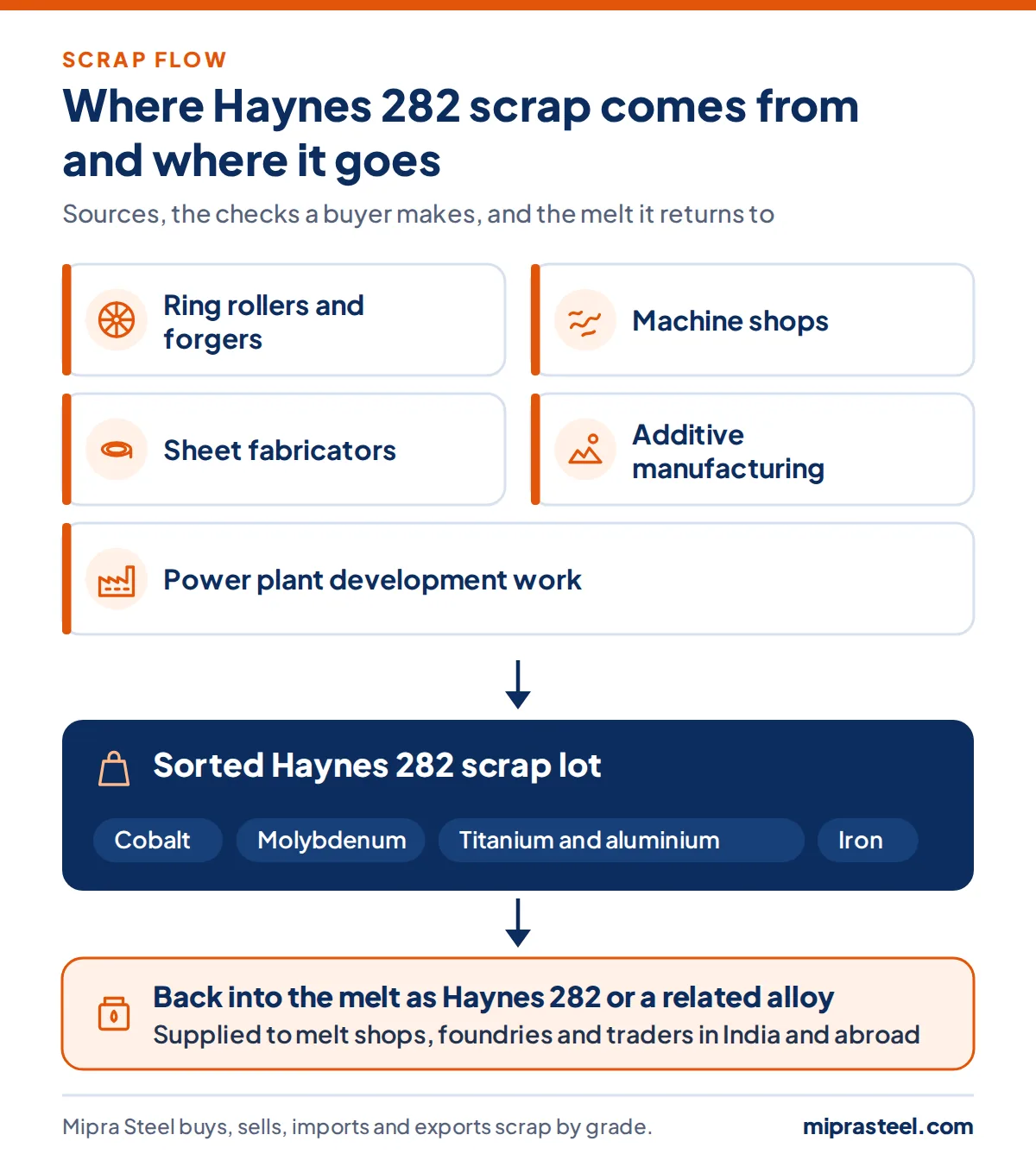
Expect 282 from the factory floor rather than the overhaul shop. The table lists the usual origins and what each one looks like.
Ring Rollers and Forgers
Crop ends, flash, test rings and rejected forgings for engine cases and seals. Heavy, clean solids that are easy to keep single-grade.
Machine Shops
Turnings and chips from casings, rings and exhaust parts. Large tonnage, but oily and easily contaminated. See tramp elements in remelting.
Sheet Fabricators
Combustor, liner and transition duct trim, weld test coupons and rejected formed parts.
Additive Manufacturing
Support structures, scrapped builds, build plates and used or out-of-specification powder. Powder is handled and described separately from solids.
Power Plant Development Work
Tube, plate and forging test pieces from advanced steam and supercritical CO2 programmes. See power generation scrap.
Haynes 282 Scrap Specification Chart
| Grade | Haynes 282 |
|---|---|
| UNS | N07208 |
| W.Nr. / EN | Not assigned; specified by UNS N07208 and AMS 5951 |
| Also known as | Alloy 282 |
| Alloy type | Precipitation-hardened (γ′) nickel superalloy |
| Density | 8.27 g/cm³ (0.299 lb/in³) |
| Magnetic | Non-magnetic. |
| HS code (customs heading) | 7503.00 (nickel waste and scrap) |
Haynes 282 Chemical Composition
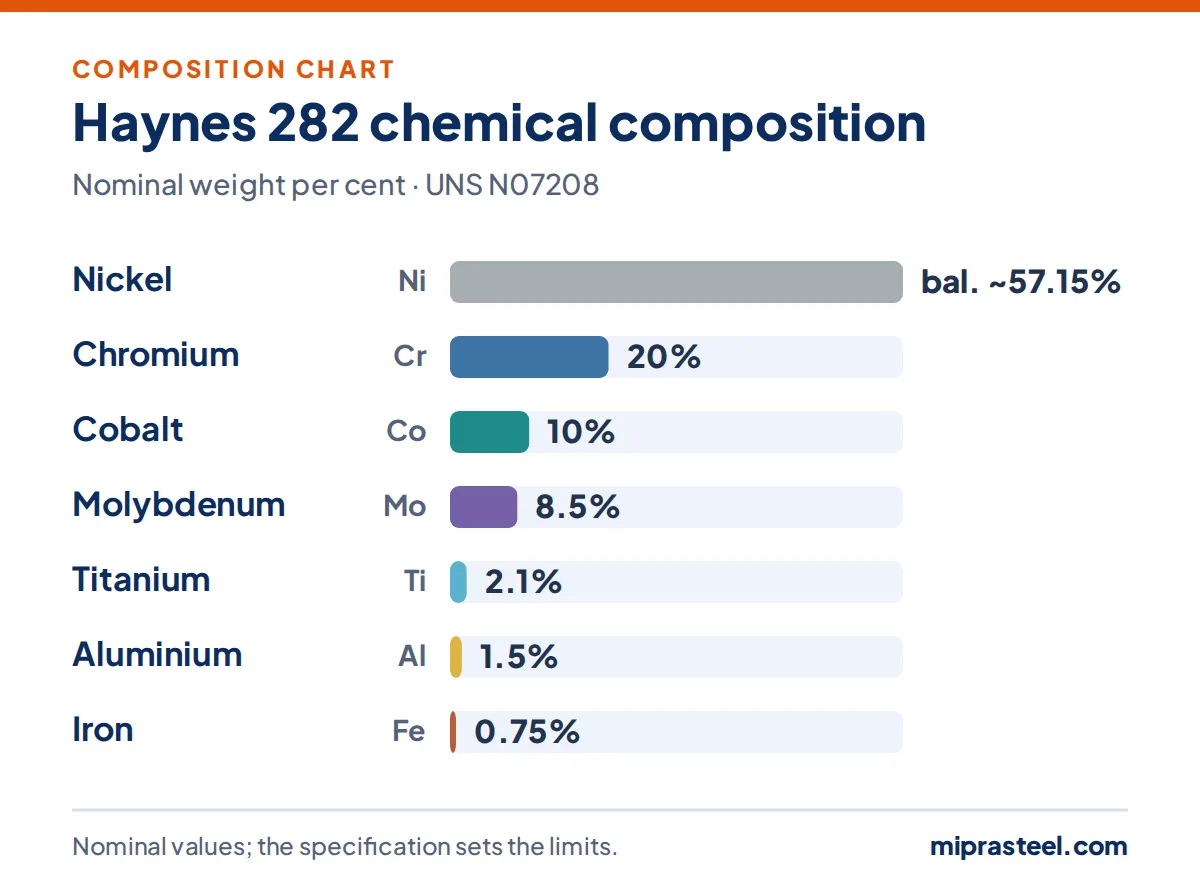
Nominal composition in weight per cent, used to describe and identify the grade. The governing specification sets the limits for each product.
| Element | Symbol | Nominal wt% | |
|---|---|---|---|
| Nickel | Ni | Balance (about 57.2) | |
| Chromium | Cr | 20 | |
| Cobalt | Co | 10 | |
| Molybdenum | Mo | 8.5 | |
| Titanium | Ti | 2.1 | |
| Aluminium (aluminum) | Al | 1.5 | |
| Iron | Fe | 0.75 |
Haynes 282 Equivalent Grades and Other Names
| Designation | Value |
|---|---|
| Trade name | Haynes 282 |
| UNS | N07208 |
| W.Nr. / EN | Not assigned; specified by UNS N07208 and AMS 5951 |
| Key specification | AMS 5951 |
| Other names in the trade | Alloy 282 |
Look up any designation in the grade name converter or the equivalent grade chart.
Haynes 282 Standards and Specifications
Haynes 282 Applications
- Aero and land gas turbine combustors, casings and rings
- Exhaust components
- Advanced ultra-supercritical steam plant components
Source industries: aerospace, power generation.
How Haynes 282 Scrap Is Identified
Alloy 282 sits in a crowded family of cobalt-bearing age-hardened alloys. The cobalt and molybdenum figures together are what place it.
| Check | What it shows for Haynes 282 |
|---|---|
| Cobalt | About 10%. Around 20% suggests C-263 or Udimet 500; around 13.5% suggests Waspaloy. |
| Molybdenum | About 8.5%, which is high for this type of alloy. Waspaloy reads about 4.3%, C-263 about 6%. |
| Titanium and aluminium | About 2.1% titanium and 1.5% aluminium. Aluminium needs OES or a light-element XRF to confirm. |
| Iron | Low, under about 1.5%. A cobalt-molybdenum reading with high iron points to a different alloy or contamination. |
| Traceability | Heat numbers, AMS 5951 or AMS 5915 certificates, and part numbers on rejected components let new scrap be described as 282 with confidence. See AMS specifications. |
Grades Most Often Confused with Haynes 282
- Nimonic C-263: has the same 20% chromium and similar titanium, but double the cobalt (20%) and less molybdenum (about 5.9%).
- Inconel 617: carries 12.5% cobalt and 9% molybdenum, close to 282, but only about 0.3% titanium and 22% chromium.
- Waspaloy: has about 13.5% cobalt, 19% chromium, 4.3% molybdenum and 3% titanium, so its molybdenum is half that of 282.
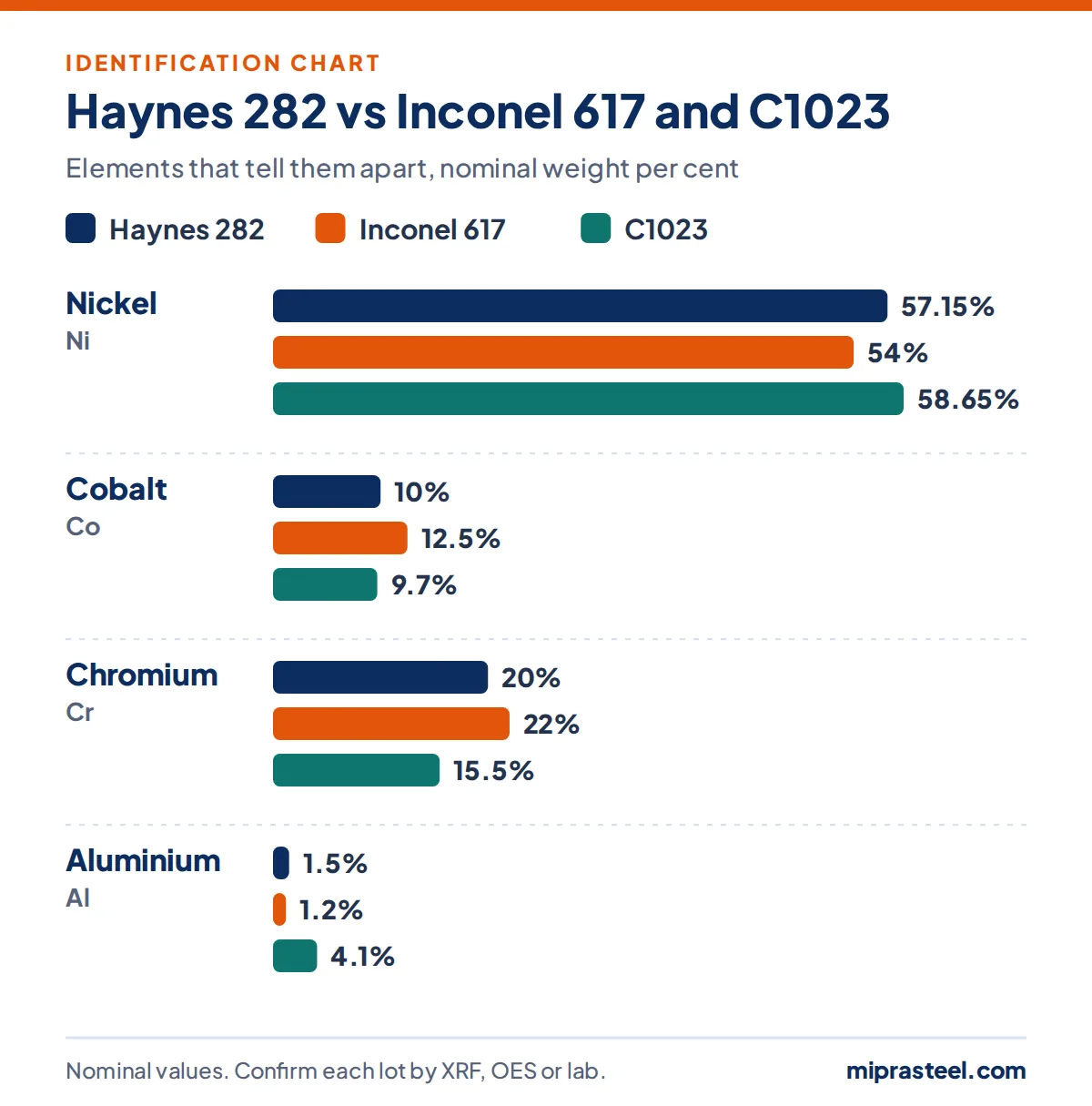
Nominal values for Haynes 282 against its closest grades on this site.
Preparing Haynes 282 Scrap for Sale
- Keep 282 apart from C-263, Waspaloy and 617, which are often machined in the same shops.
- Label each bin or drum with heat numbers where they are known.
- Drain coolant from turnings, keep them dry and remove inserts and tool tips.
- Pack powder in sealed, labelled containers, never loose with solids.
- Separate AM build plates, which may be a different alloy, from the 282 builds.
Haynes 282 Scrap Price per Kg: What Decides It
Offers for 282 scrap begin with the cobalt and molybdenum it carries, then reflect how cleanly the lot can be fed into a melt.
- Cobalt at about 10% and molybdenum at about 8.5%, both priced on their own markets, on top of nickel.
- Traceability: new scrap with heat numbers and certificates can be described exactly, which matters to buyers who remelt to specification.
- Single grade: 282 mixed with 263, 617 or Waspaloy loses its exact chemistry and is priced as a blend.
- Form: crops and forgings ahead of plate and sheet trim, then turnings, with powder valued on its own terms.
- Turnings condition: titanium and aluminium oxidise readily, so wet, oily or fine turnings lose value faster than solids.
- Volume and regularity: a steady monthly flow from one plant is easier to place than a single small batch.
Cobalt and molybdenum prices can move sharply, so an offer is only valid for its date. For the reasoning behind offers, see what decides nickel alloy scrap value.
Haynes 282 Scrap Import and Export
Importing Haynes 282 Scrap into India
Because 282 is mainly a manufacturing scrap, it comes from the countries that make engine rings, cases and combustors: Europe, North America and East Asia, with some flow through Gulf traders. A typical import is a lot of crops or turnings from one producer, often with heat-number lists. Ask for those lists and a sample reading before shipment. The consignment normally travels with a pre-shipment inspection certificate, commercial invoice, packing list and bill of lading. Our guide to importing nickel alloy scrap into India covers the steps.
Exporting Haynes 282 Scrap from India
Where Indian aerospace or power equipment shops machine or fabricate 282, the trim and turnings tend to be small but clean. Exported lots are declared as Haynes 282 with the UNS number on the invoice and packing list, weighed, and shipped in sealed drums or bags inside containers from Nhava Sheva or Mundra. Melters in Japan and South Korea are natural destinations, and our Korea office is close to them. See export documents for alloy scrap.
Customs heading: 7503.00 (nickel waste and scrap). The HS code is the international tariff heading the scrap is declared under; national tariff lines add further digits, so confirm the full line with your customs broker.
Other Haynes Scrap Grades
Related Reading
Haynes 282 Scrap FAQ
Is Haynes 282 the same as Nimonic C-263?
No, though they are close relatives. Both have about 20% chromium and 2% titanium, but 282 carries about 10% cobalt and 8.5% molybdenum, while C-263 carries about 20% cobalt and 6% molybdenum. A reading for cobalt alone is enough to separate them.
Why is there so little engine-run Haynes 282 scrap?
Because the alloy is relatively new and most parts made from it are still in service. Nearly all 282 scrap today is new material: forging crops, plate and sheet trim, rejected parts, turnings and additive manufacturing waste. Service scrap will grow as those parts reach the end of their lives.
Can additive manufacturing waste in 282 be sold?
Yes. Failed builds, supports and used powder can be sold, but each is described separately. Powder needs sealed containers and a statement of whether it has been through the machine. Build plates are often a different alloy and should be cut off or declared.
Which tariff heading is used for Haynes 282 scrap shipments?
Being nickel-base, 282 scrap is typically declared under HS 7503.00, nickel waste and scrap. Further digits depend on the importing country, so the full line should be confirmed with a customs broker before the invoice and packing list are finalised.
How do I sell 282 turnings to Mipra Steel?
Send the approximate weight, how often you generate them, the location, photographs and any readings or heat numbers. Turnings should be single-grade, drained and dry. We look at the details and respond with relevant next steps, and regular flows from one plant can be discussed as an ongoing arrangement.
Does 282 scrap need a light-element reading?
For a firm description, yes. A standard XRF shows nickel, chromium, cobalt, molybdenum and titanium, which already separates 282 from most alloys. Confirming the 1.5% aluminium needs spark OES or a light-element XRF, and some melters ask for it before accepting a lot.
What is Haynes 282 made of?
Nominally 57.2% nickel, 20% chromium, 10% cobalt, 8.5% molybdenum, 2.1% titanium, 1.5% aluminium, 0.75% iron. Specification ranges vary by product form and standard.
Published by Mipra Steel, Khetwadi, Mumbai · Updated