Titanium Grade 2 Scrap Buyer, Importer and Exporter in India
Mipra Steel handles Titanium Grade 2 scrap as a stand-alone grade from its Mumbai base, buying from plant owners, retubing contractors and fabricators, and supplying sorted lots to melters and traders.
Sell Titanium Grade 2 Scrap
Planning a condenser retube or plant rebuild with titanium in it? Tell us the equipment, the approximate weight of Grade 2, what metals it is attached to, and where it is. Photographs, equipment data sheets and any stencilled grade marks help us describe the lot. We review incoming enquiries and respond with relevant next steps.
Buy Titanium Grade 2 Scrap
If your melt shop or trading desk needs CP titanium feed, ask for Grade 2 by form and source: plate and heads, bar ends, or material from a named plant rebuild. Share quantity, acceptable residuals, the documents you require and the delivery port. We can discuss lots described by grade and UNS number.
Why Is Grade 2 the Titanium Scrap Most Plants Generate?
Ask a plant engineer which titanium is in the condenser, the brine heater or the chlorine cooler and the answer is usually Grade 2. It sits in the middle of the commercially pure range: strong enough for pressure parts at around 345 MPa minimum tensile, still easy to form and weld, and fully resistant to seawater. Because so much equipment is built from it, Grade 2 is the CP titanium that turns up most often when plants are rebuilt.
That volume shapes how the scrap trades. Melters making CP titanium ingot and slab want Grade 2 feed in quantity, and they want it consistent. A container of one grade from one plant, with the original equipment data, is easy to use. The same weight gathered from ten small jobs, with a few Grade 5 fasteners and some palladium-grade spool pieces mixed in, is not. On XRF, Grade 2 shows nothing but titanium and a little iron, so anything else in the spectrum is a warning sign.
The main complication with Grade 2 scrap is rarely the titanium itself. It is what the titanium was attached to: copper-nickel or steel tubesheets, carbon steel supports, rubber-lined flanges, painted marine fittings. Sorting that out at source decides much of the value. For the wider titanium family, see titanium scrap, and for alloyed material, the Grade 5 page.
Titanium Grade 2 belongs to the Titanium family, part of exotic alloy scrap.
Where Titanium Grade 2 Scrap Comes From
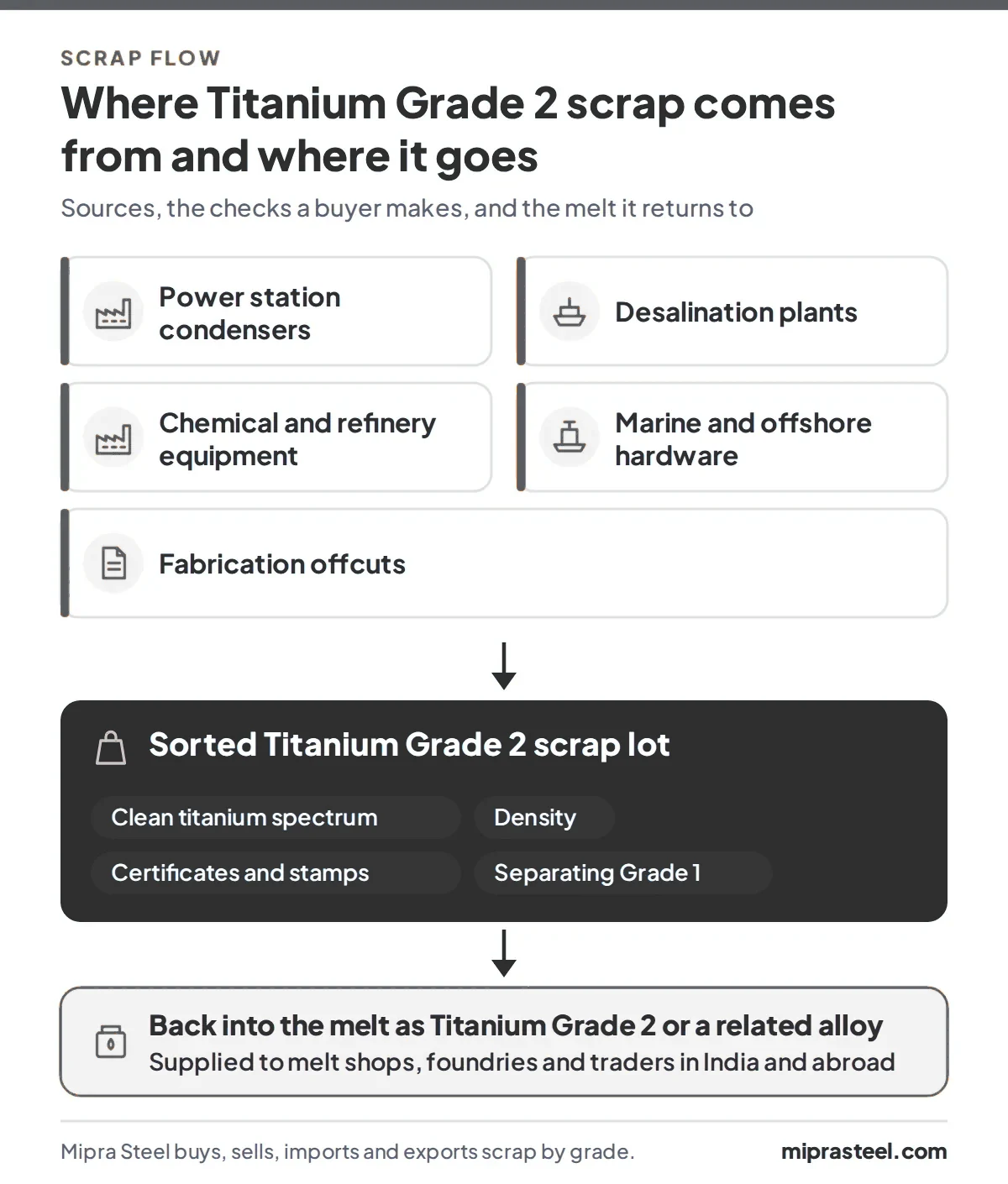
Grade 2 is released mostly in large maintenance events, which is why it often arrives in big, single-site lots.
Power Station Condensers
Seawater-cooled surface condensers built with titanium tubes to ASTM B338 are periodically retubed or replaced. See power generation scrap.
Desalination Plants
Brine heaters, heat-recovery sections and seawater pumps in thermal desalination plants use Grade 2 widely, and rebuilds release plate and tube. See desalination scrap.
Chemical and Refinery Equipment
Vessels, exchanger shells, and piping to B861 and B862 in chloride, bleach and oxidising-acid service. Plant replacements release plate, formed heads and fittings.
Marine and Offshore Hardware
Seawater systems, fittings and fabricated parts on ships and platforms, often painted or with attached steel. See marine scrap.
Fabrication Offcuts
Plate crops, skeletons and bar ends to ASTM B265 and B348 from shops building the equipment above, usually clean and with certificates.
Titanium Grade 2 Scrap Specification Chart
| Grade | Titanium Grade 2 |
|---|---|
| UNS | R50400 |
| W.Nr. / EN | 3.7035 |
| Also known as | CP titanium Grade 2 |
| Alloy type | Commercially pure titanium |
| Density | 4.51 g/cm³ (0.163 lb/in³) |
| Magnetic | Non-magnetic. |
| HS code (customs heading) | 8108.30 (titanium waste and scrap) |
Titanium Grade 2 Chemical Composition
Nominal composition in weight per cent, used to describe and identify the grade. The governing specification sets the limits for each product.
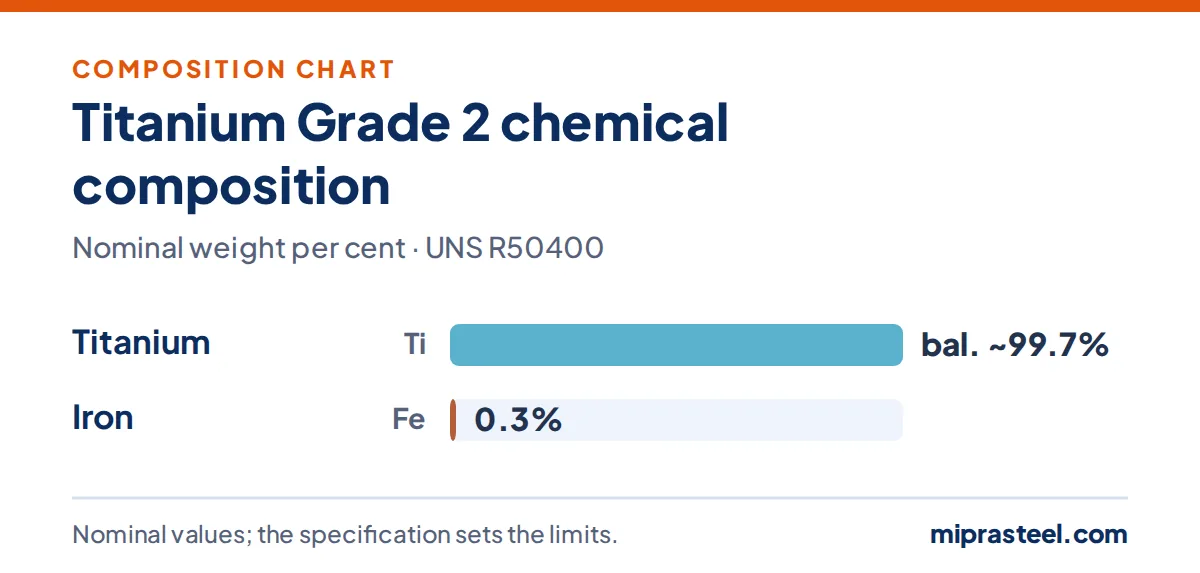
| Element | Symbol | Nominal wt% | |
|---|---|---|---|
| Titanium | Ti | Balance (about 99.7) | |
| Iron | Fe | 0.3 |
Titanium Grade 2 Equivalent Grades and Other Names
| Designation | Value |
|---|---|
| Trade name | Titanium Grade 2 |
| UNS | R50400 |
| W.Nr. / EN | 3.7035 |
| Other names in the trade | CP titanium Grade 2 |
Look up any designation in the grade name converter or the equivalent grade chart.
Titanium Grade 2 Standards and Specifications
Titanium Grade 2 Applications
- Condenser and heat exchanger tubes
- Desalination plant
- Chemical process piping and vessels
- Marine hardware
Source industries: desalination, chemical processing, power generation, marine and shipbuilding.
How Titanium Grade 2 Scrap Is Identified
The task with Grade 2 is not proving it is titanium, which is easy, but proving it is plain CP titanium of this grade.
| Check | What it shows for Titanium Grade 2 |
|---|---|
| Clean titanium spectrum | A handheld XRF should show titanium and iron only. Vanadium points to Grade 5, palladium to Grade 7 or 16, nickel and molybdenum to Grade 12. |
| Density | At 4.51 g/cm3, titanium feels far lighter than copper-nickel or steel. This quickly finds foreign tubes or stubs in a retubing lot. |
| Certificates and stamps | Mill stencils reading "Gr 2", "R50400" or B338 Gr 2 with a heat number make the description secure. |
| Separating Grade 1 | Hardness, or the original equipment data sheet, is used where Grade 1 might be present, because XRF cannot resolve the oxygen difference. |
| Attached metals | Check tube ends, flanges and supports for brass, copper-nickel or steel, which must be cut away rather than weighed in. |
Grades Most Often Confused with Titanium Grade 2
- Titanium Grade 1: is the softer, lower-oxygen grade (0.18% O, 0.20% Fe maximum); identical on XRF.
- Titanium Grade 7: is Grade 2 with about 0.15% palladium, which shows on XRF and should be kept separate. See Grade 2 vs Grade 7.
- Titanium Grade 5: reads about 6% aluminium and 4% vanadium and is much stronger. See Grade 2 vs Grade 5.
Nominal values for Titanium Grade 2 against its closest grades on this site.
Preparing Titanium Grade 2 Scrap for Sale
- Cut titanium free of tubesheets, baffles and steel supports before weighing.
- Screen every piece and pull out Grade 5 fasteners and any palladium-grade parts.
- Crop heavily heat-tinted or flame-cut edges where practical.
- Remove rubber linings, paint and marine growth, or declare them.
- Pack plate, formed parts and bar ends in separate bags or stillages.
- Record the plant, equipment and any stencilled grade marks for each batch.
Titanium Grade 2 Scrap Price per Kg: What Decides It
What a melter will pay for Grade 2 depends on how much of the delivered weight is usable CP titanium.
- Single-grade certainty: a lot screened piece by piece, with no alloyed or palladium titanium in it, can go straight into a CP melt.
- Foreign metal: copper-nickel, brass or steel left on tube ends and tubesheet stubs is deducted, and copper in particular is unwanted in titanium.
- Interstitial pickup: flame-cut edges, heavy blue or straw heat tint and scale carry extra oxygen and nitrogen.
- Coatings and residues: paint, rubber lining, sealant and marine fouling add weight and need removal.
- Form: plate, heads and bar ends are easier to charge than crushed thin-wall material or loose swarf.
- Volume and continuity: a large single-site lot or a repeat flow from a plant suits melters planning campaigns.
Demand from titanium melters changes, so a Grade 2 offer is tied to its date and to the lot as described. Our titanium selling guide covers the general method.
Titanium Grade 2 Scrap Import and Export
Importing Titanium Grade 2 Scrap into India
India brings in Grade 2 scrap from the Gulf, where desalination and power plants run large seawater systems, and from East Asia and Europe. A titanium scrap consignment into India normally carries a pre-shipment inspection certificate together with the commercial invoice, packing list and bill of lading. The usual tariff heading is HS 8108.30 for titanium waste and scrap; check the full line with your broker. Describing the lot as "Titanium Grade 2, UNS R50400, free of attached metals" avoids disputes at Nhava Sheva, Mundra or Chennai. See the import process for alloy scrap, which follows the same document trail.
Exporting Titanium Grade 2 Scrap from India
Indian refineries, chemical units, coastal power stations and fabricators produce steady Grade 2 scrap that overseas titanium melters can use. Export lots are declared as Titanium Grade 2 with UNS R50400 on the invoice and packing list, weighed, and loaded in bags, on pallets or loose in containers from Nhava Sheva or Mundra. Our offices in the UAE and South Korea help with buyers in the Gulf and East Asia, and we also serve Japan.
Customs heading: 8108.30 (titanium waste and scrap). The HS code is the international tariff heading the scrap is declared under; national tariff lines add further digits, so confirm the full line with your customs broker.
Comparisons
Other Titanium Scrap Grades
Related Reading
Titanium Grade 2 Scrap FAQ
Is Titanium Grade 2 scrap worth more than Grade 5 scrap?
Not as a rule. They serve different melts: Grade 2 goes to commercially pure products, Grade 5 to Ti-6Al-4V and aerospace alloys. Each lot is judged on its own grade certainty, cleanliness and form, and demand for the two moves independently. Keeping them apart protects the value of both.
How do I know if old condenser tubes are titanium Grade 2?
Start with the condenser data sheet or retubing specification, which usually names ASTM B338 Grade 2. Then check by weight and XRF: titanium is light and reads titanium with a trace of iron. Brass or copper-nickel tubes from earlier repairs read copper and must be sorted out.
Can Grade 2 titanium with copper-nickel tubesheet stubs be sold?
It can, but the stubs should be cut off first or declared. Copper is unwanted in a titanium melt, so a lot with attached copper-nickel is valued on the titanium after the stubs are removed. A clean, cut lot is far easier to place.
What customs code applies to titanium Grade 2 scrap?
Titanium waste and scrap is typically classified under HS 8108.30. Countries extend the code with national digits, and Indian import rules also call for a pre-shipment inspection certificate, so confirm both with your customs broker before shipping.
Does heat tint on Grade 2 titanium lower its value?
Heavy tint can. Light straw colour is mostly cosmetic, but dark blue, grey or flaky scale shows oxygen and nitrogen pickup at the surface, which a CP melt has to absorb. Buyers may ask for affected edges to be cropped.
How do I offer Titanium Grade 2 scrap to Mipra Steel?
Share the equipment it came from, the estimated weight, the location, photographs and any data sheets or stencil marks. Say whether it is cut free of other metals. We review the details and come back on how the lot can be described and moved.
Is Grade 2 titanium magnetic?
No. Commercially pure titanium is non-magnetic, as are austenitic stainless steels, so a magnet will not separate them. Weight and an XRF reading do: titanium is much lighter and shows no chromium or nickel.
What is Titanium Grade 2 made of?
Nominally 99.7% titanium, 0.3% iron. Specification ranges vary by product form and standard.
Published by Mipra Steel, Khetwadi, Mumbai · Updated