Hastelloy B-2 Scrap Buyer, Importer and Exporter in India
Mipra Steel trades Hastelloy B-2 scrap from Khetwadi, Mumbai, buying parcels from chemical plants, fabricators and traders and supplying named B-2 lots to melt shops and alloy traders.
Sell Hastelloy B-2 Scrap
If you hold B-2 plate, pump or valve parts, bar ends or turnings, tell us the weight and form, where the material sits, and send photographs. A reading per piece is the single most helpful thing, because it shows the lot is free of C-276 and B-3. Note whether parts came out of acid service and how they were cleaned. We review incoming enquiries and respond with relevant next steps. More detail is in selling Hastelloy scrap.
Buy Hastelloy B-2 Scrap
Melt shops and alloy makers looking for a molybdenum-rich nickel input can ask us for B-2 parcels. Tell us the tonnage you need, whether you can accept B-3 alongside B-2 or need them apart, the forms your furnace takes, the destination port and your timing. Lots are described by grade and UNS number, with readings or certificates where they exist.
Why Is Hastelloy B-2 Scrap Handled Differently from Other Hastelloy?
Nearly every Hastelloy grade is built on chromium. B-2 is the exception. It is close to a straight nickel-molybdenum alloy, designed for hydrochloric acid at all concentrations and temperatures, and for sulfuric and acetic acid while conditions stay reducing. Remove the oxidising agents and very little attacks it. Let them in, even as ferric or cupric salts formed when iron or copper elsewhere in the circuit meets hydrochloric acid, and it corrodes quickly. That narrow operating window keeps B-2 in a handful of services, so its scrap turns up in irregular, modest parcels rather than as a regular flow.
To a melt shop, B-2 is mainly a molybdenum unit carried in nickel. At about 28%, its molybdenum is far above the 16% in Hastelloy C-276 and the 13% in Hastelloy C-22. That is the whole case for keeping it apart. Dropped into a C-grade lot, B-2 drags molybdenum up and chromium down. Run the other way, a few pieces of C-276 put chromium into a B-grade melt that is specified to keep it very low.
Two practical points follow from the chemistry. First, B-2 is dense, about 9.2 g/cm³, so a reactor shell or a bundle of plate weighs more than its size suggests when you estimate tonnage from photographs. Second, the trade also handles B-3 (UNS N10675), a later nickel-molybdenum grade with 1% to 3% chromium and iron. The two look alike in a pile and are often called "B-type", but a melt shop buying for one will ask which it is getting.
Hastelloy B-2 belongs to the Hastelloy family, part of nickel alloy scrap.
Which Plants Release Hastelloy B-2 Scrap?
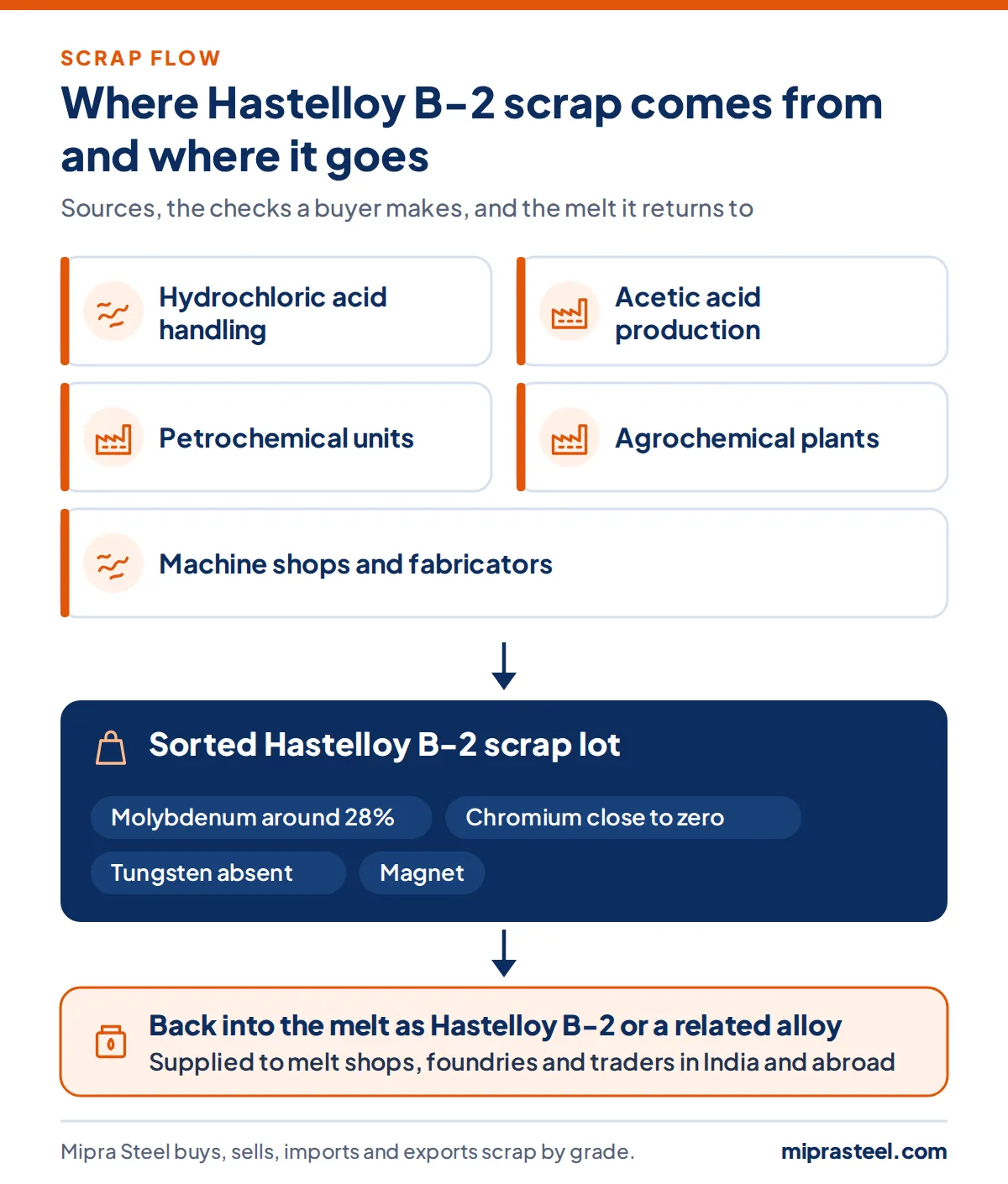
B-2 follows reducing acids. Where a process runs hot hydrochloric acid, or an acid stream kept free of oxygen and oxidising salts, there is a fair chance some of the wetted equipment is B-2.
Hydrochloric Acid Handling
Storage, transfer and recovery equipment for hydrochloric acid: vessels, column internals, pump casings and valve bodies. Replacement campaigns release plate, formed heads and machined parts. See chemical processing scrap.
Acetic Acid Production
The early stage of acetic acid processes run with an iodide catalyst uses B-2 for reducing conditions. Rebuilds give reactor components and associated piping offcuts.
Petrochemical Units
Ethyl benzene, ethylene glycol and butane isomerisation units have used B-2 in acid-wetted sections. Turnaround work produces small but clean parcels. See oil and gas scrap.
Agrochemical Plants
Herbicide and insecticide production involves halide chemistry where B-2 has been specified for reactors, pumps and valves.
Machine Shops and Fabricators
Flanges, valve trim and pump shafts cut from B-2 bar and forgings leave turnings and bar ends. Fabricators building B-2 equipment also generate plate crops and rejected weld coupons.
Hastelloy B-2 Scrap Specification Chart
| Grade | Hastelloy B-2 |
|---|---|
| UNS | N10665 |
| W.Nr. / EN | 2.4617 |
| Also known as | Alloy B-2, Hastelloy B2 |
| Alloy type | Solid-solution nickel-molybdenum |
| Density | 9.2 g/cm³ (0.332 lb/in³) |
| Magnetic | Non-magnetic. |
| HS code (customs heading) | 7503.00 (nickel waste and scrap) |
Hastelloy B-2 Chemical Composition
Nominal composition in weight per cent, used to describe and identify the grade. The governing specification sets the limits for each product.
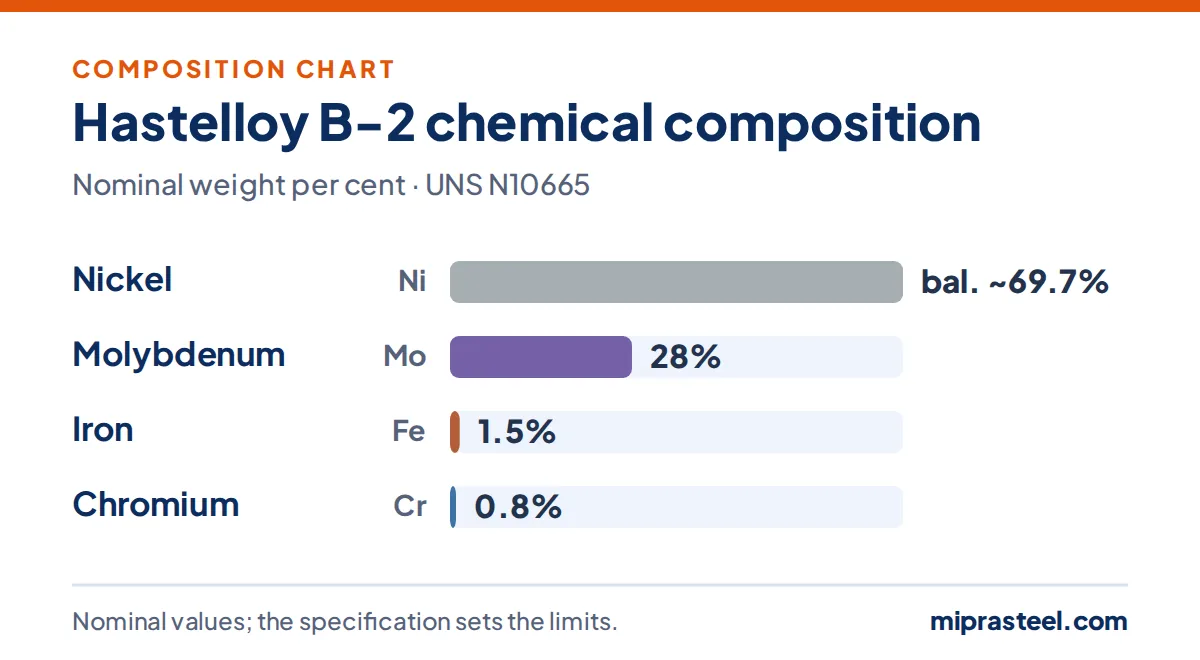
| Element | Symbol | Nominal wt% | |
|---|---|---|---|
| Nickel | Ni | Balance (about 69.7) | |
| Molybdenum | Mo | 28 | |
| Iron | Fe | 1.5 | |
| Chromium | Cr | 0.8 |
Hastelloy B-2 Equivalent Grades and Other Names
| Designation | Value |
|---|---|
| Trade name | Hastelloy B-2 |
| UNS | N10665 |
| W.Nr. / EN | 2.4617 |
| Other names in the trade | Alloy B-2, Hastelloy B2 |
Look up any designation in the grade name converter or the equivalent grade chart.
Hastelloy B-2 Standards and Specifications
Hastelloy B-2 Applications
- Hydrochloric acid process equipment
- Acetic acid and sulfuric acid under reducing conditions
- Reactors, pumps and valves
Source industries: chemical processing.
How Hastelloy B-2 Scrap Is Identified
B-2 is one of the easier grades to confirm, because the reading looks like nothing else in the nickel families. The risk is not misreading it; the risk is that a stray C-grade or B-3 piece sits in the bag unnoticed.
| Check | What it shows for Hastelloy B-2 |
|---|---|
| Molybdenum around 28% | No routine nickel alloy outside the B family reads this high. If molybdenum is at 13% to 16%, you are looking at a C-grade. |
| Chromium close to zero | B-2 carries well under 1% chromium. A reading of 1% to 3% chromium with similar iron suggests B-3; 15% or more means a C-grade. |
| Tungsten absent | C-276 brings about 4% tungsten and C-22 about 3%. Tungsten on a "B-2" reading is a sign of mixing. |
| Magnet | B-2 is non-magnetic. A magnet only helps to find carbon-steel nozzles, supports or bolting left attached to the alloy. |
| Weight for size | At about 9.2 g/cm³ it is heavier than C-276 (8.89) and much heavier than Hastelloy X (8.22). Useful when checking declared weights against dimensions. |
| Paperwork | Certificates to ASTM B333 (plate and sheet), B335 (bar) or B622 quoting UNS N10665 or 2.4617 identify the material before any reading is taken. |
Grades Most Often Confused with Hastelloy B-2
- Hastelloy C-276: reads 16% molybdenum with 15.5% chromium and about 4% tungsten, so chromium alone separates it from B-2.
- B-3 (UNS N10675): is also nickel-molybdenum with 27% to 32% molybdenum, but carries 1% to 3% chromium. It is not covered by a separate page here and is described by its own name when readings confirm it.
- Hastelloy C-22: has 22% chromium and 13% molybdenum and belongs in a different lot entirely.
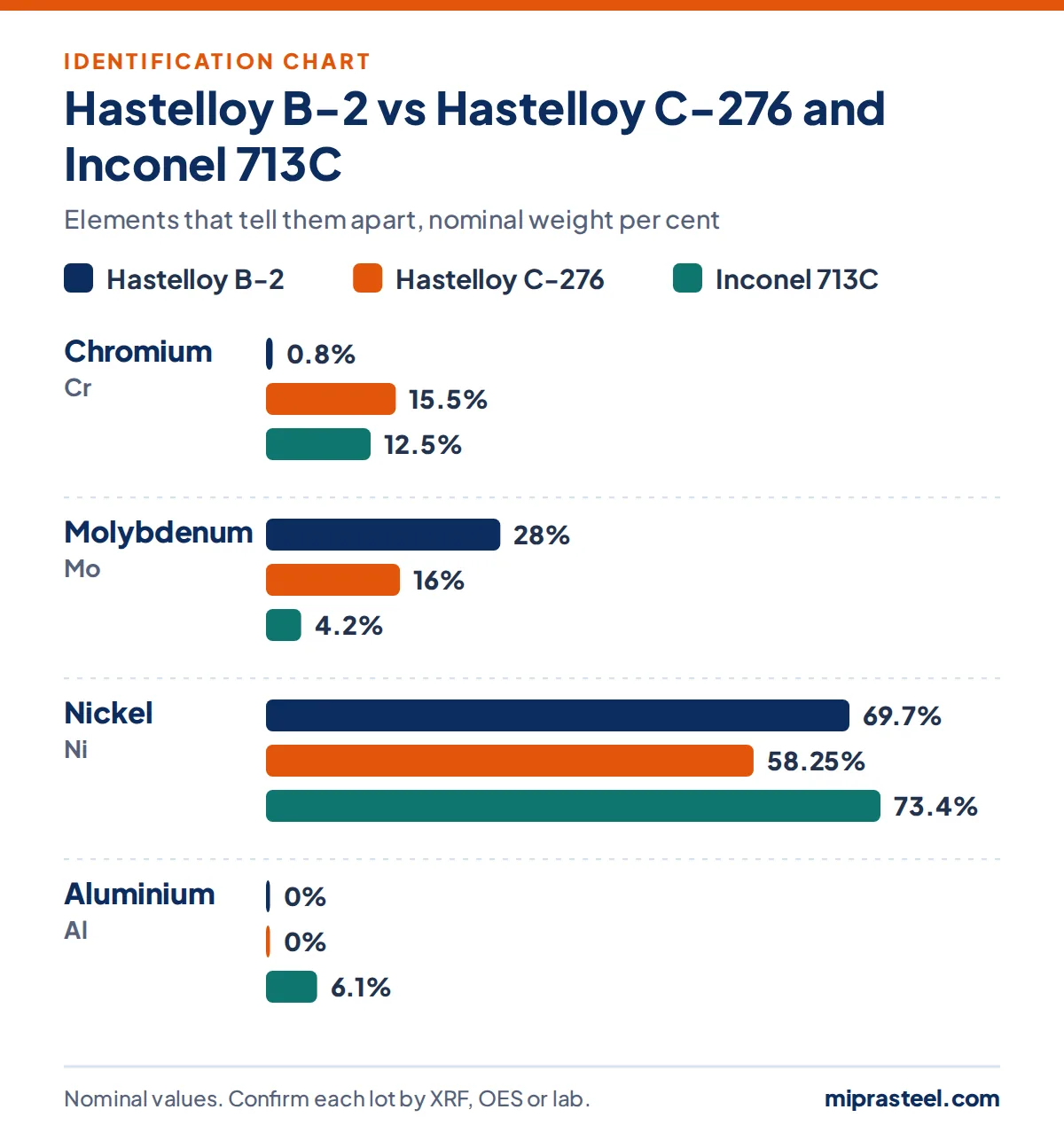
Nominal values for Hastelloy B-2 against its closest grades on this site.
Preparing Hastelloy B-2 Scrap for Sale
- Bag B-2 on its own; never let it share a bin with C-276, C-22 or B-3.
- Cut off carbon-steel nozzles, supports and bolting before weighing.
- Drain and neutralise acid-service parts and record how they were cleaned.
- Strip rubber, PTFE and other linings or gaskets.
- Keep turnings dry, separate from solids, and free of tool tips.
- Label each bag with grade, UNS N10665 and any heat numbers.
Hastelloy B-2 Scrap Price per Kg: What Decides It
People often ask why B-2 is priced on molybdenum. The answer is in the analysis: more than a quarter of every kilogram is molybdenum, so the molybdenum market moves a B-2 offer at least as much as nickel does.
- Contained molybdenum (about 28%) and nickel (about 70%), valued against the day's metal markets.
- Chromium cleanliness: a B-2 lot with C-grade pieces in it loses the reason a buyer wanted B-2, and is priced as mixed Hastelloy.
- Clear naming: B-2 confirmed by readings or certificates, B-3 named separately, and anything unconfirmed described as "B-type" carries a discount for the uncertainty.
- Form: plate, heads, bar ends and forgings sit above turnings, and turnings above mixed fines.
- Process residue: equipment out of acid service should be drained, neutralised and free of linings, gaskets and attached carbon steel.
- Parcel size: B-2 often comes in small quantities, so freight and handling cost per kilogram weigh more heavily than on a bulk grade.
Each offer is dated because metal markets move daily. The general method is set out in how nickel alloy scrap is valued, and the contained metal calculator shows how much molybdenum a given weight carries.
Hastelloy B-2 Scrap Import and Export
Importing Hastelloy B-2 Scrap into India
B-2 is used in fewer plants than C-276, so India imports it in smaller parcels, usually from chemical plant rebuilds in Europe, East Asia and the Gulf, often consolidated by traders with other Hastelloy. Imported metal scrap is inspected before loading and arrives with a pre-shipment inspection certificate, commercial invoice, packing list and bill of lading, normally into Nhava Sheva or Mundra. Ask the shipper to describe it as Hastelloy B-2, UNS N10665, and to keep it in its own bags rather than in a general Hastelloy container. Our import guide covers the steps.
Exporting Hastelloy B-2 Scrap from India
Indian fabricators of hydrochloric acid equipment and machine shops cutting B-2 bar release small, clean parcels that melt shops abroad will take when they are named correctly. For export, lots are listed by grade and UNS number on the invoice and packing list, weighed, and shipped in bags or drums inside containers. Buyers in Japan, South Korea and Europe tend to ask for piece-by-piece readings on a grade this specific. Our offices in Dubai and South Korea help with buyers in the Gulf and East Asia.
Customs heading: 7503.00 (nickel waste and scrap). The HS code is the international tariff heading the scrap is declared under; national tariff lines add further digits, so confirm the full line with your customs broker.
Comparisons
Other Hastelloy Scrap Grades
Related Reading
Hastelloy B-2 Scrap FAQ
Is Hastelloy B-2 the same as Hastelloy B-3?
No. Both are nickel-molybdenum alloys made for hydrochloric acid, but B-3 (UNS N10675) carries 1% to 3% chromium and iron, while B-2 has under 1% chromium. Melt shops often treat them as close cousins, yet a correctly named lot of either is easier to place than a parcel described only as "B-type".
Why does Hastelloy B-2 corrode in some acid plants?
Because it has almost no chromium to protect it in oxidising conditions. Ferric or cupric salts, which can form when iron or copper is present in a hydrochloric acid system, attack it quickly, as do wet chlorine and hypochlorite. Equipment exposed to those conditions is a common source of B-2 scrap.
Can B-2 scrap be melted with C-276 scrap?
Not without changing the result. B-2 brings about 28% molybdenum and almost no chromium; C-276 brings 16% molybdenum and 15.5% chromium. A mixed lot fits neither specification, so buyers price it as mixed Hastelloy. Keep the two apart from the start.
How heavy is Hastelloy B-2 compared with other Hastelloy grades?
B-2 has a density of about 9.2 g/cm³, against about 8.89 for C-276 and 8.69 for C-22. The difference is small per piece but noticeable on a large vessel, so estimate weight using the B-2 figure and confirm on a weighbridge.
Is Hastelloy B-2 magnetic?
No. B-2 is non-magnetic, as are the C-grades, so a magnet cannot tell them apart. It is still useful for catching carbon-steel attachments. Grade confirmation needs an XRF or OES reading; see how XRF sorts nickel alloys.
Which customs heading applies when shipping B-2 scrap?
Being nickel-base, B-2 scrap is typically entered under HS 7503.00, nickel waste and scrap. Each country adds its own digits to that heading, so confirm the complete tariff line with your customs broker before the shipment is booked.
Who buys Hastelloy B-2 scrap in India?
Mipra Steel in Mumbai is one buyer, and we also supply and export B-2 lots. Send the weight, form, location, photographs and any readings or certificates. B-2 tends to move in small parcels, so tell us the real quantity rather than waiting to build a larger one.
What is Hastelloy B-2 made of?
Nominally 69.7% nickel, 28% molybdenum, 1.5% iron, 0.8% chromium. Specification ranges vary by product form and standard.
Published by Mipra Steel, Khetwadi, Mumbai · Updated