Is Incoloy Scrap a Nickel Alloy, and How Does It Differ from Inconel?
Incoloy sits in an awkward spot for anyone sorting scrap. It contains more nickel than iron, so customs and melters class it as a nickel alloy. Yet roughly a third of every Incoloy piece is iron, and that sets it well apart from the Inconel grades it is so often sold as. "Inconel 825" and "Inconel 925" are two of the commonest mislabels in the trade. The names are understandable, since the alloys came out of the same stable, but the chemistry is different and a buyer prices what the chemistry says.
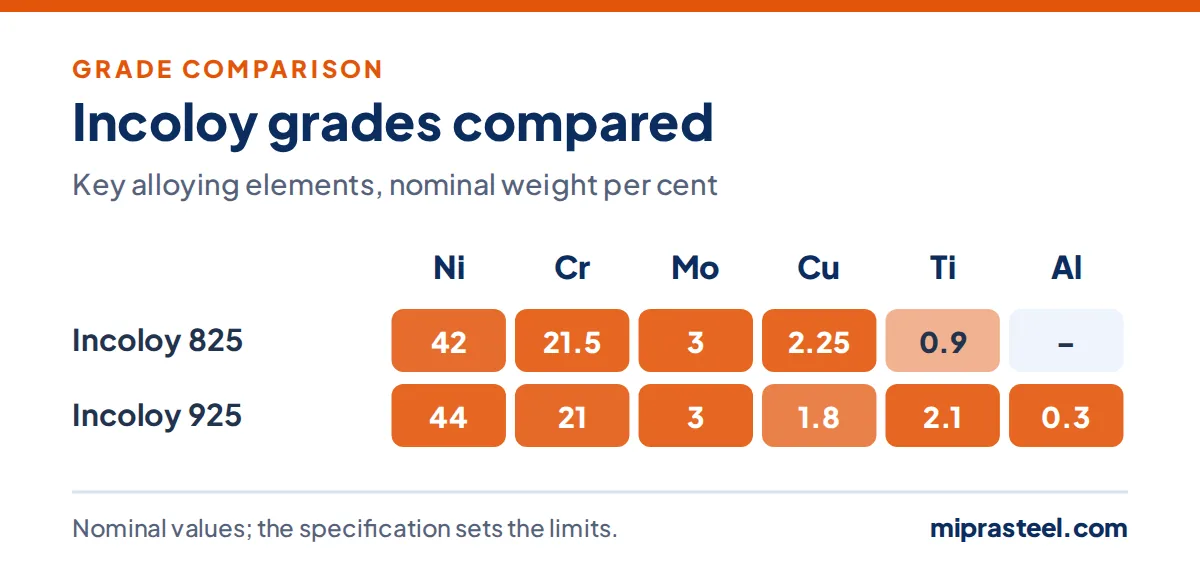
The two grades handled here are siblings. Incoloy 825 is the corrosion grade: molybdenum and copper make it resistant to sulfuric and phosphoric acid, and titanium under 1% stabilises it against sensitisation during welding. Incoloy 925 takes the same base and adds about 2.1% titanium with some aluminium so it can be age-hardened for strength. The result is a valve stem, hanger or downhole tool that resists sour well fluids and also carries load.
For scrap, 825 and 925 are close enough that a mixed bag is not a disaster, but they are still two grades. A melter making 925 wants the titanium; a melter making 825 has to dilute it. Keeping them apart costs little and protects the description. The things that really damage an Incoloy lot are stray Inconel pieces, stainless steel offcuts from the same plant, and the unrelated Incoloy 800, 800H and 800HT grades, which have about 32% nickel and no molybdenum or copper.
Incoloy is a registered trademark of the Special Metals group; here it names the scrap of those alloys.
Incoloy Scrap Grades We Buy and Sell
Incoloy Chemical Composition
| Grade | Ni | Fe | Cr | Mo | Cu | Ti |
|---|---|---|---|---|---|---|
| Incoloy 825 | 42 | 30.4 | 21.5 | 3 | 2.3 | 0.9 |
| Incoloy 925 | 44 | 27.8 | 21 | 3 | 1.8 | 2.1 |
Nominal weight per cent. Specification ranges vary by product form and standard.
How to Tell Incoloy Grades Apart
An XRF reading identifies Incoloy within seconds if you look at iron and copper together. The harder job is telling 825 from 925, which comes down to titanium.
| Check | What it shows for Incoloy |
|---|---|
| Iron | About 28% to 30% places a piece in the Incoloy family. Inconel 625 reads under 5%; Inconel 718 about 18%. |
| Copper | Around 2% copper alongside the iron is the family signature. No Inconel grade carries copper. |
| Titanium | About 0.9% suggests 825. About 2.1%, with a trace of aluminium, suggests 925. |
| Molybdenum | Both read about 3%. Zero molybdenum with about 32% nickel means Incoloy 800-series, a different family. |
| Hardness and form | 925 is usually bar, forgings or machined parts in the aged condition; 825 is more often plate, sheet and fabricated equipment. |
| Certificates | Heat numbers and certificates quoting N08825 or N09925 settle 825 against 925 where titanium readings sit close. |
Grades Most Often Confused with Incoloy
- Inconel 625: the Inconel most often confused with 825 in acid and offshore plant; about 62% nickel, 9% molybdenum, 3.6% niobium and under 5% iron.
- 20Mo-4: an iron-nickel alloy for the same acids; about 37.5% nickel, 24% chromium, 4% molybdenum and only 1% copper.
- Inconel 706: also iron-rich (about 37.5%) and age-hardened, but with 16% chromium, 2.9% niobium and no copper or molybdenum.
Copper Plus Iron Means Incoloy
About 2% copper alongside 30% iron is the Incoloy signature. No Inconel grade carries both.
Titanium Separates 925 from 825
Incoloy 925 carries about 2.1% titanium and some aluminium for age-hardening; 825 carries under 1% titanium.
Don’t Confuse with Incoloy 800 Series
Incoloy 800, 800H and 800HT have about 32% nickel and no molybdenum or copper. They are a separate grade family.
Where Incoloy Scrap Comes From
Incoloy scrap is concentrated in a few process industries, and 825 and 925 rarely come from the same place.
Sulfuric and Phosphoric Acid Plants
Evaporator, cooler and pickling-tank rebuilds release 825 plate, sheet, internals and fabrication offcuts. See chemical processing scrap.
Steel Pickling Lines
Tanks, heating coils, hooks and baskets in 825 are replaced as they wear, often carrying acid residue that has to be washed off before sale.
Sour Oil and Gas Production
825 is used for clad and lined line pipe and tubing. 925 goes into tubing hangers, valve stems and downhole tools. See oil and gas scrap.
Oilfield Machine Shops
Machining 925 bar into stems, hangers and fasteners produces bar ends and turnings, normally with good traceability to a heat.
Pollution Control and Nuclear Reprocessing
Scrubber and waste-handling equipment in 825 comes out during plant upgrades.
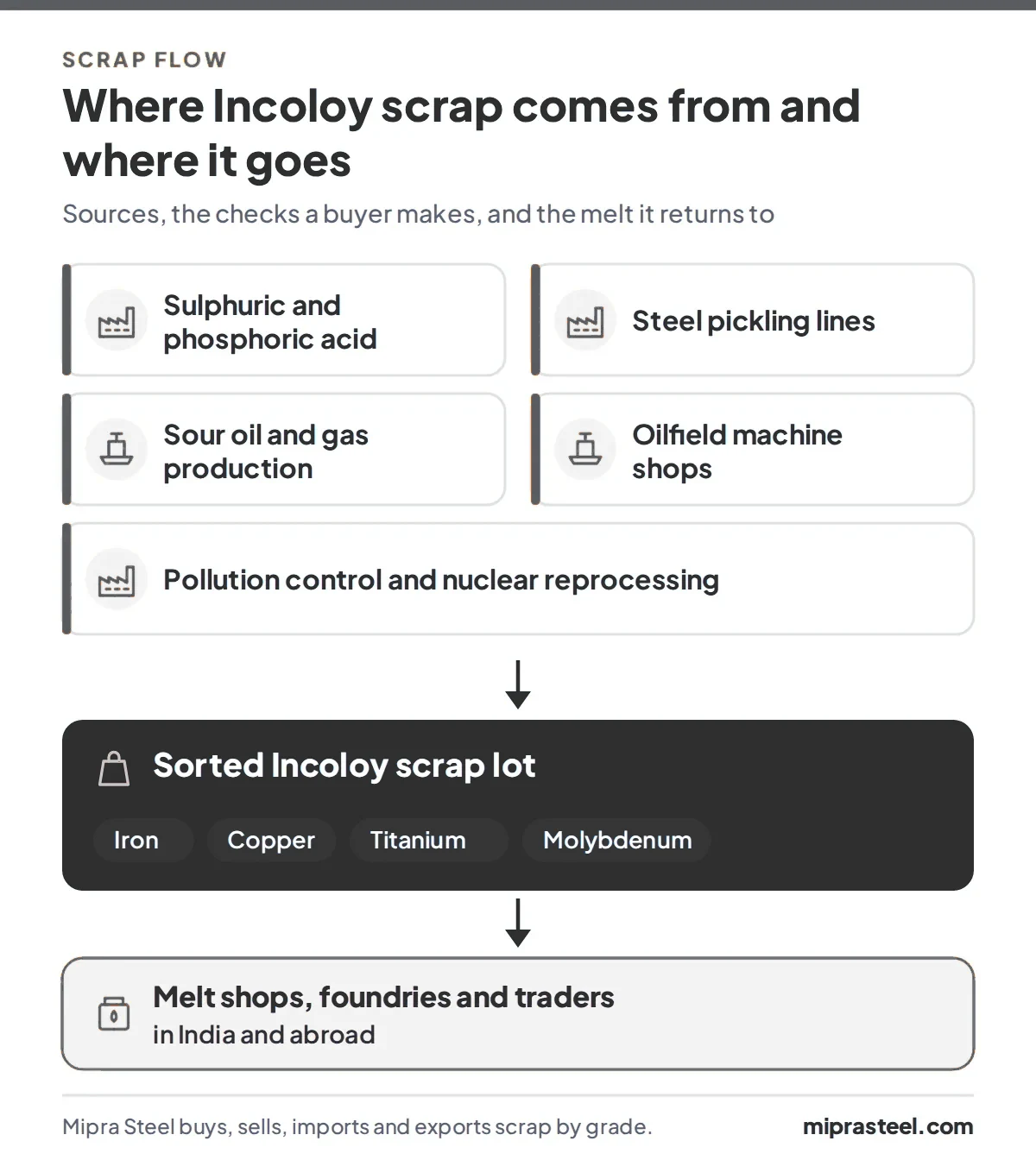
Source industries: chemical processing, oil and gas, marine and shipbuilding.
Comparisons
Incoloy Scrap Buyer, Importer and Exporter in India
From Khetwadi, Mumbai, Mipra Steel buys and sells Incoloy 825 and 925 scrap, sourced from acid and oilfield users in India and abroad and supplied to melters and traders.
Sell Incoloy Scrap
If you are clearing Incoloy from an acid plant, pickling line or oilfield store, send the grade if known, approximate weight, form and location, with photographs. Material labelled "Inconel 825" or "Inconel 925" is fine to offer under that label; we will describe it correctly. XRF readings showing iron, copper and titanium are especially useful. We review incoming enquiries and respond with relevant next steps.
Buy Incoloy Scrap
For melters and traders who need Incoloy scrap, tell us whether you require 825, 925 or either, the quantity, acceptable forms and the destination port. Lots can be described with UNS numbers and readings, and we can discuss the documents that travel with them.
Preparing Incoloy Scrap for Sale
- Label 825 and 925 separately, using titanium readings or certificates to decide.
- Wash acid residue and sludge off pickling-line and acid-plant parts.
- Take out stainless steel, 800-series and Inconel pieces before packing.
- Keep turnings from 925 bar in sealed drums, dry and free of tool tips.
- Note the original plant or application on the packing list.
Incoloy Scrap Price per Kg: What Decides It
Incoloy scrap is valued on its nickel first, with molybdenum, chromium and copper behind it. Because nickel is around 42% rather than 55% to 76%, the starting point sits below most Inconel grades, and how an Incoloy lot is presented decides much of the rest.
- Contained nickel, at roughly 42% for 825 and 44% for 925, and about 3% molybdenum.
- A correct description. A lot sold as "Inconel" and found to be Incoloy loses the buyer's trust as well as value; a lot described as Incoloy from the start does not.
- 825 and 925 kept apart, so the titanium in 925 is not an unwanted addition for an 825 melt.
- Freedom from stainless steel and 800-series offcuts, which share plants and look identical.
- Form: plate, bar ends and solid fabrication offcuts ahead of turnings; clean pieces ahead of acid-coated ones.
- Weight, packing and how far the lot is from a port.
For the general method, see how nickel alloy scrap is valued. Offers are always dated because nickel and molybdenum markets move.
Incoloy Scrap Import and Export
Importing Incoloy Scrap into India
Incoloy reaches Indian buyers mostly from the Gulf, where sour gas and refinery work use 825 and 925, and from European and East Asian chemical plants. Each consignment is inspected before it is loaded, and the inspection certificate travels with the commercial invoice, packing list and bill of lading. Describing the material as Incoloy 825 or 925 with its UNS number, rather than as "Inconel", keeps the customs entry and the commercial description consistent. Nhava Sheva and Mundra are the usual ports. Read the import guide for nickel alloy scrap.
Exporting Incoloy Scrap from India
Indian acid plants, pickling lines and fabrication shops release Incoloy 825 offcuts and retired equipment, and oilfield machine shops add 925. For export, lots are weighed and packed by grade, with the grade and UNS number on the invoice and packing list, and shipped in bags or drums inside containers or loose. Our offices in the UAE and South Korea are close to buyers in the Gulf and East Asia, and lots also move to Spain and the Netherlands.
Customs heading: 7503.00 (nickel waste and scrap). The HS code is the international tariff heading the scrap is declared under; national tariff lines add further digits, so confirm the full line with your customs broker.
Related Reading
Incoloy Scrap FAQ
Is Incoloy 825 scrap the same as Inconel 825 scrap?
Yes. They are the same alloy, UNS N08825. "Incoloy 825" is the correct name; "Inconel 825" is a widespread mislabel. A buyer will describe the lot as Incoloy 825 and price it on that chemistry, so the label used when offering it does not change the value.
How do I tell Incoloy 925 scrap from 825?
Check titanium on an XRF or OES reading. 925 carries about 2.1% titanium with a little aluminium; 825 carries under 1% titanium. Everything else reads much the same, so certificates and the part type (aged bar and oilfield parts point to 925) help when readings sit close.
Why is Incoloy scrap priced lower than Inconel scrap?
Mainly because it holds less nickel, about 42% to 44% against 55% to 76% for most Inconel grades, and around 30% iron that adds little. Its molybdenum and copper help, but cannot close that gap.
Is Incoloy 800 traded with 825 and 925?
No. Incoloy 800, 800H and 800HT carry about 32% nickel and no molybdenum or copper, so they are a separate material. Keep them out of 825 and 925 lots, because a piece of 800 changes the chemistry of the lot.
Is Incoloy magnetic?
Incoloy 825 and 925 are non-magnetic. A magnet will separate them from carbon steel and duplex, but not from austenitic stainless steel or Inconel. A chemistry reading is needed for that. See PMI testing.
What HS code do exporters use for Incoloy scrap?
Incoloy 825 and 925 contain more nickel than iron, so they are typically entered under HS 7503.00 as nickel waste and scrap. Check the full national line with your customs broker.
Can I sell a small quantity of Incoloy scrap to Mipra Steel?
Yes, send the details. Give the grade, weight, form and location with photographs, and any readings or certificates. Smaller lots are often combined with others of the same grade, so a clear description matters more than size.
Published by Mipra Steel, Khetwadi, Mumbai · Updated