Super Duplex 2507 Scrap Buyer, Importer and Exporter in India
Mipra Steel trades super duplex 2507 scrap from Mumbai, buying from offshore, desalination and fabrication sources in India and the Gulf and supplying described lots to stainless melt shops and traders.
Sell Super Duplex 2507 Scrap
Selling super duplex scrap? Tell us the form (flanges, plate crops, fittings, turnings), approximate weight and location, and send photographs that show any F53 or S32750 markings. Say whether you have confirmed the lot is free of S32760 and attach readings or certificates if you have them. We review incoming enquiries and respond with relevant next steps.
Buy Super Duplex 2507 Scrap
If you melt super duplex or need high-molybdenum stainless units, ask us for 2507 lots. Give the tonnage, the forms your furnace takes, any limit you set on copper, the destination and your timing. Lots are described by grade and UNS number, and certificates or readings go with them where the seller provided them.
What Makes 2507 Scrap "Super" Duplex?
The word "super" is about pitting resistance. Designers rate stainless steels with a pitting resistance equivalent number (PREN), calculated from chromium, molybdenum and nitrogen. Standard 2205 lands around 35. Grade 2507, with 25% chromium, 4% molybdenum and 0.28% nitrogen, lands around 42, and the trade generally calls anything above 40 super duplex. That margin is what lets 2507 sit in warm seawater, firewater ring mains and sour process streams where 2205 would pit.
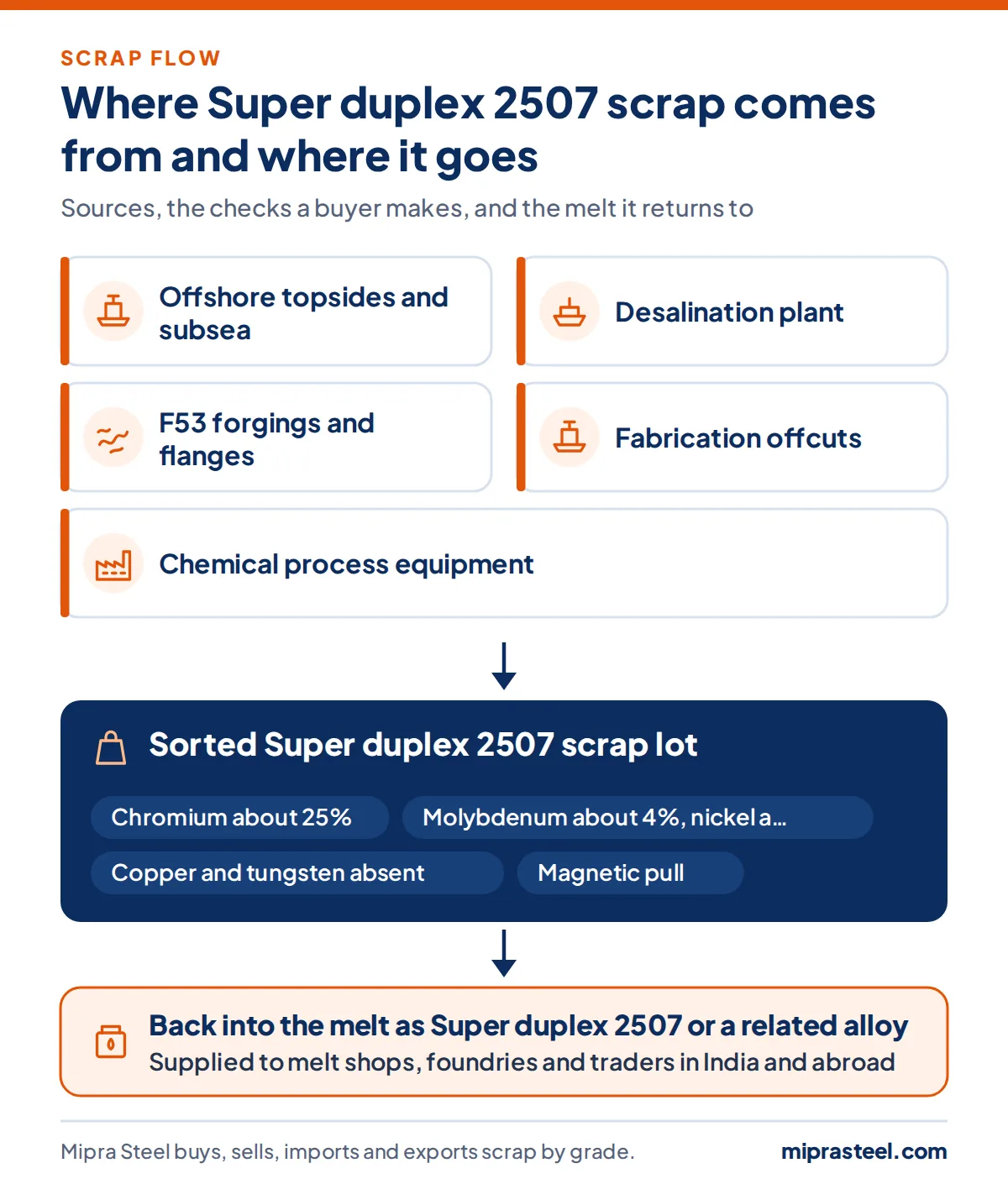
Because it was chosen for seawater and offshore duty, 2507 scrap clusters around platforms, FPSOs, desalination plants and the shops that fabricate for them. It reaches the market in bursts: a topside replacement, a decommissioning campaign or a reverse-osmosis train rebuild can release tonnes of one grade at once.
For the melt shop, 2507 brings more nickel and molybdenum than 2205 for every tonne charged, which is the core of its value. It also has a chemistry rule worth knowing: S32750 allows no more than 0.5% copper and has no tungsten addition. Its close relative S32760 carries 0.5% to 1% of each. A mill making 2507 cannot use a lot that has been topped up with S32760, so the two are kept in separate bags even though they look and behave almost the same on a magnet.
Trade names you will see include SAF 2507, Super Duplex 32750 and the ASTM A182 forging grade F53.
Super duplex 2507 belongs to the Duplex and super-austenitic family, part of exotic alloy scrap.
Where Super Duplex 2507 Scrap Is Generated
Expect 2507 wherever seawater meets high pressure. These are the usual origins.
Offshore Topsides and Subsea
Firewater, seawater injection and cooling systems on platforms and FPSOs, replaced during upgrades or removed at decommissioning. See oil and gas scrap.
Desalination Plant
High-pressure sections of reverse-osmosis trains, energy-recovery equipment and brine handling, rebuilt during plant upgrades. See desalination scrap.
F53 Forgings and Flanges
Machining of F53 flanges, valve bodies and hubs leaves turnings, crop ends and rejected parts, usually with heat numbers stamped.
Fabrication Offcuts
Plate crops and fitting offcuts from yards building offshore modules. Single-job offcuts are often one heat and certificate.
Chemical Process Equipment
Heat exchangers and process equipment in chloride-bearing service. See chemical plant scrap.
Super Duplex 2507 Scrap Specification Chart
| Grade | Super duplex 2507 |
|---|---|
| UNS | S32750 |
| W.Nr. / EN | 1.4410 |
| Also known as | Super Duplex 32750, UNS S32750, F53, SAF 2507 |
| Alloy type | Super duplex stainless steel |
| Density | 7.8 g/cm³ (0.282 lb/in³) |
| Magnetic | Magnetic (ferritic phase). |
| HS code (customs heading) | 7204.21 (stainless steel waste and scrap) |
Super Duplex 2507 Chemical Composition
Nominal composition in weight per cent, used to describe and identify the grade. The governing specification sets the limits for each product.
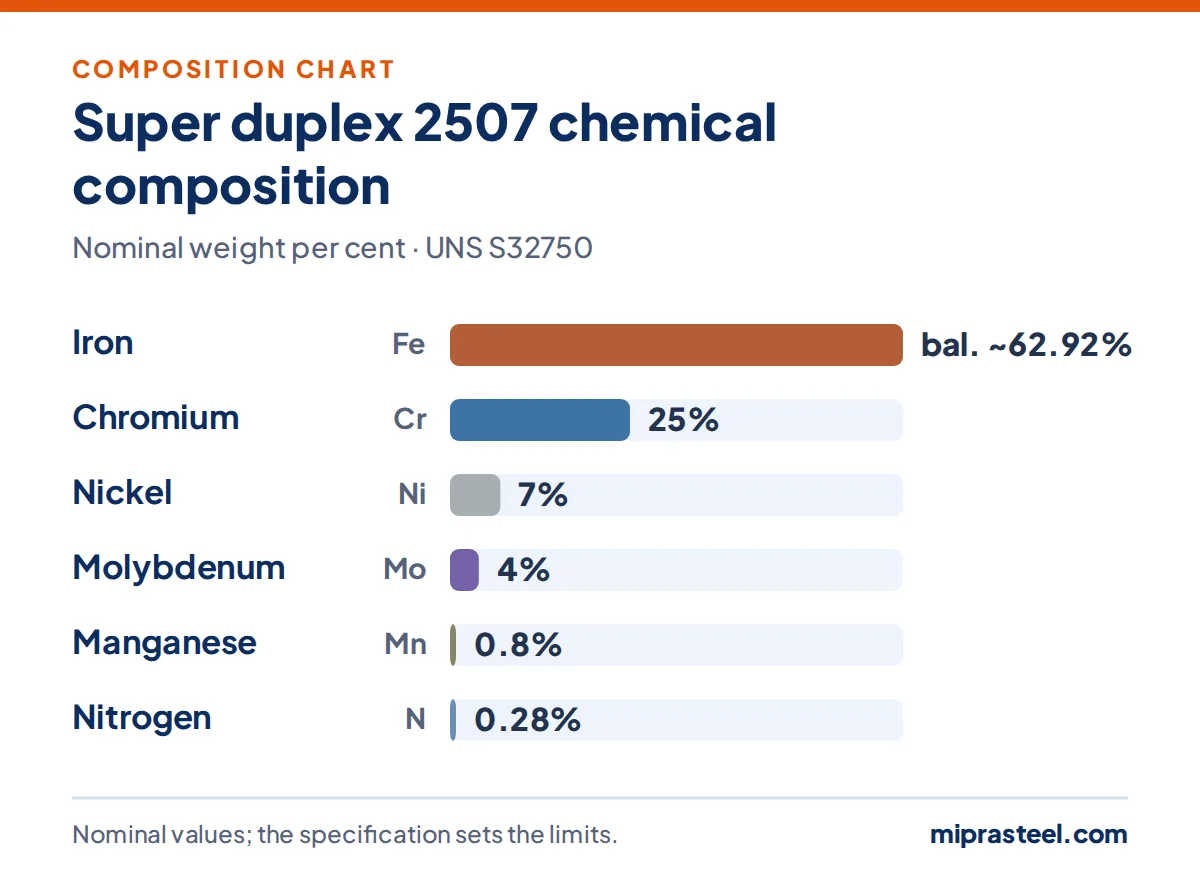
| Element | Symbol | Nominal wt% | |
|---|---|---|---|
| Iron | Fe | Balance (about 62.9) | |
| Chromium | Cr | 25 | |
| Nickel | Ni | 7 | |
| Molybdenum | Mo | 4 | |
| Manganese | Mn | 0.8 | |
| Nitrogen | N | 0.28 |
Super Duplex 2507 Equivalent Grades and Other Names
| Designation | Value |
|---|---|
| Trade name | Super duplex 2507 |
| UNS | S32750 |
| W.Nr. / EN | 1.4410 |
| Other names in the trade | Super Duplex 32750, UNS S32750, F53, SAF 2507 |
Look up any designation in the grade name converter or the equivalent grade chart.
Super Duplex 2507 Standards and Specifications
Super Duplex 2507 Applications
- Seawater injection and firewater piping
- Offshore topsides and subsea equipment
- Desalination high-pressure piping
- Chemical process equipment
Source industries: oil and gas, desalination, marine and shipbuilding.
How Super Duplex 2507 Scrap Is Identified
Every super duplex lot is checked against two neighbours: 2205 below it and S32760 beside it. The readings below decide which one you have.
| Check | What it shows for Super duplex 2507 |
|---|---|
| Chromium about 25% | Separates it from 2205 at around 22.5%. |
| Molybdenum about 4%, nickel about 7% | Both are higher than 2205 (3% and 5.5%). Nickel well above 10% with no magnetic pull suggests an austenitic grade instead. |
| Copper and tungsten absent | The key test against S32760. A reading of roughly 0.75% copper and 0.75% tungsten means the piece belongs in an S32760 lot. |
| Magnetic pull | Present, because of the ferrite. It confirms the piece is not 254 SMO or 316L, nothing more. |
| Markings and certificates | F53, S32750, 1.4410 or SAF 2507 on the part or certificate. Some material is dual-marked S32750/S32760, and it should be checked on XRF before sorting. |
Grades Most Often Confused with Super Duplex 2507
- Super duplex S32760: has the same 25% chromium and 7% nickel but about 3.5% molybdenum plus about 0.75% each of copper and tungsten.
- Duplex 2205: reads about 22.5% chromium, 5.5% nickel and 3% molybdenum.
- 254 SMO: is used in the same seawater systems but is non-magnetic, with about 18% nickel and 6% molybdenum.
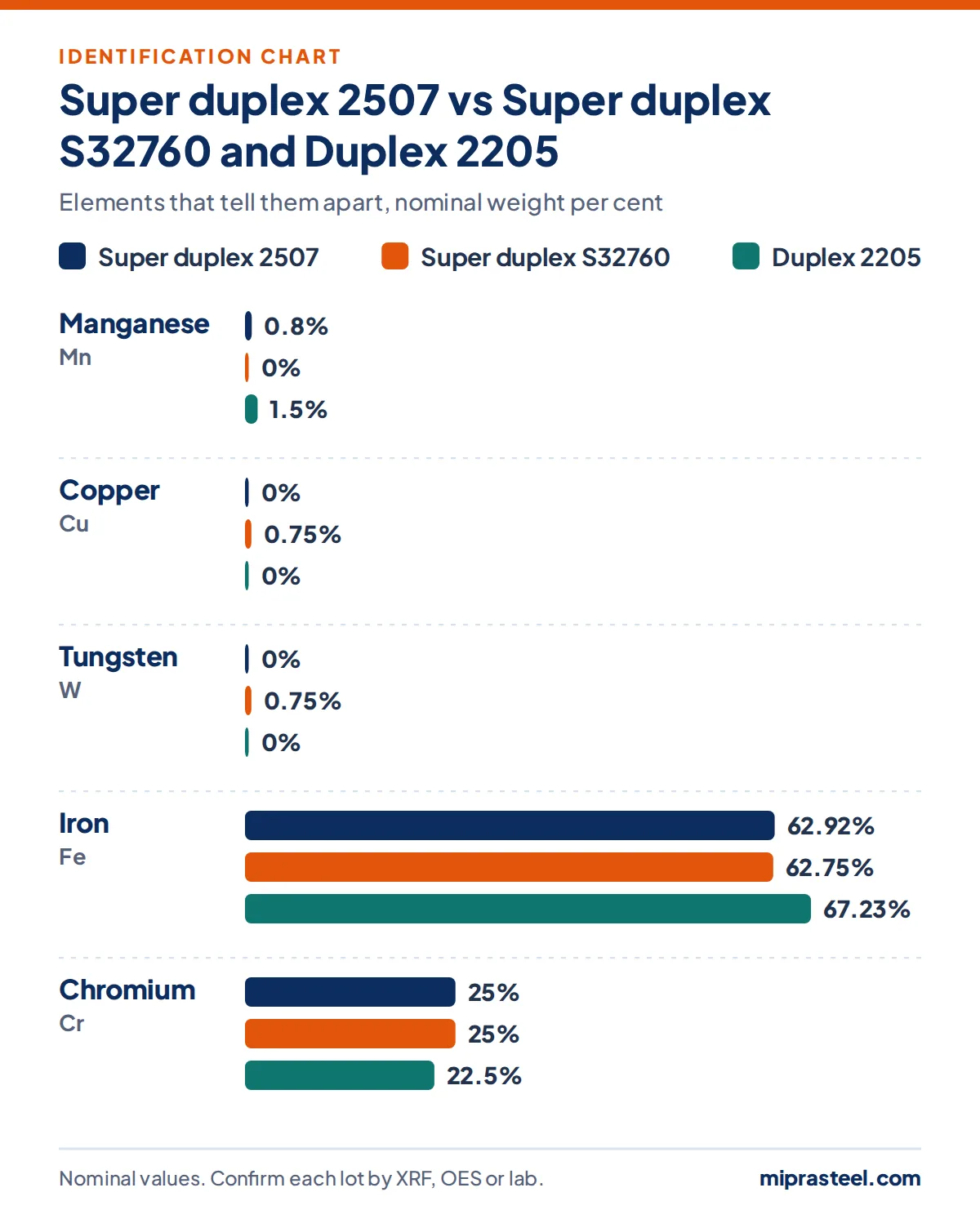
Nominal values for Super duplex 2507 against its closest grades on this site.
Preparing Super Duplex 2507 Scrap for Sale
- Read every piece for copper and tungsten before it goes into a 2507 bag.
- Strip paint, insulation, gaskets and carbon-steel bolting from offshore parts.
- Keep F53 forgings and turnings apart from plate and fittings.
- Label dual-marked S32750/S32760 material and hold it until a reading settles it.
- Photograph heat numbers and keep the certificates with the lot.
Super Duplex 2507 Scrap Price per Kg: What Decides It
A super duplex scrap price per kg is quoted on the day, for a specific lot. These are the things that move it.
- Contained nickel (about 7%) and molybdenum (about 4%): both higher than in 2205, and molybdenum is the larger value driver.
- Separation from S32760: a lot proven free of copper and tungsten can go to a 2507 melt; a mixed super duplex lot has fewer outlets.
- Documentation: F53 or S32750 certificates and heat numbers from offshore jobs let a buyer accept the lot as described.
- Attachments and coatings: offshore material often carries paint, insulation, carbon-steel supports and bolting, all of which come off before weighing.
- Form and tonnage: heavy flanges and plate crops in container loads are easier to place than small mixed parcels or wet turnings.
For the general pricing method, read how alloy scrap is valued. The contained metal calculator shows how much nickel and molybdenum a given weight carries.
Super Duplex 2507 Scrap Import and Export
Importing Super Duplex 2507 Scrap into India
Much of the 2507 that India imports comes from the Gulf, where offshore fields and large desalination plants release it, and from North Sea decommissioning in Europe. Each consignment is inspected before shipment and travels with a pre-shipment inspection certificate, commercial invoice, packing list and bill of lading. Describing it on all documents as super duplex 2507, UNS S32750, rather than as stainless scrap, keeps the declared and commercial descriptions aligned. Lots generally land at Nhava Sheva or Mundra. Read how alloy scrap imports into India work.
Exporting Super Duplex 2507 Scrap from India
Indian forging units and offshore fabricators produce F53 turnings, crops and rejected forgings that go abroad to melt shops and traders. Exported lots are weighed, labelled S32750 on the invoice and packing list, and packed in bags or drums inside containers. Our UAE office in Dubai sits near offshore and desalination sources, and our South Korea office is close to East Asian shipyards and mills. See alloy scrap export documents.
Customs heading: 7204.21 (stainless steel waste and scrap). The HS code is the international tariff heading the scrap is declared under; national tariff lines add further digits, so confirm the full line with your customs broker.
Comparisons
Other Duplex and Super-Austenitic Scrap Grades
Related Reading
Super Duplex 2507 Scrap FAQ
What is the difference between 2205 and 2507 scrap?
2507 carries about 25% chromium, 7% nickel and 4% molybdenum; 2205 carries about 22.5%, 5.5% and 3%. Both are magnetic duplex steels, so only an XRF reading or reliable markings tell them apart. 2507 lots usually command more because of the extra nickel and molybdenum.
Can super duplex 2507 and S32760 scrap be sold together?
They can be sold as a mixed super duplex lot, but that lot is worth less to a melt shop. S32750 allows at most 0.5% copper and has no tungsten, so a 2507 producer cannot freely use material that includes S32760. Separating them by XRF before sale keeps both lots useful.
Is super duplex scrap a nickel alloy?
No. With roughly 63% iron and 7% nickel, 2507 is a stainless steel. It is classified, sold and melted as alloyed stainless scrap, not as nickel alloy scrap, though it often comes out of the same offshore plant as nickel alloys.
What HS code applies to super duplex scrap exports?
As stainless steel scrap, 2507 is typically declared under HS 7204.21. National tariffs add digits beyond the six-digit heading, so confirm the complete code with your customs broker in both the exporting and importing country.
What does F53 stamped on a flange mean?
F53 is the ASTM A182 forging grade for UNS S32750, which is super duplex 2507. F55 is S32760 and F51 or F60 is 2205. The stamp is a good first guide, but buyers still ask for a reading before accepting the grade.
Does Mipra Steel buy super duplex turnings?
Yes, alongside solids. Turnings should be from one grade, drained of coolant and kept dry. Tell us the weight and location and send photographs; readings from the parent bar or forging help describe the lot.
Why does offshore 2507 scrap need extra preparation?
Offshore equipment usually arrives with paint, insulation, rubber gaskets, carbon-steel supports and bolting still attached. None of it is super duplex, and carbon steel passes the magnet test, so it must be removed by hand before the lot is weighed.
What is Super duplex 2507 made of?
Nominally 62.9% iron, 25% chromium, 7% nickel, 4% molybdenum, 0.8% manganese, plus about 0.28% nitrogen. Specification ranges vary by product form and standard.
Published by Mipra Steel, Khetwadi, Mumbai · Updated