20Mo-4 Scrap Buyer, Importer and Exporter in India
Mipra Steel trades 20Mo-4 scrap as a nickel alloy grade from Khetwadi, Mumbai, kept apart from stainless steel and other acid-service alloys.
Sell 20Mo-4 Scrap
Have 20Mo-4 plate offcuts, sheet trim, bar ends or equipment parts? Send us the weight, form, location and photographs, and any mill certificates quoting UNS N08024 or ASTM B463, B464 or B473. XRF readings showing nickel, molybdenum and copper settle the Alloy 20 and 825 question quickly. We review incoming enquiries and respond with relevant next steps.
Buy 20Mo-4 Scrap
Melters producing nickel-iron-chromium-molybdenum alloys, or traders assembling acid-service grades, can ask us for 20Mo-4. Tell us the quantity, acceptable forms, any copper or molybdenum window you need, and the delivery port. Volumes are modest, so lots are described individually with their readings or certificates.
What Is 20Mo-4, and Why Is Its Scrap Traded as a Nickel Alloy?
Sulfuric acid is awkward to contain. Plain stainless steel works in some concentrations and temperatures and fails quickly in others, and chlorides in the process stream bring pitting on top. Alloy 20 (UNS N08020) answered much of this with high nickel and about 3.5% copper. 20Mo-4 shifts the balance: molybdenum goes up to about 4% for pitting and crevice resistance, chromium rises to nearly 24%, and copper drops to about 1%. A small niobium addition, about 0.25%, ties up carbon so welded joints keep their corrosion resistance.
In the scrap trade, the key line in its specification is that nickel (35 to 40%) is higher than iron. That is why 20Mo-4 is bought and declared as nickel alloy scrap, not as stainless steel scrap, even though it looks and machines like a heavy austenitic stainless. A 20Mo-4 offcut sold into a stainless lot gives away most of its nickel value, and a stray 316 piece in a 20Mo-4 lot pulls nickel and molybdenum down for the buyer.
The composition on this page uses the mid-points of the ASTM limits for N08024. Plate and sheet are made to ASTM B463, welded pipe to B464 and bar to B473, so mill certificates for 20Mo-4 normally quote one of those numbers. See ASTM B nickel alloy specifications.
On our site 20Mo-4 sits with the duplex and super austenitic grades because buyers meet it in the same chemical plants, but chemically it belongs with the high-nickel corrosion alloys such as Incoloy 825. Names in circulation include 20Mo-4, 20Mo4, Alloy 20Mo-4 and, by mistake, "20M04".
20Mo-4 belongs to the Duplex and super-austenitic family, part of exotic alloy scrap.
Where 20Mo-4 Scrap Is Generated
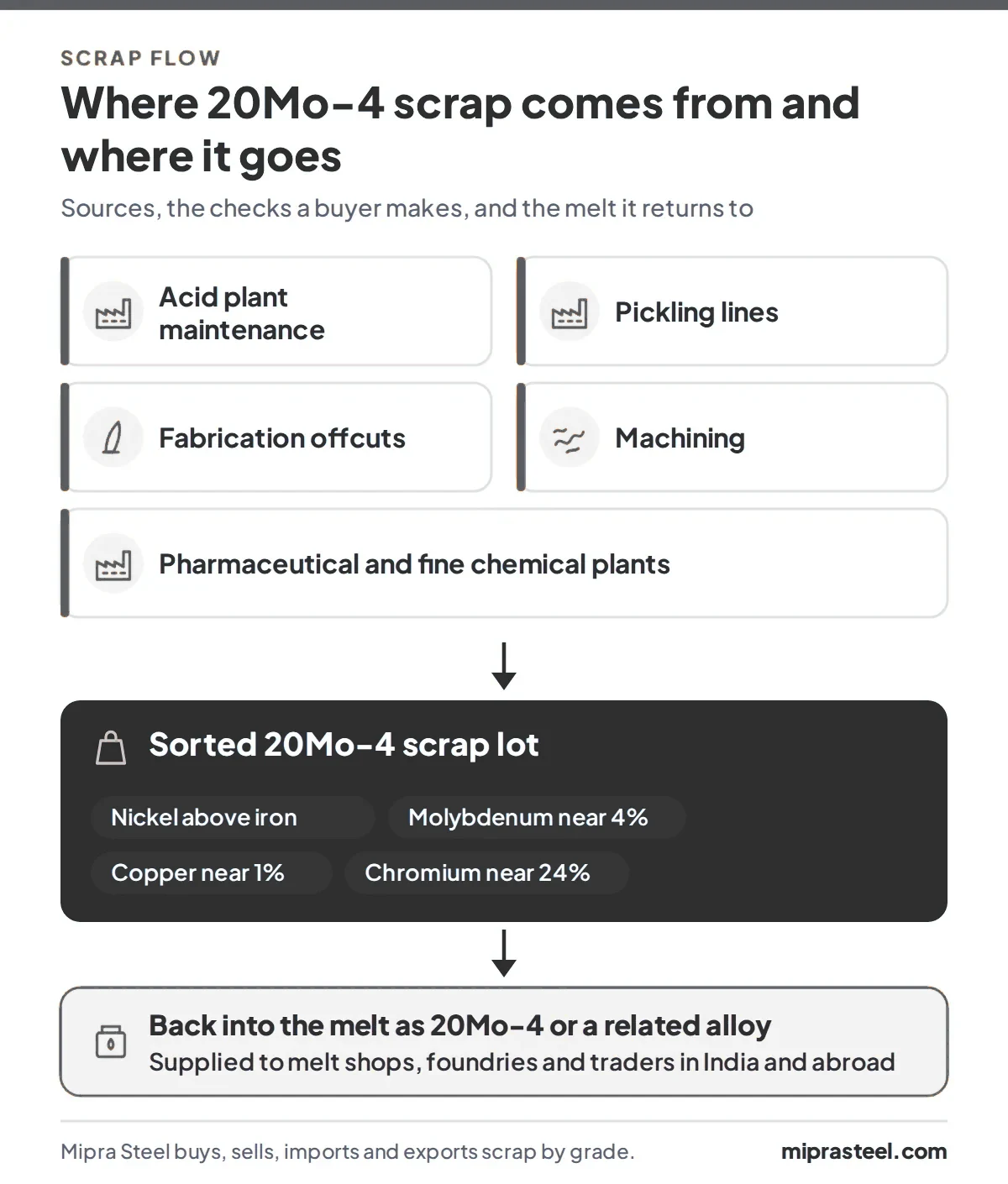
20Mo-4 is a niche alloy, so its scrap comes in modest volumes from a small number of acid-handling and pharmaceutical plants and the shops that fabricate for them.
Acid Plant Maintenance
Vessel shells, nozzles, agitators and heat exchanger parts replaced in sulfuric and phosphoric acid service. See chemical processing scrap.
Pickling Lines
Tanks, racks and fittings from steel pickling equipment, often stained and with acid residue to be cleaned.
Fabrication Offcuts
Plate crops, sheet trim and nozzle cut-outs from shops building process equipment to ASTM B463 material.
Machining
Bar ends and turnings from flanges and fittings machined from B473 bar.
Pharmaceutical and Fine Chemical Plants
Exchanger bundles and vessel internals released when a plant changes its process or rebuilds.
20Mo-4 Scrap Specification Chart
| Grade | 20Mo-4 |
|---|---|
| UNS | N08024 |
| W.Nr. / EN | Not assigned; specified by UNS N08024 and ASTM B463 and B473 |
| Also known as | 20Mo4, Alloy 20Mo-4, UNS N08024 |
| Alloy type | Nickel-iron-chromium-molybdenum corrosion alloy |
| Density | Not published |
| Magnetic | Non-magnetic (austenitic). |
| HS code (customs heading) | 7503.00 (nickel waste and scrap) |
20Mo-4 Chemical Composition
Nominal composition in weight per cent, used to describe and identify the grade. The governing specification sets the limits for each product.
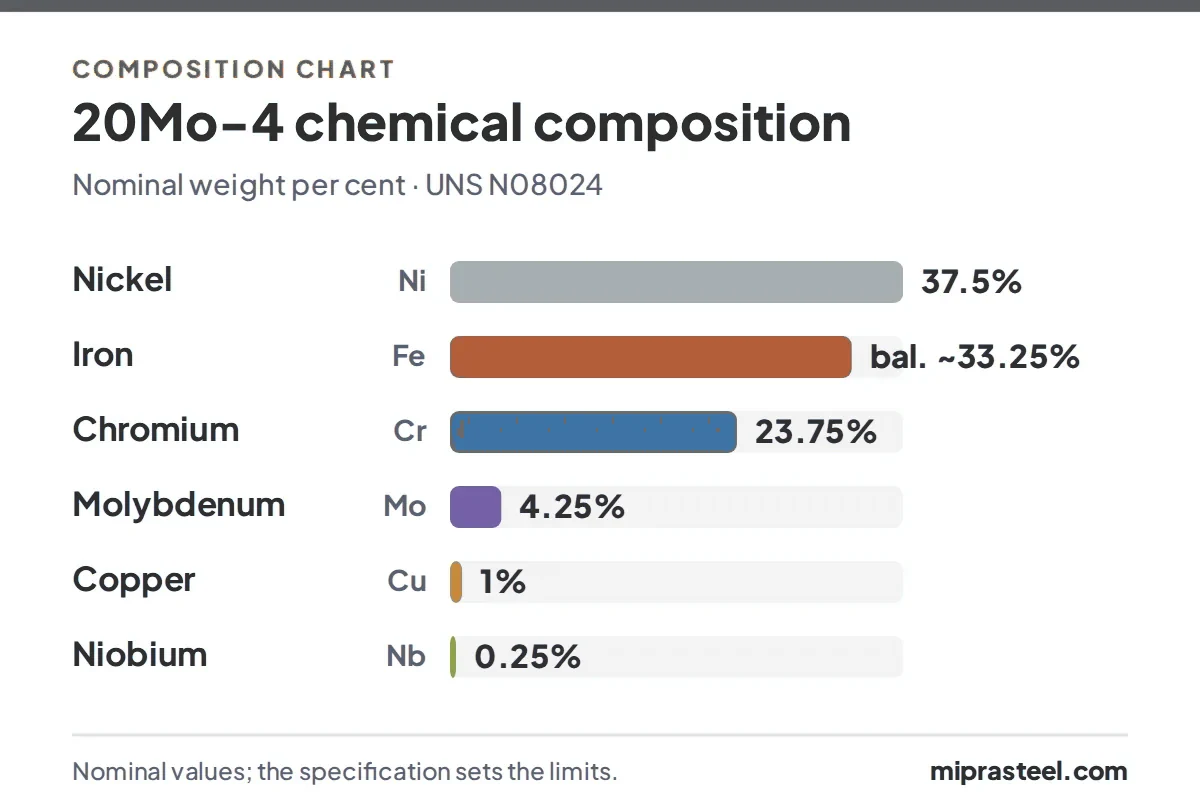
| Element | Symbol | Nominal wt% | |
|---|---|---|---|
| Nickel | Ni | 37.5 | |
| Iron | Fe | Balance (about 33.3) | |
| Chromium | Cr | 23.8 | |
| Molybdenum | Mo | 4.3 | |
| Copper | Cu | 1 | |
| Niobium | Nb | 0.25 |
20Mo-4 Equivalent Grades and Other Names
| Designation | Value |
|---|---|
| Trade name | 20Mo-4 |
| UNS | N08024 |
| W.Nr. / EN | Not assigned; specified by UNS N08024 and ASTM B463 and B473 |
| Key specification | ASTM B463 and B473 |
| Other names in the trade | 20Mo4, Alloy 20Mo-4, UNS N08024 |
Look up any designation in the grade name converter or the equivalent grade chart.
20Mo-4 Standards and Specifications
20Mo-4 Applications
- Sulfuric and phosphoric acid process equipment
- Chemical and pharmaceutical plant piping
- Pickling equipment
- Heat exchangers in mixed-acid service
Source industries: chemical processing.
How 20Mo-4 Scrap Is Identified
20Mo-4 is non-magnetic, like the stainless steels and nickel alloys it is found with, so a magnet will not sort it. Chemistry does.
| Check | What it shows for 20Mo-4 |
|---|---|
| Nickel above iron | About 37% nickel with about 33% iron. A reading with iron well above nickel is stainless or a super austenitic grade. |
| Molybdenum near 4% | Between Alloy 20 (about 2.5%) and 20Mo-6 (about 6%), and a quick way to place the piece in the family. |
| Copper near 1% | Alloy 20 reads about 3.5% copper. A low copper figure with 4% molybdenum points to 20Mo-4. |
| Chromium near 24% | Higher than Incoloy 825 (21.5%) and Alloy 20 (about 20%). |
| Titanium and niobium | Incoloy 825 shows about 0.9% titanium. 20Mo-4 shows a trace of niobium instead. |
| Certificates and stamps | ASTM B463, B464 or B473 with UNS N08024 on the mill certificate or plate stencil. See why magnets cannot sort austenitic alloys. |
Grades Most Often Confused with 20Mo-4
- Incoloy 825: 42% nickel, 30% iron, 21.5% chromium, 3% molybdenum, 2.25% copper and about 0.9% titanium.
- 254 SMO: iron-base, with only 18% nickel against 55% iron, and about 6.1% molybdenum.
- Alloy 20 (N08020): about 2.5% molybdenum and 3.5% copper, so lower in molybdenum and much higher in copper.
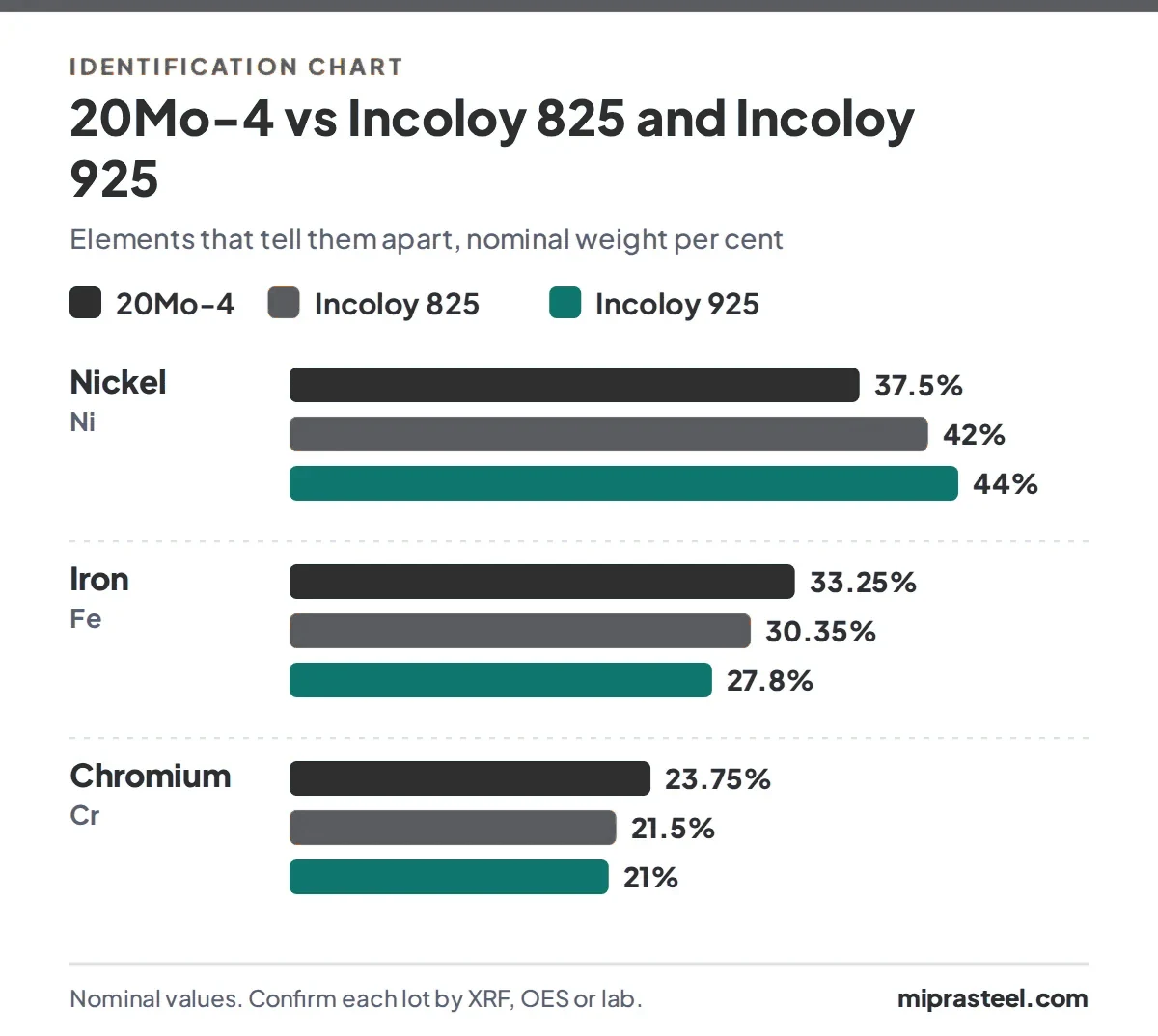
Nominal values for 20Mo-4 against its closest grades on this site.
Preparing 20Mo-4 Scrap for Sale
- Read every piece and keep anything with iron above nickel out of the 20Mo-4 lot.
- Strip gaskets, PTFE or rubber linings and carbon-steel attachments from plant parts.
- Wash or neutralise acid residue before packing, and keep the material dry.
- Keep plate offcuts, bar ends and turnings in separate bags or drums.
- Store certificates quoting UNS N08024 with the lot.
20Mo-4 Scrap Price per Kg: What Decides It
A 20Mo-4 scrap price per kg starts from nickel and molybdenum and is then adjusted for grade certainty and condition.
- Nickel at about 37%, the largest part of the contained value.
- Molybdenum at about 4%, with chromium near 24%.
- Clean separation from 316, 904L and other stainless steels, which carry far less nickel.
- Separation from Incoloy 825 and Alloy 20, which melters treat as different chemistries.
- Acid residue, scale, rubber or PTFE linings and gaskets on plant parts, all of which must be removed or allowed for.
- Form: plate and solid offcuts against turnings, which carry coolant and fines.
Nickel and molybdenum prices change daily, so offers are dated. More on pricing in what moves nickel alloy scrap value.
20Mo-4 Scrap Import and Export
Importing 20Mo-4 Scrap into India
20Mo-4 is used by acid and fine chemical producers in Europe, North America and parts of Asia, and their rebuilds release small, well-documented lots. Imported metal scrap is inspected before it leaves origin and travels with its pre-shipment inspection certificate, commercial invoice, packing list and bill of lading; the usual entry ports are Nhava Sheva, Mundra and Chennai. Because nickel exceeds iron, the import description should name 20Mo-4, UNS N08024, as nickel alloy scrap so it is not confused with stainless. See how nickel alloy scrap is imported into India.
Exporting 20Mo-4 Scrap from India
Indian fabricators of acid-service equipment generate clean 20Mo-4 offcuts. Exported lots name the grade and UNS N08024 on invoice and packing list, are weighed, and travel bagged or in drums inside containers from Nhava Sheva or Mundra. Buyers include melters and corrosion-alloy traders in Europe, for example the Netherlands and Italy, and in East Asia, where our South Korea office helps. See alloy scrap export documents.
Customs heading: 7503.00 (nickel waste and scrap). The HS code is the international tariff heading the scrap is declared under; national tariff lines add further digits, so confirm the full line with your customs broker.
Other Duplex and Super-Austenitic Scrap Grades
Related Reading
20Mo-4 Scrap FAQ
What is the difference between 20Mo-4 and Alloy 20?
Molybdenum and copper. 20Mo-4 has about 4% molybdenum and 1% copper; Alloy 20 (N08020) has about 2.5% molybdenum and 3.5% copper. 20Mo-4 also carries a little more chromium, close to 24%. On an XRF, copper is usually the quickest separator.
Is 20Mo-4 scrap sold as stainless steel scrap?
No. Its nickel content, 35 to 40%, is higher than its iron, so it trades as nickel alloy scrap. Selling it into a stainless lot gives away nickel value, and stainless pieces mixed into a 20Mo-4 lot lower what the buyer will pay.
How is 20Mo-4 different from 20Mo-6?
20Mo-6 (UNS N08026) carries about 6% molybdenum, against about 4% in 20Mo-4. The two are often found in similar plants, so a molybdenum reading on every piece keeps them apart.
Can 20Mo-4 be told apart from Incoloy 825?
Yes, with a reading. Incoloy 825 shows about 42% nickel, 3% molybdenum, 2.25% copper and about 0.9% titanium. 20Mo-4 shows about 37% nickel, 4% molybdenum, 1% copper and a trace of niobium rather than titanium.
Which standards cover 20Mo-4?
ASTM B463 covers plate, sheet and strip, B464 welded pipe and B473 rod and bar, all under UNS N08024. Mill certificates quoting these numbers are good supporting evidence when a lot is described.
What HS code should 20Mo-4 scrap be declared under?
As nickel is its largest constituent, 20Mo-4 scrap is typically declared as nickel waste and scrap under HS 7503.00 rather than under the stainless steel headings. Confirm the full national code with your customs broker.
Does Mipra Steel handle small lots of 20Mo-4?
Yes. 20Mo-4 usually turns up in modest quantities, and small, well-documented lots are welcome. Share the weight, form, location, photographs and any certificates or readings.
What is 20Mo-4 made of?
Nominally 37.5% nickel, 33.3% iron, 23.8% chromium, 4.3% molybdenum, 1% copper, 0.25% niobium. Specification ranges vary by product form and standard.
Published by Mipra Steel, Khetwadi, Mumbai · Updated