Duplex 2205 Scrap Buyer, Importer and Exporter in India
Mipra Steel handles Duplex 2205 scrap from Khetwadi, Mumbai, buying from plants, flange makers, fabricators and traders, and supplying described lots to stainless melt shops and traders.
Sell Duplex 2205 Scrap
To sell duplex 2205 scrap, tell us whether you have plate crops, flanges and forgings, sheet trim or turnings, roughly how much of each, and where it is. Photographs of markings such as F51, F60, S32205 or 1.4462 help, as do mill certificates or PMI readings. Mention whether any clad plate is present. We review incoming enquiries and respond with relevant next steps.
Buy Duplex 2205 Scrap
Melt shops making duplex, and stainless producers looking for chromium, nickel and molybdenum units, can source described 2205 lots through Mipra Steel. Tell us the tonnage, acceptable forms, whether you need S32205 specifically or accept S31803, the destination port and timing. Lots are described by grade and UNS number on the paperwork.
What Counts as Duplex 2205 Scrap, and Why Keep It Apart from 316?
Engineers moved to 2205 when 316L kept failing from chloride stress-corrosion cracking. The duplex structure, roughly equal parts ferrite and austenite, gives about twice the strength of 316L, so a vessel or manifold can be built with thinner walls. That combination put 2205 into process plant, chemical tankers, pulp mills and desalination equipment, and it is the duplex grade a scrap buyer meets far more often than the super duplex ones.
Two UNS numbers describe it. S31803 is the original; S32205 came later with tighter minimums on chromium, molybdenum and nitrogen. Most mills now certify plate and forgings to both, so the trade treats them as one material. Forgings carry their own labels: ASTM A182 F51 is S31803 and F60 is S32205. You will also see Werkstoff 1.4462 on European certificates.
For a melt shop, 2205 scrap is a ready-made source of chromium, nickel and molybdenum in the right ratio for making duplex again. That only holds if the lot is clean. Pieces of super duplex 2507, ordinary 316L or carbon steel all shift the chemistry, and 2205 cannot be separated from carbon steel with a magnet because both are attracted. The magnet only tells you a piece is not austenitic. See how the magnet test works and where it stops being useful.
Compared with 316 scrap, 2205 carries roughly half the nickel (5.5% against 10% to 14%) but more chromium and similar or higher molybdenum. That is why a 2205 lot is not simply priced as 316, and why the two should never share a bag.
Duplex 2205 belongs to the Duplex and super-austenitic family, part of exotic alloy scrap.
Where Duplex 2205 Scrap Turns Up
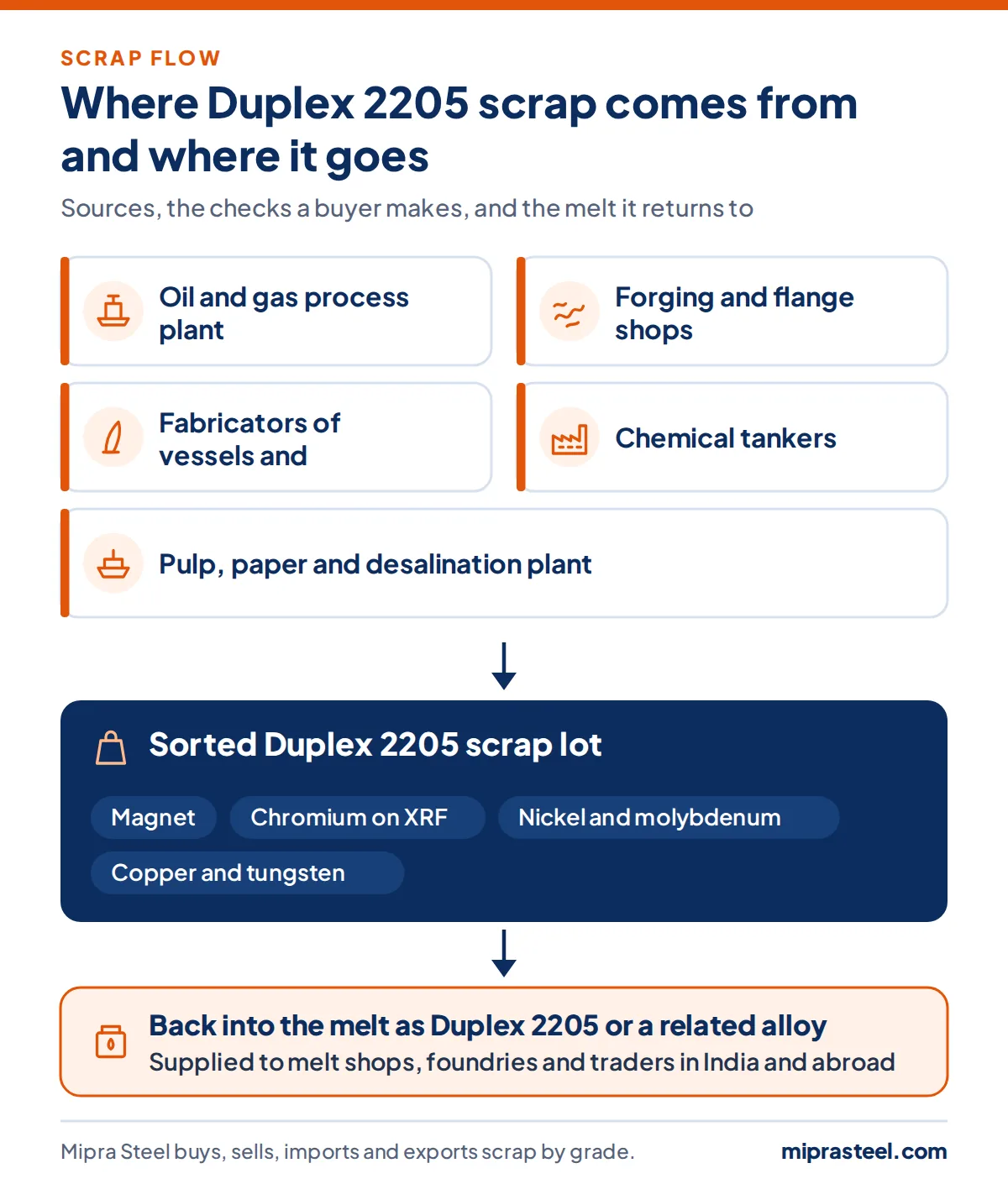
2205 is a workhorse grade, so its scrap comes from many places at once. These are the streams that give the cleanest, single-grade lots.
Oil and Gas Process Plant
Revamps of manifolds, separators and produced-water systems release flanges, fittings, valve bodies and cut sections. See oil and gas scrap.
Forging and Flange Shops
F51 and F60 flanges and fittings machined from forged rings and bar leave turnings, rejected forgings and crop ends. Heat numbers are usually stamped, which helps.
Fabricators of Vessels and Exchangers
Plate crops, nozzle cut-outs and tube-sheet trepanning from pressure-vessel and heat-exchanger work. Plate trim from a single job tends to be one heat.
Chemical Tankers
Cargo tanks on many chemical tankers are built in duplex. When tanks are repaired or vessels are recycled, large plate sections come out. Some tankers use stainless-clad steel instead, which is a different material.
Pulp, Paper and Desalination Plant
Digesters, bleach-plant equipment and evaporators are rebuilt on long cycles. See desalination plant scrap.
Duplex 2205 Scrap Specification Chart
| Grade | Duplex 2205 |
|---|---|
| UNS | S32205 / S31803 |
| W.Nr. / EN | 1.4462 |
| Also known as | Duplex 31803, UNS S31803, UNS S32205, F51, F60 |
| Alloy type | Duplex stainless steel |
| Density | 7.8 g/cm³ (0.282 lb/in³) |
| Magnetic | Magnetic, because of its ferrite |
| HS code (customs heading) | 7204.21 (stainless steel waste and scrap) |
Duplex 2205 Chemical Composition
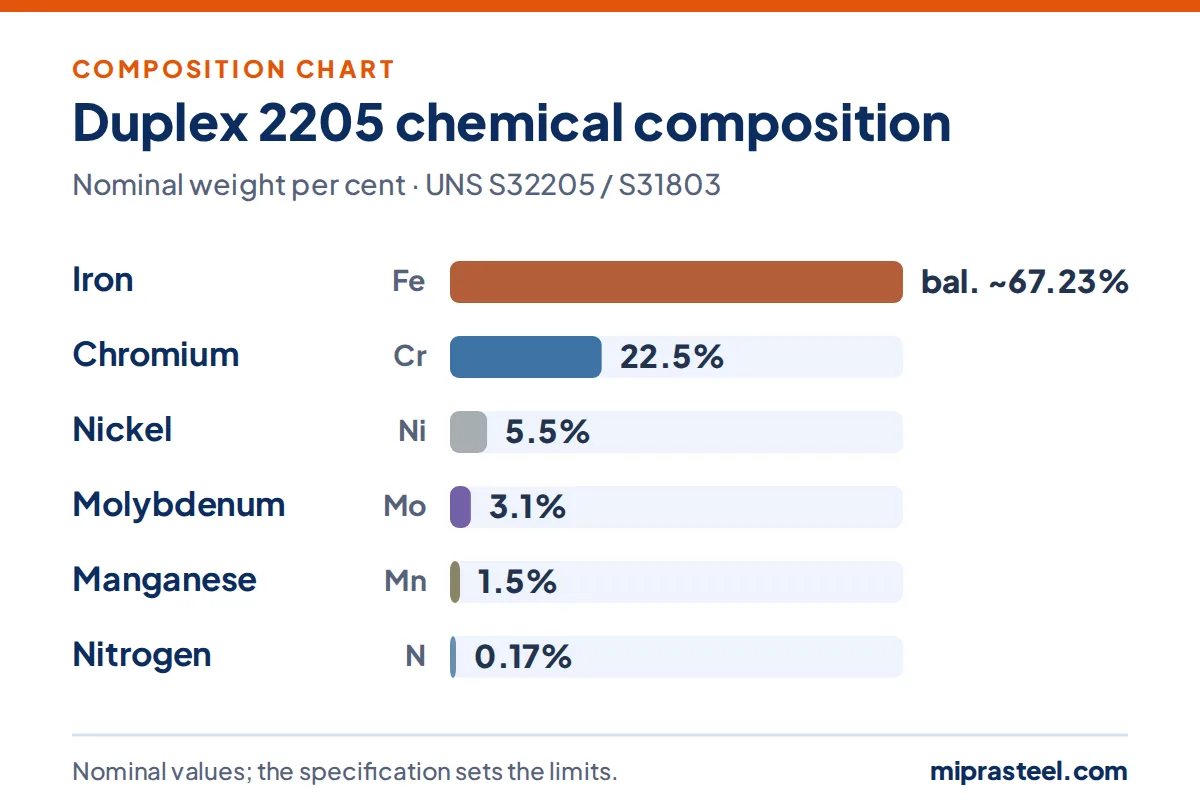
Nominal composition in weight per cent, used to describe and identify the grade. The governing specification sets the limits for each product.
| Element | Symbol | Nominal wt% | |
|---|---|---|---|
| Iron | Fe | Balance (about 67.2) | |
| Chromium | Cr | 22.5 | |
| Nickel | Ni | 5.5 | |
| Molybdenum | Mo | 3.1 | |
| Manganese | Mn | 1.5 | |
| Nitrogen | N | 0.17 |
Duplex 2205 Equivalent Grades and Other Names
| Designation | Value |
|---|---|
| Trade name | Duplex 2205 |
| UNS | S32205 / S31803 |
| W.Nr. / EN | 1.4462 |
| Other names in the trade | Duplex 31803, UNS S31803, UNS S32205, F51, F60 |
Look up any designation in the grade name converter or the equivalent grade chart.
Duplex 2205 Standards and Specifications
Duplex 2205 Applications
- Oil and gas process piping and manifolds
- Chemical tankers and storage tanks
- Pressure vessels and heat exchangers
- Desalination and pulp and paper equipment
Source industries: oil and gas, chemical processing, desalination, marine and shipbuilding.
How Duplex 2205 Scrap Is Identified
Sorting 2205 is a two-step job: first prove the piece is duplex, then prove it is not a super duplex grade.
| Check | What it shows for Duplex 2205 |
|---|---|
| Magnet | A clear pull rules out 316L and 254 SMO, which are austenitic. It does not rule out carbon steel or 400-series stainless, so it is a first filter only. |
| Chromium on XRF | About 22% to 23%. A reading near 25% means a super duplex grade; 17% to 18% with a magnet pull points to ferritic or martensitic stainless. |
| Nickel and molybdenum | About 5.5% nickel and 3% molybdenum. 316L reads 10% to 14% nickel with no magnetic pull. |
| Copper and tungsten | Should be near zero. Readings around 0.75% each point to S32760. |
| Nitrogen | A handheld XRF cannot read nitrogen. If a buyer needs it confirmed, that takes OES or a laboratory. See XRF, OES and lab analysis compared. |
| Clad or solid | On tank plate, test both faces. A duplex face over a carbon-steel back is clad plate and is described separately. |
Grades Most Often Confused with Duplex 2205
- Super duplex 2507: is also magnetic but reads about 25% chromium, 7% nickel and 4% molybdenum.
- Super duplex S32760: reads like 2507 with about 0.75% copper and 0.75% tungsten added.
- 254 SMO: is non-magnetic, with about 18% nickel and 6% molybdenum.
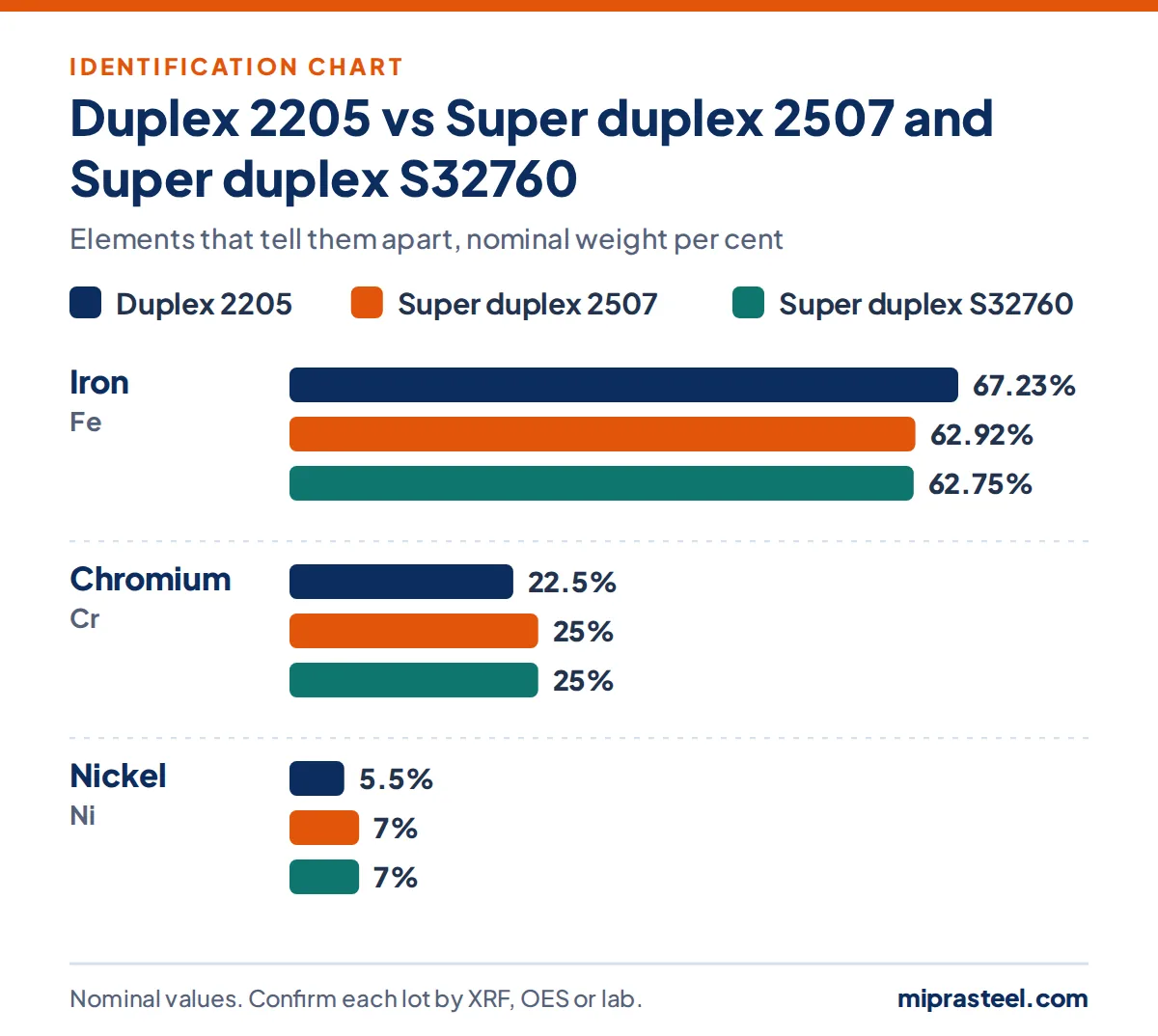
Nominal values for Duplex 2205 against its closest grades on this site.
Preparing Duplex 2205 Scrap for Sale
- Check every piece with a magnet, then confirm grade with XRF, because the magnet alone lets carbon steel through.
- Bag S32750 and S32760 pieces separately from 2205 even if there are only a few.
- Cut off carbon-steel brackets, studs and lifting lugs before weighing.
- Keep clad tank plate in its own labelled lot.
- Keep F51 and F60 turnings dry and drained, in drums marked with the grade.
Duplex 2205 Scrap Price per Kg: What Decides It
People ask for a duplex scrap price per kg as if it were a fixed number. It is not. The offer for a 2205 lot is built from these points.
- Nickel and molybdenum content: with only about 5.5% nickel, 2205 depends more on its 3% molybdenum and 22% chromium than a 316 lot does.
- Proof that it is 2205 and not a blend: readings per piece or matching certificates for F51, F60 or S32205 plate let a buyer treat it as duplex melt input rather than mixed stainless.
- Contamination by carbon steel: because the magnet will not catch it, stray carbon-steel pieces, attachments and clad plate are the usual reason a 2205 lot is marked down.
- Form: heavy plate crops and forgings are easier to charge than light sheet, and both are worth more than oily turnings.
- Quantity and pick-up point: a full container of bagged 2205 near Nhava Sheva or Mundra handles differently from a few hundred kilos inland.
Nickel, molybdenum and chromium prices change daily, so every 2205 offer is dated. The general method is set out in what moves alloy scrap prices.
Duplex 2205 Scrap Import and Export
Importing Duplex 2205 Scrap into India
India imports duplex scrap from the Gulf, where oil and gas plant and desalination work generate it, and from Europe and East Asia. Imported metal scrap is inspected before shipment and arrives with a pre-shipment inspection certificate, commercial invoice, packing list and bill of lading. Describing the lot as Duplex 2205, UNS S31803 / S32205, with XRF readings attached avoids it being treated as generic stainless. Main entry ports are Nhava Sheva and Mundra, with Chennai for southern buyers. See import documents and inspection.
Exporting Duplex 2205 Scrap from India
Indian flange makers and fabricators turn out steady volumes of 2205 crops, rejected forgings and turnings. Exported lots are weighed, described by grade and UNS number on the invoice and packing list, and shipped bagged or loose in containers. Our offices in Dubai and South Korea are close to duplex users in the Gulf and East Asia, and we also serve buyers in Saudi Arabia. See export paperwork for alloy scrap.
Customs heading: 7204.21 (stainless steel waste and scrap). The HS code is the international tariff heading the scrap is declared under; national tariff lines add further digits, so confirm the full line with your customs broker.
Comparisons
Other Duplex and Super-Austenitic Scrap Grades
Related Reading
Duplex 2205 Scrap FAQ
Is Duplex 2205 scrap magnetic?
Yes. About half of its structure is ferrite, so a magnet pulls on it. That separates it from 316L and other austenitic stainless steels, but not from carbon steel, ferritic stainless or the super duplex grades, which are also magnetic. Confirm the grade with an XRF reading.
Is S31803 scrap the same as S32205 scrap?
For trading purposes, yes. S32205 is a tighter version of S31803 with higher minimum chromium, molybdenum and nitrogen, and most material is dual-certified. Both are sold as 2205. A buyer who specifically needs S32205 will ask for certificates.
Is 2205 scrap worth more than 316 scrap?
Not automatically. 316 carries more nickel (10% to 14% against about 5.5%), while 2205 carries more chromium and comparable or higher molybdenum. Which lot fetches more depends on nickel and molybdenum prices on the day and on how clean each lot is.
What does F51 mean on duplex scrap?
F51 is the ASTM A182 forging designation for UNS S31803. F60 is the same for S32205. Both are duplex 2205, so F51 and F60 flanges and fittings go into the same lot. F53 and F55 are super duplex and must be kept apart.
Which HS code covers duplex 2205 scrap?
Duplex is a stainless steel, so its scrap is typically declared under HS 7204.21, waste and scrap of stainless steel, not under nickel scrap headings. Your customs broker should confirm the full national tariff line before the shipment is booked.
How do I sell duplex scrap to Mipra Steel?
Send the form, approximate weight, location and photographs, plus any readings or certificates. Say if the lot includes clad plate or turnings, and whether pieces carry F51, F60 or 1.4462 markings. The sell scrap form or the contact page both reach us.
Why was my duplex lot downgraded?
Usually because of carbon steel. Brackets, studs, clad backing and stray carbon-steel offcuts all stick to the magnet just like 2205, so they slip through magnet-only sorting. Super duplex pieces in the bag are the other common cause.
What is Duplex 2205 made of?
Nominally 67.2% iron, 22.5% chromium, 5.5% nickel, 3.1% molybdenum, 1.5% manganese, plus about 0.17% nitrogen. Specification ranges vary by product form and standard.
Published by Mipra Steel, Khetwadi, Mumbai · Updated