Hastelloy X Scrap Buyer, Importer and Exporter in India
Mipra Steel deals in Hastelloy X scrap as its own grade, collecting from turbine repair, aero overhaul, sheet fabrication and furnace sources, and passing described lots on to melt shops and traders at home and abroad.
Sell Hastelloy X Scrap
To sell Hastelloy X scrap, tell us whether it is new fabrication trim, used combustor or duct parts, furnace hardware or wire ends, and give the weight and location. Send photographs showing both faces of used parts so coatings and braze are visible. Readings, part numbers or certificates naming UNS N06002 help. Mention any Haynes 230 or other alloys in the same consignment. We review incoming enquiries and respond with relevant next steps.
Buy Hastelloy X Scrap
Melt shops and alloy producers looking for Hastelloy X as charge can send their required quantity, accepted forms (trim, skeleton, baled sheet, used parts), limits on coated material, destination and delivery window. Lots are described as Hastelloy X, UNS N06002, and we can discuss which readings and documents accompany them.
Why Is Hastelloy X Used in Combustors, and How Does That Shape the Scrap Trade?
A combustor liner has a hard life: thin sheet, flame on one side, cooling air on the other, and thousands of heat-up and cool-down cycles. Hastelloy X was designed for exactly that. Its 22% chromium forms a protective oxide in oxidising gas up to about 1,200 °C (2,190 °F), its 9% molybdenum stiffens the nickel matrix without any ageing treatment, and it forms and welds easily, so fabricators can roll, press, punch and weld it into cans, ducts and seals. Furnace builders and petrochemical heater makers use it for the same reasons.
In the scrap trade, that makes Alloy X mostly a sheet and fabricated-part material. Lots are liners with rows of cooling holes, transition pieces, louvres, flame tubes, tailpipe sections, muffles, trays and the offcut skeletons left after parts are blanked from a sheet. Plate and bar exist, but in smaller tonnage.
For a melter, Hastelloy X is a nickel-chromium-molybdenum feed with an iron level that sets it apart from the corrosion grades. That is the most common sorting mistake: it carries the Hastelloy name, so it gets thrown in with Hastelloy C-276, yet it has about half the molybdenum, much more iron and almost no tungsten. The other frequent mix-up is Haynes 230, which does the same job in many combustors but carries 14% tungsten.
Weld wire to AWS ERNiCrMo-2 is Hastelloy X chemistry, so wire ends and spools from combustor repair shops belong in a Hastelloy X lot.
Hastelloy X belongs to the Hastelloy family, part of nickel alloy scrap.
Where Hastelloy X Scrap Comes From
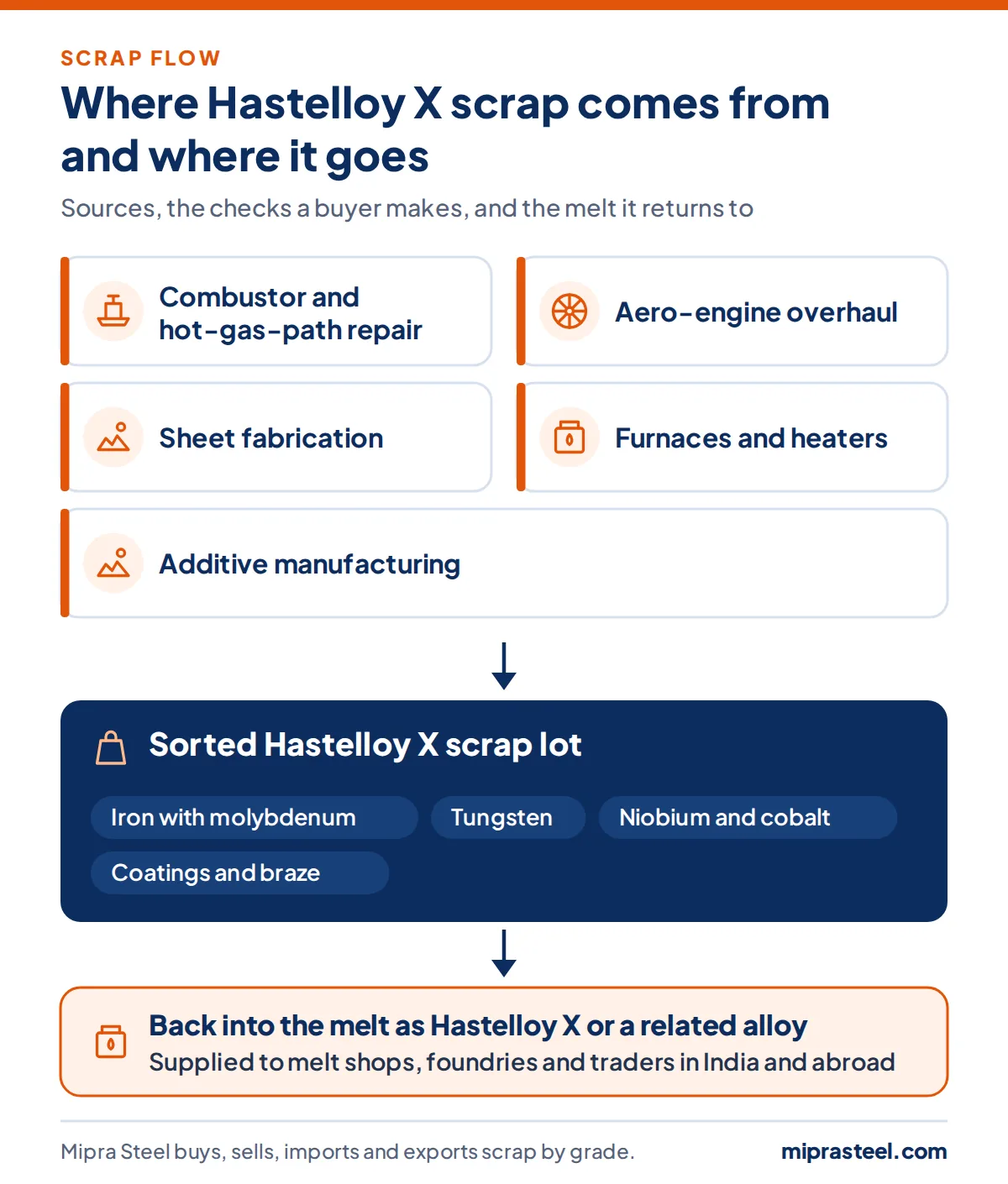
Hastelloy X scrap follows hot-section maintenance schedules and sheet fabrication, so supply clusters around overhaul shops, engine and turbine repair centres and furnace builders.
Combustor and Hot-Gas-Path Repair
Liners, transition ducts, cross-fire tubes and seals replaced at inspections of land and aero gas turbines. Many carry a ceramic thermal barrier coating and braze repairs. See power generation scrap.
Aero-Engine Overhaul
Afterburner liners, tailpipe and exhaust sections, and flame tube parts from military and civil engine work. See aerospace scrap.
Sheet Fabrication
Blanking skeletons, laser-cut trim, rejected pressings and edge strips from shops building combustor and duct parts. This is usually the cleanest X a market sees.
Furnaces and Heaters
Muffles, retorts, baskets, trays and burner parts from heat-treating furnaces and petrochemical heaters. See heat treatment and furnace scrap.
Additive Manufacturing
Hastelloy X is printed for combustor parts, so failed builds, supports and spent build plates from print shops are an occasional source.
Hastelloy X Scrap Specification Chart
| Grade | Hastelloy X |
|---|---|
| UNS | N06002 |
| W.Nr. / EN | 2.4665 |
| Also known as | Alloy X, Hastelloy XR (related grade) |
| Alloy type | Solid-solution nickel-chromium-iron-molybdenum |
| Density | 8.22 g/cm³ (0.297 lb/in³) |
| Magnetic | Non-magnetic. |
| HS code (customs heading) | 7503.00 (nickel waste and scrap) |
Hastelloy X Chemical Composition
Nominal composition in weight per cent, used to describe and identify the grade. The governing specification sets the limits for each product.
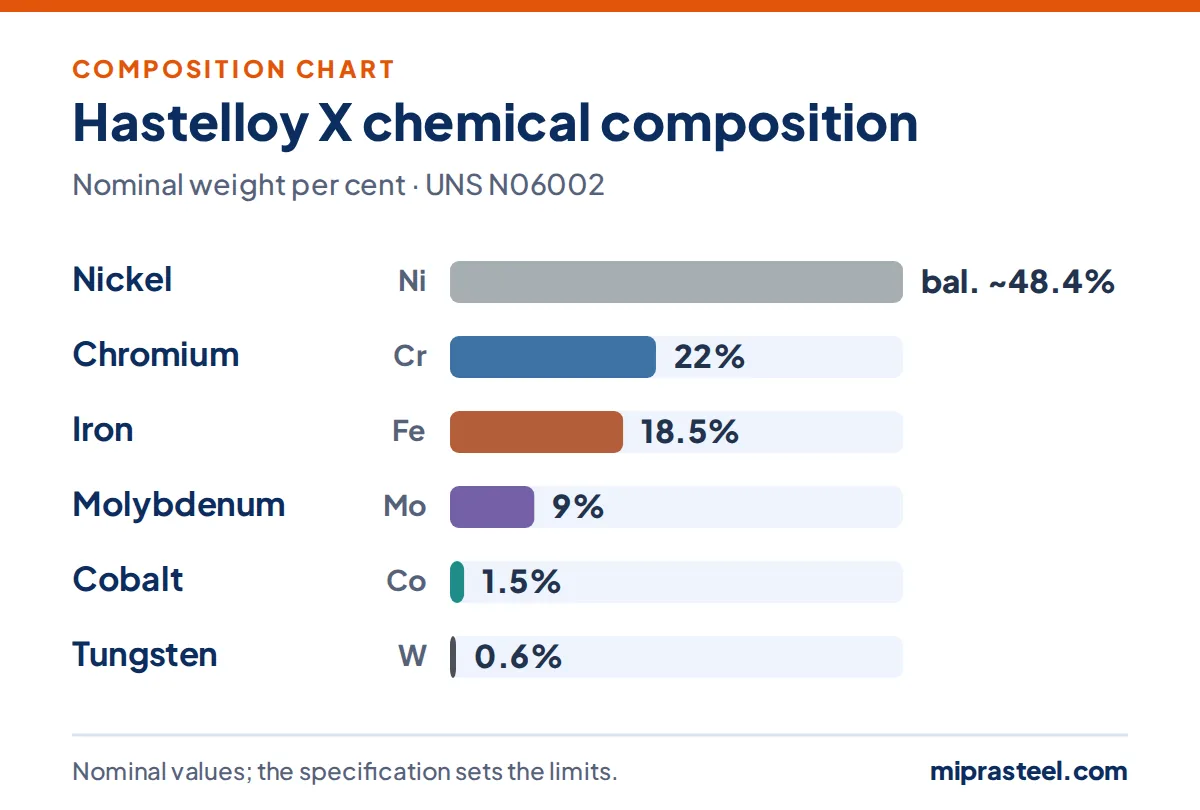
| Element | Symbol | Nominal wt% | |
|---|---|---|---|
| Nickel | Ni | Balance (about 48.4) | |
| Chromium | Cr | 22 | |
| Iron | Fe | 18.5 | |
| Molybdenum | Mo | 9 | |
| Cobalt | Co | 1.5 | |
| Tungsten | W | 0.6 |
Hastelloy X Equivalent Grades and Other Names
| Designation | Value |
|---|---|
| Trade name | Hastelloy X |
| UNS | N06002 |
| W.Nr. / EN | 2.4665 |
| Other names in the trade | Alloy X, Hastelloy XR (related grade) |
Look up any designation in the grade name converter or the equivalent grade chart.
Hastelloy X Standards and Specifications
Hastelloy X Applications
- Gas turbine combustors and transition ducts
- Afterburner and tailpipe parts
- Industrial furnace components
- Petrochemical heater parts
Source industries: aerospace, power generation, heat treatment and furnaces.
How Hastelloy X Scrap Is Identified
Combustor sheet gives few visual clues, and several heat-resisting alloys share the job. Buyers lean on a short list of readings.
| Check | What it shows for Hastelloy X |
|---|---|
| Iron with molybdenum | About 18.5% iron alongside 9% molybdenum is the signature. Molybdenum near 9% with iron under 5% points to Inconel 625 or Inconel 617. |
| Tungsten | Should read well under 1%. About 14% tungsten is Haynes 230; 3% to 4% tungsten with 16% molybdenum is C-276. |
| Niobium and cobalt | No niobium, which rules out 625. Cobalt around 1.5% is normal; a reading near 12% cobalt is Inconel 617. |
| Coatings and braze | Read a cleaned spot of bare metal, not the coating. Ceramic thermal barrier layers and braze fillets distort readings and are noted on the description. |
| Magnet | Hastelloy X is non-magnetic. Strongly magnetic brackets, studs or support frames are steel and come out before weighing. |
| Specifications | Material certified to ASTM B435 or AMS 5536 sheet, or AMS 5754 bar, with UNS N06002 on the certificate, can be described as X without doubt. |
Grades Most Often Confused with Hastelloy X
- Haynes 230: used in the same combustors, but about 14% tungsten, 2% molybdenum and only 1.5% iron, against X's 0.6% tungsten, 9% molybdenum and 18.5% iron.
- Inconel 625: the same 9% molybdenum and similar chromium, but iron near 4% and about 3.6% niobium, which X does not have.
- Inconel 617: also 22% chromium and 9% molybdenum, but with about 12.5% cobalt, 1.2% aluminium and around 1% iron.
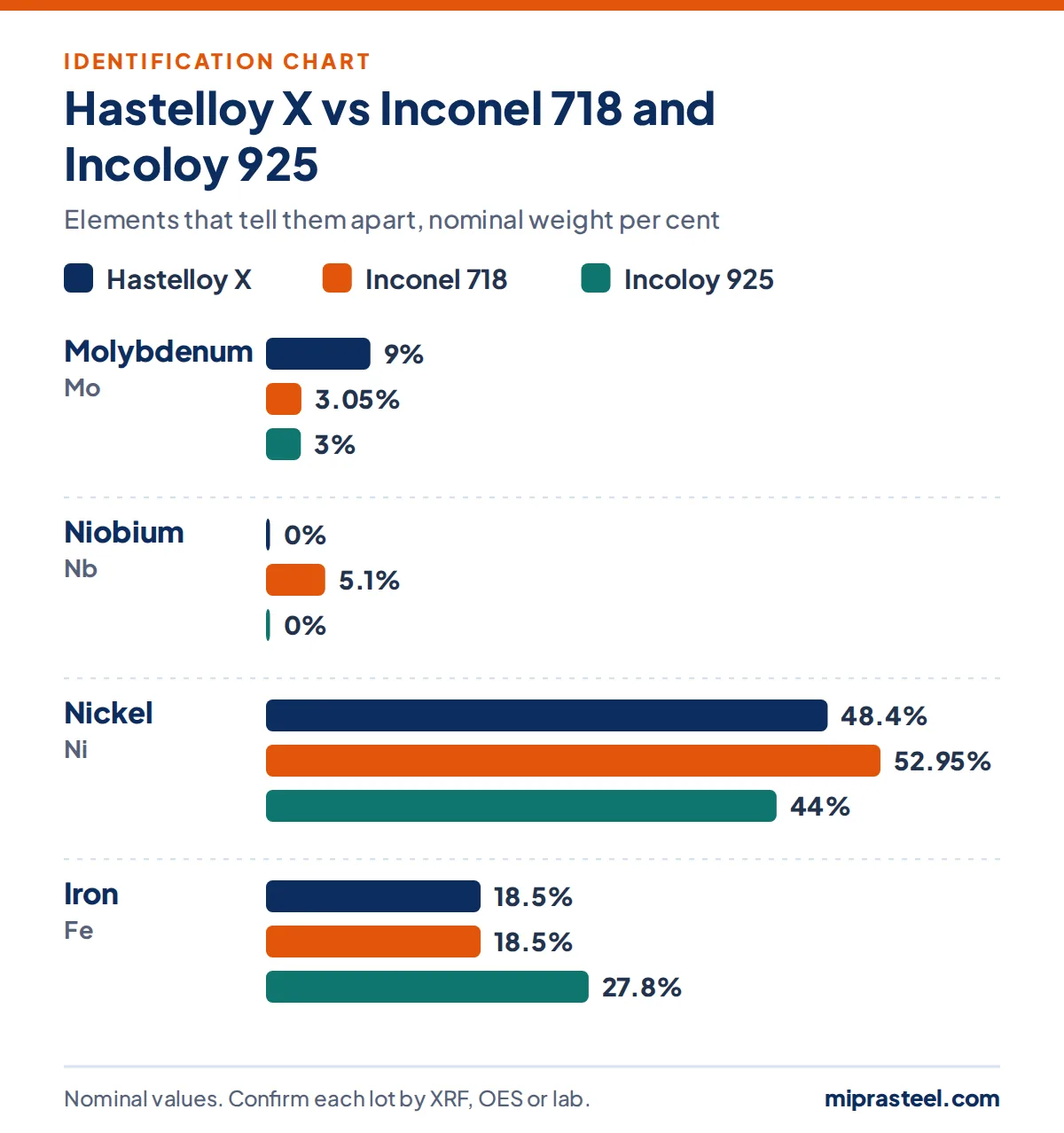
Nominal values for Hastelloy X against its closest grades on this site.
Preparing Hastelloy X Scrap for Sale
- Sort combustor parts by alloy before anything else: X, Haynes 230, 617 and cobalt alloys each go in their own bin.
- Keep new trim and skeletons apart from used, coated or brazed parts.
- Strip steel brackets, studs and frames, and knock off loose ceramic.
- Bale or flatten thin liners and skeletons so they pack densely.
- Collect ERNiCrMo-2 wire ends with the X lot, not with general nickel wire.
- Keep certificates or part numbers that show UNS N06002 with the lot.
Hastelloy X Scrap Price per Kg: What Decides It
No fixed Hastelloy X scrap price per kg applies across lots. The offer is built from contained metal, then adjusted for how the material arrives.
- Nickel at around 48%, with 9% molybdenum and 22% chromium adding to the value; the 18.5% iron adds little.
- Single-grade certainty. X sorted away from 230, 625, 617 and the C-alloys, with readings to show it, is described as X. A mixed combustor bin is priced for the work of sorting it.
- Coatings and repairs: thermal barrier coatings, bond coats and braze joints reduce the usable metal and add elements a melter has to account for.
- Thickness and density of the lot: thin perforated liners and loose skeletons are bulky to ship and handle compared with plate, bar or baled sheet.
- Clean new fabrication trim generally ahead of used, oxidised, coated hot-section parts of the same grade.
- Steel attachments, ceramics and dirt left on parts, which a buyer deducts for.
Nickel and molybdenum markets move daily, so offers carry a date. The article on nickel alloy scrap value explains how buyers work out a figure.
Hastelloy X Scrap Import and Export
Importing Hastelloy X Scrap into India
Hastelloy X reaches India mainly from regions with large gas turbine fleets and engine overhaul centres: the Gulf, East Asia and Europe. Combustor parts tend to come in mixed hot-section consignments, so asking the shipper to separate X from 230, 617 and cobalt alloys before loading avoids surprises. Imported scrap is inspected before shipment and carries a pre-shipment inspection certificate with the commercial invoice, packing list and bill of lading. A packing list naming Hastelloy X, UNS N06002, by weight keeps customs and commercial descriptions aligned at Nhava Sheva, Mundra or Chennai. Our guide to importing nickel alloy scrap into India covers the steps.
Exporting Hastelloy X Scrap from India
Sheet fabricators and turbine repair work in India produce Hastelloy X trim and used parts that suit overseas melters making heat-resisting nickel alloys. Export lots are described by grade and UNS number on the invoice and packing list, weighed, and packed as bales, bags or loose bulky parts in containers. Light, bulky liners are often baled or flattened to improve container loading. Buyers in Japan, Italy and the Gulf take this kind of material, and our offices in Dubai and South Korea support trade in those regions. See export documents for alloy scrap.
Customs heading: 7503.00 (nickel waste and scrap). The HS code is the international tariff heading the scrap is declared under; national tariff lines add further digits, so confirm the full line with your customs broker.
Comparisons
Other Hastelloy Scrap Grades
Related Reading
Hastelloy X Scrap FAQ
Is Hastelloy X the same as Haynes 230 for scrap purposes?
No. They often sit in the same combustor bin, but Haynes 230 carries about 14% tungsten and very little iron, while Hastelloy X carries about 18.5% iron, 9% molybdenum and well under 1% tungsten. A melter treats them as different feeds, so mixed lots are sorted and priced for the work. See Hastelloy X vs Haynes 230.
Can Hastelloy X be packed with Hastelloy C-276 scrap?
It should not be. The shared trade name hides a large difference: C-276 has about 16% molybdenum and 4% tungsten with low iron, while X has 9% molybdenum and 18.5% iron. One in the other spoils the analysis of both.
Are coated combustor liners still sold as Hastelloy X?
Yes, but described as coated used parts, not as clean X. Thermal barrier coatings and braze repairs reduce the usable metal, so the description and offer reflect them. Clean new trim is a separate, higher category.
What is Hastelloy XR, and does it go with X?
XR is a related grade with a similar base chemistry. Whether it can join an X lot depends on the buyer, so keep it labelled and documented by analysis rather than mixing it in.
Who buys Hastelloy X scrap in India?
Melt shops and alloy producers making heat-resisting nickel alloys and welding consumables, along with traders who consolidate hot-section material for export. Mipra Steel buys and sells Alloy X lots; send the weight, form, location and photographs to start a discussion.
What HS code does Hastelloy X scrap use?
Being nickel-base, it is typically declared under HS 7503.00, nickel waste and scrap. The national line adds more digits, so confirm it with your customs broker before booking.
Which standards cover Hastelloy X material?
Wrought Hastelloy X is supplied to ASTM B435 for plate and sheet, B572 for bar and B622 for pipe and tube, and to AMS 5536 and AMS 5754 for aerospace use. Certificates quoting these help a scrap lot get described accurately. See ASTM B nickel alloy specifications.
What is Hastelloy X made of?
Nominally 48.4% nickel, 22% chromium, 18.5% iron, 9% molybdenum, 1.5% cobalt, 0.6% tungsten. Specification ranges vary by product form and standard.
Published by Mipra Steel, Khetwadi, Mumbai · Updated