What Sits in the Duplex Family, and Why Does Each Grade Need Its Own Lot?
Five grades share this page because they share the same plants, not the same chemistry. The two-phase steels come first. Duplex 2205 is the general-purpose member, with about 22.5% chromium, 5.5% nickel and 3% molybdenum. Super duplex 2507 pushes chromium to 25%, nickel to 7% and molybdenum to 4%. Super duplex S32760 is close to 2507 but carries about 0.75% each of copper and tungsten. All three are roughly half ferrite and half austenite, so they pull a magnet.
The other two are fully austenitic and ignore a magnet. 254 SMO is a 6Mo grade: 20% chromium, 18% nickel, just over 6% molybdenum and 0.2% nitrogen on an iron base. 20Mo-4 is the odd one out. With about 37% nickel against 33% iron it is a nickel alloy, typically declared as nickel waste and scrap rather than stainless, and it is bought on its nickel.
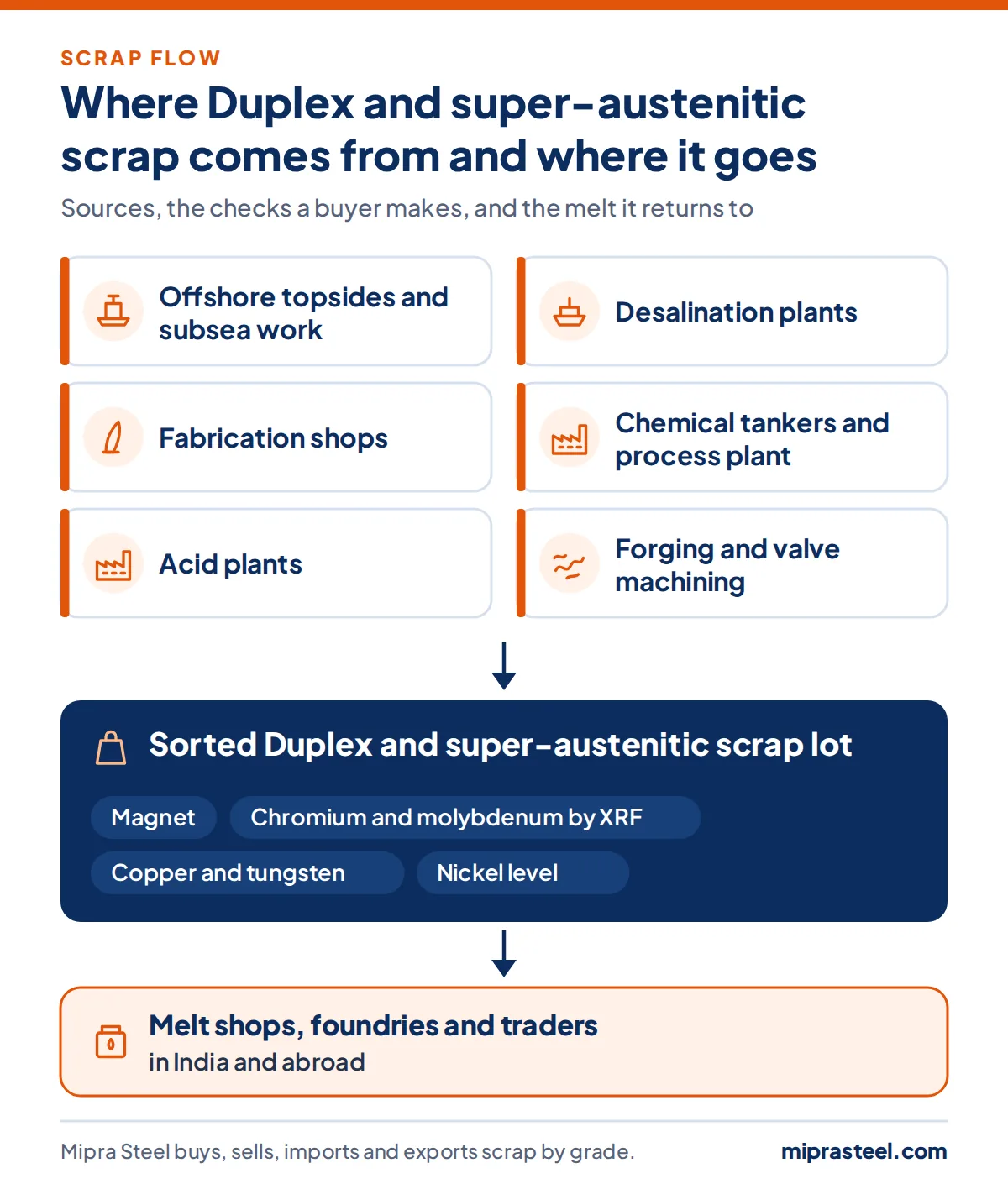
In practice the family sorts in three moves. A magnet splits the duplex steels from the austenitic pair. An XRF reading of chromium and molybdenum then separates 2205 from the 25% chromium grades, and copper plus tungsten picks out S32760 from 2507. Nickel near 18% with 6% molybdenum is 254 SMO; nickel in the high thirties is 20Mo-4.
Why bother? A stainless melt shop making super duplex wants 25% chromium and 4% molybdenum in its charge and cannot use a bag diluted with 2205. A mill making 2507 does not want tungsten and copper from S32760. And plain 316L offcuts, which carry only 2 to 3% molybdenum, drag the whole lot down to ordinary stainless value. For the commercial side, see our guide to selling duplex scrap.
Duplex and Super-Austenitic Scrap Grades We Buy and Sell
Duplex and Super-Austenitic Chemical Composition
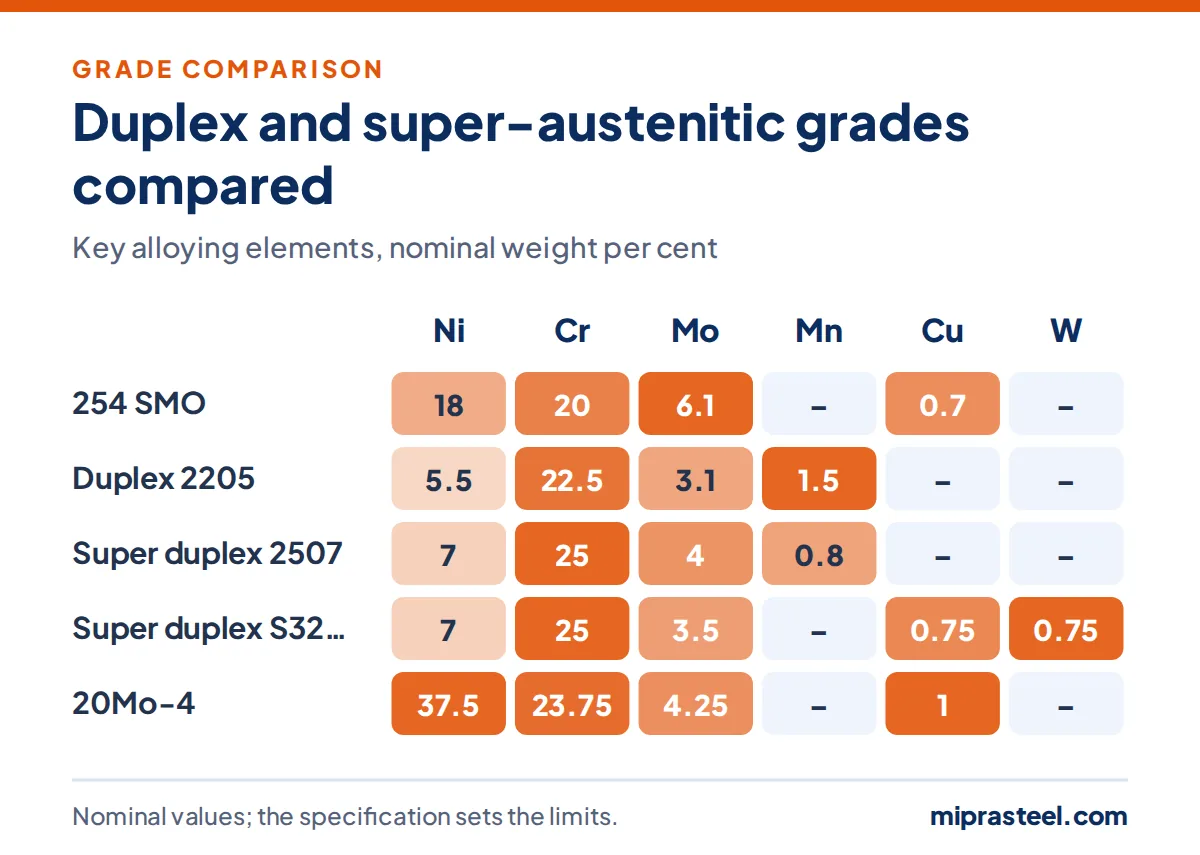
| Grade | Fe | Ni | Cr | Mo | Mn | Cu | W |
|---|---|---|---|---|---|---|---|
| 254 SMO | 55 | 18 | 20 | 6.1 | – | 0.7 | – |
| Duplex 2205 | 67.2 | 5.5 | 22.5 | 3.1 | 1.5 | – | – |
| Super duplex 2507 | 62.9 | 7 | 25 | 4 | 0.8 | – | – |
| Super duplex S32760 | 62.8 | 7 | 25 | 3.5 | – | 0.75 | 0.75 |
| 20Mo-4 | 33.3 | 37.5 | 23.8 | 4.3 | – | 1 | – |
Nominal weight per cent. Specification ranges vary by product form and standard.
How to Tell Duplex and Super-Austenitic Grades Apart
Identification starts with a magnet and ends with an analysis. The ASTM forging designations stamped on parts are a useful shortcut.
| Check | What it shows for Duplex and super-austenitic |
|---|---|
| Magnet | Duplex 2205, 2507 and S32760 are magnetic from their ferrite; 254 SMO and 20Mo-4 are not. See the magnet test. |
| Chromium and molybdenum by XRF | About 22.5% Cr and 3% Mo marks 2205; 25% Cr with 3.5 to 4% Mo marks a super duplex. |
| Copper and tungsten | Readings near 0.75% of each separate S32760 from 2507, which has neither. |
| Nickel level | About 5.5% for 2205, 7% for the super duplex grades, 18% for 254 SMO and around 37% for 20Mo-4. |
| Forging marks | F51 or F60 means 2205, F53 means 2507, F55 means S32760 and F44 means 254 SMO under ASTM A182. |
| Nitrogen and carbon | Neither shows on handheld XRF; a mill certificate or laboratory analysis covers them when a buyer asks. |
Grades Most Often Confused with Duplex and Super-Austenitic
- 316L stainless: non-magnetic like 254 SMO but only about 10 to 14% nickel and 2 to 3% molybdenum; it should be kept out of every lot on this page.
- 904L (N08904): austenitic with about 25% nickel, 20% chromium, 4.5% molybdenum and 1.5% copper; sits between 254 SMO and 20Mo-4 on an XRF screen.
- Hastelloy C-276: also used in seawater and acid service, but nickel-base with 16% molybdenum and 4% tungsten.
A Magnet Separates Duplex from 254 SMO
Duplex grades are magnetic because of their ferrite; 254 SMO and other austenitic grades are not. See the magnet test guide.
Chromium and Molybdenum Separate Duplex from Super Duplex
2205 has about 22.5% chromium and 3% molybdenum; 2507 and S32760 have 25% chromium and 3.5–4% molybdenum. See 2205 vs 2507.
Copper and Tungsten Separate S32760 from 2507
About 0.75% each in S32760, none in 2507.
Where Duplex and Super-Austenitic Scrap Comes From
These grades are chosen for chloride and seawater duty, so the scrap follows offshore, coastal and acid-plant work.
Offshore Topsides and Subsea Work
Seawater injection, firewater and produced-water lines, manifolds and valve bodies in 2507 and S32760 come out during decommissioning and brownfield upgrades. See oil and gas.
Desalination Plants
High-pressure reverse osmosis piping, pump casings and intake hardware use super duplex and 254 SMO, and rebuilds release flanges, fittings and plate. See desalination.
Fabrication Shops
Plate crops, nozzle cut-outs, flange blanks and bar ends from vessel, exchanger and skid fabrication are mostly 2205, with smaller volumes of super duplex.
Chemical Tankers and Process Plant
Cargo tank plate and heating coils in 2205, plus pulp-bleach and flue-gas cleaning equipment in 254 SMO.
Acid Plants
Sulfuric and phosphoric acid piping, vessels and exchanger tube sheets supply most 20Mo-4 lots, usually alongside Alloy 20.
Forging and Valve Machining
F51, F53, F55 and F44 forgings leave turnings and solid crops; the forging number on a valve body or flange often identifies the grade directly.
Source industries: desalination, marine and shipbuilding, oil and gas, chemical processing.
Comparisons
Duplex and 254 SMO Stainless Scrap Buyer, Importer and Exporter in India
Mipra Steel trades duplex, super duplex, 254 SMO and 20Mo-4 scrap from Khetwadi, Mumbai, buying graded lots from fabricators and plant owners and supplying them to stainless and alloy melt shops.
Sell Duplex and Super-Austenitic Scrap
To sell duplex scrap, tell us which of the five grades you believe it is and why: forging marks such as F51, F53, F55 or F44, mill certificates, or a set of XRF readings. Give the form (plate crops, flanges, valve bodies, bar ends or turnings), the weight of each grade, the location and clear photographs. Say whether any 316L or nickel alloy pieces are in the pile. We review incoming enquiries and respond with relevant next steps.
Buy Duplex and Super-Austenitic Scrap
Melt shops and foundries sourcing duplex or 6Mo revert should state the target grade, the minimum molybdenum and nickel they need, any limit on copper or tungsten, the form they can charge and the monthly quantity. 20Mo-4 should be requested separately because it goes to nickel-alloy melters. We describe each lot by grade, form and the readings or certificates that support it.
Preparing Duplex and Super-Austenitic Scrap for Sale
- Run a magnet over every piece and bag magnetic duplex apart from non-magnetic 254 SMO and 20Mo-4.
- Read chromium, molybdenum, copper and tungsten to split 2205, 2507 and S32760.
- Pull out any 316L, carbon steel and nickel alloy pieces before weighing.
- Photograph forging stamps and heat numbers on flanges and valve bodies.
- Keep turnings dry and away from solids, and note the coolant used.
- Label each bag with grade, UNS number and net weight.
Duplex and Super-Austenitic Scrap Price per Kg: What Decides It
Duplex and 6Mo scrap is priced as alloyed stainless, so the offer follows the contained nickel and molybdenum, then the cleanness of the sort.
- Grade group: super duplex and 254 SMO carry more molybdenum, and 254 SMO more nickel, than 2205, so mixing them into 2205 gives away value.
- Molybdenum content: the main element that separates these grades from 316L, and the one a stainless melt shop pays attention to.
- Nickel content: modest in the duplex grades, significant in 254 SMO, and the paying element in 20Mo-4.
- Contamination with 316L, carbon steel or nickel alloys: even a few pieces force a buyer to re-sort or downgrade.
- Form: plate crops and heavy flanges are easier to charge than light turnings, which also carry coolant and oxide.
- Copper and tungsten in S32760: welcome when the buyer melts S32760, unwanted when they melt 2507.
- Paperwork: mill certificates or forging marks make the description easier to accept.
Any duplex scrap price per kg is tied to that day's nickel and molybdenum markets and stainless demand, so offers are dated. Our scrap value guide explains the contained-metal approach.
Duplex and Super-Austenitic Scrap Import and Export
Importing Duplex and Super-Austenitic Scrap into India
Most duplex and super duplex scrap entering India comes from Gulf offshore and desalination work and from European and East Asian fabrication. It is typically declared as stainless steel waste and scrap under HS 7204.21, while 20Mo-4 is typically declared under 7503.00 as nickel scrap; your customs broker should confirm the national line. Lots arrive with a pre-shipment inspection certificate, commercial invoice, packing list and bill of lading, usually at Nhava Sheva or Mundra. Naming each grade and its UNS number on the invoice avoids the whole consignment being treated as ordinary stainless. See importing alloy scrap into India.
Exporting Duplex and Super-Austenitic Scrap from India
Indian fabricators and refinery and fertiliser plant shutdowns release 2205 and super duplex offcuts that stainless mills abroad use as low-cost molybdenum and chromium units. Exported lots are described grade by grade, with UNS numbers on the invoice and packing list, weighed and shipped in bags, drums or loose in containers. Our Dubai office covers Gulf buyers, our South Korea office covers East Asia, and we also supply Italy, Spain and the Netherlands.
Customs heading: 7204.21 (stainless steel waste and scrap). The HS code is the international tariff heading the scrap is declared under; national tariff lines add further digits, so confirm the full line with your customs broker.
Related Reading
Duplex and 254 SMO Stainless Scrap FAQ
Is duplex scrap magnetic?
Yes. Duplex 2205 and the super duplex grades are about half ferrite, so a magnet sticks to them, though less firmly than to carbon steel. 254 SMO and 20Mo-4 are fully austenitic and non-magnetic. A magnet therefore splits the family in two, but cannot tell 2205 from 2507.
Is super duplex scrap worth more than 2205 scrap?
Usually, yes. Super duplex 2507 and S32760 carry about 25% chromium, 7% nickel and 3.5 to 4% molybdenum against roughly 22.5%, 5.5% and 3% in 2205, so each tonne holds more alloy. The premium only holds if the lot is not mixed with 2205.
How do I tell S32760 from 2507 in a scrap pile?
Look for copper and tungsten. S32760 carries about 0.75% of each and 2507 has neither. Chromium, nickel and molybdenum are almost the same, so only those two elements, or an F55 against F53 forging stamp, separate them. S32760 is also known by the Zeron 100 trade name. See 2507 vs S32760.
Why is 20Mo-4 grouped with duplex if it is a nickel alloy?
Because it comes out of the same acid and chemical plants and arrives in the same mixed lots. With about 37% nickel it is priced and typically declared as nickel scrap, so it should always be bagged and invoiced apart from the stainless grades.
What PREN do these grades have?
Pitting resistance equivalent numbers work out at about 35 for 2205, above 40 for 2507 and S32760, and about 43 for 254 SMO. The figures explain why plants choose each grade, but scrap is paid on contained nickel and molybdenum, not PREN.
Which HS code covers duplex and super duplex scrap?
Duplex, super duplex and 254 SMO scrap is typically classified as stainless steel waste and scrap under HS 7204.21. 20Mo-4 is the exception and typically goes under 7503.00. Confirm the full national tariff line with your customs broker.
Can I sell a mixed duplex lot to Mipra Steel?
Yes, a mixed lot can be offered if it is described honestly. Send photographs, any readings or forging marks, the approximate share of each grade and whether 316L is present. A lot split by grade before sale is easier for a melt shop to accept, so pre-sorting usually pays for itself.
Published by Mipra Steel, Khetwadi, Mumbai · Updated