René 125 Scrap Buyer, Importer and Exporter in India
Mipra Steel trades René 125 as a named hafnium-bearing blade grade from Khetwadi, Mumbai, with offices in Dubai and South Korea.
Sell René 125 Scrap
Holding René 125 blades, vanes or casting returns? Tell us the weight and piece count, whether the parts are coated, stripped or straight from the foundry, and where they are stored. Blade part numbers, heat records and any XRF readings showing hafnium and tantalum help us describe the lot accurately. We review incoming enquiries and respond with relevant next steps.
Buy René 125 Scrap
Foundries and master-alloy melters sourcing René 125 revert can send us the tonnage, the forms they accept (gates and risers, stripped blades, coated blades), any limits on core residue, and the delivery port. Lots are offered by name only where records support it, otherwise as hafnium-bearing blade revert with readings.
What Is René 125, and How Does It Differ from René 80?
GE designed René 125 as a step beyond René 80, its production blade alloy of the early 1970s. A 1975 technical paper on the alloy reported about 60°F (roughly 33°C) more temperature capability than René 80 and showed that complex, internally cored blades could be cast from it. To get there, the designers cut chromium to under 9%, raised aluminium to nearly 5% for more gamma prime, and added tantalum, tungsten and hafnium.
Hafnium is the detail a scrap buyer notices first. At about 1.5% it improves the ductility of grain boundaries and helps thin-walled castings fill without hot tearing, and it shows up clearly on a modern XRF. Few equiaxed alloys of its generation carry that much hafnium, which is why a René 125 reading looks more like a directionally solidified alloy than like René 80.
For the melt shop, roughly one-seventh of every kilogram is tungsten, tantalum, molybdenum and hafnium (7 + 3.8 + 2 + 1.5 = 14.3%), on top of 10% cobalt. That makes clean René 125 revert worth keeping as its own grade. Thrown into a mixed superalloy lot, those elements are diluted and the melter can only pay for the average.
You will see the name written René 125, Rene 125, R125 and R-125 in enquiries. René is a GE designation, and this page is about scrap of the alloy, not about new parts. The wider family is on our René alloy scrap page.
René 125 belongs to the René family, part of superalloy scrap.
Where René 125 Scrap Turns Up
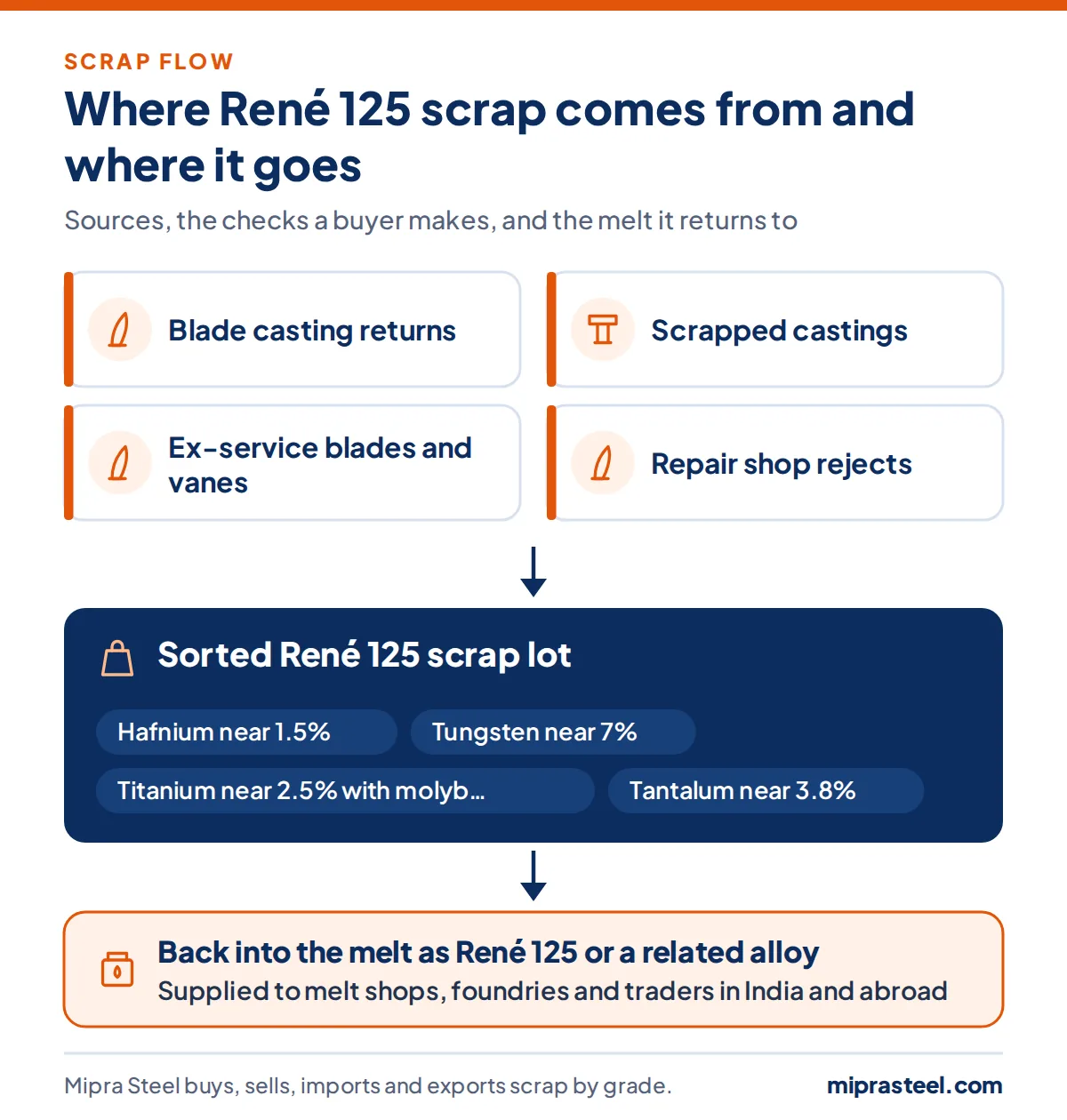
Because René 125 was built for cored aero turbine blades, its scrap follows two streams: the investment foundry and the engine overhaul shop.
Blade Casting Returns
Gates, runners, pour cups and cut-off clusters from blade and vane moulds, normally uncoated and linked to a heat record.
Scrapped Castings
Blades rejected at X-ray or fluorescent inspection for porosity, core shift or wall-thickness faults. Ceramic core residue may still sit inside the airfoil.
Ex-Service Blades and Vanes
Parts removed at aero engine overhaul once they pass their life or repair limits, usually with an aluminide coating.
Repair Shop Rejects
Blades stripped for repair and then condemned, which arrive bare and often with the repair shop's paperwork.
René 125 Scrap Specification Chart
| Grade | René 125 |
|---|---|
| UNS | Not assigned (proprietary GE alloy) |
| W.Nr. / EN | Not assigned |
| Identified by | GE material specification, casting records and analysis |
| Also known as | Rene 125 |
| Alloy type | Cast superalloy |
| Density | Not published |
| Magnetic | Non-magnetic. |
| HS code (customs heading) | 7503.00 (nickel waste and scrap) |
René 125 Chemical Composition
Nominal composition in weight per cent, used to describe and identify the grade. The governing specification sets the limits for each product.
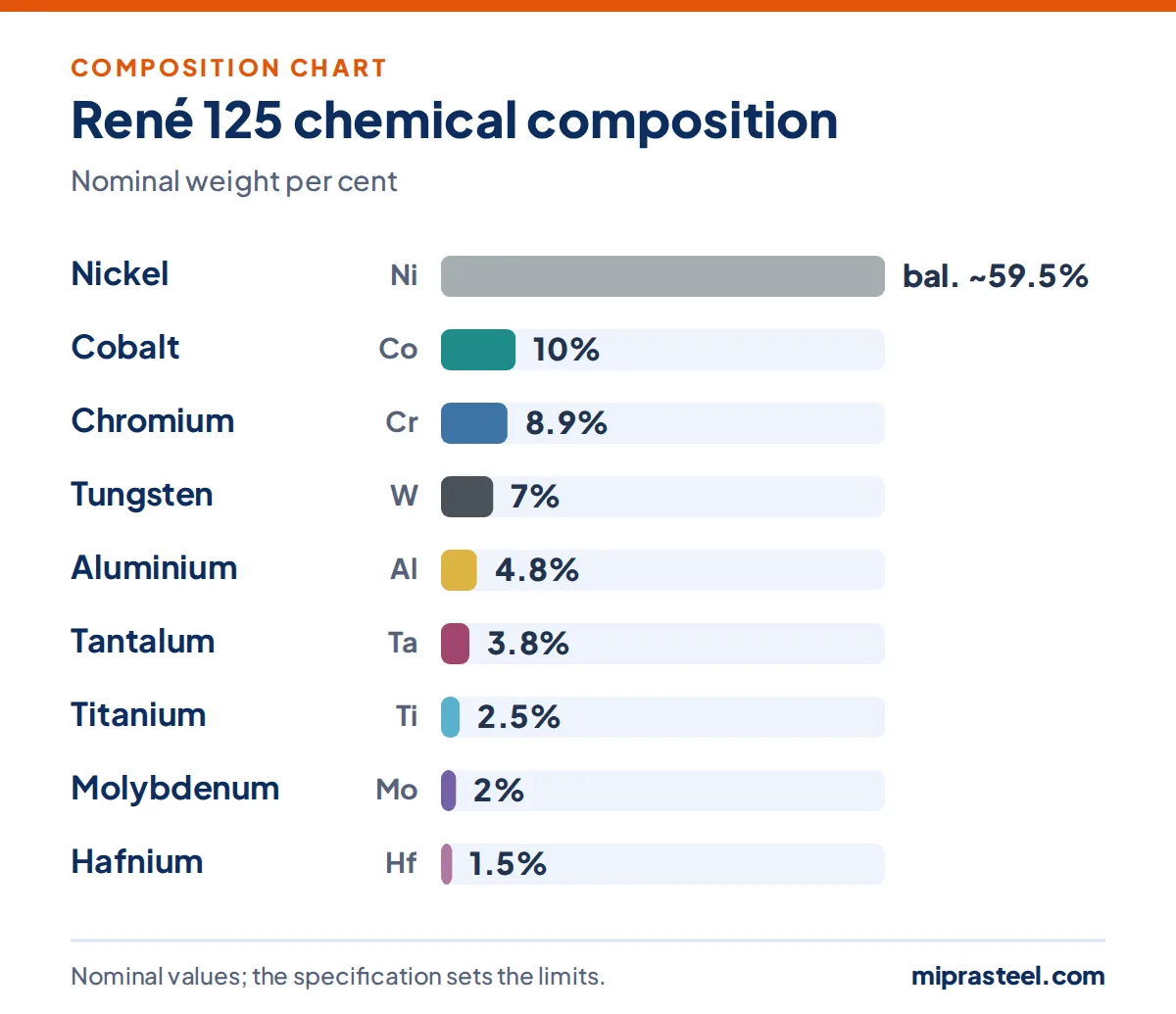
| Element | Symbol | Nominal wt% | |
|---|---|---|---|
| Nickel | Ni | Balance (about 59.5) | |
| Cobalt | Co | 10 | |
| Chromium | Cr | 8.9 | |
| Tungsten | W | 7 | |
| Aluminium (aluminum) | Al | 4.8 | |
| Tantalum | Ta | 3.8 | |
| Titanium | Ti | 2.5 | |
| Molybdenum | Mo | 2 | |
| Hafnium | Hf | 1.5 |
René 125 Equivalent Grades and Other Names
| Designation | Value |
|---|---|
| Trade name | René 125 |
| UNS | Not assigned (proprietary GE alloy) |
| W.Nr. / EN | Not assigned |
| Other names in the trade | Rene 125 |
Look up any designation in the grade name converter or the equivalent grade chart.
René 125 Standards and Specifications
Supplied to turbine OEM specifications.
René 125 Applications
- Turbine blades and vanes
Source industries: aerospace, power generation.
How René 125 Scrap Is Identified
René 125 sits among a cluster of hafnium-bearing blade alloys. These checks separate it from its neighbours before anyone agrees a description.
| Check | What it shows for René 125 |
|---|---|
| Hafnium near 1.5% | Confirms a hafnium-modified casting alloy. René 80 and IN-738 type alloys read little or none. |
| Tungsten near 7% | Lower than the 9.5 to 10% of René 108 and MAR-M 247, and a useful first split. |
| Titanium near 2.5% with molybdenum near 2% | Both noticeably higher than in René 108 (0.7% and 0.5%). This pair is what points to René 125 rather than a MAR-M 247 type alloy. |
| Tantalum near 3.8% | Tantalum needs a clean, ground spot and enough reading time; a short shot through coating can under-read it. |
| Coating and core residue | Grind through aluminide coating, which lifts aluminium. Knock out loose core ceramic, which is non-metallic weight. |
| Records | Part numbers or heat certificates are what let a lot be sold as René 125 by name. See XRF, OES and lab analysis compared. |
Grades Most Often Confused with René 125
- René 108: same 1.5% hafnium, but about 9.5% tungsten, 0.7% titanium and 0.5% molybdenum.
- MAR-M 247: 10% tungsten, 1% titanium, 0.7% molybdenum and 3% tantalum alongside 1.5% hafnium.
- MAR-M 246: 10% tungsten with 2.5% molybdenum and 1.5% tantalum, and no hafnium.
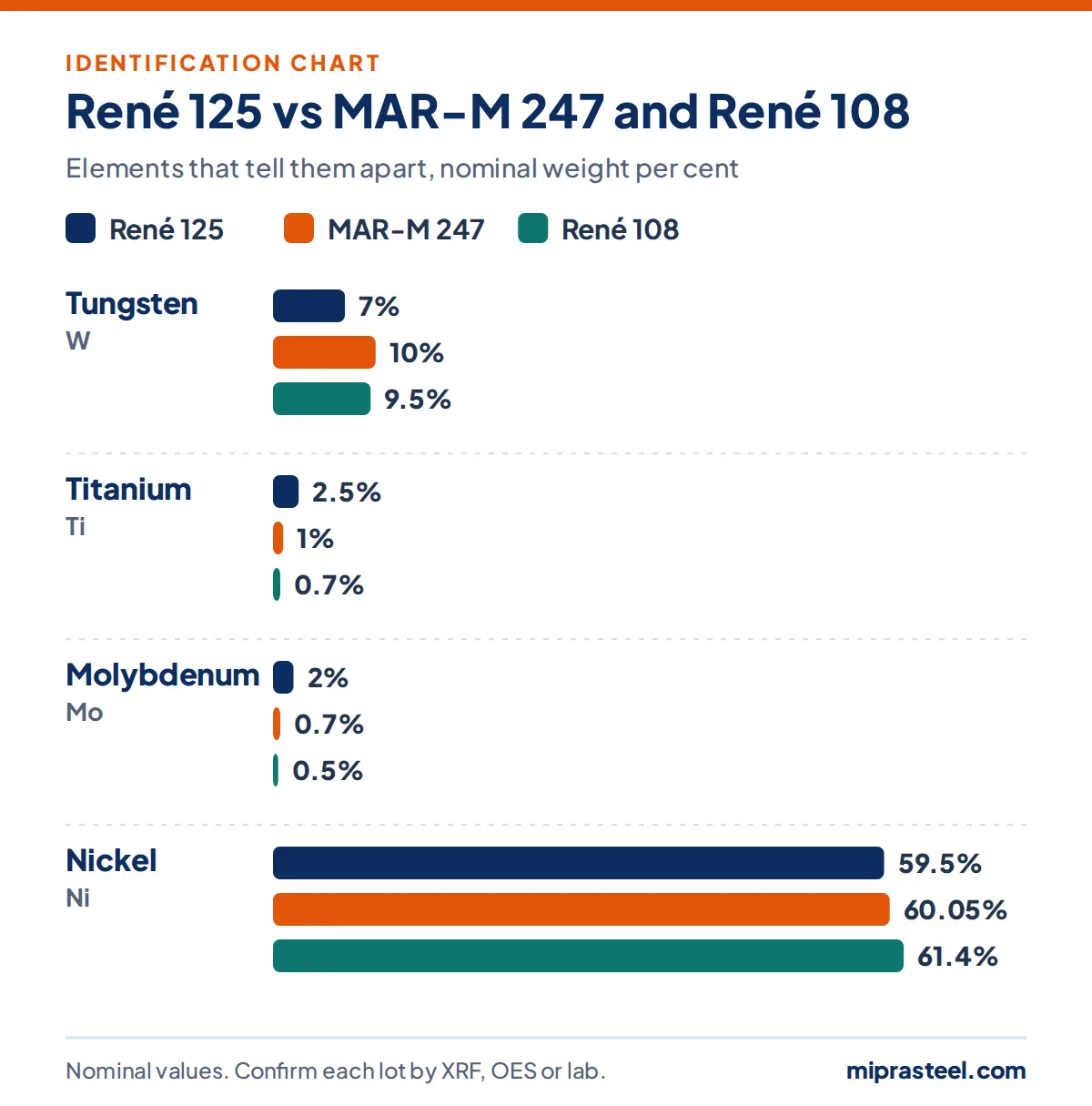
Nominal values for René 125 against its closest grades on this site.
Preparing René 125 Scrap for Sale
- Bag René 125 apart from René 80, René 108 and MAR-M 247, even when the parts are similar in size.
- Shake or knock loose ceramic core out of hollow blades before weighing.
- Keep coated ex-service blades in one package and stripped or foundry material in another.
- Record part numbers and heat numbers on a sheet that travels with the packages.
- Keep grinding swarf dry and in its own sealed drum.
René 125 Scrap Price per Kg: What Decides It
A René 125 scrap price per kg is worked out lot by lot. The refractory content gives the starting point; the questions below decide how much of it a buyer will actually pay for.
- Contained cobalt (about 10%) and tungsten (about 7%), which with nickel make up most of the metal value.
- Tantalum near 3.8% and hafnium near 1.5%, both of which a melter making hafnium-bearing grades can use directly.
- Whether the lot can be named René 125 from records, or only described as a hafnium-bearing blade revert.
- Separation from René 108, MAR-M 247 and René 80 blades taken out of the same engine module.
- Ceramic core left in hollow blades, and coating on service parts, both deducted as non-metal or contamination.
- Lot form: solid gates and whole blades over grinding swarf, which oxidises and carries abrasive.
Cobalt, tungsten and tantalum each follow their own market, so a quote is tied to its date. The method behind it is set out in how alloy scrap value is worked out.
René 125 Scrap Import and Export
Importing René 125 Scrap into India
René 125 enters India mainly as part of mixed turbine scrap from engine overhaul and casting centres in Europe, North America and East Asia. Ask the shipper to pack it separately from René 80 and René 108, since all three can arrive from the same overhaul. The consignment is inspected before loading and travels with its pre-shipment inspection certificate, commercial invoice, packing list and bill of lading, usually landing at Nhava Sheva, Mundra or Chennai. Naming the grade on every document, and attaching readings, keeps the customs description in line with the commercial one. More in bringing nickel alloy scrap into India.
Exporting René 125 Scrap from India
Exported René 125 lots are described by grade on the invoice and packing list, weighed, and packed in drums or wooden cases inside containers, which protects thin blade airfoils from being crushed with heavier gates. Melters of hafnium-bearing alloys in East Asia and Europe are the natural outlet. Our offices in South Korea and Dubai help with buyers in Japan and the Gulf. See which documents go with an alloy scrap export.
Customs heading: 7503.00 (nickel waste and scrap). The HS code is the international tariff heading the scrap is declared under; national tariff lines add further digits, so confirm the full line with your customs broker.
Other René Scrap Grades
Related Reading
René 125 Scrap FAQ
Is René 125 the same as René 108?
No. Both contain about 1.5% hafnium, but René 108 runs at roughly 9.5% tungsten with low titanium (0.7%) and molybdenum (0.5%). René 125 has about 7% tungsten, 2.5% titanium and 2% molybdenum. On a handheld reading that difference is usually large enough to separate them.
Why does René 125 contain hafnium?
Hafnium at about 1.5% strengthens grain boundaries and improves castability, helping thin, cored blade walls fill without hot tearing. For a scrap buyer, it is also a handy marker: a clear hafnium reading quickly moves René 125 out of the René 80 group.
How much better is René 125 than René 80?
A 1975 technical paper on René 125 reported about 60°F (roughly 33°C) more temperature capability than René 80, which was then GE's production blade alloy. The gain comes from more aluminium, plus tantalum, tungsten and hafnium, with less chromium.
Can René 125 scrap be sold without certificates?
Yes, but usually under a broader description such as hafnium-bearing blade revert, backed by readings on the pieces. Selling it as René 125 by name needs part numbers or heat records, because René 108 and MAR-M 247 type alloys read close to it.
Does ceramic core inside blades affect the price?
It does. Core ceramic adds weight that is not metal and can contaminate a melt, so buyers either deduct for it or ask for it to be removed. Knocking out loose core before weighing gives a cleaner lot and fewer arguments.
Which customs heading applies when shipping René 125 scrap?
Being nickel-base, it is typically declared under HS 7503.00, the heading for nickel waste and scrap. Importing and exporting countries add their own digits, so check the full line with your customs broker.
How do I start a sale of René 125 scrap with Mipra Steel?
Send weight, piece count, condition and location, along with photographs and any part numbers or readings. Single boxes of blades and larger revert lots are both considered, and the lot description is agreed before any offer.
What is René 125 made of?
Nominally 59.5% nickel, 10% cobalt, 8.9% chromium, 7% tungsten, 4.8% aluminium, 3.8% tantalum, 2.5% titanium, 2% molybdenum, 1.5% hafnium. Specification ranges vary by product form and standard.
Published by Mipra Steel, Khetwadi, Mumbai · Updated