C1023 Scrap Buyer, Importer and Exporter in India
Mipra Steel buys C1023 foundry revert, rejected castings and ex-service vanes, and supplies described C1023 lots to superalloy melters and revert processors.
Sell C1023 Scrap
Holding C1023 revert or vanes? Tell us what the material is (gates and risers, rejected castings, swarf, ex-service vanes or segments), the weight, and where it is. Send photographs, plus melt-number analyses if the foundry has them. Readings should show molybdenum and confirm that tungsten, tantalum and niobium are absent. We review incoming enquiries and respond with relevant next steps.
Buy C1023 Scrap
Melt shops and revert processors that want a molybdenum and cobalt input free of refractory elements can ask us for C1023. Let us know the tonnage, whether coated ex-service vanes are acceptable or only foundry revert, your residual limits, and the port. We describe the material as C1023 cast nickel superalloy scrap, with the analyses available for each lot.
What Is C1023 Alloy, and Where Does Its Scrap Come from?
C1023 is an aero-engine casting alloy, not a sheet or bar grade. It is poured as equiaxed investment castings for static parts in the turbine: nozzle guide vanes, seal segments and casing sections such as ring flares, and some low-pressure turbine parts. These parts do not rotate, so the alloy is tuned for strength and stability at temperature in a cast shape rather than for the fatigue demands placed on a blade. It is known in the trade only by its designation; there is no UNS number, Werkstoff number or open ASTM or AMS material specification, and parts are made to engine-maker specifications.
Chemically it is unusual among cast superalloys. Many blade and vane alloys rely on tungsten, tantalum or niobium for strength. C1023 carries none of them in its specification and leans on about 8.3% molybdenum instead, alongside roughly 10% cobalt and a combined aluminium and titanium near 7.7%. To a melter, that profile is useful precisely because it is clean: a C1023 lot brings molybdenum and cobalt without adding refractory elements that would have to be diluted out.
The alloy is described as hard to weld, repair or machine in the as-cast condition, which shapes the scrap. Vane rings and segments that fail inspection are often scrapped rather than repaired, so foundry revert and rejected castings make up a large share, alongside gates, risers, machining swarf and ex-service vanes. Like most superalloy revert, its value depends on keeping it single-grade; see superalloy revert recycling for how melters reuse it.
C1023 belongs to the superalloy family.
Where C1023 Scrap Arises
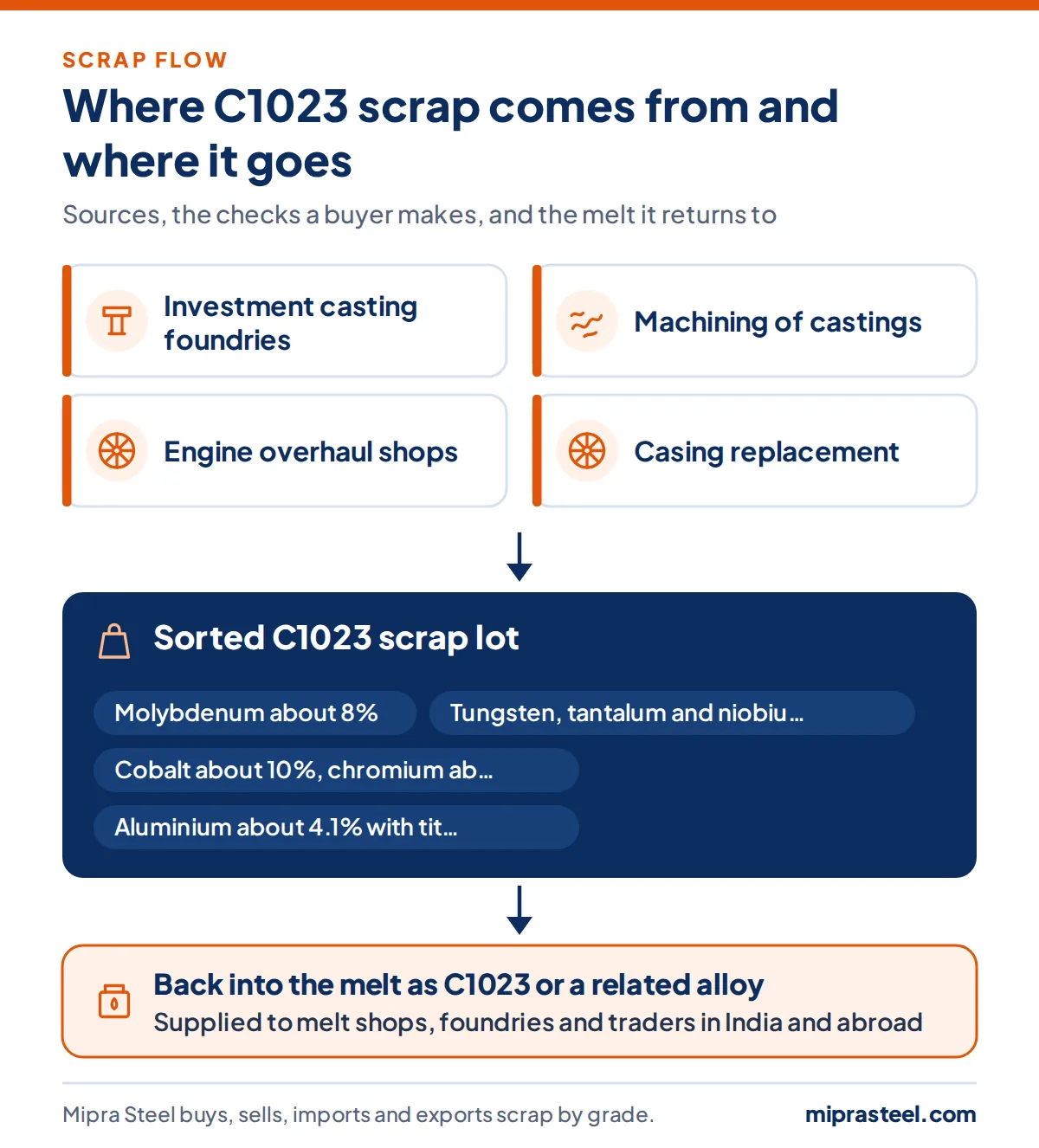
Because C1023 is used only for castings, its scrap comes from a short list of places.
Investment Casting Foundries
Gates, runners, risers, pour cups and rejected vane and segment castings. This revert is usually the cleanest and easiest C1023 to describe.
Machining of Castings
Grinding and machining of vane platforms, flanges and casing faces produce swarf and small offcuts.
Engine Overhaul Shops
Ex-service nozzle guide vanes and seal segments that cannot be repaired, usually coated and oxidised. See aerospace scrap and turbine blade and vane scrap.
Casing Replacement
Ring flare and casing sections removed during engine rebuilds, sometimes with fasteners or brackets of other alloys attached.
C1023 Scrap Specification Chart
| Grade | C1023 |
|---|---|
| UNS | Not assigned (proprietary OEM alloy) |
| W.Nr. / EN | Not assigned |
| Identified by | OEM specification, part records and analysis |
| Also known as | C-1023, C 1023 |
| Alloy type | Cast (equiaxed) nickel superalloy |
| Density | Not published |
| Magnetic | Non-magnetic. |
| HS code (customs heading) | 7503.00 (nickel waste and scrap) |
C1023 Chemical Composition
Nominal composition in weight per cent, used to describe and identify the grade. The governing specification sets the limits for each product.
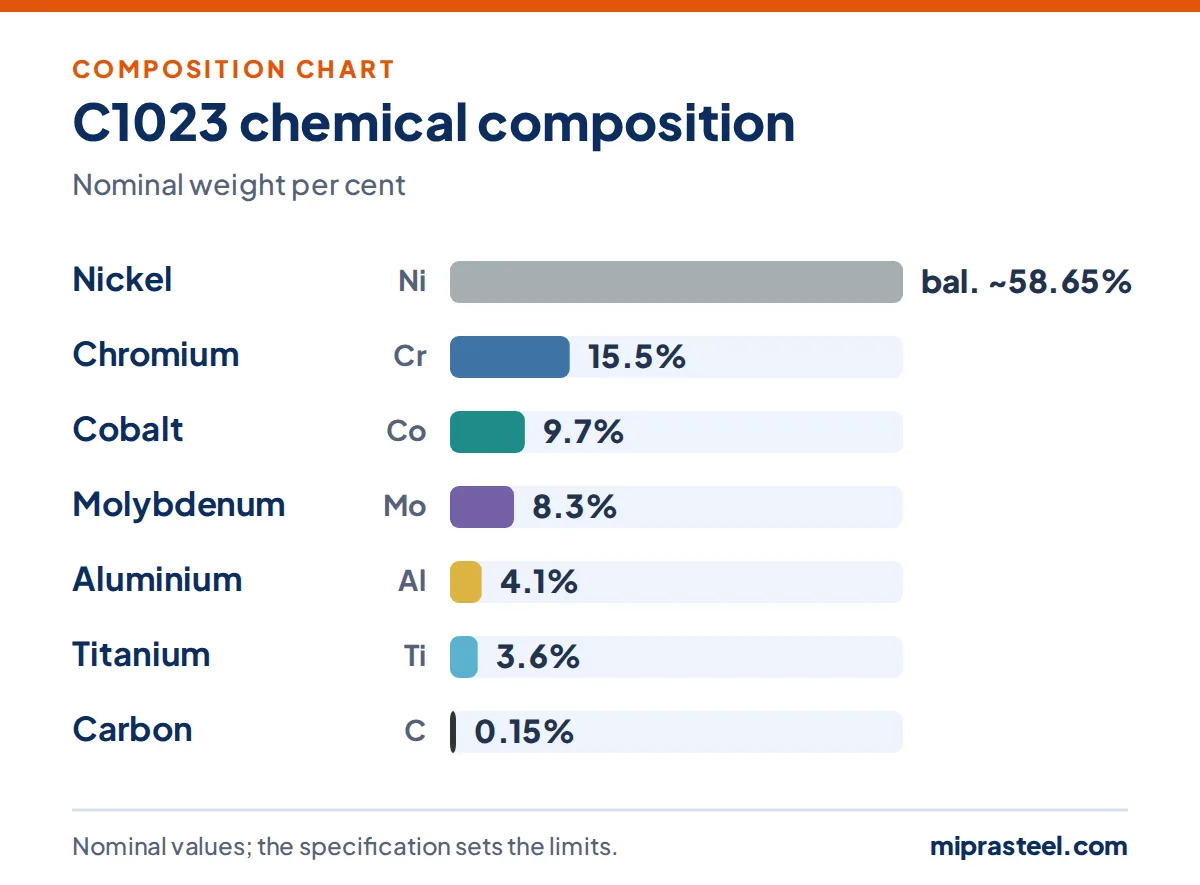
| Element | Symbol | Nominal wt% | |
|---|---|---|---|
| Nickel | Ni | Balance (about 58.7) | |
| Chromium | Cr | 15.5 | |
| Cobalt | Co | 9.7 | |
| Molybdenum | Mo | 8.3 | |
| Aluminium (aluminum) | Al | 4.1 | |
| Titanium | Ti | 3.6 | |
| Carbon | C | 0.15 |
C1023 Equivalent Grades and Other Names
| Designation | Value |
|---|---|
| Trade name | C1023 |
| UNS | Not assigned (proprietary OEM alloy) |
| W.Nr. / EN | Not assigned |
| Other names in the trade | C-1023, C 1023 |
Look up any designation in the grade name converter or the equivalent grade chart.
C1023 Standards and Specifications
OEM specification.
C1023 Applications
- Equiaxed nozzle guide vanes
- Seal segments and turbine casing castings
Source industries: aerospace, power generation.
How C1023 Scrap Is Identified
With no UNS number and few open documents, C1023 is identified almost entirely by chemistry. These are the readings that matter.
| Check | What it shows for C1023 |
|---|---|
| Molybdenum about 8% | High molybdenum for a cast gamma-prime alloy, and the first number to look for. |
| Tungsten, tantalum and niobium at or near zero | The second half of the fingerprint. Any meaningful tungsten or tantalum points to another vane alloy or contamination. |
| Cobalt about 10%, chromium about 15.5% | Separates C1023 from cobalt-free cast alloys such as IN-713C. |
| Aluminium about 4.1% with titanium about 3.6% | Aluminium needs spark OES or light-element XRF; a standard handheld unit may miss it. See XRF, OES and lab methods. |
| Coating on ex-service vanes | Grind through aluminide or overlay coatings before testing, and test more than one vane per batch. |
| Foundry paperwork | Heat or melt numbers on revert and part numbers on castings tie a lot back to the alloy where analysis certificates exist. |
Grades Most Often Confused with C1023
- René 80: is also a cast nickel alloy with about 9.5% cobalt, but carries about 4% molybdenum, 4% tungsten and 5% titanium.
- Inconel 713C: has about 2% niobium, 6% aluminium and 4.2% molybdenum, and no cobalt.
- René 77: reads about 15% cobalt and 4.2% molybdenum, roughly half the molybdenum of C1023.
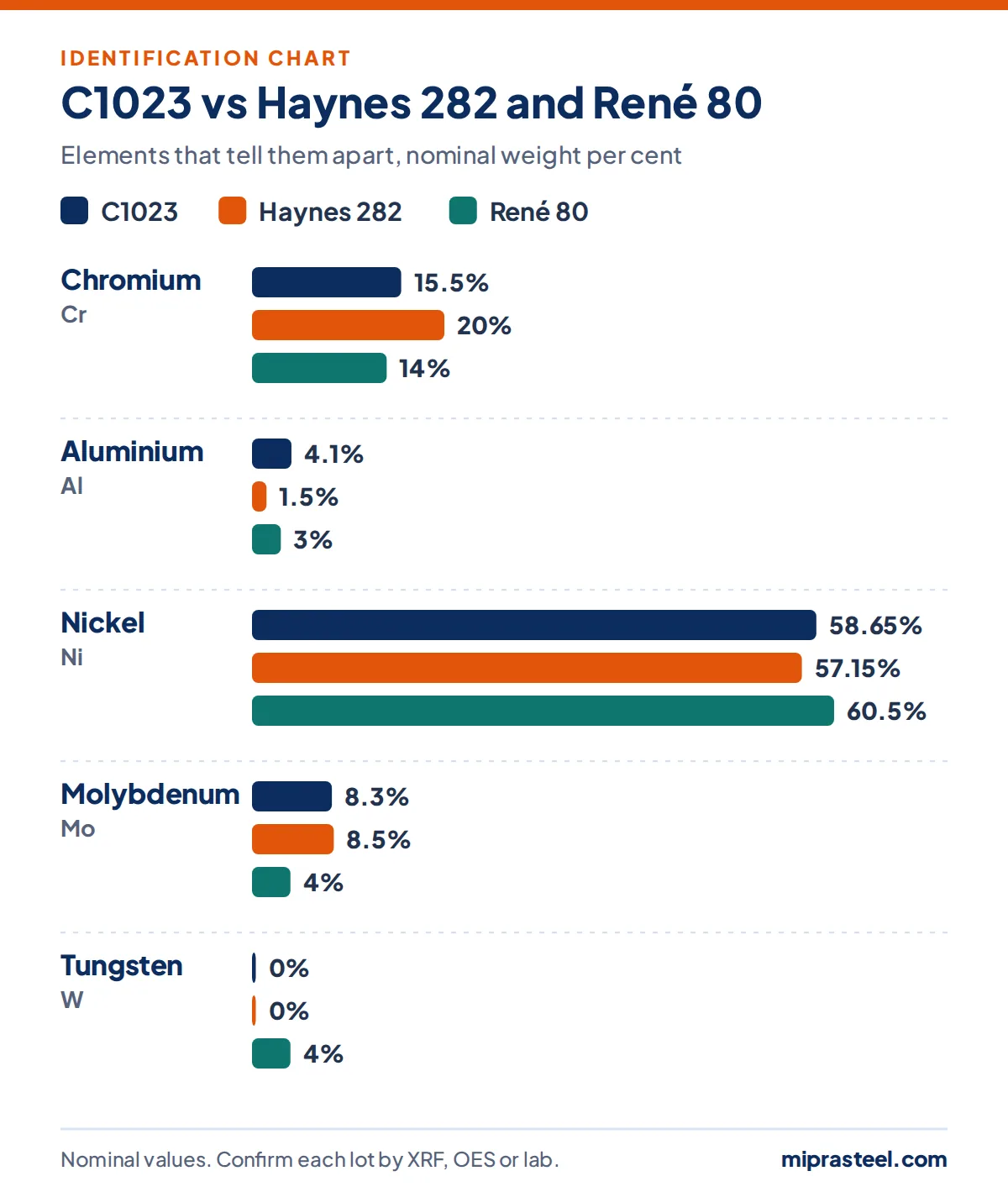
Nominal values for C1023 against its closest grades on this site.
Preparing C1023 Scrap for Sale
- Shot-blast or knock off ceramic shell and core from gates and castings.
- Keep C1023 revert in containers that no other vane alloy shares.
- Batch ex-service vanes by engine source and test samples from each batch.
- Remove brackets, bolts and seals made of other alloys from casing sections.
- Write the melt numbers or part numbers on each drum label.
C1023 Scrap Price per Kg: What Decides It
There is no published market quote for C1023 scrap. What a buyer will offer per kg is worked up from its contents and adjusted for the state of the lot.
- Nickel at nearly 59%, cobalt near 10% and molybdenum above 8% make up the metal value.
- Clean chemistry: the absence of tungsten, tantalum and niobium is only worth something if the lot proves it, piece by piece or batch by batch.
- Revert against ex-service: foundry gates and rejected castings usually command more confidence than coated, oxidised vanes.
- Ceramic shell and core residue on castings and gates, which must be blasted off or allowed for.
- Mixing with other cast vane alloys from the same foundry or overhaul, which forces the lot down to a generic description.
- Lot size and the number of analyses supporting it.
Nickel, cobalt and molybdenum each trade daily, so offers carry a date. For the general method, read what decides nickel alloy scrap price.
C1023 Scrap Import and Export
Importing C1023 Scrap into India
C1023 revert arises at aero-engine casting foundries and overhaul centres abroad, mainly in Europe, with ex-service vanes also coming from the Gulf and East Asia. Inbound cargo needs an inspection certificate from origin issued before loading, an invoice, packing list and B/L, and usually clears at Nhava Sheva or Mundra. Since the alloy has no UNS number, the description should read "C1023 cast nickel-base superalloy scrap" with the analysis attached, so customs and the receiving melter see the same thing. See India import requirements.
Exporting C1023 Scrap from India
Where C1023 revert or ex-service vanes are held in India, the quantities are usually modest. Export lots are described by alloy name on the invoice and packing list, with analyses in place of a UNS reference, then weighed and packed in drums inside containers. Outlets are mainly revert users in Europe, Japan and South Korea, and our Korea and UAE offices handle East Asian and Gulf contacts. See how alloy scrap exports are documented.
Customs heading: 7503.00 (nickel waste and scrap). The HS code is the international tariff heading the scrap is declared under; national tariff lines add further digits, so confirm the full line with your customs broker.
Related Reading
C1023 Scrap FAQ
What is C1023 alloy?
C1023 is a cast, gamma-prime strengthened nickel superalloy used for static aero-engine parts such as nozzle guide vanes, seal segments and casings. Nominally it has about 15.5% chromium, 9.7% cobalt, 8.3% molybdenum, 4.1% aluminium and 3.6% titanium, with no tungsten, tantalum or niobium.
Does C1023 have a UNS number or ASTM specification?
No UNS number, Werkstoff number or open ASTM or AMS material specification is published for C1023. It is made to engine-maker specifications. That is why scrap lots are described by name and backed with an analysis rather than a standard reference.
How is C1023 different from René 80?
Molybdenum and tungsten separate them. C1023 reads about 8.3% molybdenum and no tungsten; René 80 reads about 4% of each, with titanium near 5% against about 3.6% in C1023. Cobalt is close in both, so it does not help.
Why do C1023 vanes get scrapped rather than repaired?
The alloy is described as difficult to weld, repair or machine as cast. Damaged or out-of-tolerance vanes and segments are therefore often scrapped, which is one reason ex-service and rejected C1023 castings reach the market as scrap.
Can Mipra Steel take C1023 foundry revert?
Yes. Mipra Steel buys and sells C1023 gates, risers, rejected castings, swarf and ex-service vanes. Share the weight, form, location and any melt analyses, and keep the material apart from other vane alloys.
What tariff heading is used for C1023 scrap?
Nickel is the base, so the usual heading is HS 7503.00 for nickel waste and scrap. Add the alloy name and an analysis to the documents because there is no UNS number, and confirm the full national line with a customs broker.
What does it mean that C1023 is equiaxed?
It is cast so that grains form in all directions, not as directionally solidified or single crystal parts. Equiaxed casting suits large static parts like vane rings and casings. For scrap, it simply tells you the material is conventionally cast revert or castings, not single-crystal blade alloy.
What is C1023 made of?
Nominally 58.7% nickel, 15.5% chromium, 9.7% cobalt, 8.3% molybdenum, 4.1% aluminium, 3.6% titanium, 0.15% carbon. Specification ranges vary by product form and standard.
Published by Mipra Steel, Khetwadi, Mumbai · Updated