GTD-262 Scrap Buyer, Importer and Exporter in India
Mipra Steel, Khetwadi, Mumbai, buys and supplies GTD-262 nozzle scrap and revert, connecting plants and foundries with superalloy melters in India and overseas.
Sell GTD-262 Scrap
Have GTD-262 segments or casting revert? The most useful thing you can send is an OES or lab result showing aluminium, alongside the weight, location, segment count and photographs of part numbers. Say whether the material has been in service and whether it is coated. We review incoming enquiries and respond with relevant next steps.
Buy GTD-262 Scrap
Melting or trading nozzle revert? If you need GTD-262 specifically, say what evidence you require for the aluminium level (OES, lab certificate or casting records), along with tonnage, acceptable condition and destination. If a blended 241/262 lot suits your melt, say so, as it widens the material available.
What Is GTD-262 Scrap, and Why Is It Hard to Confirm?
GTD-262 is the youngest member of a small lineage of nozzle alloys. GTD-222 came first; GTD-241 removed its tantalum and raised niobium; GTD-262 then took the 241 chemistry and lifted aluminium from about 1.2% to about 1.7%. Aluminium, together with titanium, forms the gamma-prime precipitate that gives cast superalloys their strength at temperature, so a modest increase buys more creep capability in the vane without changing the alloy's character. The background is covered in how gamma-prime superalloys work.
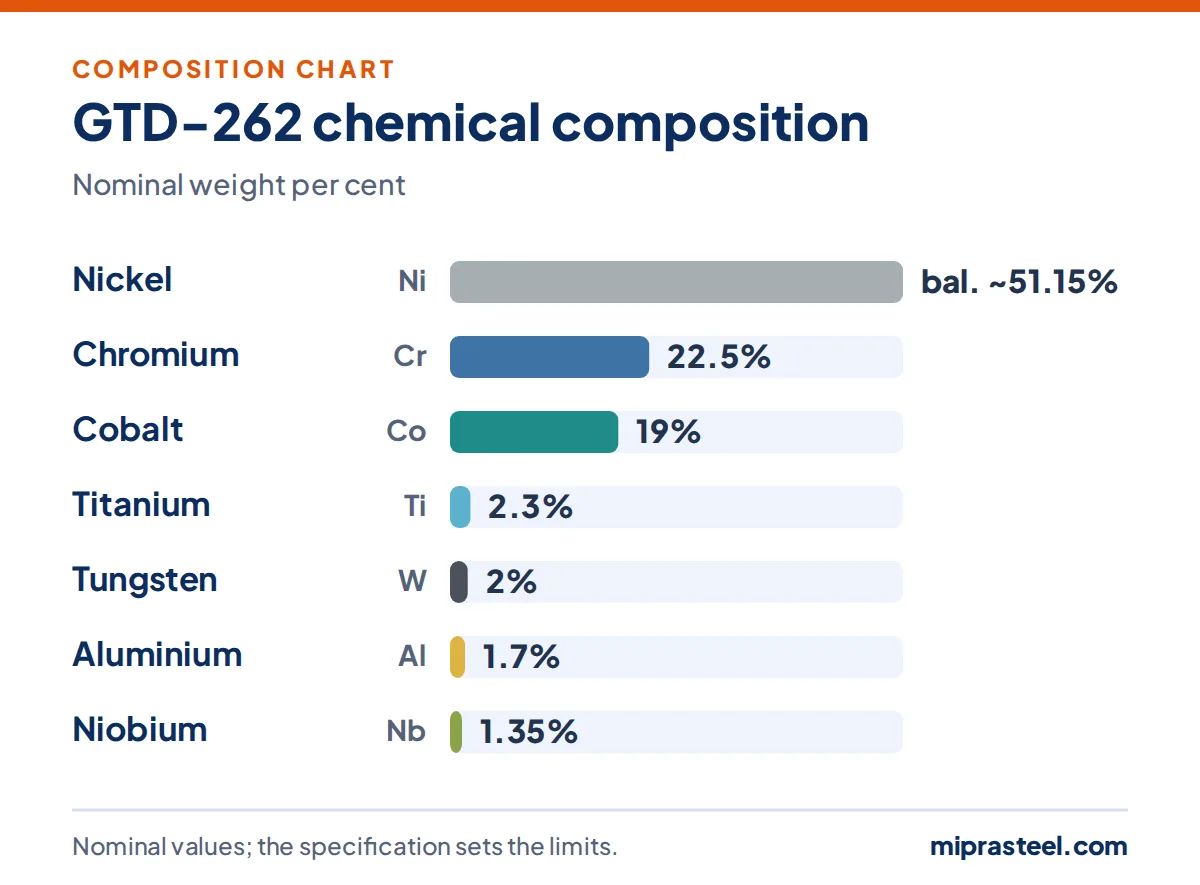
In round numbers the alloy is 51% nickel with 22.5% chromium and 19% cobalt; the minor additions are titanium (2.3%), tungsten (2%), aluminium (1.7%) and niobium (1.35%), and there is no tantalum. It is non-magnetic and is cast to turbine OEM specifications rather than to any public standard.
Here is the difficulty for traders. Half a percentage point of aluminium is the only nominal difference between GTD-262 and GTD-241. Aluminium is a light element, and an ordinary handheld XRF either cannot see it or reads it with too much scatter to separate 1.2% from 1.7%. A seller who scans a pallet of nozzle segments will see the same chromium, cobalt, niobium and zero tantalum on both alloys.
Confirming GTD-262 therefore takes spark OES, a light-element XRF configuration or laboratory analysis, preferably supported by part numbers and casting records. Lots that cannot be confirmed are still saleable, but as 241/262 nozzle revert rather than under the 262 name. For the trade-offs between methods, see XRF vs OES vs lab analysis.
GTD-262 belongs to the GTD family, part of superalloy scrap.
Sources of GTD-262 Scrap
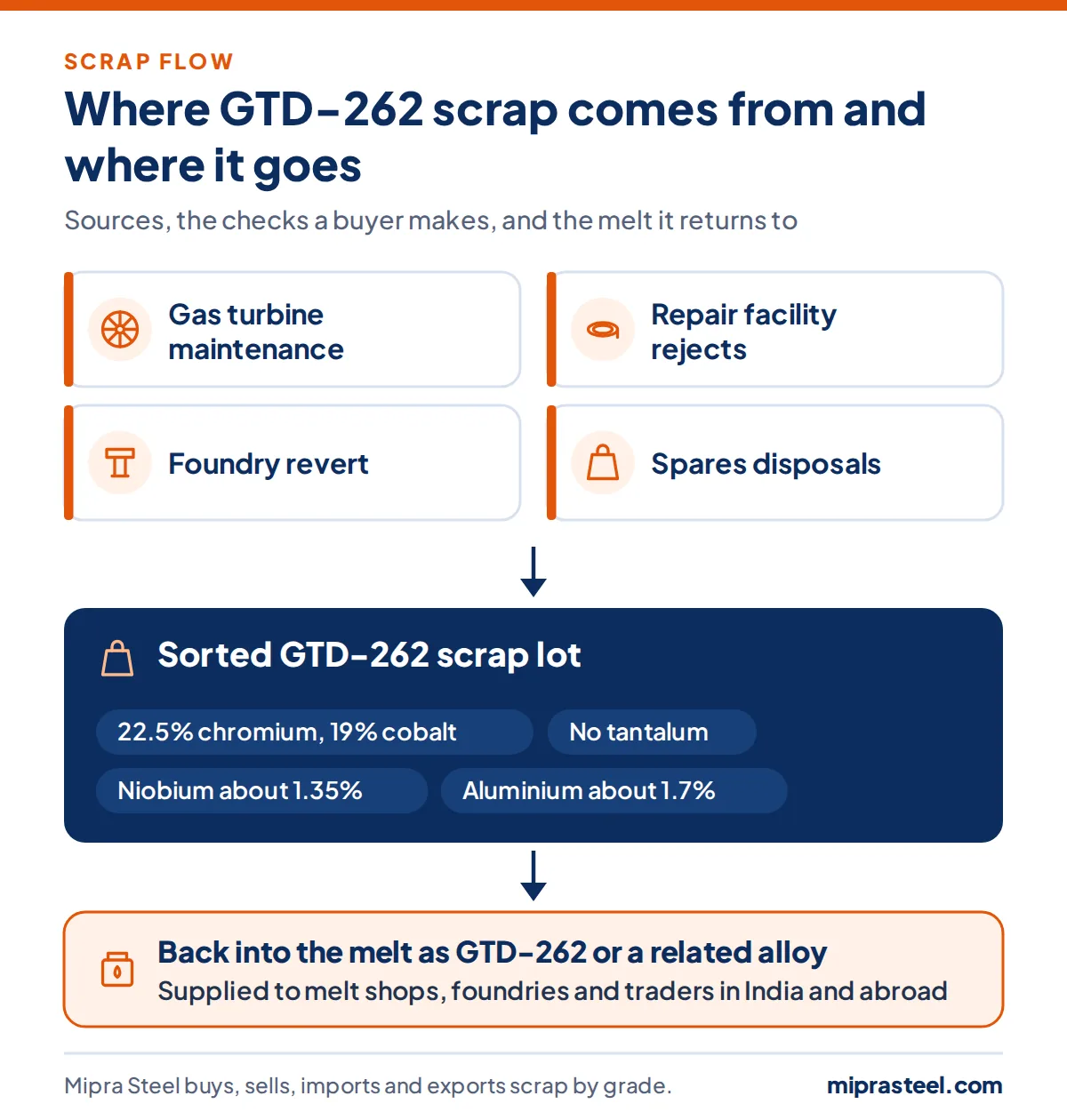
Expect GTD-262 in modest quantities, and almost always alongside other nozzle alloys from the same machines.
Gas Turbine Maintenance
Nozzle segments retired at hot-gas-path inspections and major overhauls once repair limits are reached, from utility and independent power plants. See power generation scrap.
Repair Facility Rejects
Segments that fail incoming inspection, sections cut away during repair, and scrapped weld trial pieces.
Foundry Revert
Runners, risers, sprues and non-conforming castings from investment foundries pouring nozzles. Clean, uncoated and with known heat chemistry.
Spares Disposals
Obsolete or surplus segments held as spares for retired or converted units.
GTD-262 Scrap Specification Chart
| Grade | GTD-262 |
|---|---|
| UNS | Not assigned (proprietary GE alloy) |
| W.Nr. / EN | Not assigned |
| Identified by | GE Power specification, part records and analysis |
| Also known as | GTD 262 |
| Alloy type | Cast γ′ superalloy |
| Density | Not published |
| Magnetic | Non-magnetic. |
| HS code (customs heading) | 7503.00 (nickel waste and scrap) |
GTD-262 Chemical Composition
Nominal composition in weight per cent, used to describe and identify the grade. The governing specification sets the limits for each product.
| Element | Symbol | Nominal wt% | |
|---|---|---|---|
| Nickel | Ni | Balance (about 51.2) | |
| Chromium | Cr | 22.5 | |
| Cobalt | Co | 19 | |
| Titanium | Ti | 2.3 | |
| Tungsten | W | 2 | |
| Aluminium (aluminum) | Al | 1.7 | |
| Niobium | Nb | 1.4 |
GTD-262 Equivalent Grades and Other Names
| Designation | Value |
|---|---|
| Trade name | GTD-262 |
| UNS | Not assigned (proprietary GE alloy) |
| W.Nr. / EN | Not assigned |
| Other names in the trade | GTD 262 |
Look up any designation in the grade name converter or the equivalent grade chart.
GTD-262 Standards and Specifications
Supplied to turbine OEM specifications.
GTD-262 Applications
- Turbine nozzles (vanes) in heavy-duty gas turbines
Source industries: power generation.
How GTD-262 Scrap Is Identified
The checks below separate GTD-262 from everything except GTD-241 quickly; the last step, aluminium, is where the effort goes.
| Check | What it shows for GTD-262 |
|---|---|
| 22.5% chromium, 19% cobalt | Confirms the GTD-222 family of nozzle alloys and excludes 14% chromium bucket alloys. |
| No tantalum | Rules out GTD-222 (about 1% tantalum) and IN-939 (about 1.4%). |
| Niobium about 1.35% | Consistent with both GTD-241 and GTD-262; on its own it does not decide between them. |
| Aluminium about 1.7% | The deciding reading. It needs spark OES, a light-element XRF setup or a lab result; 1.2% points to GTD-241. |
| Clean metal for analysis | OES and XRF both need a ground spot clear of coating, oxide and repair weld, otherwise aluminium from a coating can inflate the result. |
| Records | Part numbers and casting certificates that name GTD-262 carry as much weight as the chemistry. |
Grades Most Often Confused with GTD-262
- GTD-241: is identical on chromium, cobalt, niobium and tantalum; aluminium is about 1.2% against roughly 1.7% in GTD-262.
- GTD-222: carries about 1% tantalum, less niobium (about 0.8%) and about 1.2% aluminium.
- IN-939: has about 1.9% aluminium but also 3.7% titanium and 1.4% tantalum, which handheld XRF picks up.
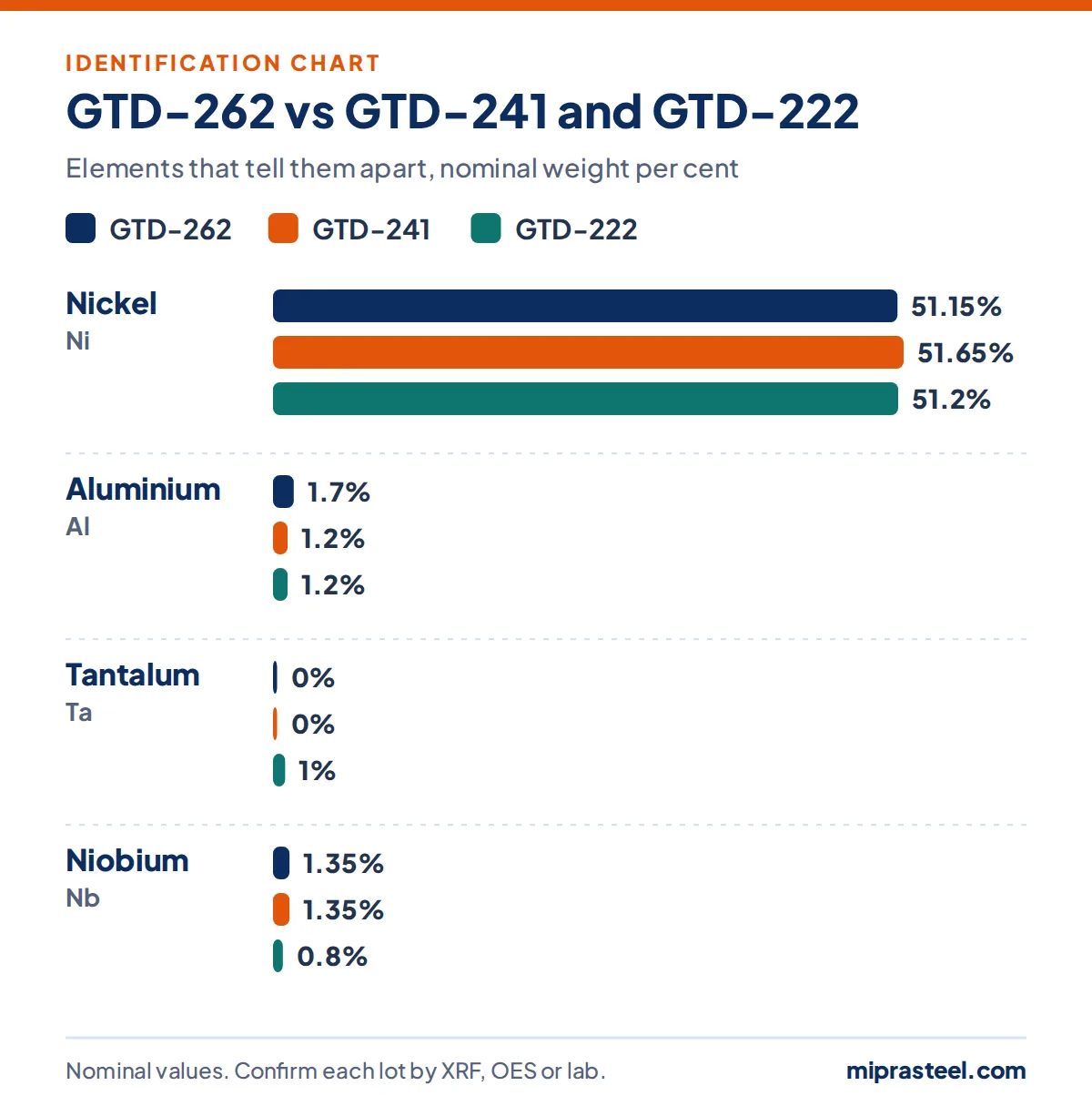
Nominal values for GTD-262 against its closest grades on this site.
Preparing GTD-262 Scrap for Sale
- Get an OES or lab aluminium result on ground metal before calling a lot GTD-262.
- Do not mix 262 segments into GTD-241 or GTD-222 lots, even when the handheld readings match.
- Separate coated engine-run segments from uncoated foundry revert.
- Remove inserts, seals and attached hardware not cast in GTD-262.
- Photograph part numbers and file the analysis and casting records with the lot.
GTD-262 Scrap Price per Kg: What Decides It
For GTD-262 scrap, the price per kg is built from the metal content and then adjusted for how much analysis the buyer must do to trust the name.
- Nickel at roughly 51% and cobalt near 19% carry most of the value, and both are quoted on daily markets.
- Confirmed aluminium: a lot with OES or lab results showing about 1.7% aluminium can be sold as GTD-262; without it, the lot is offered as 241/262 revert.
- Absence of tantalum, which some melters specifically need when building tantalum-free nozzle heats.
- Engine-run versus new: aluminide or other coatings on used segments add surface aluminium that complicates the very reading that defines this grade.
- Foreign parts left attached, such as inserts, seals or steel hardware.
- Volume and location: GTD-262 is usually available in small parcels, so consolidation and freight weigh more heavily than for common alloys.
With nickel and cobalt both moving daily, a GTD-262 figure is valid only on its date. See how nickel alloy scrap prices are worked out.
GTD-262 Scrap Import and Export
Importing GTD-262 Scrap into India
Heavy-duty turbine fleets in the Gulf, East Asia and Europe are the main origins for GTD-262 scrap reaching India. Each shipment is inspected before loading, and that certificate accompanies the bill of lading, invoice and packing list. Because the grade hinges on aluminium, attaching OES or lab results to the shipping file avoids disputes on arrival. Western India imports normally land at Nhava Sheva or Mundra. See importing nickel alloy scrap into India.
Exporting GTD-262 Scrap from India
Exported GTD-262 lots are listed by grade, segment count and net weight on the invoice and packing list, with the analysis that supports the aluminium figure attached. Segments travel in crates, drums or bags inside containers. Our South Korea and UAE offices sit near superalloy buyers and turbine operators, and buyers and sellers in Saudi Arabia are served from Dubai. See export documents for alloy scrap.
Customs heading: 7503.00 (nickel waste and scrap). The HS code is the international tariff heading the scrap is declared under; national tariff lines add further digits, so confirm the full line with your customs broker.
Other GTD Scrap Grades
Related Reading
GTD-262 Scrap FAQ
How is GTD-262 different from GTD-241?
GTD-262 raises aluminium from about 1.2% to about 1.7% on the same 22.5% chromium, 19% cobalt, 1.35% niobium base. Aluminium helps form gamma-prime, so 262 gains strength at temperature. Everything else in the nominal chemistry is the same, which is why the two are so easily confused in scrap.
Why can't my handheld analyser confirm GTD-262?
Most handheld XRF units cannot measure aluminium precisely, and aluminium is the only element that separates GTD-262 from GTD-241. A spark OES reading, a light-element XRF configuration or a lab analysis on clean, ground metal is needed. Part numbers and casting records help confirm the result.
Does a coating affect the GTD-262 reading?
Yes. Many hot-section coatings are rich in aluminium, so a reading taken on a coated surface can overstate aluminium and make GTD-241 look like 262. Grind to bare base metal before any OES or XRF reading, and record where on the segment the reading was taken.
Is GTD-262 scrap worth separating if the lot is small?
Usually yes, provided the aluminium can be confirmed. A documented small parcel can be combined with other GTD-262 later, whereas once it is blended into GTD-241 revert it can only be sold under the mixed description. Keep it bagged and labelled until enough has accumulated.
Can I sell GTD-262 scrap to Mipra Steel from outside India?
Yes. Mipra Steel imports nozzle scrap as well as buying locally, and its Dubai and Korea offices help with overseas sellers. Share the weight, location, photographs, aluminium analysis and port of loading, and we will come back with what is needed to move the lot.
What tariff code does GTD-262 scrap travel under?
Expect it to be entered under 7503.00, nickel waste and scrap, which is the usual heading for nickel-base superalloy revert. Each customs authority adds national digits, so confirm the full code with your broker before the documents are prepared.
What is GTD-262 made of?
Nominally 51.2% nickel, 22.5% chromium, 19% cobalt, 2.3% titanium, 2% tungsten, 1.7% aluminium, 1.4% niobium. Specification ranges vary by product form and standard.
Published by Mipra Steel, Khetwadi, Mumbai · Updated