Inconel 718 Scrap Buyer, Importer and Exporter in India
Mipra Steel buys Inconel 718 turnings, solids and bar ends from machine shops, forgers and traders, and supplies described 718 lots to melt shops and traders in India and abroad.
Sell Inconel 718 Scrap
Selling 718 swarf or offcuts? Tell us the form (turnings, bar ends, forgings, mixed solids), the weight, whether turnings are crushed and de-oiled, and the industry the parts were machined for. Certificates or heat numbers, an XRF reading or two and photographs of the material help. If you produce 718 turnings every month, mention the monthly quantity. We review incoming enquiries and respond with relevant next steps.
Buy Inconel 718 Scrap
Sourcing 718 scrap for remelting? Specify the form you can charge, the maximum oil or moisture you accept in turnings, whether you need aerospace-traceable material, the tonnage and your port. Lots are described as Inconel 718, UNS N07718, and we can discuss which analyses and documents accompany each shipment.
Why Is There So Much Inconel 718 Scrap, and What Makes It Different?
Alloy 718 came out of International Nickel research that started in 1958, and it was patented in 1962. Its trick is niobium. After a solution treatment and an ageing cycle, niobium combines with nickel to form a fine gamma double prime precipitate, which gives the alloy high strength up to about 650 °C (1,200 °F) while leaving it weldable. That balance is why jet-engine discs, shafts, casings and rings use it, and why oil and gas companies specify it for wellhead parts, valve stems and downhole tools under API 6A718.
The scrap story follows the machining. A 718 disc or ring often starts as a forging several times heavier than the finished part, and the difference leaves the shop as turnings. So, unlike most nickel alloys, 718 reaches the market mainly as swarf, not solids. Bar ends, sawn crops, rejected forgings and test rings make up much of the rest.
What a melter values in 718 is the niobium as much as the nickel. Around 5% niobium is unusual, and melt shops making 718 or other niobium-bearing grades can use clean, single-grade 718 scrap as part of their charge. What they cannot use is 718 contaminated with Inconel 625, Inconel 706 or stainless steel, because each brings the wrong iron, molybdenum or niobium balance.
One practical point: 718 is the alloy most often misdescribed as 625 in mixed lots, since both carry niobium and look identical. Iron is the quickest way to separate them.
Inconel 718 belongs to the Inconel family, part of nickel alloy scrap.
Who Generates Inconel 718 Scrap
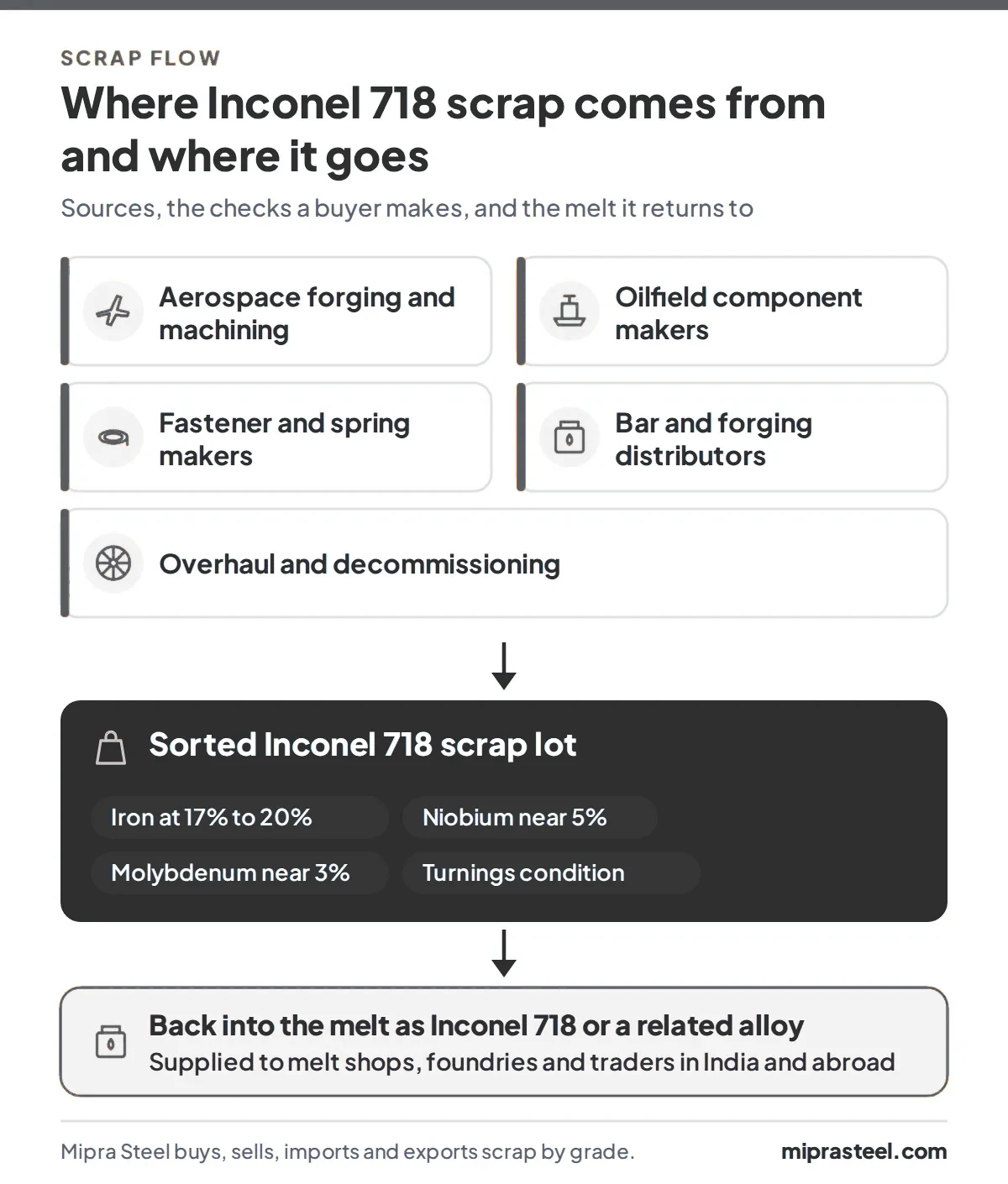
Expect four main streams, and expect most of the tonnage to be swarf rather than solid metal.
Aerospace Forging and Machining
Engine discs, shafts, rings and casings machined from 718 forgings and billet produce large volumes of turnings, and occasional rejected forgings and test rings. See aerospace scrap.
Oilfield Component Makers
Valve stems, hangers, wellhead parts and downhole tools machined to API 6A718 produce turnings, bar ends and rejected parts. See oil and gas scrap.
Fastener and Spring Makers
High-strength bolting and springs leave short bar crops, wire ends and rejected batches.
Bar and Forging Distributors
Saw cuts, end crops and off-size lengths from cutting 718 bar to order. Usually clean and traceable to a heat.
Overhaul and Decommissioning
Retired engine casings, shafts, oilfield valve internals and cryogenic fittings. These need a reading on every piece because 718 parts often sit beside other alloys.
Inconel 718 Scrap Specification Chart
| Grade | Inconel 718 |
|---|---|
| UNS | N07718 |
| W.Nr. / EN | 2.4668 |
| Also known as | Alloy 718 |
| Alloy type | Precipitation-hardened nickel-chromium-iron (γ″) |
| Density | 8.19 g/cm³ (0.296 lb/in³) |
| Magnetic | Non-magnetic. |
| HS code (customs heading) | 7503.00 (nickel waste and scrap) |
Inconel 718 Chemical Composition
Nominal composition in weight per cent, used to describe and identify the grade. The governing specification sets the limits for each product.
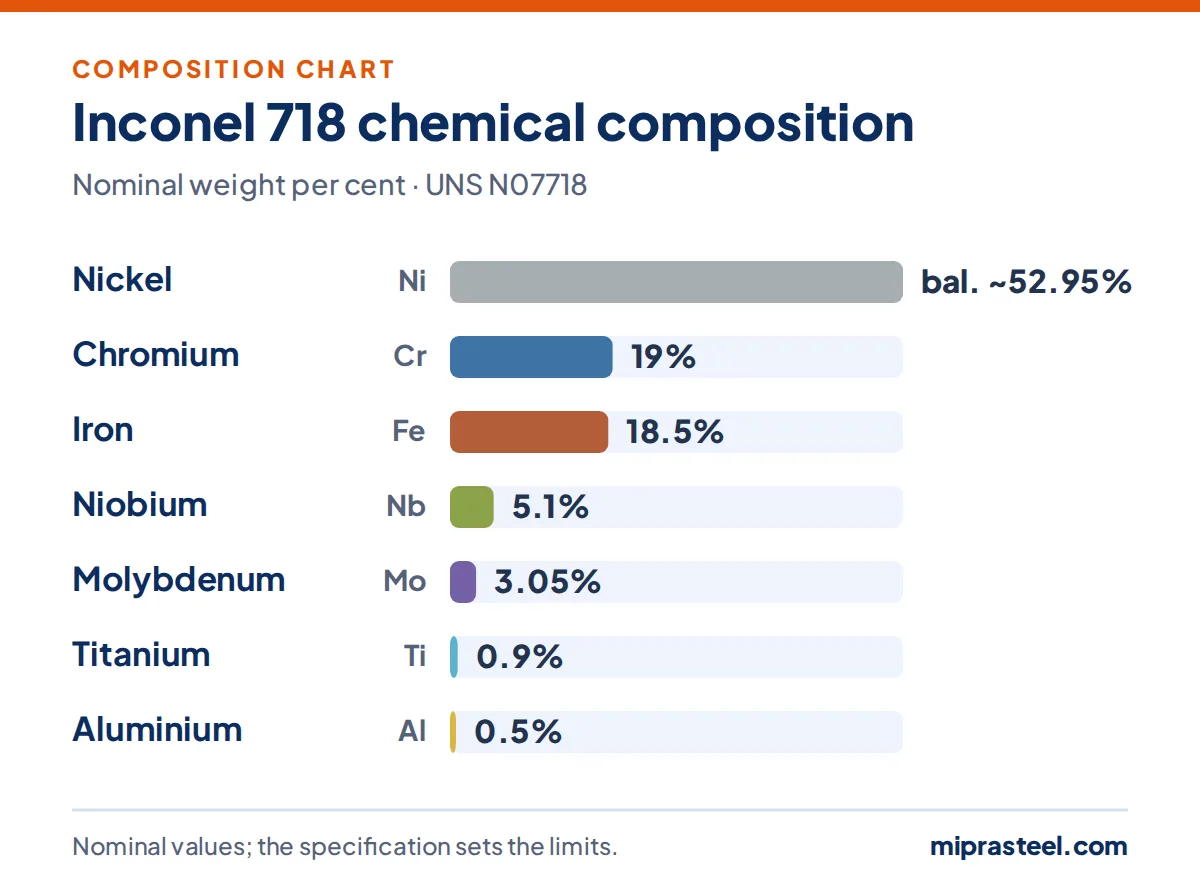
| Element | Symbol | Nominal wt% | |
|---|---|---|---|
| Nickel | Ni | Balance (about 53) | |
| Chromium | Cr | 19 | |
| Iron | Fe | 18.5 | |
| Niobium | Nb | 5.1 | |
| Molybdenum | Mo | 3.1 | |
| Titanium | Ti | 0.9 | |
| Aluminium (aluminum) | Al | 0.5 |
Inconel 718 Equivalent Grades and Other Names
| Designation | Value |
|---|---|
| Trade name | Inconel 718 |
| UNS | N07718 |
| W.Nr. / EN | 2.4668 |
| Other names in the trade | Alloy 718 |
Look up any designation in the grade name converter or the equivalent grade chart.
Inconel 718 Standards and Specifications
| Product form | Standard | ASME equivalent |
|---|---|---|
| Bar and forging stock | ASTM B637 | No ASME edition |
| Plate, sheet and strip | ASTM B670 | No ASME edition |
| Plate, sheet and strip | AMS 5596 | No ASME edition |
| Bar and forgings, solution treated | AMS 5662 | No ASME edition |
| Bar and forgings, solution treated and aged | AMS 5663 | No ASME edition |
| Welding wire | AMS 5832 | No ASME edition |
| Oilfield equipment | API 6A718 | No ASME edition |
Inconel 718 Applications
- Jet engine discs, shafts, casings and rings
- Oil and gas wellhead, valve and downhole components
- Fasteners and high-strength bolting
- Cryogenic tankage
- Springs
Source industries: aerospace, oil and gas, power generation.
How Inconel 718 Scrap Is Identified
Before anyone talks weight, a buyer of 718 wants to see iron, niobium and molybdenum on the same reading.
| Check | What it shows for Inconel 718 |
|---|---|
| Iron at 17% to 20% | This single reading separates 718 from 625 (under 5% iron) and 600 (about 8%). If iron is missing, it is not 718. |
| Niobium near 5% | Confirms the gamma double prime strengthener. 706 also has niobium, but only about 3%, with far more iron. |
| Molybdenum near 3% | Rules out Hastelloy X, which reads about 18.5% iron like 718 but carries 9% molybdenum and no niobium. |
| Turnings condition | Check for oil, water, tool-tip fragments and mixed swarf from shared machines. Carbide inserts in 718 swarf are a common complaint from melters. |
| Heat numbers and certificates | Aerospace and API forgings are usually traceable; certificates quoting AMS 5662, AMS 5663 or API 6A718 support the description. |
| Magnet | 718 is non-magnetic. A magnet will flag carbon steel or ferritic stainless mixed into swarf. |
Grades Most Often Confused with Inconel 718
- Inconel 625: also has niobium (about 3.6%) but under 5% iron and about 9% molybdenum.
- Inconel 706: a 718 relative for large turbine discs, with about 37.5% iron, 41.65% nickel and 2.9% niobium.
- Incoloy 925: shares oilfield use and 3% molybdenum, but carries about 28% iron, 2% copper and no niobium.
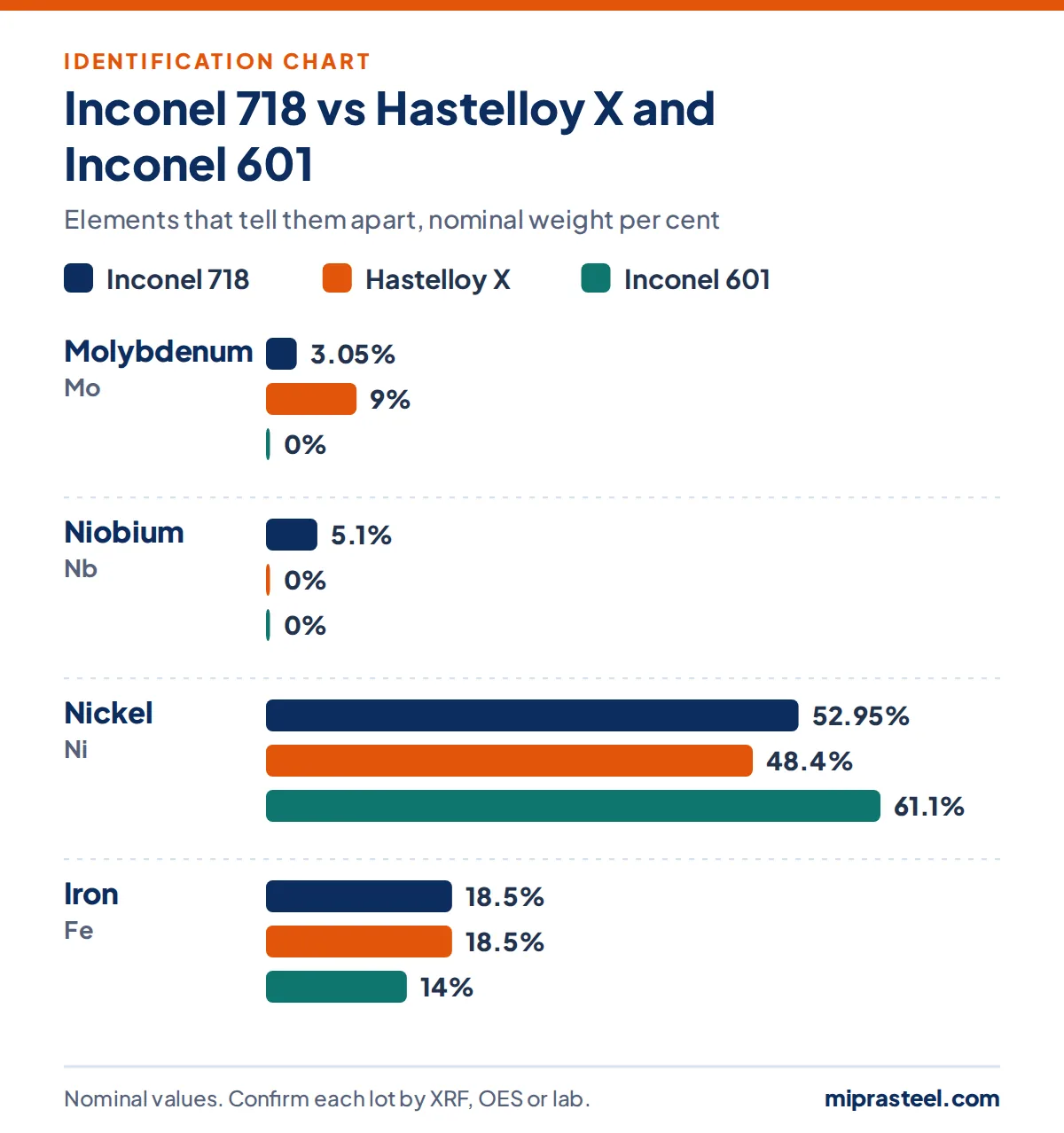
Nominal values for Inconel 718 against its closest grades on this site.
Preparing Inconel 718 Scrap for Sale
- Give 718 its own swarf bin at each machine and empty it before switching alloys.
- Spin or drain turnings to remove cutting oil, then store them under cover.
- Pick out broken carbide inserts and tool tips with a magnet sweep and by eye.
- Keep bar ends and forgings with their heat numbers visible and their certificates filed.
- Separate 718 from 625, 706 and Incoloy 925 parts, which often share the same shop floor.
- Weigh and label each drum or bag with grade, form and net weight.
Inconel 718 Scrap Price per Kg: What Decides It
Every 718 offer comes down to three questions: how much nickel and niobium is in the lot, how sure the buyer is that it is all 718, and how much cleaning the material needs.
- Contained nickel (about 53%) and niobium (about 5%), with molybdenum and chromium adding to melt value.
- Form: solids and bar ends are worth more than turnings; turnings are discounted for oil, moisture and fine contamination.
- Swarf cleanliness: crushed, de-oiled, dry turnings from one alloy are a different product from wet, long, mixed swarf.
- Aerospace traceability: lots backed by certificates and heat numbers are easier to place with melters who need documented input.
- Contamination risk: tool tips, 625 or stainless swarf from shared machines lower the offer or send the lot for sorting.
- Quantity and regularity: a machine shop producing 718 turnings every month can be quoted differently from a single clearance lot.
Nickel and niobium markets set the base, so any Inconel 718 scrap price per kg is quoted for a date. Use the contained metal calculator to see what a lot carries.
Inconel 718 Scrap Import and Export
Importing Inconel 718 Scrap into India
Large volumes of 718 turnings come from regions with heavy aerospace machining, such as Europe, North America and East Asia, and from Gulf oilfield service centres. Into India, each consignment needs a pre-shipment inspection certificate along with the commercial invoice, packing list and bill of lading, and lands mainly at Nhava Sheva, Mundra or Chennai. Turnings should be declared as turnings, not solids, and shipped dry: moisture adds weight and can cause trouble at inspection. Read how imports of nickel alloy scrap into India work.
Exporting Inconel 718 Scrap from India
Indian forging and machining work for aerospace and oilfield customers produces 718 swarf, bar ends and crops. Exported lots are weighed and shipped in drums or bulk bags within containers, described by grade and UNS number on invoice and packing list. Gulf buyers are served through our UAE office, and melters in Europe, including Italy, take documented 718 lots. See export documents for alloy scrap.
Customs heading: 7503.00 (nickel waste and scrap). The HS code is the international tariff heading the scrap is declared under; national tariff lines add further digits, so confirm the full line with your customs broker.
Comparisons
Other Inconel Scrap Grades
Related Reading
Inconel 718 Scrap FAQ
Is Inconel 718 scrap worth more than Inconel 625 scrap?
Usually not. 625 contains more nickel (about 62% against 53%) and about 9% molybdenum, while 718 carries about 18% iron, which adds little value. 718 has more niobium, about 5% against 3.6%, which narrows the gap. The outcome on any day depends on nickel, molybdenum and niobium prices and on the condition of each lot.
How do I separate 718 and 625 turnings that have been mixed?
In practice they cannot be separated economically once mixed as swarf, because the chips look identical. A mixed lot is described and valued as mixed 718/625 turnings. The fix is upstream: separate bins at each machine and a reading on the bar before it is cut.
Why does Inconel 718 contain niobium?
Niobium is what makes 718 strong. During ageing, it forms gamma double prime, a nickel-niobium precipitate that hardens the alloy and gives it high strength up to about 650 °C (1,200 °F). The same niobium is a large part of what a melter values in 718 scrap.
Is Inconel 718 magnetic?
No. Solution-treated and aged 718 is non-magnetic at room temperature. A magnet is still useful on 718 swarf: anything it picks up is likely carbon steel, ferritic stainless or tool fragments that should not be in the lot.
Is there a separate market for aerospace-certified 718 scrap?
Yes, in the sense that traceable, single-grade 718 with certificates and heat numbers is easier to sell to melters who need documented input. The chemistry is the same, but the paperwork reduces a buyer's risk. Keep certificates with the material from the start.
What is the HS code for exporting 718 turnings?
718 is nickel-base, so turnings and solids are typically declared under HS 7503.00, nickel waste and scrap. The national tariff line differs by country, so confirm the full code with your customs broker before shipping.
Who buys Inconel 718 scrap in India?
Melt shops, traders and exporters handling nickel alloys buy it, mainly as turnings and bar ends. Mipra Steel in Mumbai is one of them: send the form, weight, location, photographs and any readings or certificates, and we will look at the lot.
What does API 6A718 mean on a scrap certificate?
It refers to the API standard for 718 used in oilfield equipment such as wellhead and valve components. Seeing it on a certificate tells a buyer the parts were made from documented 718 to oilfield requirements, which supports the grade description of the scrap.
What is Inconel 718 made of?
Nominally 53% nickel, 19% chromium, 18.5% iron, 5.1% niobium, 3.1% molybdenum, 0.9% titanium, 0.5% aluminium. Specification ranges vary by product form and standard.
Published by Mipra Steel, Khetwadi, Mumbai · Updated