IN-939 Scrap Buyer, Importer and Exporter in India
Mipra Steel trades IN-939 vane scrap and casting revert, including IN-939 low Zr lots, from Mumbai, with offices in Dubai and South Korea close to turbine-heavy markets.
Sell IN-939 Scrap
Have IN-939 vane segments or casting revert? Send the piece count and weight, the turbine model and stage if you know them, photographs of the parts and any part numbers, and readings showing chromium, cobalt, titanium and tungsten. If you are offering the lot as low Zr, include the zirconium analysis and how it was obtained. We review incoming enquiries and respond with relevant next steps.
Buy IN-939 Scrap
Melting vane alloys and need IN-939 revert? Tell us whether you need standard or low Zr material, whether ex-service vanes are acceptable or only foundry revert, the analysis you require with each lot, the quantity and your destination port. Lots are described by grade, and low Zr lots only when analysis supports that description.
What Is IN-939, and Why Do Buyers Care About Its Zirconium?
IN-939 has no UNS number and no ASTM specification. It is bought and cast to turbine makers' own specifications, which tells you where it lives: in the hot section of industrial and marine gas turbines, mostly as nozzle guide vanes and vane segments. Its design goal was hot-corrosion resistance. Turbines that burn fuels carrying sulfur and sodium, or that breathe salt-laden air, attack low-chromium blade alloys quickly. IN-939 answers that with about 22% chromium, backed by 19% cobalt for strength at temperature.
That cobalt is what sets its scrap value apart from the Inconel grades most traders know. A tonne of IN-939 carries roughly 190 kg of cobalt alongside about 486 kg of nickel, plus titanium, tungsten, tantalum and niobium. To a superalloy melter, single-grade IN-939 revert is a direct charge for new IN-939 or similar vane alloys.
Zirconium is the detail that splits the market. Superalloy makers add it in very small, controlled amounts, because it strengthens grain boundaries, but too much raises the risk of hot cracking and brittle grain-boundary phases. Melters therefore watch the zirconium in any revert they charge. "IN-939 low Zr" is the trade description for lots kept low in zirconium for melts that need it. There is no published standard defining it, so the description only holds when it is documented by analysis on the lot.
IN-939 is now also used as a powder for additive manufacturing of gas turbine parts, so its name appears in more places than it once did.
IN-939 belongs to the Inconel family, part of nickel alloy scrap.
Where IN-939 Scrap Comes From
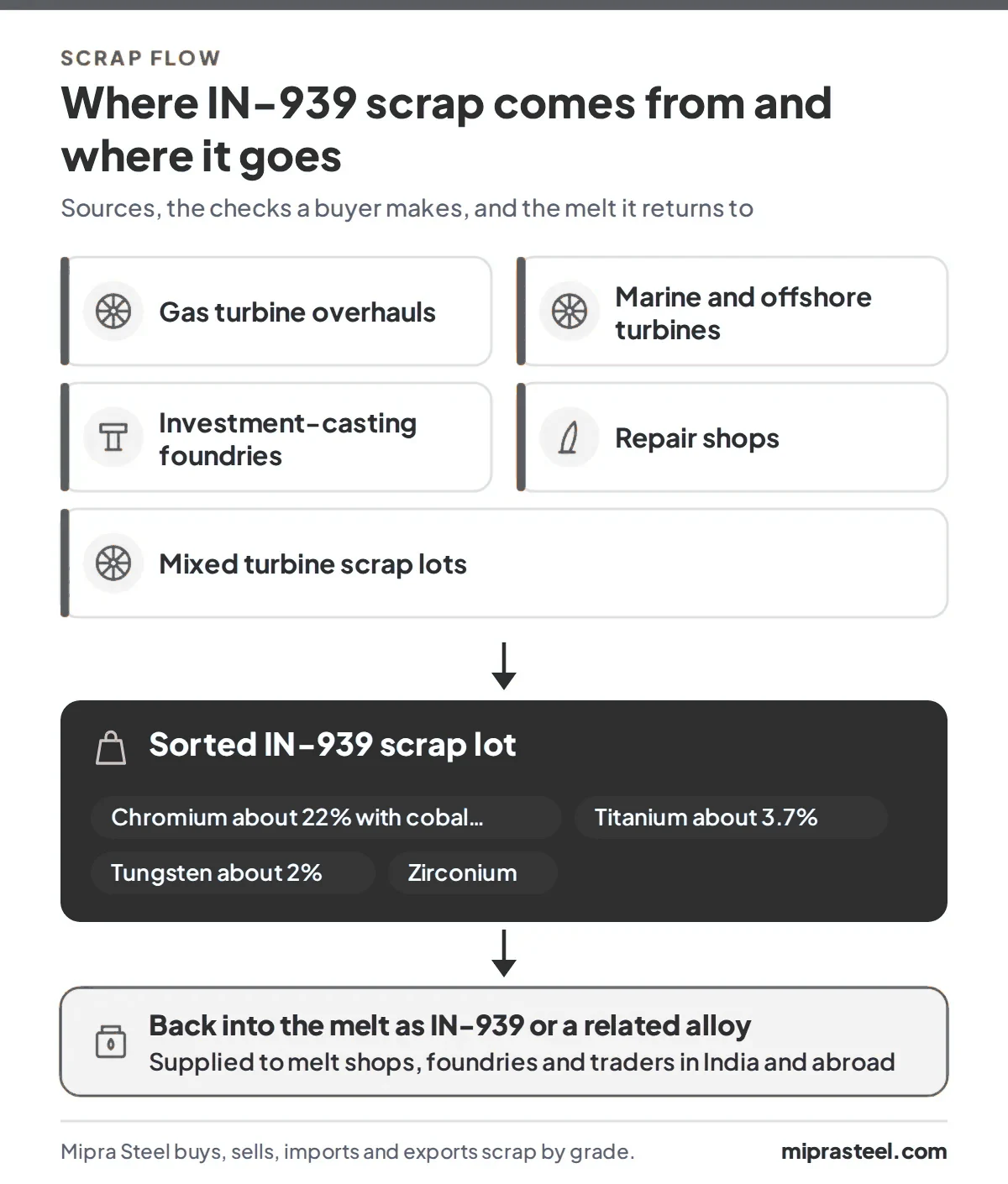
IN-939 is not a machining alloy. Nearly all of it reaches the scrap market either from a casting house or from a turbine overhaul.
Gas Turbine Overhauls
Vane segments and nozzle guide vanes replaced at hot-section inspections of industrial power turbines. See power generation scrap.
Marine and Offshore Turbines
Vanes from naval and offshore power turbines, where salt and fuel sulfur make hot-corrosion resistance the reason for the alloy. See marine scrap.
Investment-Casting Foundries
Gates, risers, pour cups and rejected vane castings. The cleanest IN-939 there is, usually with a heat analysis that can support a low Zr description.
Repair Shops
Vane segments judged beyond repair after stripping, and offcuts from segment repair. These often carry coatings and braze or weld repairs.
Mixed Turbine Scrap Lots
Hot-section clear-outs where IN-939 vanes sit beside GTD, MGA or René blades. Each piece needs a reading.
IN-939 Scrap Specification Chart
| Grade | IN-939 |
|---|---|
| UNS | Not assigned (proprietary turbine OEM alloy) |
| W.Nr. / EN | Not assigned |
| Identified by | Turbine OEM specification, casting records and analysis |
| Also known as | Inconel 939, Alloy 939, IN-939 low Zr |
| Alloy type | Cast precipitation-hardened superalloy |
| Density | Not published |
| Magnetic | Non-magnetic. |
| HS code (customs heading) | 7503.00 (nickel waste and scrap) |
IN-939 Chemical Composition
Nominal composition in weight per cent, used to describe and identify the grade. The governing specification sets the limits for each product.
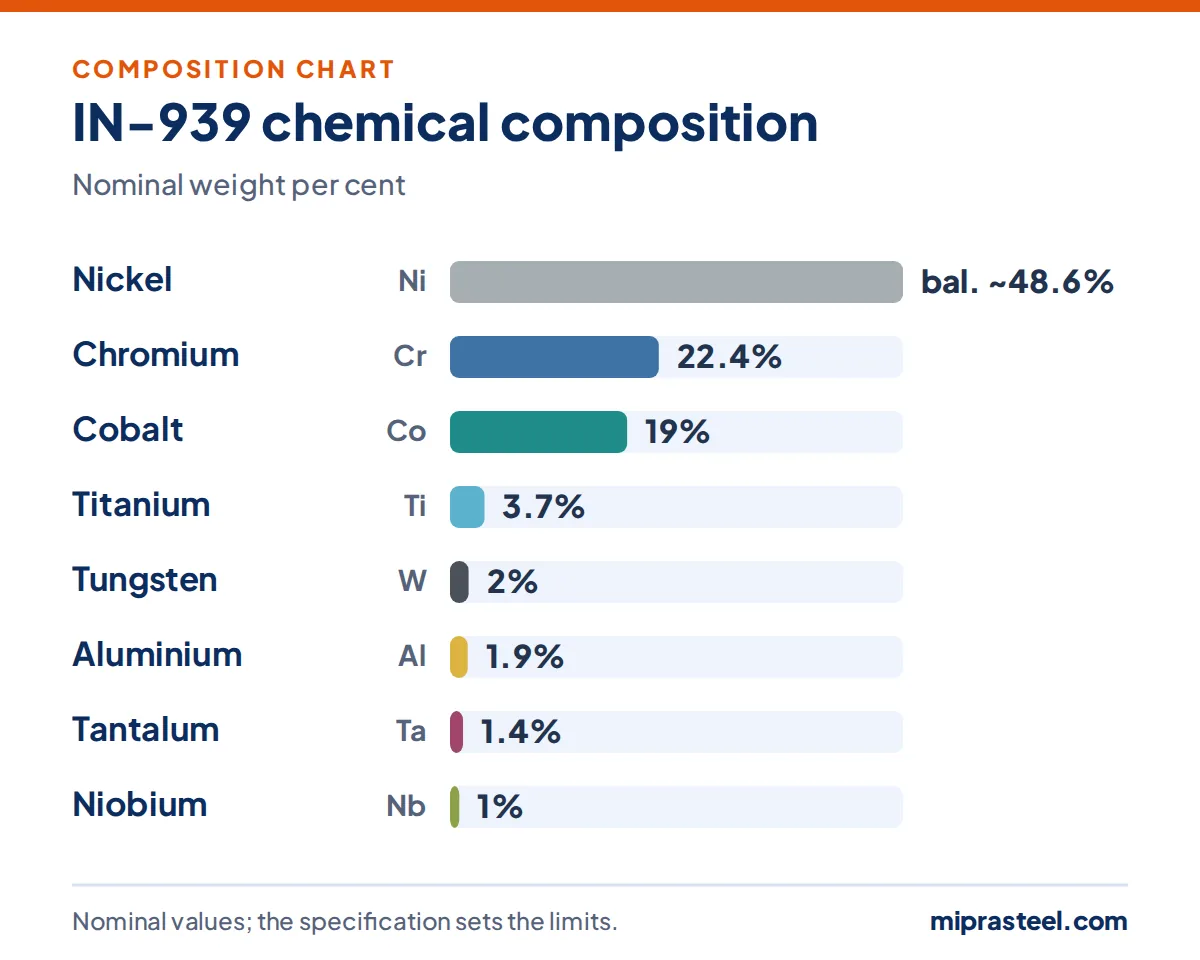
| Element | Symbol | Nominal wt% | |
|---|---|---|---|
| Nickel | Ni | Balance (about 48.6) | |
| Chromium | Cr | 22.4 | |
| Cobalt | Co | 19 | |
| Titanium | Ti | 3.7 | |
| Tungsten | W | 2 | |
| Aluminium (aluminum) | Al | 1.9 | |
| Tantalum | Ta | 1.4 | |
| Niobium | Nb | 1 |
IN-939 Equivalent Grades and Other Names
| Designation | Value |
|---|---|
| Trade name | IN-939 |
| UNS | Not assigned (proprietary turbine OEM alloy) |
| W.Nr. / EN | Not assigned |
| Other names in the trade | Inconel 939, Alloy 939, IN-939 low Zr |
Look up any designation in the grade name converter or the equivalent grade chart.
IN-939 Standards and Specifications
Supplied to turbine OEM specifications.
IN-939 Applications
- Nozzle guide vanes and vane segments
- Industrial and marine gas turbine hot sections
Source industries: power generation, marine and shipbuilding.
How IN-939 Scrap Is Identified
Several vane alloys share the 22% chromium and 19% cobalt pattern, so titanium, tungsten and chromium readings decide whether a piece is IN-939.
| Check | What it shows for IN-939 |
|---|---|
| Chromium about 22% with cobalt about 19% | Places the piece in the IN-939 group of vane alloys, away from blade alloys with 8% to 14% chromium. |
| Titanium about 3.7% | The key reading. GTD-222 and its siblings sit nearer 2.3% titanium, so titanium is what separates them. |
| Tungsten about 2% | MGA 2400 looks almost identical but carries about 6% tungsten and 19% chromium. |
| Zirconium | Needed only if the lot is to be described as low Zr. Trace zirconium needs a clean, freshly ground spot and a suitable XRF or OES method; uncertainty at trace levels is real. |
| Coatings and repairs | Ex-service vanes may carry protective coatings and braze or weld repairs. Read through a ground spot, not the coated surface. |
| Part numbers and turbine source | Knowing the turbine model and the stage the vanes came from narrows the alloy down before testing. |
Grades Most Often Confused with IN-939
- GTD-222: same 22.5% chromium and 19% cobalt, but about 2.3% titanium against 3.7% in IN-939.
- MGA 2400: 19% cobalt and 3.7% titanium like IN-939, but about 19% chromium and 6% tungsten.
- GTD-241: another 22.5% chromium, 19% cobalt vane alloy, with about 2.3% titanium and 1.35% niobium.
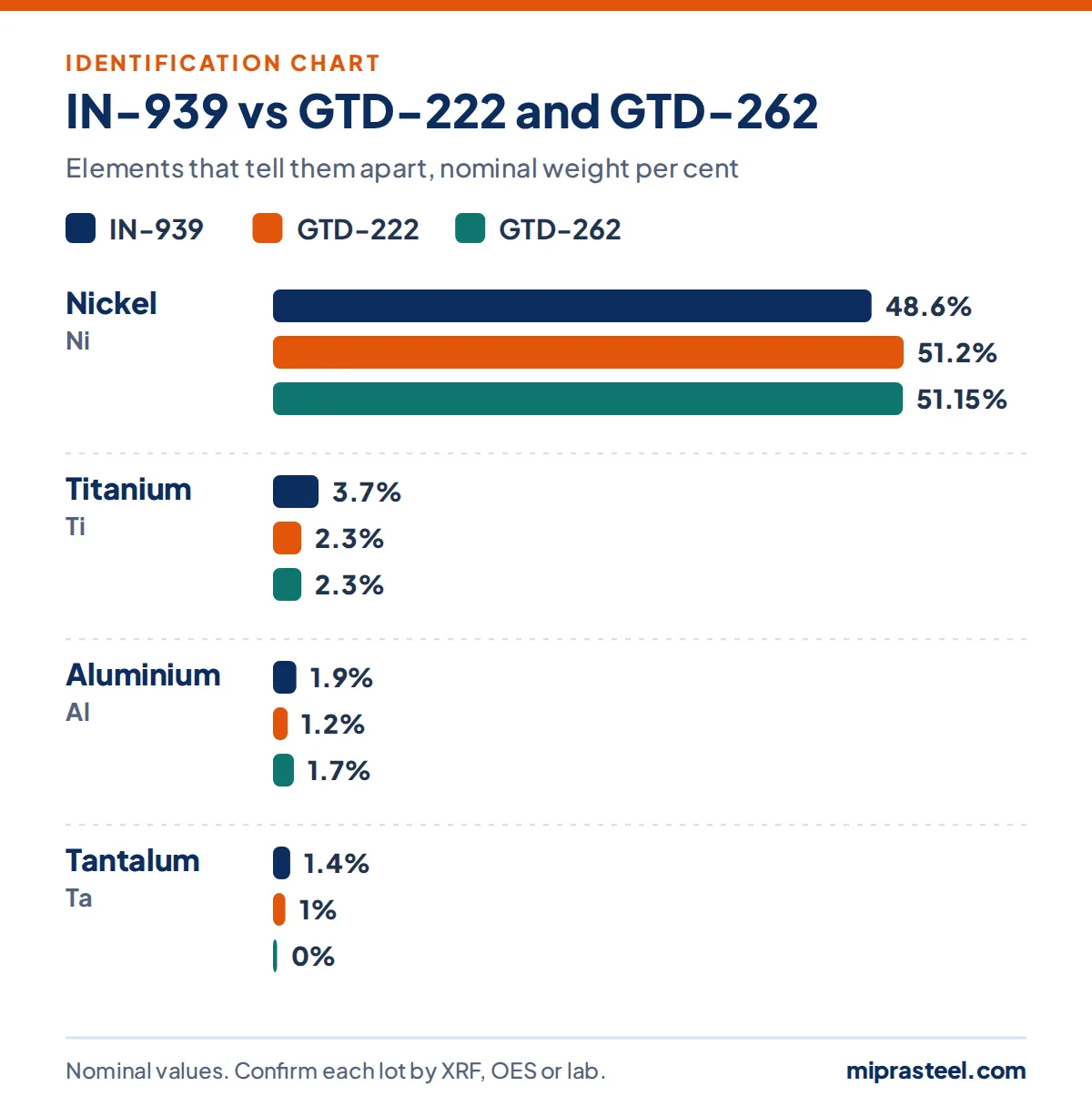
Nominal values for IN-939 against its closest grades on this site.
Preparing IN-939 Scrap for Sale
- Read every vane for titanium and tungsten before it joins an IN-939 lot.
- Pack low Zr pieces separately from standard IN-939 and keep their analyses with them.
- Strip steel fixtures, seal rings and attachments from vane segments.
- Keep foundry revert and ex-service vanes in separate drums.
- Record turbine model, stage and part numbers on the packing list where known.
IN-939 Scrap Price per Kg: What Decides It
IN-939 is priced as a cobalt-bearing superalloy. Beyond metal content, the question a buyer asks is whether it can go straight into a melt.
- Contained cobalt (about 19%) and nickel (about 49%), plus tantalum, tungsten, titanium and niobium.
- Single-grade certainty: IN-939 mixed with GTD-222 or MGA 2400 is no longer a direct charge for any of them.
- Zirconium documentation: a lot sold as IN-939 low Zr needs analysis to match, and the description has to be supported for every piece.
- Revert versus ex-service: foundry revert is clean; used vanes carry coatings, oxide, braze and repair weld metal that a melter has to allow for.
- Attachments: steel fixtures, rings or mixed-alloy assemblies must come off before the lot is weighed.
- Lot size and paperwork: turbine part numbers, overhaul records and readings make a lot easier to place.
Cobalt and nickel prices both move, so any IN-939 scrap price per kg is quoted against a date. Our guide to what decides nickel alloy scrap value covers the method.
IN-939 Scrap Import and Export
Importing IN-939 Scrap into India
IN-939 vanes come out of power stations, LNG plants and naval fleets that run industrial and marine gas turbines, so Gulf, European and East Asian overhaul centres are typical origins. Shipments into India land at Nhava Sheva, Mundra or Chennai with a pre-shipment inspection certificate, commercial invoice, packing list and bill of lading. Coated vanes should be described as ex-service turbine scrap of IN-939, with readings attached, so that the customs description and the inspection agree. See importing nickel alloy scrap into India.
Exporting IN-939 Scrap from India
Gas turbines run in Indian power stations and process plants, and their overhauls release vane scrap. Export lots of IN-939 are described by grade on invoice and packing list, weighed, and shipped in drums or bulk bags inside containers. Superalloy melters in Europe, including the Netherlands, and buyers in the Gulf are among the destinations; our Dubai office serves Saudi Arabia and the wider region. See alloy scrap export documents.
Customs heading: 7503.00 (nickel waste and scrap). The HS code is the international tariff heading the scrap is declared under; national tariff lines add further digits, so confirm the full line with your customs broker.
Other Inconel Scrap Grades
Related Reading
IN-939 Scrap FAQ
What does "IN-939 low Zr" mean?
It is a trade description for IN-939 lots kept low in zirconium for melts that require it. No alloy standard defines a low Zr version of IN-939, so the term carries weight only when the lot comes with analysis showing its zirconium. Buyers should ask for that analysis, and sellers should keep low Zr pieces physically apart from standard IN-939.
Why do melters keep low-zirconium revert separate?
Zirconium is added to superalloys in small, controlled amounts. Too much, especially with boron, raises the risk of hot cracking and brittle phases at grain boundaries. A melter who needs tight zirconium control cannot easily dilute a high-Zr charge, so low-Zr revert is bought and stored as its own material.
How do I tell IN-939 from GTD-222 scrap?
Look at titanium. Both read about 22% to 22.5% chromium and 19% cobalt, but IN-939 carries about 3.7% titanium against roughly 2.3% in GTD-222. Tantalum and aluminium are a little higher in IN-939 too. On used vanes, read a clean, ground spot rather than the coating.
Is IN-939 the same alloy as MGA 2400?
No, though they are close. Both have about 19% cobalt and 3.7% titanium. MGA 2400 has about 19% chromium and 6% tungsten, while IN-939 has about 22.4% chromium and 2% tungsten. Mixing them spoils a lot for buyers who want either one.
Why does IN-939 contain so much chromium?
For hot-corrosion resistance. Gas turbines burning fuels with sulfur, or running in salty marine air, form corrosive deposits on hot-section parts. About 22% chromium lets IN-939 vanes resist that attack far longer than low-chromium blade alloys, which is why it is chosen for vanes in industrial and marine turbines.
Which customs code applies to IN-939 scrap?
Nickel is the largest element in IN-939, so its scrap is typically classified under HS 7503.00, nickel waste and scrap, even with 19% cobalt present. National tariff lines add digits under that heading. Confirm the exact line with your customs broker.
Does Mipra Steel take used, coated vane segments?
Yes. Mipra Steel buys and sells ex-service IN-939 vanes as well as foundry revert. Coated and repaired vanes are described as ex-service material. Send the piece count, weight, turbine source, photographs and any readings, and we will review the lot.
What is IN-939 made of?
Nominally 48.6% nickel, 22.4% chromium, 19% cobalt, 3.7% titanium, 2% tungsten, 1.9% aluminium, 1.4% tantalum, 1% niobium. Specification ranges vary by product form and standard.
Published by Mipra Steel, Khetwadi, Mumbai · Updated