What Is Ni-Resist, and Why Sell It by Type Instead of as Cast Iron?
Ni-Resist is cast iron with enough nickel in it to change the structure of the iron itself. Ordinary grey iron has a ferritic or pearlitic matrix and rusts readily. Add 15% or more nickel and the matrix becomes austenite, the same structure found in 300-series stainless, while the flake graphite and 2 to 3% carbon of a cast iron remain. The result casts like iron but resists seawater, brine, alkalis and wear far better, which is why pump and valve makers use it for parts that would corrode in plain iron and cost too much in stainless or bronze.
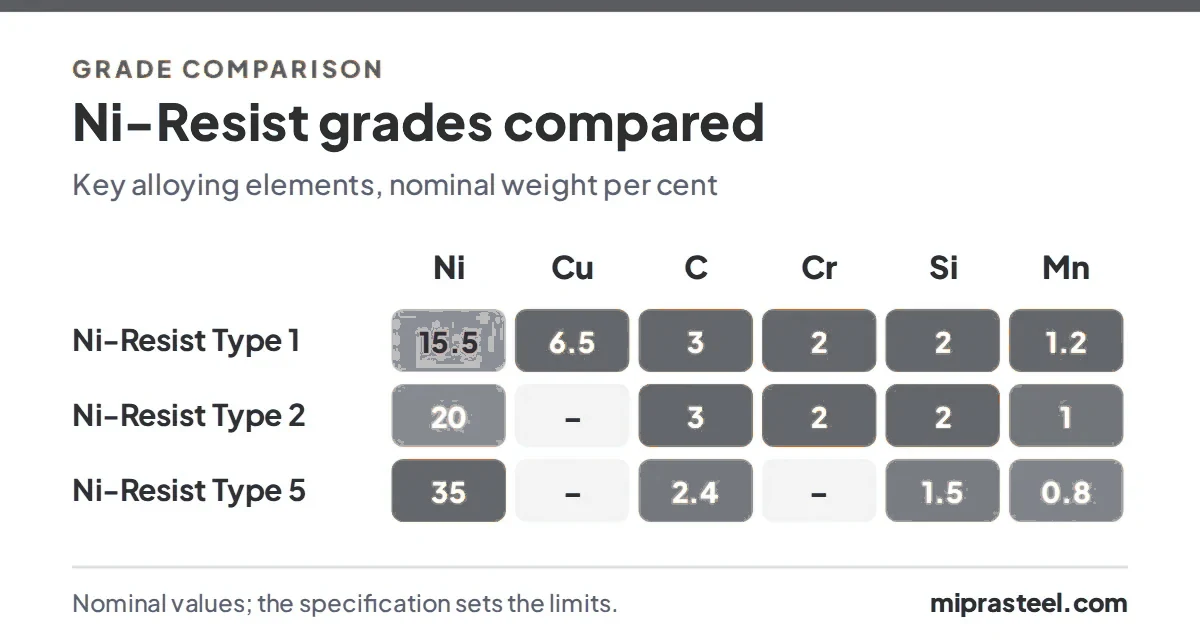
Three types cover nearly all the scrap that turns up. Type 1 adds about 6.5% copper to 15.5% nickel and is the classic seawater pump iron. Type 2 drops the copper and raises nickel to about 20%, so it can handle caustic, soap and food duties where copper is not wanted. Type 5 goes to about 35% nickel with no copper or chromium, giving very low thermal expansion for machine-tool parts, dies and gauges.
Those differences decide where the scrap can be melted. A foundry pouring Type 2 cannot charge Type 1 returns without picking up copper it does not want. A Type 5 lot holds more than twice the nickel of Type 1, and that difference is lost if it is sold in a mixed heap. Sold as plain cast iron, any of them is underpriced.
Ni-Resist is not a nickel alloy and is not stainless steel. Its 2 to 3% carbon puts it in the cast iron class for customs as well as for melting. See the wider exotic alloy scrap range for the materials it travels with.
Ni-Resist Scrap Grades We Buy and Sell
Ni-Resist Chemical Composition
| Grade | Fe | Ni | Cu | C | Cr | Si | Mn |
|---|---|---|---|---|---|---|---|
| Ni-Resist Type 1 | 69.8 | 15.5 | 6.5 | 3 | 2 | 2 | 1.2 |
| Ni-Resist Type 2 | 72 | 20 | – | 3 | 2 | 2 | 1 |
| Ni-Resist Type 5 | 60.3 | 35 | – | 2.4 | – | 1.5 | 0.8 |
Nominal weight per cent. Specification ranges vary by product form and standard.
How to Tell Ni-Resist Grades Apart
Ni-Resist looks like any grey casting, so a magnet, an analysis and the part history do the identifying.
| Check | What it shows for Ni-Resist |
|---|---|
| Magnet | Types 1 and 2 are non-magnetic, unlike ordinary cast iron. Type 5 can be mildly magnetic at room temperature, so a magnet alone does not rule it out. See magnet sorting. |
| Copper by XRF | About 6.5% copper is the mark of Type 1; Types 2 and 5 show essentially none. |
| Nickel by XRF | About 15.5% for Type 1, 20% for Type 2 and 35% for Type 5. |
| Chromium | Types 1 and 2 carry about 2% chromium; Type 5 has none to speak of. |
| Carbon by OES | Spark OES confirms 2 to 3% carbon and shows the piece is cast iron, not a wrought nickel alloy or stainless. See XRF vs OES vs lab. |
| Casting marks and drawings | Pump nameplates, pattern numbers and maker drawings often state the material directly. |
Grades Most Often Confused with Ni-Resist
- Grey or ductile cast iron: same appearance and fracture but strongly magnetic, with no meaningful nickel.
- Austenitic stainless castings (CF8, CF8M): non-magnetic too, but with 18 to 20% chromium, far less carbon and no graphite.
- Monel or nickel-aluminium bronze pump parts: also used in seawater pumps; Monel is about two-thirds nickel and NAB is copper-base, both clear on XRF.
Copper Identifies Type 1
About 6.5% copper; Types 2 and 5 have none.
Nickel Level Separates Types 2 and 5
About 20% against 35%.
Carbon Needs OES
XRF can’t see carbon or graphite. OES confirms that a piece is cast iron and not a wrought stainless or nickel alloy.
Where Ni-Resist Scrap Comes From
Almost all Ni-Resist is cast, and most of it is pump or valve hardware, so scrap appears when equipment in wet, corrosive service is replaced.
Seawater and Cooling-Water Pumps
Casings, impellers and wear rings from ships, power station intakes and refinery cooling systems, mostly Type 1 and Type 2. See marine and shipbuilding.
Desalination Intakes and Brine Handling
Pump bodies and valve castings from intake and brine-reject systems. See desalination.
Caustic, Soap and Food Plants
Type 2 pump and valve castings chosen because copper is unwanted in the product stream.
Machine Tools and Precision Equipment
Type 5 beds, frames, forming dies and gauge bodies chosen for dimensional stability.
Foundry Returns
Gates, risers and rejected castings at foundries that pour austenitic iron.
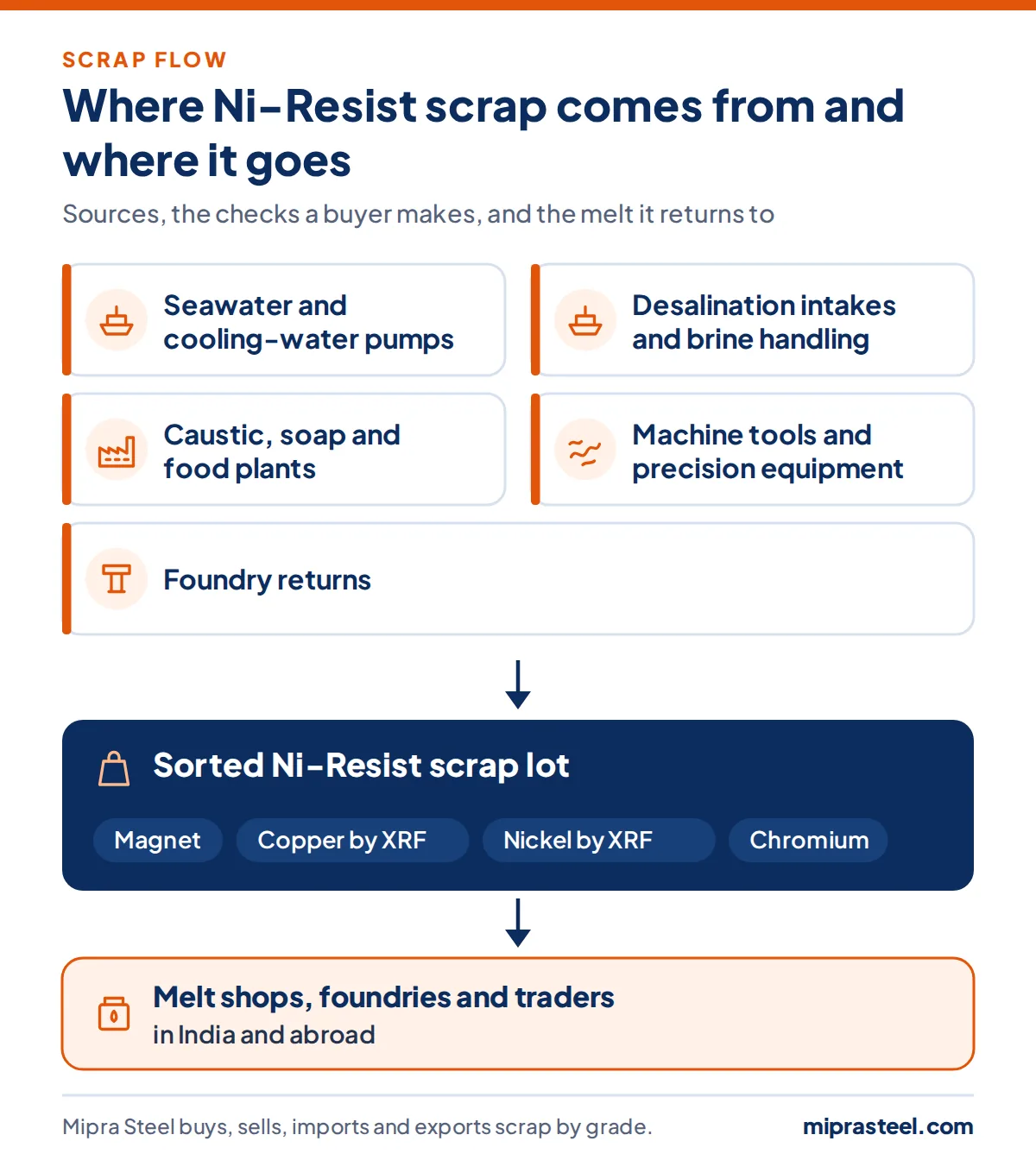
Source industries: marine and shipbuilding, desalination, chemical processing, heat treatment and furnaces.
Ni-Resist Scrap Buyer, Importer and Exporter in India
Mipra Steel trades Ni-Resist scrap from Khetwadi, Mumbai, buying pump, valve and machine castings by type and supplying foundries that pour austenitic and nickel-bearing iron.
Sell Ni-Resist Scrap
Have old Ni-Resist pumps or valves? Send photographs of the castings and any nameplates, the type if known, approximate weight, how many pieces still have bronze rings or steel shafts fitted, and the location. XRF readings of nickel and copper on a few pieces are a big help, because they settle Type 1 against Type 2 straight away. We review incoming enquiries and respond with relevant next steps.
Buy Ni-Resist Scrap
Foundries pouring Ni-Resist castings can use clean returns of the same type as charge material. Tell us the type you pour, your limits on copper and chromium, the maximum piece size your furnace accepts and the quantity you need. Type 1, Type 2 and Type 5 are offered as separate lots, each described with the readings or records that support it.
Preparing Ni-Resist Scrap for Sale
- Test each casting with a magnet and pull out anything that grabs hard; it is plain iron.
- Read nickel and copper on representative pieces and stack Types 1, 2 and 5 separately.
- Remove bronze wear rings, steel shafts, fasteners and non-metallic linings.
- Photograph nameplates and pattern numbers before the castings are broken.
- Record piece count and approximate weight per type.
Ni-Resist Scrap Price per Kg: What Decides It
A Ni-Resist offer starts from the nickel it contains, which makes the type the first thing a buyer asks.
- Type and nickel level: about 35% nickel in Type 5 against 15.5% in Type 1 is the largest single difference between lots.
- Copper: an asset for a foundry pouring Type 1, a restriction for anyone melting copper-free iron.
- Separation from plain cast iron: even a few grey-iron castings in the lot pull down the average nickel.
- Attachments: bronze wear rings, steel shafts, bolts and rubber or plastic linings must be removed or allowed for.
- Piece size: heavy pump casings that will not fit a furnace mouth have to be broken first, which costs the buyer time.
- Evidence: nameplates, drawings or readings let the buyer accept the type without retesting every piece.
Ni-Resist is paid on nickel, and nickel prices move every day, so offers are quoted for the date of the lot description. Our nickel scrap value guide explains the contained-metal method.
Ni-Resist Scrap Import and Export
Importing Ni-Resist Scrap into India
Ni-Resist scrap reaches India from ship-breaking, Gulf desalination and power plant overhauls, and European and East Asian pump refurbishment. It is typically declared as cast iron waste and scrap under HS 7204.10, despite its nickel; confirm the national line with your customs broker. Each consignment travels with a pre-shipment inspection certificate, commercial invoice, packing list and bill of lading, and lands mostly at Nhava Sheva or Mundra. Naming the Ni-Resist type on the invoice, with nickel content, keeps the lot from being valued as ordinary iron. See importing alloy scrap into India.
Exporting Ni-Resist Scrap from India
Indian refineries, fertiliser plants, coastal power stations and pump repair shops release Ni-Resist castings that foundries abroad remelt into new austenitic iron. Export lots are described by type and nickel content on the invoice and packing list, weighed, and shipped loose or on pallets in containers. Our Dubai office covers Gulf buyers and our South Korea office covers East Asia; we also ship to Italy and Spain.
Customs heading: 7204.10 (cast iron waste and scrap). The HS code is the international tariff heading the scrap is declared under; national tariff lines add further digits, so confirm the full line with your customs broker.
Related Reading
Ni-Resist Scrap FAQ
What is Ni-Resist?
It is a family of austenitic cast irons, with 15 to 35% nickel added to grey iron so that the matrix becomes austenite. It keeps the castability and graphite of cast iron but resists corrosion, heat and wear much better, and is used for pumps, valves and stable machine parts.
Why is Ni-Resist scrap valued for its nickel content?
Because nickel is the expensive element in it. A tonne of Type 1 holds about 155 kg of nickel and a tonne of Type 5 about 350 kg, against almost none in ordinary cast iron. Foundries that pour Ni-Resist can use those units directly, so identified lots are worth more than general iron scrap.
How can I tell Ni-Resist Type 1 from Type 2?
Check copper. Type 1 carries about 6.5% copper and 15.5% nickel, while Type 2 has no copper and about 20% nickel. Both are non-magnetic and look the same, so an XRF reading or the pump maker's material record is needed.
Is Ni-Resist magnetic?
Types 1 and 2 are not, which is a quick way to separate them from ordinary cast iron. Type 5, with about 35% nickel, can be mildly magnetic at room temperature, so a weak pull on a heavy, high-nickel casting does not mean it is plain iron.
Which HS code applies to Ni-Resist scrap?
It is typically classified as cast iron waste and scrap, HS 7204.10, because it is a cast iron with 2 to 3% carbon, not a nickel alloy. National tariff lines vary, so confirm the full code with your customs broker.
Are ductile Ni-Resist grades handled the same way?
They are sold the same way but kept as separate lots. Ductile austenitic irons such as the D-2 types under ASTM A439 have spheroidal rather than flake graphite and slightly different chemistry, so a foundry will want them described separately from the grey Types 1, 2 and 5.
How do I offer Ni-Resist pumps to Mipra Steel?
Share photographs, nameplate details, approximate weight, piece count and location, plus any readings you hold. Say whether shafts and wear rings are still fitted. If the type is unknown, describe the service the pump was in, as seawater, caustic or precision duty points to the likely type.
Published by Mipra Steel, Khetwadi, Mumbai · Updated