Nimonic 75 Scrap Buyer, Importer and Exporter in India
Mipra Steel buys and sells Nimonic 75 scrap from Khetwadi, Mumbai, working with heat-treatment shops, engine repair shops, instrument makers and stockholders in India and overseas.
Sell Nimonic 75 Scrap
To sell Nimonic 75 scrap, send us the form (sheet trim, fixtures, sheath, bar), an estimated weight, the location and photographs. Readings that show titanium and iron help separate it from 600 and 80A. If sheaths are included, tell us whether they still hold insulation and wire. We review incoming enquiries and respond with relevant next steps.
Buy Nimonic 75 Scrap
Producers of nickel-chromium alloys and traders who need clean, low-iron Nimonic 75 can send their quantity, accepted forms, destination and timing. Lots are described as Nimonic 75, UNS N06075, W.Nr 2.4951, and we can talk through which readings and certificates accompany them.
What Is Nimonic 75, and What Is Its Scrap Good for?
Nimonic 75 is where the Nimonic story starts. It was introduced in the 1940s for turbine blades in the prototype Whittle jet engines, and was soon overtaken for blades by stronger, age-hardened grades. It found a long second life as a sheet alloy: combustion chamber parts, flame tubes, furnace fixtures and thermocouple sheaths, anywhere a part needs to resist scaling at high temperature without carrying much load. The European Union even uses it as a certified reference material for creep testing.
The chemistry is plain: about 20% chromium, a little titanium and carbon, and nickel making up most of the rest, with iron held low. That simplicity makes it a clean, predictable melt input for anyone producing nickel-chromium alloys or heating-element grades. It carries no cobalt, molybdenum or tungsten, so its value rests almost entirely on nickel and on proof that the lot is what it claims to be.
That is where 75 gets into trouble. To a magnet and to the eye it looks like any other nickel-chromium sheet, and furnaces often hold 75 next to Inconel 600, 80/20 resistance wire and Nimonic 80A fixtures. The difference between those grades is a few percent of iron, titanium or aluminium, and buyers expect a reading to show it. See Nimonic 75 vs Nimonic 80A for a side-by-side view.
Nimonic 75 belongs to the Nimonic family, part of nickel alloy scrap.
Where Nimonic 75 Scrap Is Found
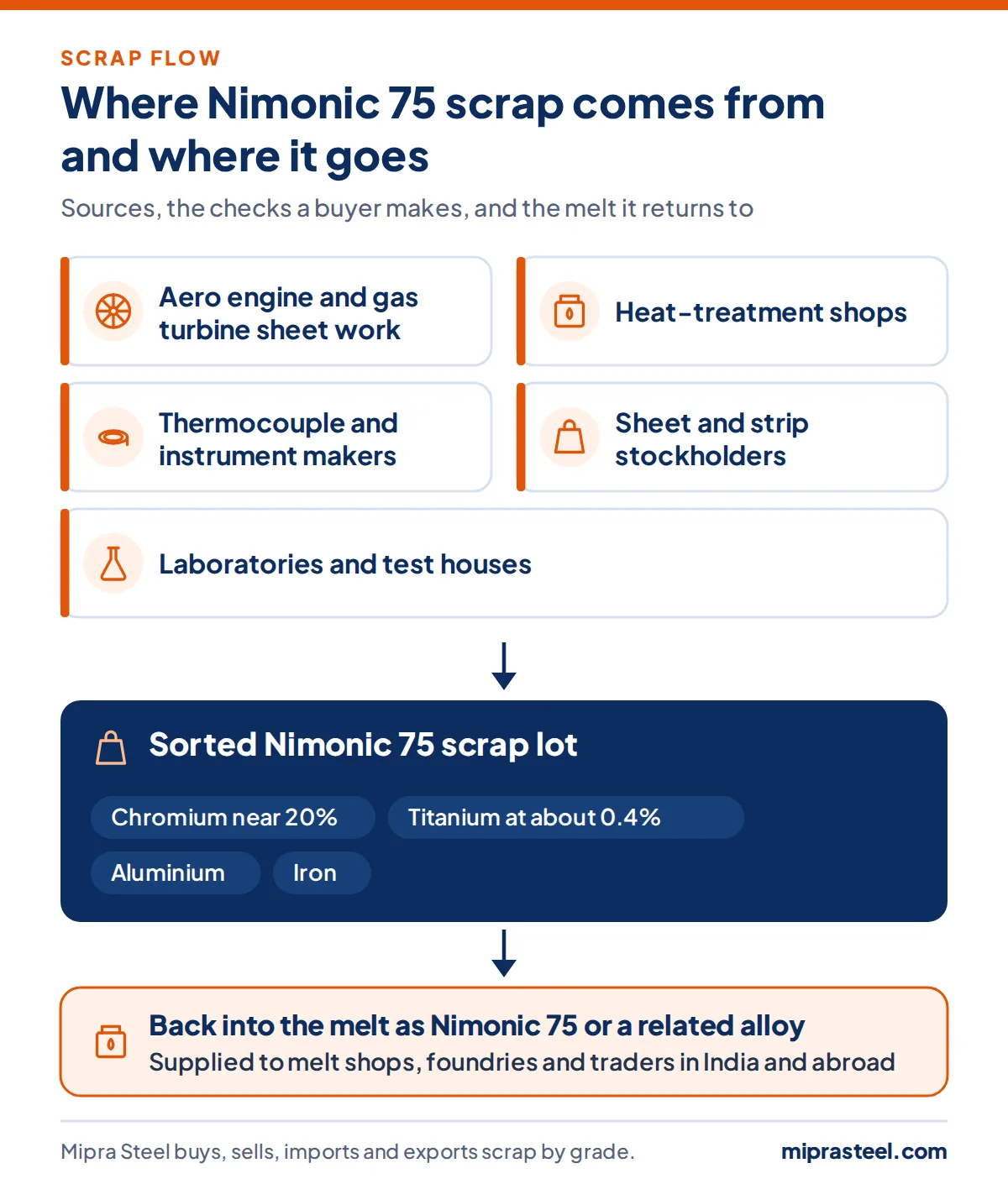
Nimonic 75 rarely arrives as a big single lot. Look for it in these places.
Aero Engine and Gas Turbine Sheet Work
Combustion liners, flame tube sections, ducting and heat shields from older engine types, plus trim from repair shops. See aerospace scrap.
Heat-Treatment Shops
Baskets, trays, muffles and fixtures that have reached the end of their life, often scaled and distorted. See heat-treatment and furnace scrap.
Thermocouple and Instrument Makers
Sheath offcuts and rejected mineral-insulated cable. Used sheaths contain magnesia insulation and thermocouple wires of other alloys inside.
Sheet and Strip Stockholders
Offcuts, edge trim and short ends cut to BS HR 203 or EN specifications, usually with paperwork.
Laboratories and Test Houses
Creep test pieces and offcuts, small but well documented.
Nimonic 75 Scrap Specification Chart
| Grade | Nimonic 75 |
|---|---|
| UNS | N06075 |
| W.Nr. / EN | 2.4951 |
| Also known as | Alloy 75 |
| Alloy type | Solid-solution nickel-chromium |
| Density | 8.37 g/cm³ (0.302 lb/in³) |
| Magnetic | Non-magnetic. |
| HS code (customs heading) | 7503.00 (nickel waste and scrap) |
Nimonic 75 Chemical Composition
Nominal composition in weight per cent, used to describe and identify the grade. The governing specification sets the limits for each product.
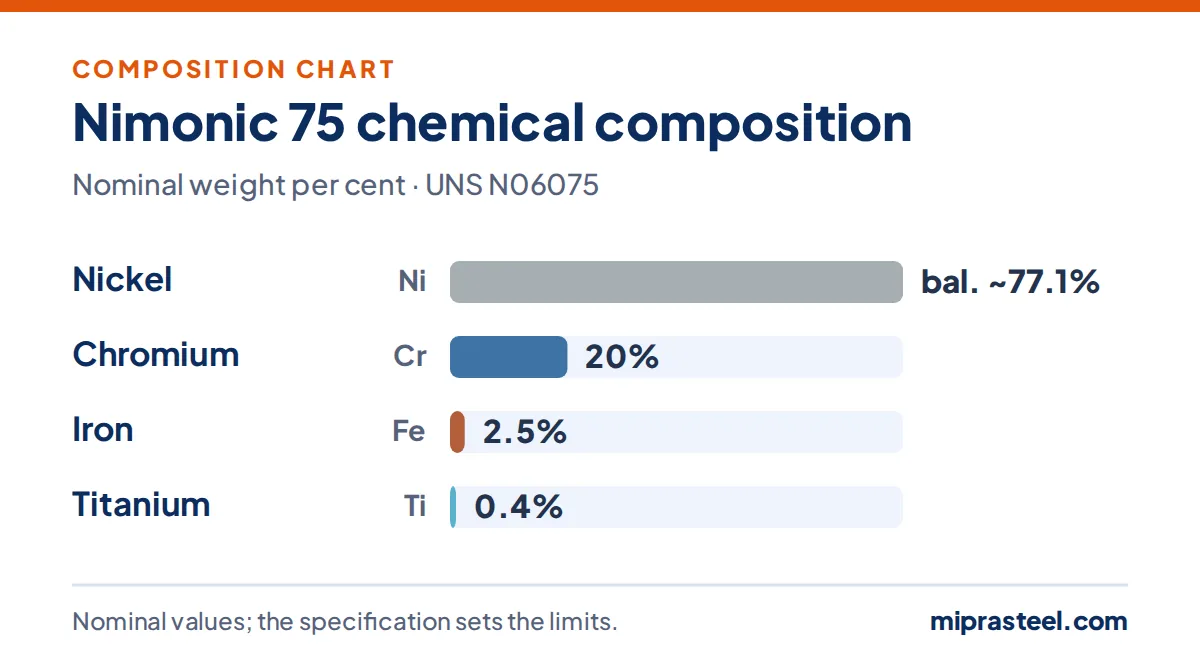
| Element | Symbol | Nominal wt% | |
|---|---|---|---|
| Nickel | Ni | Balance (about 77.1) | |
| Chromium | Cr | 20 | |
| Iron | Fe | 2.5 | |
| Titanium | Ti | 0.4 |
Nimonic 75 Equivalent Grades and Other Names
| Designation | Value |
|---|---|
| Trade name | Nimonic 75 |
| UNS | N06075 |
| W.Nr. / EN | 2.4951 |
| Other names in the trade | Alloy 75 |
Look up any designation in the grade name converter or the equivalent grade chart.
Nimonic 75 Standards and Specifications
Nimonic 75 Applications
- Gas turbine sheet components
- Heat-treatment fixtures and furnace parts
- Thermocouple sheaths
Source industries: aerospace, heat treatment and furnaces.
How Nimonic 75 Scrap Is Identified
Most mistakes with 75 are not about what it is but about what it is not. These are the readings that rule the neighbours out.
| Check | What it shows for Nimonic 75 |
|---|---|
| Chromium near 20% | Nickel around 77% with chromium near 20% places it in the 80/20 group. Inconel 600 reads lower, about 15.5%. |
| Titanium at about 0.4% | Small but present. Nickel-chromium resistance wire reads close to zero titanium, Nimonic 80A over 2%. |
| Aluminium | Should be very low. A reading near 1.4% means Nimonic 80A; confirm with OES or a light-element XRF. |
| Iron | Nominally about 2.5%, with 5% as the specification ceiling. Around 8% points to Inconel 600. |
| Hollow items | Cut or crush a sample of thermocouple sheath to check for magnesia powder and inner wires before weighing. |
| Markings | BS HR 5, HR 203, HR 403 or W.Nr 2.4951 stencils and certificates are common on 75 stock. See EN, DIN and BS designations. |
Grades Most Often Confused with Nimonic 75
- Nimonic 80A: shares the 20% chromium base but carries about 2.25% titanium and 1.4% aluminium.
- Inconel 600: has similar nickel but about 15.5% chromium and 8% iron, with no titanium addition.
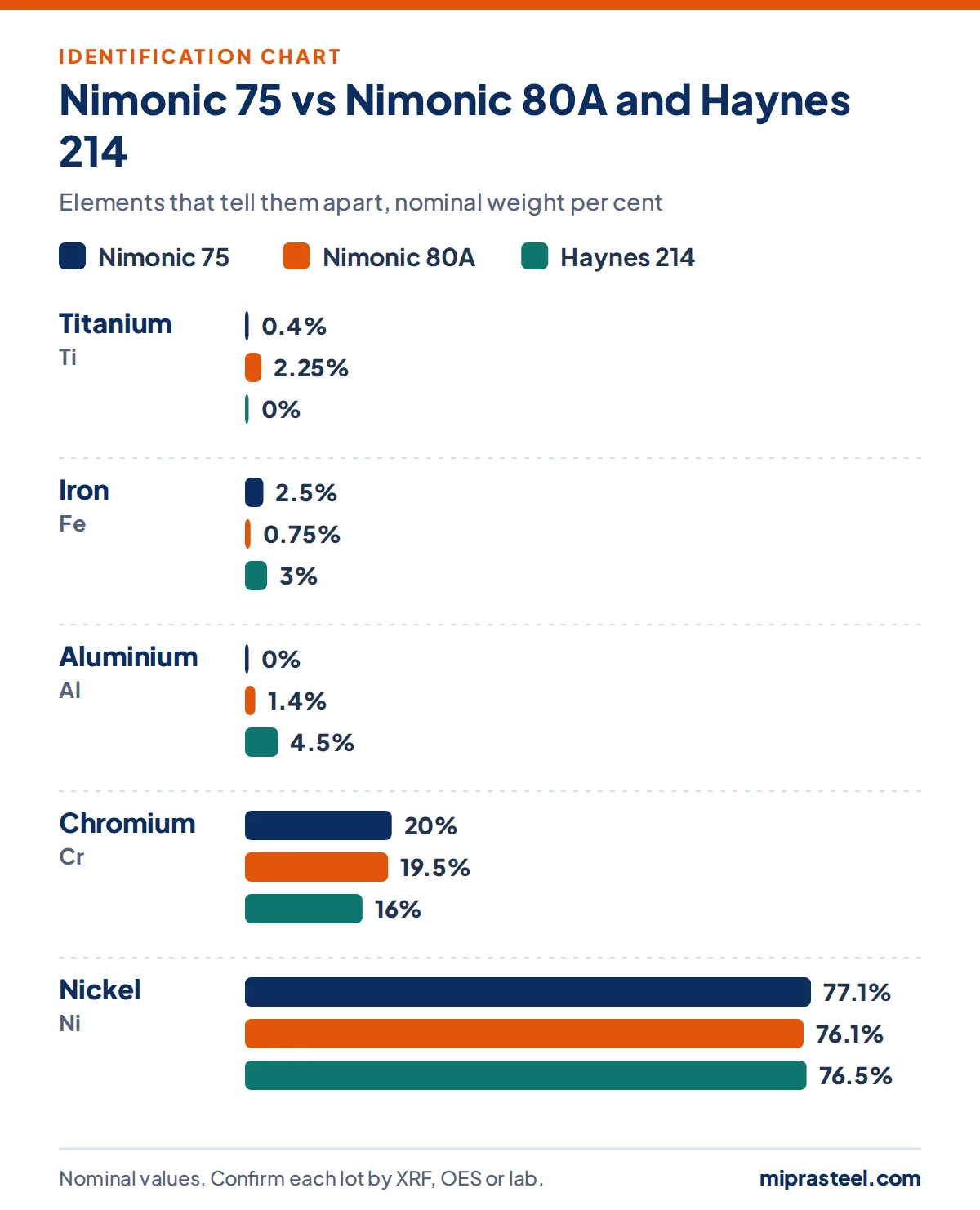
Nominal values for Nimonic 75 against its closest grades on this site.
Preparing Nimonic 75 Scrap for Sale
- Read every fixture for titanium and iron, and pull out any Inconel 600 or 80A pieces.
- Empty or declare thermocouple sheaths, since magnesia and inner wires are not Nimonic 75.
- Knock loose scale off old furnace parts before weighing.
- Bundle thin sheet and strip so it cannot blow or tangle during handling.
- Keep stencilled offcuts and certificates together in the same bag.
Nimonic 75 Scrap Price per Kg: What Decides It
With nickel and chromium as its only significant elements, Nimonic 75 is priced close to the nickel market. The gap between a good and a poor offer comes from the lot itself.
- Nickel content of about 77%, with chromium near 20% adding a little.
- Low iron: a lot that reads near 2.5% iron is cleaner melt input than one blended with Inconel 600.
- Separation from 80A: mixing the two hides the titanium and aluminium a buyer of either grade expects.
- Hidden weight: magnesia and inner wires in sheaths, or scale on old fixtures, reduce the metal a buyer actually gets.
- Form and thickness: thin sheet and foil oxidise more in melting than heavy offcuts and bar.
- Documents: certificates naming 2.4951 or N06075 support a firmer description.
Every offer is dated because nickel moves daily. Read the factors behind nickel alloy scrap price per kg for the full picture.
Nimonic 75 Scrap Import and Export
Importing Nimonic 75 Scrap into India
Much of the 75 that reaches India comes from the United Kingdom and continental Europe, where the alloy has long been specified to BS HR and EN standards, and from repair shops in the Gulf and East Asia. It usually arrives mixed into heat-resistant or turbine sheet consignments, so ask the shipper to bag it separately with readings. Imported scrap normally carries a pre-shipment inspection certificate, commercial invoice, packing list and bill of lading. Read the guide to importing nickel alloy scrap into India.
Exporting Nimonic 75 Scrap from India
Heat-treatment and engineering clusters in India release Nimonic 75 fixtures and sheet in steady small amounts. Grouped into one lot with readings, they suit melters of nickel-chromium alloys abroad. Lots are declared as Nimonic 75 with UNS and Werkstoff numbers on the invoice and packing list, weighed, and shipped in bags or drums inside containers. Buyers in Italy, the Netherlands and the Gulf can be reached from Mumbai and our Dubai office. See export documents for alloy scrap.
Customs heading: 7503.00 (nickel waste and scrap). The HS code is the international tariff heading the scrap is declared under; national tariff lines add further digits, so confirm the full line with your customs broker.
Comparisons
Other Nimonic Scrap Grades
Related Reading
Nimonic 75 Scrap FAQ
What is the difference between Nimonic 75 and Nimonic 80A scrap?
Titanium and aluminium. Nimonic 75 has about 0.4% titanium and almost no aluminium, while 80A has about 2.25% titanium and 1.4% aluminium, which makes it age-hardenable. Both have about 20% chromium on a nickel base, so a reading that shows titanium is needed to tell them apart.
Is Nimonic 75 the same as nichrome wire?
Not quite. Both are about 80% nickel and 20% chromium, but Nimonic 75 has a deliberate titanium addition of about 0.4% and controlled carbon, and is made to aerospace sheet and bar standards. Resistance wire usually has no titanium. Keep them in separate lots, since buyers often want one or the other.
Is Nimonic 75 scrap valuable?
It is valued mainly for its nickel, about 77% of its weight, with some value from chromium. It carries no cobalt or molybdenum, so it sits below the cobalt-bearing Nimonic grades. Clean, low-iron, single-grade lots with readings are placed most easily.
Who would buy used Nimonic 75 thermocouple sheaths?
Melters and traders handling nickel-chromium scrap, provided the contents are declared. Used sheaths hold magnesia insulation and thermocouple wires of different alloys. They are sold either emptied or as a described item with an estimate of the metal fraction.
Under which HS code does Nimonic 75 scrap move?
It is a nickel-base alloy, so its scrap is typically declared under HS 7503.00, nickel waste and scrap. Countries add further digits of their own, so confirm the exact line with a customs broker at both ends of the shipment.
How can I offer my Nimonic 75 scrap to Mipra Steel?
Send the form, weight, location and photographs, plus readings or certificates if you have them. Small lots from several sources can be discussed together. We review each enquiry and respond with relevant next steps.
What is Nimonic 75 made of?
Nominally 77.1% nickel, 20% chromium, 2.5% iron, 0.4% titanium. Specification ranges vary by product form and standard.
Published by Mipra Steel, Khetwadi, Mumbai · Updated