MGA 1400 DS Scrap Buyer, Importer and Exporter in India
Mipra Steel trades MGA 1400 DS blades and DS revert from Khetwadi, Mumbai, separately from conventionally cast MGA 1400.
Sell MGA 1400 DS Scrap
To sell MGA 1400 DS blades, send the number of blades and weight, the turbine model and row, coating condition and location. Close photographs of the airfoil showing the grain pattern, root part numbers and any reading that shows hafnium help us agree a DS description. We review incoming enquiries and respond with relevant next steps.
Buy MGA 1400 DS Scrap
DS foundries and alloy melters sourcing MGA 1400 DS can tell us the quantity, whether hafnium-bearing blades suit their melt, which documents they need with each lot, whether coated blades are acceptable, and the delivery port. Lots are offered as MGA 1400 DS only where reading, structure and records line up.
What Does "DS" Mean in MGA 1400 DS, and Does It Change the Scrap?
DS stands for directionally solidified. The blade is cast in a mould that is withdrawn slowly from the furnace, so the metal freezes from the root upwards and the grains grow as long columns running the length of the airfoil. With no grain boundaries lying across the main load direction, the blade resists creep and thermal fatigue better than an equiaxed casting of the same chemistry. Mitsubishi Heavy Industries developed MGA 1400 DS with Mitsubishi Materials after studying the effect of hafnium additions and heat treatment, and its published work names the M501G and up-rated M501F and M701F turbines as applications.
For anyone handling the scrap, the uncomfortable fact is that the published composition is the same as conventionally cast MGA 1400, apart from hafnium. MHI has not published the hafnium figure, so we do not quote one, and the composition table on this page shows the MGA 1400 base. A reading can show that hafnium is present, but it cannot tell you the target level.
So the description of an MGA 1400 DS lot rests on three things together: the hafnium showing on a reading, the columnar grain pattern visible on an etched or grit-blasted surface, and the paperwork, meaning turbine model, row and part numbers or a casting record. A lot with only one of the three is better offered as MGA 1400 type blade scrap with a note on what was seen.
Does the distinction matter commercially? Yes, mainly to melters. Hafnium is welcome in DS and some equiaxed blade melts and unwanted in others, so a melter needs to know whether it is there. Keeping DS and CC blades apart lets each go to the melt that wants it.
MGA 1400 DS belongs to the MGA family, part of superalloy scrap.
Sources of MGA 1400 DS Scrap
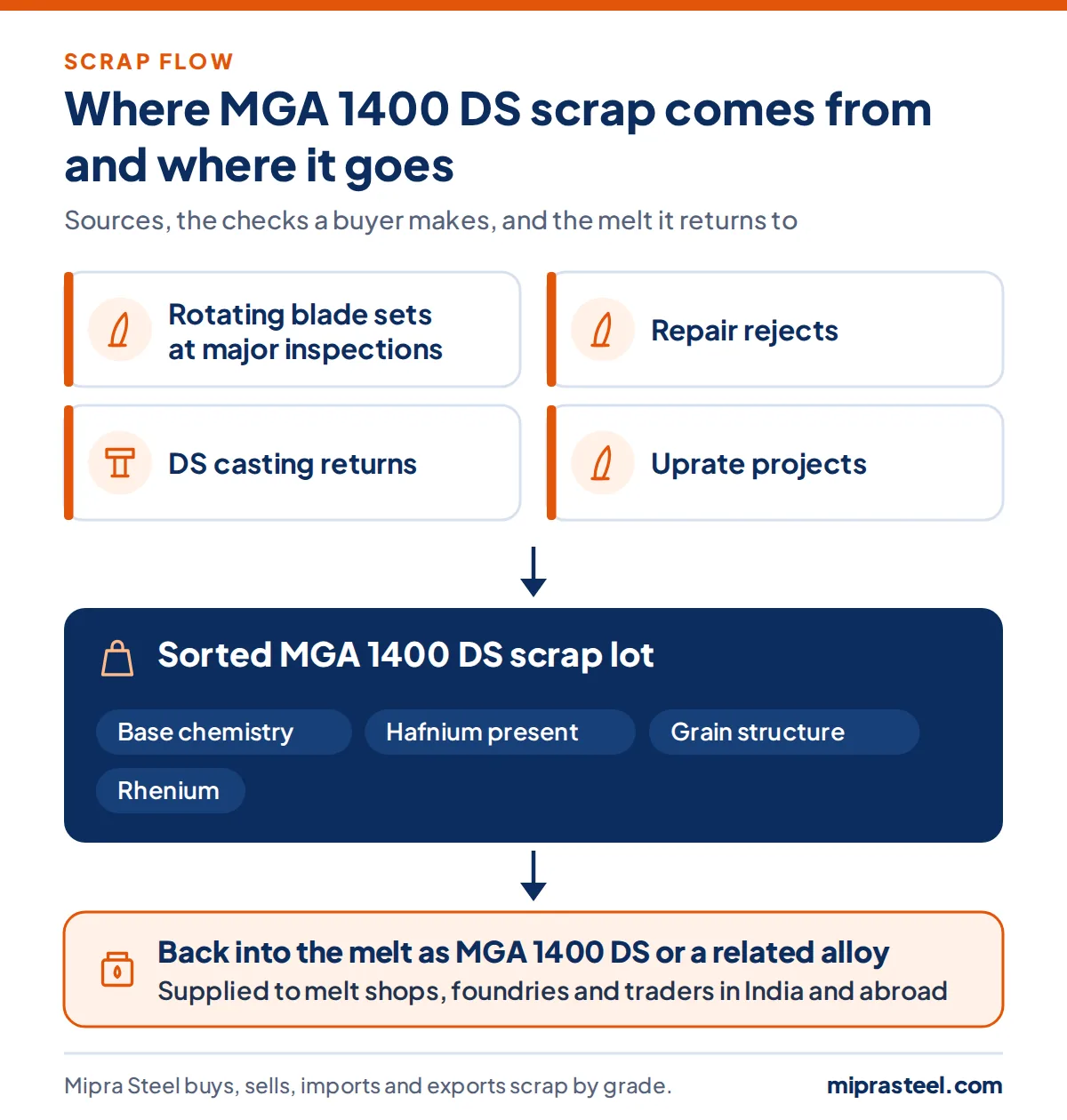
MGA 1400 DS scrap appears wherever later Mitsubishi frames are overhauled and where their DS blades are cast.
Rotating Blade Sets at Major Inspections
Blades from higher-firing Mitsubishi turbines retired at their life limit, usually coated, with tip rub or oxidation.
Repair Rejects
DS blades stripped for repair and then condemned, often for recrystallised grains or cracks in the airfoil.
DS Casting Returns
Starter blocks, gates and rejected DS castings from blade production, documented by heat.
Uprate Projects
When an F-class unit is uprated, older blade rows can be released in sets. See turbine scrap from power plants.
MGA 1400 DS Scrap Specification Chart
| Grade | MGA 1400 DS |
|---|---|
| UNS | Not assigned (proprietary Mitsubishi Heavy Industries alloy) |
| W.Nr. / EN | Not assigned |
| Identified by | Mitsubishi specification, turbine part records and analysis |
| Also known as | MGA1400DS, MGA 1400DS |
| Alloy type | Directionally solidified nickel superalloy |
| Density | Not published |
| Magnetic | Non-magnetic. |
| HS code (customs heading) | 7503.00 (nickel waste and scrap) |
MGA 1400 DS Chemical Composition
Nominal composition in weight per cent, used to describe and identify the grade. The governing specification sets the limits for each product.
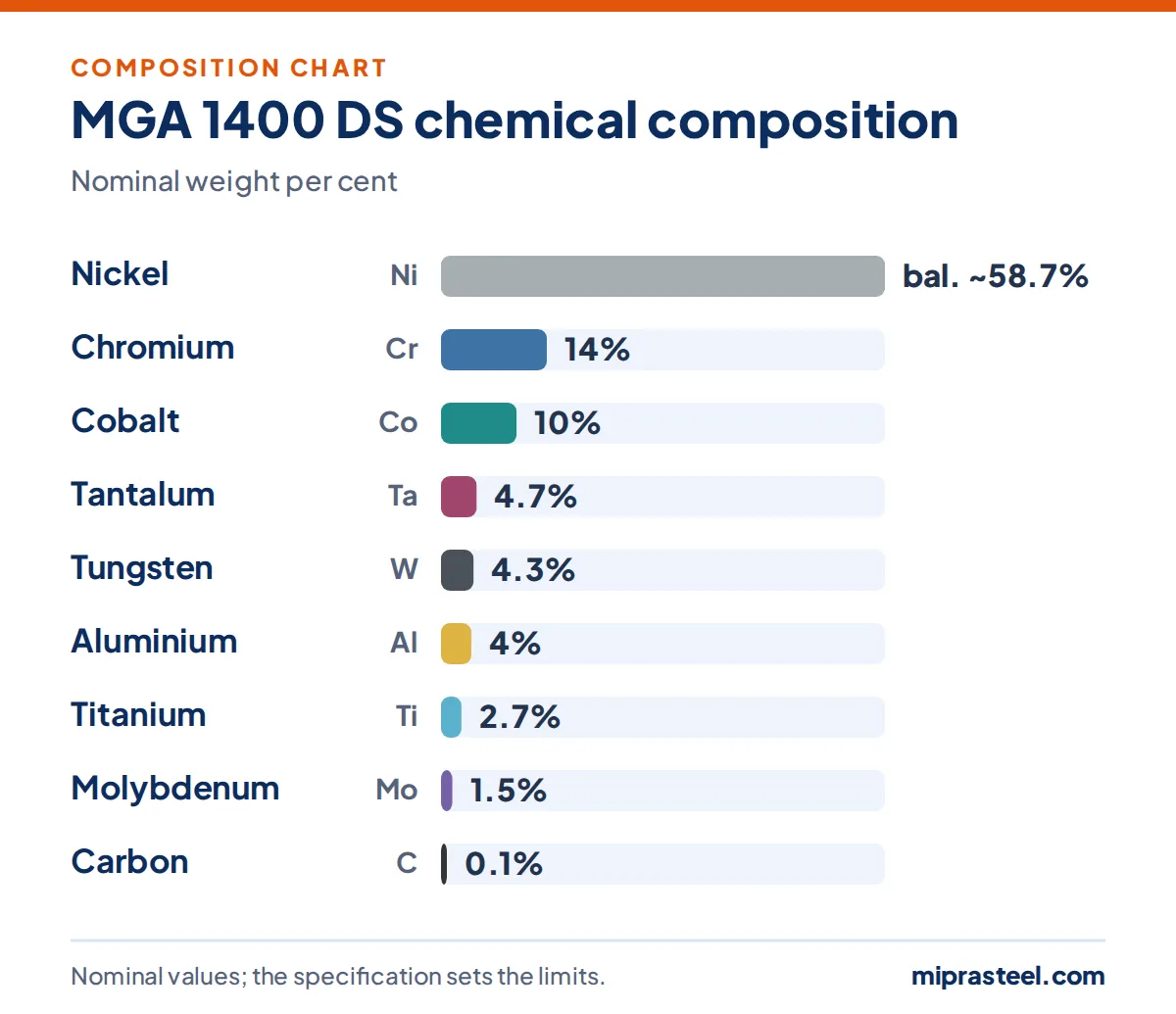
| Element | Symbol | Nominal wt% | |
|---|---|---|---|
| Nickel | Ni | Balance (about 58.7) | |
| Chromium | Cr | 14 | |
| Cobalt | Co | 10 | |
| Tantalum | Ta | 4.7 | |
| Tungsten | W | 4.3 | |
| Aluminium (aluminum) | Al | 4 | |
| Titanium | Ti | 2.7 | |
| Molybdenum | Mo | 1.5 | |
| Carbon | C | 0.1 |
MGA 1400 DS Equivalent Grades and Other Names
| Designation | Value |
|---|---|
| Trade name | MGA 1400 DS |
| UNS | Not assigned (proprietary Mitsubishi Heavy Industries alloy) |
| W.Nr. / EN | Not assigned |
| Other names in the trade | MGA1400DS, MGA 1400DS |
Look up any designation in the grade name converter or the equivalent grade chart.
MGA 1400 DS Standards and Specifications
Mitsubishi Heavy Industries specification.
MGA 1400 DS Applications
- Directionally solidified industrial gas turbine blades
Source industries: power generation.
How MGA 1400 DS Scrap Is Identified
No single test proves MGA 1400 DS. Buyers look for chemistry, structure and records that agree with each other.
| Check | What it shows for MGA 1400 DS |
|---|---|
| Base chemistry | About 14% chromium, 10% cobalt, 4.7% tantalum and 2.7% titanium places the piece in the MGA 1400 family rather than with GTD-111. |
| Hafnium present | A clear hafnium signal on a blade that otherwise matches MGA 1400 is consistent with the DS version. No target level is published. |
| Grain structure | Long grains running root to tip on an etched or lightly blasted airfoil show directional solidification. A fine, speckled pattern shows equiaxed casting. |
| Rhenium | Should be absent. Rhenium points to a single-crystal alloy such as René N5 or PWA 1484. |
| Coating | Ground test spots are essential; bond coats and aluminides distort aluminium and chromium. |
| Documents | Turbine model, row, part number or casting records. Without them, the honest description is MGA 1400 type DS blade scrap. See reading test certificates. |
Grades Most Often Confused with MGA 1400 DS
- MGA 1400: same published base chemistry, equiaxed grains and no hafnium addition.
- GTD-111: also cast DS, with 14% chromium, but about 4.9% titanium, 2.8% tantalum and 3% aluminium.
- René 108: a DS alloy with about 1.5% hafnium, but only 8.4% chromium and 9.5% tungsten.
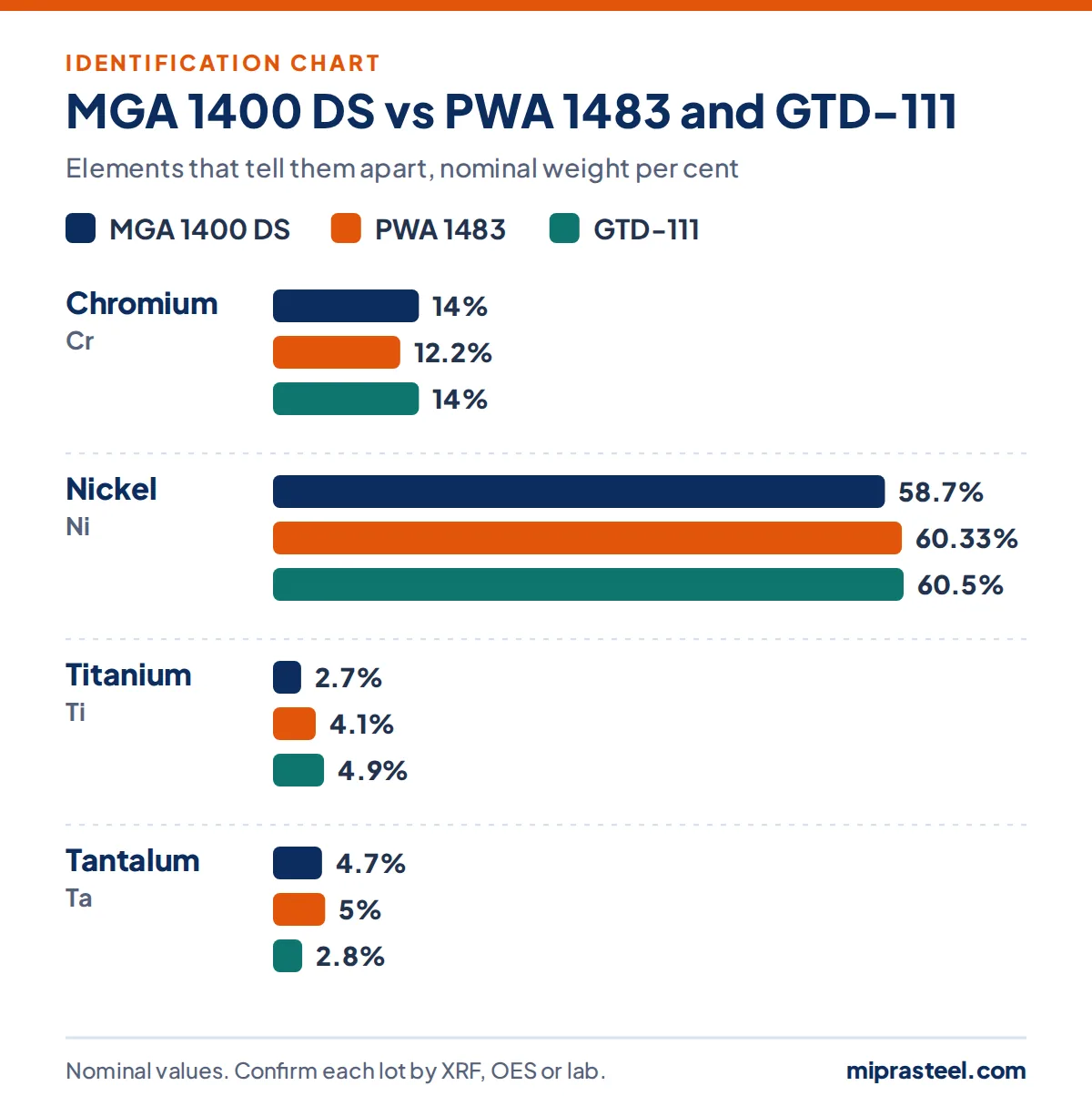
Nominal values for MGA 1400 DS against its closest grades on this site.
Preparing MGA 1400 DS Scrap for Sale
- Keep DS blades and equiaxed MGA 1400 blades in different packages, labelled.
- Photograph the grain pattern on a few blades from each package.
- Grind one test spot per blade type and note hafnium, tantalum and titanium.
- Remove seal pins, shims and lock plates from the roots.
- Record turbine model, row and part numbers on the packing list.
MGA 1400 DS Scrap Price per Kg: What Decides It
MGA 1400 DS scrap price per kg is set by its contained metals and by how firmly the DS description can be supported.
- Tantalum near 4.7% and tungsten near 4.3%, with 10% cobalt and a nickel base.
- Hafnium content, which adds value for a melter of hafnium-bearing alloys and is a drawback for one who must keep it out.
- Evidence for the DS description: grain structure, hafnium reading and records agreeing.
- Clear separation from conventionally cast MGA 1400 and from GTD-111 removed in similar outages.
- Coating, braze and attached root hardware on service blades.
- Set completeness and condition, since whole blades are easier to verify than broken pieces.
Tantalum, cobalt and nickel are priced independently, so offers are dated. Background on revert value is in superalloy revert recycling.
MGA 1400 DS Scrap Import and Export
Importing MGA 1400 DS Scrap into India
Indian imports of MGA 1400 DS come mainly from overhaul and trading channels serving Mitsubishi G and F-class fleets in East Asia and the Gulf. Ask the seller to label DS and equiaxed blades separately and to send photographs of the grain pattern before loading. Imported metal scrap is inspected at origin, and the shipment travels with a pre-shipment inspection certificate, invoice, packing list and bill of lading, usually to Nhava Sheva, Mundra or Chennai. See our nickel alloy scrap import and buying page.
Exporting MGA 1400 DS Scrap from India
Exported MGA 1400 DS lots carry the grade and casting route on the invoice and packing list, are weighed, and are packed in crates or drums so airfoils are not crushed. They ship in containers from Nhava Sheva or Mundra. Buyers are DS foundries and revert traders, many in East Asia, and our offices in South Korea and Dubai keep us near the Korean, Japanese and Gulf trade. See alloy scrap export paperwork.
Customs heading: 7503.00 (nickel waste and scrap). The HS code is the international tariff heading the scrap is declared under; national tariff lines add further digits, so confirm the full line with your customs broker.
Other MGA Scrap Grades
Related Reading
MGA 1400 DS Scrap FAQ
How much hafnium is in MGA 1400 DS?
The figure has not been published. Mitsubishi's published work describes MGA 1400 DS as MGA 1400 developed with a hafnium addition for directional solidification, without giving the level. A reading can confirm hafnium is present, but no one should quote a target figure.
Is MGA 1400 DS worth more than MGA 1400?
It depends on the buyer. The base metals are the same, so the difference comes from hafnium and from how well the DS description is supported. A melter producing hafnium-bearing DS alloys may value it more; one who must keep hafnium out may not.
How can I see whether a blade is directionally solidified?
Look at the airfoil after a light etch or grit blast. DS blades show long, parallel grains running from root to tip. Conventionally cast blades show many small grains in random directions. A single-crystal blade shows no grain boundaries at all.
Which turbines use MGA 1400 DS blades?
Mitsubishi's published work states that MGA 1400 DS has been applied in the M501G and in up-rated M501F and M701F turbines. Other units may use it as well, so blade part numbers are the reliable way to confirm a particular lot.
Can MGA 1400 DS and GTD-111 DS be packed together?
They should not be. Both are DS blade alloys with 14% chromium, but GTD-111 carries more titanium and less tantalum. Mixing them leaves a melter with a charge matching neither, which lowers what the lot can fetch.
What HS heading is used for MGA 1400 DS scrap?
Because it is a nickel-base superalloy, it is typically declared under HS 7503.00 for nickel waste and scrap. Each country adds its own subheading, so the complete code should be checked with a customs broker.
What should I send Mipra Steel to offer MGA 1400 DS blades?
The blade count, weight, turbine model and row, coating condition, location, and photographs that show the grain pattern and root markings. Any reading showing hafnium helps. Partial rows and mixed-condition sets can be discussed.
What is MGA 1400 DS made of?
Nominally 58.7% nickel, 14% chromium, 10% cobalt, 4.7% tantalum, 4.3% tungsten, 4% aluminium, 2.7% titanium, 1.5% molybdenum, 0.1% carbon. Specification ranges vary by product form and standard.
Published by Mipra Steel, Khetwadi, Mumbai · Updated