MAR-M 509 Scrap Buyer, Importer and Exporter in India
Mipra Steel buys and sells MAR-M 509 scrap from Mumbai, alongside other cobalt alloy grades, and keeps it described apart from nickel-base superalloys.
Sell MAR-M 509 Scrap
To sell MAR-M 509 revert or vane segments, send the weight, the form (revert, rejected castings, ex-service vanes or swarf), the location and clear photographs. A reading that shows cobalt, tantalum and zirconium is very helpful, because it tells a buyer at once whether the lot is 509 or ECY-768. Note any coatings or repairs on ex-service vanes.
Buy MAR-M 509 Scrap
Cobalt alloy producers and vane foundries sourcing MAR-M 509 revert can send us the quantity, form, acceptable zirconium range, destination and timing. If your melt can take either 509 or ECY-768, say so, as that widens the lots available. Each lot is described by grade and supporting analysis.
Is MAR-M 509 a Nickel Alloy or a Cobalt Alloy?
Cobalt. The MAR-M name puts it next to MAR-M 246 and MAR-M 247 in most price lists, and that causes real mistakes in the scrap trade. Those two are nickel superalloys strengthened by gamma prime. MAR-M 509 has cobalt as its base metal and gets its high-temperature strength from carbides: the 0.6% carbon combines with tantalum, zirconium, titanium and chromium to form hard particles that pin the structure in place. It has no gamma prime phase to speak of.
That design suits parts that sit still in hot gas rather than spin. Nozzle guide vanes and other static hot-section castings in aero and industrial gas turbines are its home, where resistance to oxidation in hot gas matters more than the very high creep strength a rotating blade needs. It is also produced as powder for additive manufacturing.
For whoever melts it again, the point is the cobalt. A tonne of MAR-M 509 contains around 550 kg of cobalt plus 70 kg of tungsten and 35 kg of tantalum. Put that same tonne into a nickel superalloy lot and most of its value disappears, because a nickel melt rarely wants that much cobalt and chromium. Kept apart and described correctly, it goes to producers of cobalt alloys and back to vane foundries. Our cobalt alloy scrap page covers the wider family.
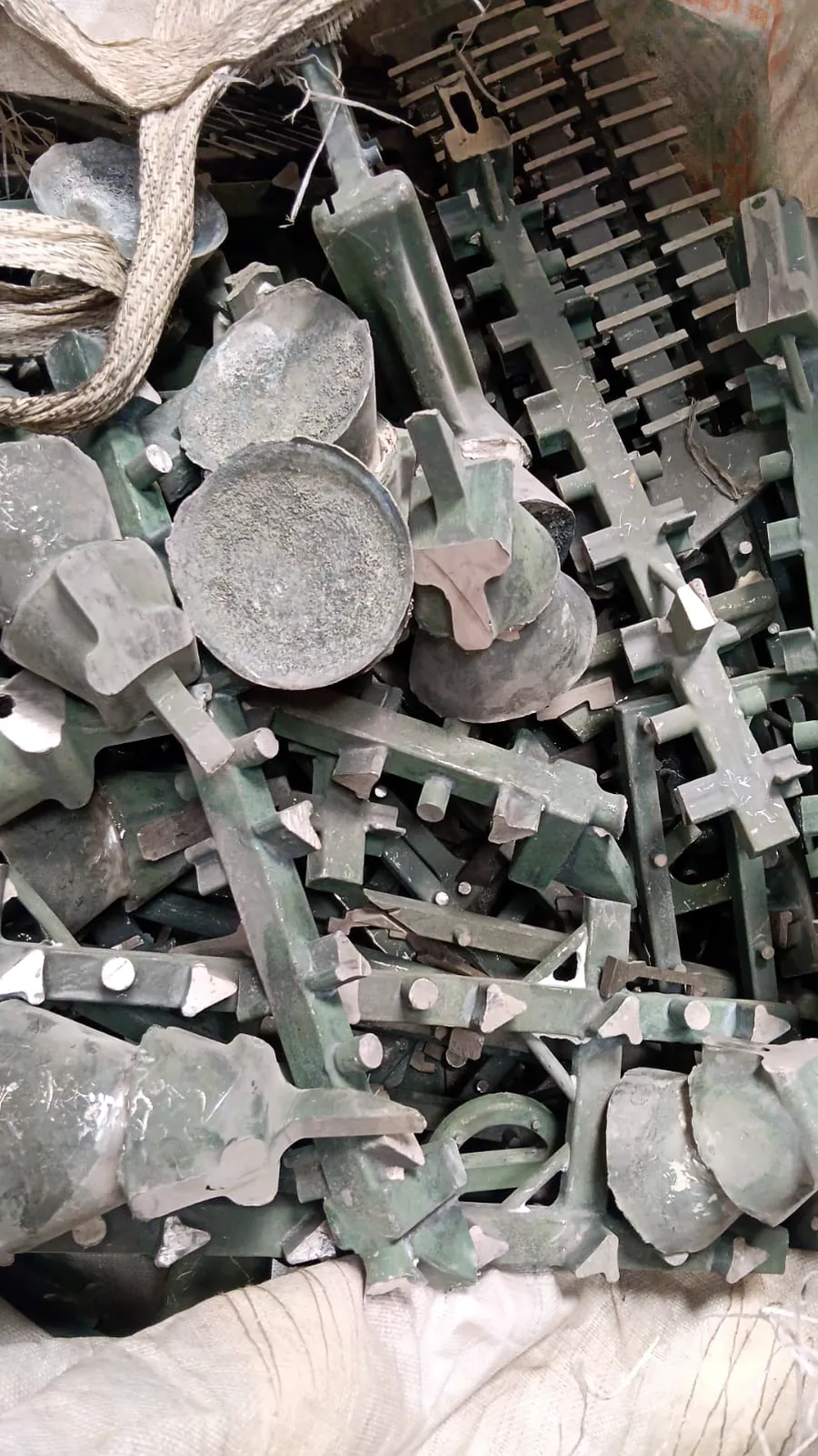
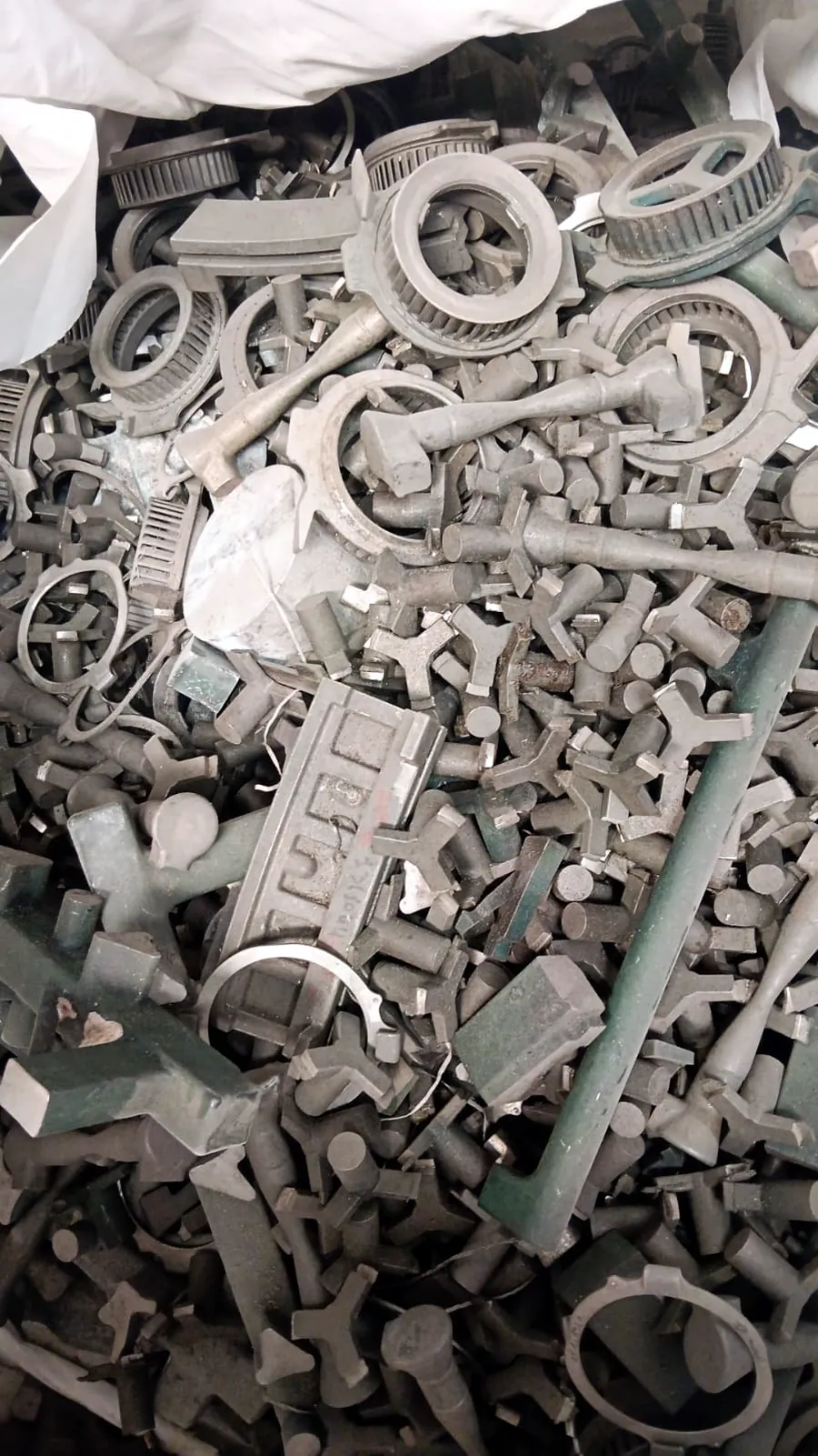
The lot photos on this page show real MAR-M 509 revert: gating trees, pour cups, runners and rings left over after vane castings were cut free.
MAR-M 509 belongs to the MAR-M family, part of superalloy scrap.
Sources of MAR-M 509 Scrap
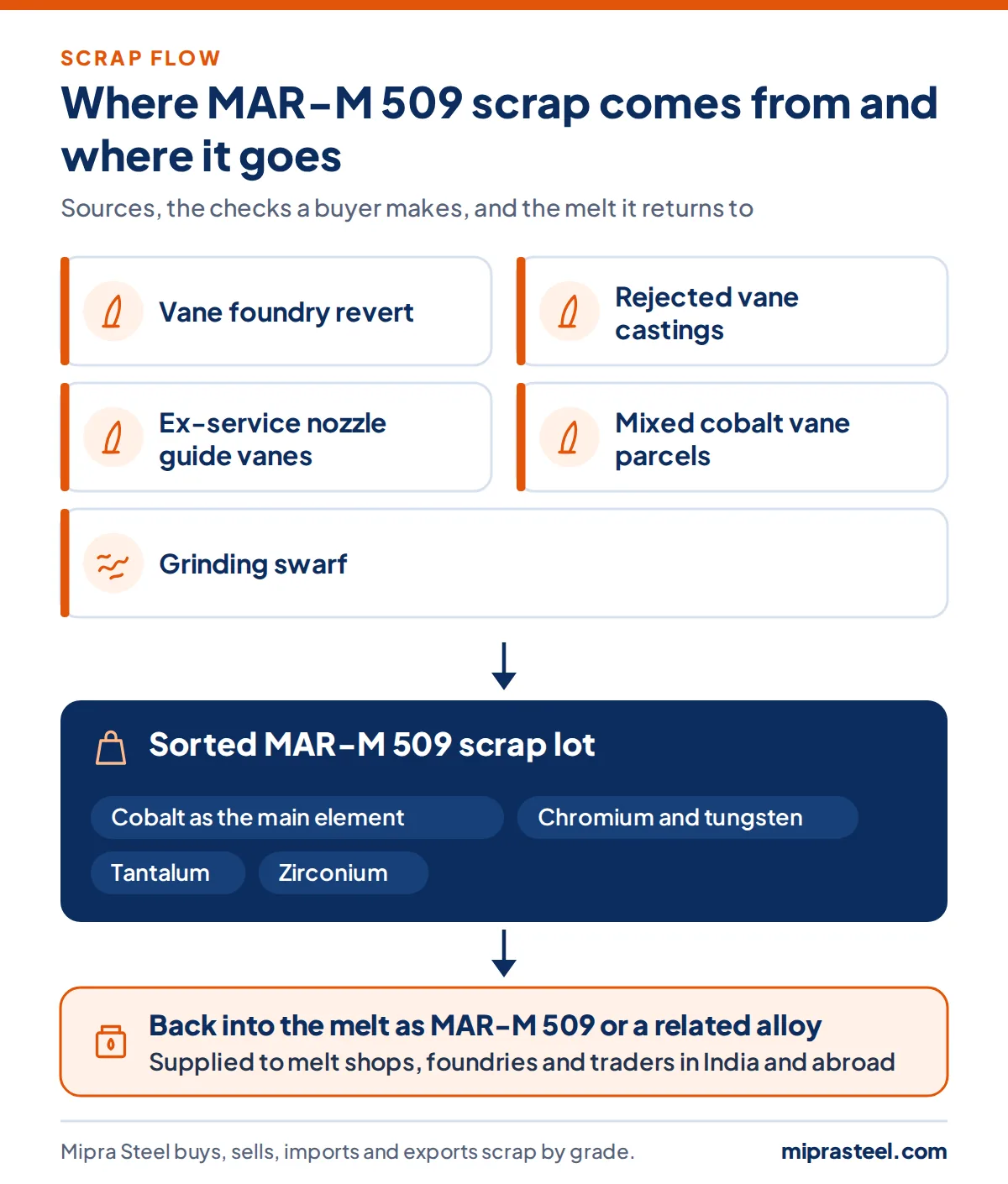
MAR-M 509 scrap comes from the two ends of a vane's life: the foundry that casts it and the overhaul shop that removes it.
Vane Foundry Revert
Gating systems, runners, risers, pour cups and rings from investment-cast vane segments. Heavy, clean and easy to keep single-grade.
Rejected Vane Castings
Segments that failed dimensional or radiographic inspection. Correct chemistry, often with shell residue in passages.
Ex-Service Nozzle Guide Vanes
Segments removed at engine or turbine overhaul, often after weld repair and recoating. See power generation scrap and aerospace scrap.
Mixed Cobalt Vane Parcels
Overhaul parcels where 509 segments sit with ECY-768 or X-40 parts from other turbine stages. Every piece needs a reading before the parcel can carry one name.
Grinding Swarf
From finishing vane platforms and airfoils. A separate, lower-value material that must stay out of solid lots.
MAR-M 509 Scrap Specification Chart
| Grade | MAR-M 509 |
|---|---|
| UNS | Not assigned (proprietary MAR-M trade-name alloy) |
| W.Nr. / EN | Not assigned |
| Identified by | Customer or OEM specification, heat certificate and analysis |
| Also known as | Mar-M509, MM509, MAR M509 |
| Alloy type | Cast cobalt-base superalloy |
| Density | 8.86 g/cm³ (0.32 lb/in³) |
| Magnetic | Not a reliable test for this grade; confirm by XRF. |
| HS code (customs heading) | 8105.30 (cobalt waste and scrap) |
MAR-M 509 Chemical Composition
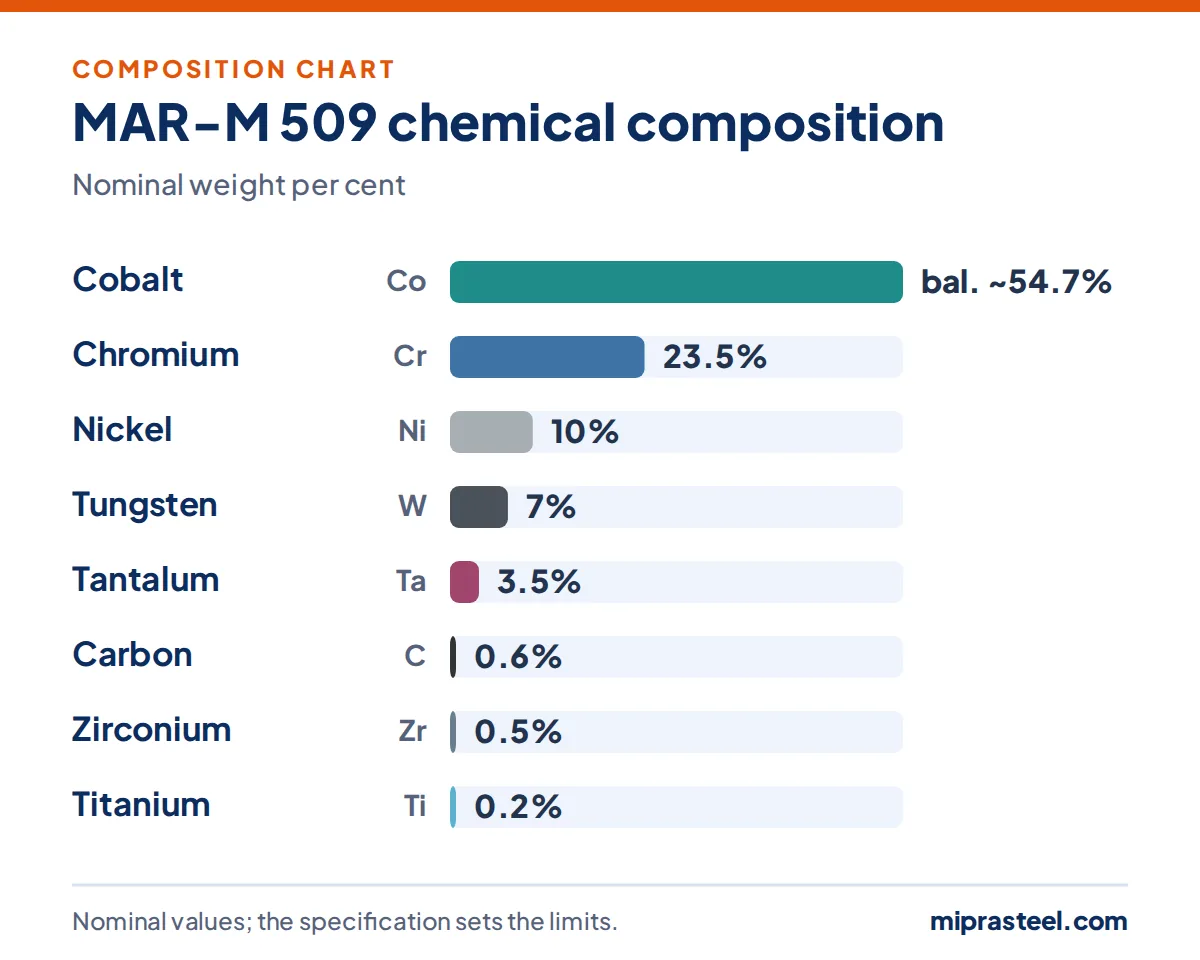
Nominal composition in weight per cent, used to describe and identify the grade. The governing specification sets the limits for each product.
| Element | Symbol | Nominal wt% | |
|---|---|---|---|
| Cobalt | Co | Balance (about 54.7) | |
| Chromium | Cr | 23.5 | |
| Nickel | Ni | 10 | |
| Tungsten | W | 7 | |
| Tantalum | Ta | 3.5 | |
| Carbon | C | 0.6 | |
| Zirconium | Zr | 0.5 | |
| Titanium | Ti | 0.2 |
MAR-M 509 Equivalent Grades and Other Names
| Designation | Value |
|---|---|
| Trade name | MAR-M 509 |
| UNS | Not assigned (proprietary MAR-M trade-name alloy) |
| W.Nr. / EN | Not assigned |
| Other names in the trade | Mar-M509, MM509, MAR M509 |
Look up any designation in the grade name converter or the equivalent grade chart.
MAR-M 509 Standards and Specifications
Supplied to AMS and OEM specifications.
MAR-M 509 Applications
- Gas turbine nozzle guide vanes
- Static hot-section castings in aero and industrial gas turbines
Source industries: aerospace, power generation.
How MAR-M 509 Scrap Is Identified
The cobalt reading settles the family in seconds. Separating 509 from other cobalt vane alloys takes more care.
| Check | What it shows for MAR-M 509 |
|---|---|
| Cobalt as the main element | Around 55% cobalt with only about 10% nickel. If nickel reads higher than cobalt, the piece is not MAR-M 509. |
| Chromium and tungsten | About 23.5% chromium and 7% tungsten are expected. |
| Tantalum | Roughly 3.5%. X-40, another cobalt vane alloy, carries similar chromium, nickel and tungsten but no tantalum. |
| Zirconium | About 0.5% is normal for 509. A reading at or below 0.05% points to ECY-768, and low-level zirconium needs OES or laboratory work to confirm. See choosing XRF, OES or lab analysis. |
| Molybdenum | Should be essentially absent. Several per cent molybdenum on a cobalt base means a cobalt-chromium-molybdenum alloy such as F75. |
| Magnet | Not reliable for this grade. Use an analyser. |
Grades Most Often Confused with MAR-M 509
- ECY-768: nearly the same cobalt, chromium, nickel, tungsten and tantalum, but zirconium at 0.05% or less against about 0.5%.
- F75 Co-Cr-Mo: cobalt-base too, but about 28% chromium and 6% molybdenum, with nickel and tungsten kept very low.
- MAR-M 247: shares the MAR-M name only: nickel-base at about 60% nickel, with 10% cobalt, 1.5% hafnium and 5.5% aluminium.

Nominal values for MAR-M 509 against its closest grades on this site.
Preparing MAR-M 509 Scrap for Sale
- Never put MAR-M 509 in the same bag as MAR-M 246, MAR-M 247 or any nickel superalloy.
- Separate 509 from ECY-768 by zirconium analysis and label each lot.
- Break loose ceramic shell off gating and pour cups.
- Keep ex-service vanes apart from foundry revert.
- Store grinding swarf dry, in closed drums, away from solids.
MAR-M 509 Scrap Price per Kg: What Decides It
The MAR-M 509 scrap price per kg follows cobalt first. Tungsten, tantalum and nickel add to it, and the lot's condition decides how much of that a buyer can actually pay.
- Cobalt content near 55%, priced on the cobalt market, which moves differently from nickel.
- Tungsten (about 7%) and tantalum (about 3.5%), both recovered when the lot goes back into a cobalt alloy melt.
- Separation from nickel-base material. A single-grade 509 lot is a cobalt alloy input; mixed with MAR-M 247 or René revert, it is a problem for both.
- Revert versus ex-service vanes: revert is clean, while overhaul vanes may carry coatings, braze or weld repairs that a buyer allows for.
- Confirmed zirconium. Buyers who need ECY-768 or 509 specifically pay for the analysis that tells them which they are getting.
- Shell residue, attachments and lot size, which all change the yield and handling cost.
Since cobalt and tantalum prices can move sharply, every offer is valid for a short period only. More on pricing logic in how alloy scrap is valued.
MAR-M 509 Scrap Import and Export
Importing MAR-M 509 Scrap into India
MAR-M 509 reaches India from gas turbine overhaul activity and vane foundries abroad, often through traders in the Gulf. Cobalt-base alloy scrap is typically declared under HS 8105.30, cobalt waste and scrap, not under the nickel heading; confirm the national line with your customs broker. Imported metal scrap is inspected before shipment and accompanied by a pre-shipment inspection certificate, commercial invoice, packing list and bill of lading. Describing the goods as MAR-M 509 cobalt-base alloy scrap, with readings, avoids a mismatch at the port. See importing alloy scrap into India.
Exporting MAR-M 509 Scrap from India
Exported 509 is invoiced as cobalt-base alloy scrap with the grade named, weighed, and shipped in bags or drums inside containers from Nhava Sheva or Mundra. Each lot's analysis travels with it. Our UAE office sits close to gas turbine overhaul activity in the Gulf, including Saudi Arabia, and our South Korea office serves East Asian cobalt alloy users. See alloy scrap export paperwork.
Customs heading: 8105.30 (cobalt waste and scrap). The HS code is the international tariff heading the scrap is declared under; national tariff lines add further digits, so confirm the full line with your customs broker.
Other MAR-M Scrap Grades
Related Reading
MAR-M 509 Scrap FAQ
Why is MAR-M 509 called MAR-M if it is a cobalt alloy?
MAR-M is a family name for cast alloys, not a statement about the base metal. MAR-M 246 and MAR-M 247 in the same family are nickel-base, while 509 is cobalt-base with about 55% cobalt. In scrap, the base metal matters far more than the family name.
Can MAR-M 509 be sold as ECY-768?
Only if the analysis supports it, and usually it does not. The two are almost identical except zirconium: about 0.5% in MAR-M 509 against 0.05% or less in ECY-768. Some buyers accept either for their melt and list them together, but the lot should still be described by what the analysis shows.
What gives MAR-M 509 its strength at high temperature?
Carbides. About 0.6% carbon forms carbides with tantalum, zirconium, titanium and chromium in the cobalt matrix. That is a different mechanism from the gamma prime strengthening of nickel superalloys like MAR-M 247, and it suits static parts such as nozzle guide vanes.
Is MAR-M 509 scrap worth more than nickel superalloy scrap?
Often, yes, because cobalt is its main element. The comparison depends on cobalt, nickel, tungsten and tantalum prices on the day, and on how clean and well documented each lot is. A mixed lot of 509 with nickel alloys is usually worth less than either kept separate.
Which customs code covers MAR-M 509 scrap?
Being cobalt-base, MAR-M 509 scrap is typically classified under HS 8105.30, cobalt waste and scrap, rather than 7503.00 for nickel. Your customs broker should confirm the full national line for the destination.
Does Mipra Steel buy used MAR-M 509 nozzle guide vanes?
Yes, Mipra Steel buys and sells ex-service 509 vane segments as well as foundry revert. Send photographs, piece count, weight, location and any readings or part records. We review incoming enquiries and respond with relevant next steps.
What is MAR-M 509 made of?
Nominally 54.7% cobalt, 23.5% chromium, 10% nickel, 7% tungsten, 3.5% tantalum, 0.6% carbon, 0.5% zirconium, 0.2% titanium. Specification ranges vary by product form and standard.
Published by Mipra Steel, Khetwadi, Mumbai · Updated