GTD-111 Scrap Buyer, Importer and Exporter in India
Mipra Steel trades GTD-111 by the set and by the grade, keeping equiaxed, DS and documented low Zr lots apart from each other and from the nozzle alloys that leave the turbine at the same time.
Sell GTD-111 Scrap
Have GTD-111 buckets from an inspection or overhaul? Tell us the stage, the number of buckets, the total weight, whether they are coated or stripped, and whether they are equiaxed or DS if known. Photographs of the dovetail roots and markings, plus any readings or certificates showing zirconium, help a lot. We review incoming enquiries and respond with relevant next steps.
Buy GTD-111 Scrap
Foundries and melt shops that use GTD-111 revert or buckets can tell us the quantity, the form (buckets, revert, pieces), whether they need equiaxed, DS or documented low Zr material, and their destination port. Each lot is described by grade and form, and we can discuss which analyses and origin records travel with it.
What Is GTD-111, and Where Does Its Scrap Come from?
GTD-111 is GE's creep-resistant bucket alloy for land-based gas turbines. Power stations running heavy-duty units replace front-stage buckets on a schedule, at hot-gas-path inspections and major overhauls, so GTD-111 scrap comes out in full sets rather than one piece at a time. A single stage can mean dozens of large buckets, each with its dovetail root, platform, airfoil and often a tip shroud.
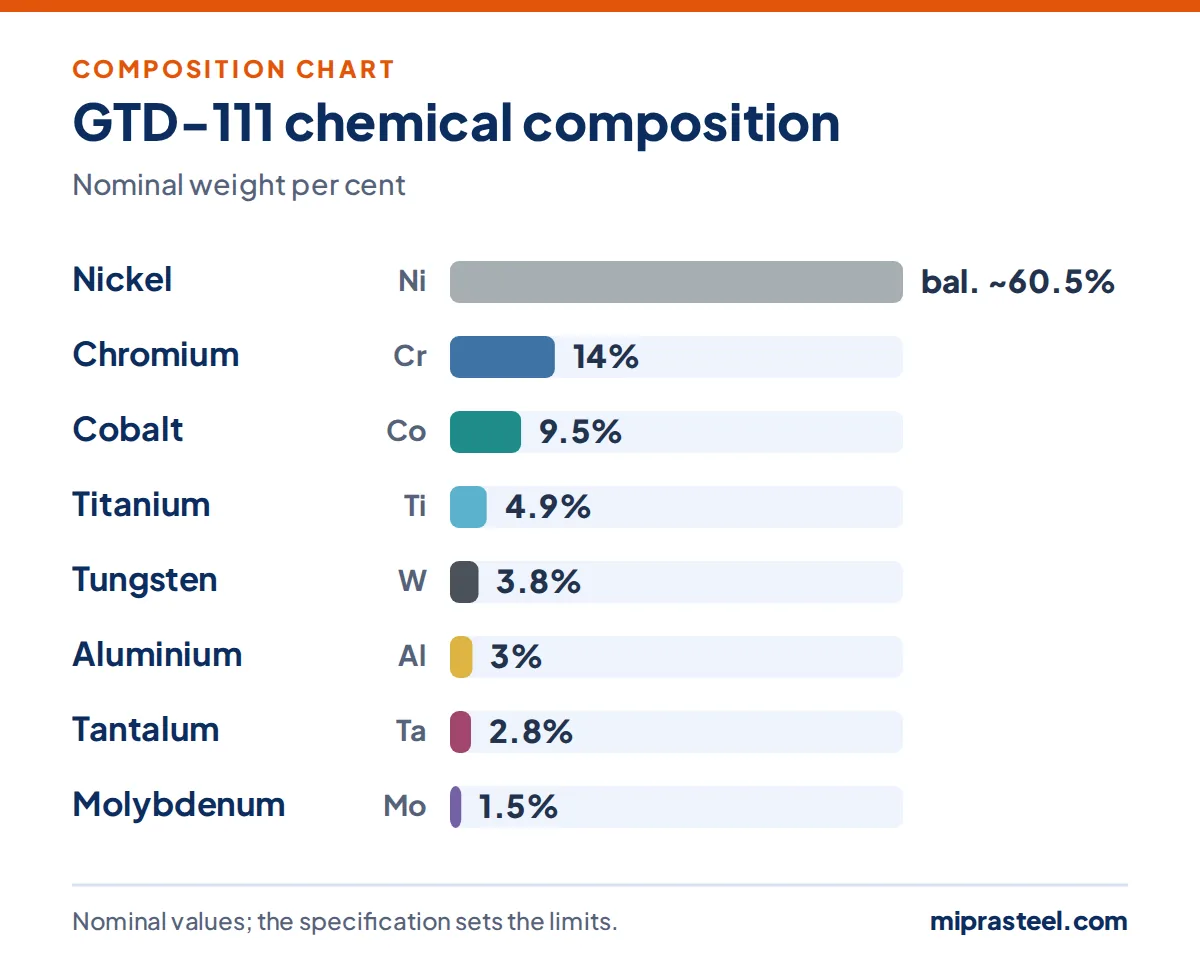
The chemistry is a high-titanium gamma prime alloy: about 60% nickel, 14% chromium, 9.5% cobalt, 4.9% titanium, 3.8% tungsten, 3% aluminium, 2.8% tantalum and 1.5% molybdenum. Its chemistry sits very close to René 80, and the two look alike on paper. The 2.8% tantalum is the quickest way to tell them apart, and it is also part of what a melt shop pays for.
GTD-111 is cast in two ways. Equiaxed buckets have many small grains. Directionally solidified (DS) buckets have long columnar grains running along the airfoil, which give better creep life in the direction of centrifugal load. The nominal alloy is the same, but buyers like to know which casting route they are getting, and trade lists show "GTD-111 DS" for that reason.
Then there is "GTD-111 low Zr". No published specification defines it. It is a trade description for GTD-111 lots kept low in zirconium, documented by analysis, for melts that need zirconium held down. Zirconium and boron at grain boundaries help an equiaxed casting, but too much contributes to hot cracking and embrittlement, so some melters set tight zirconium limits on their revert. A lot earns the low Zr description from its readings or certificates, not from its label. See GTD alloy scrap for the family.
GTD-111 belongs to the GTD family, part of superalloy scrap.
Where GTD-111 Scrap Is Generated
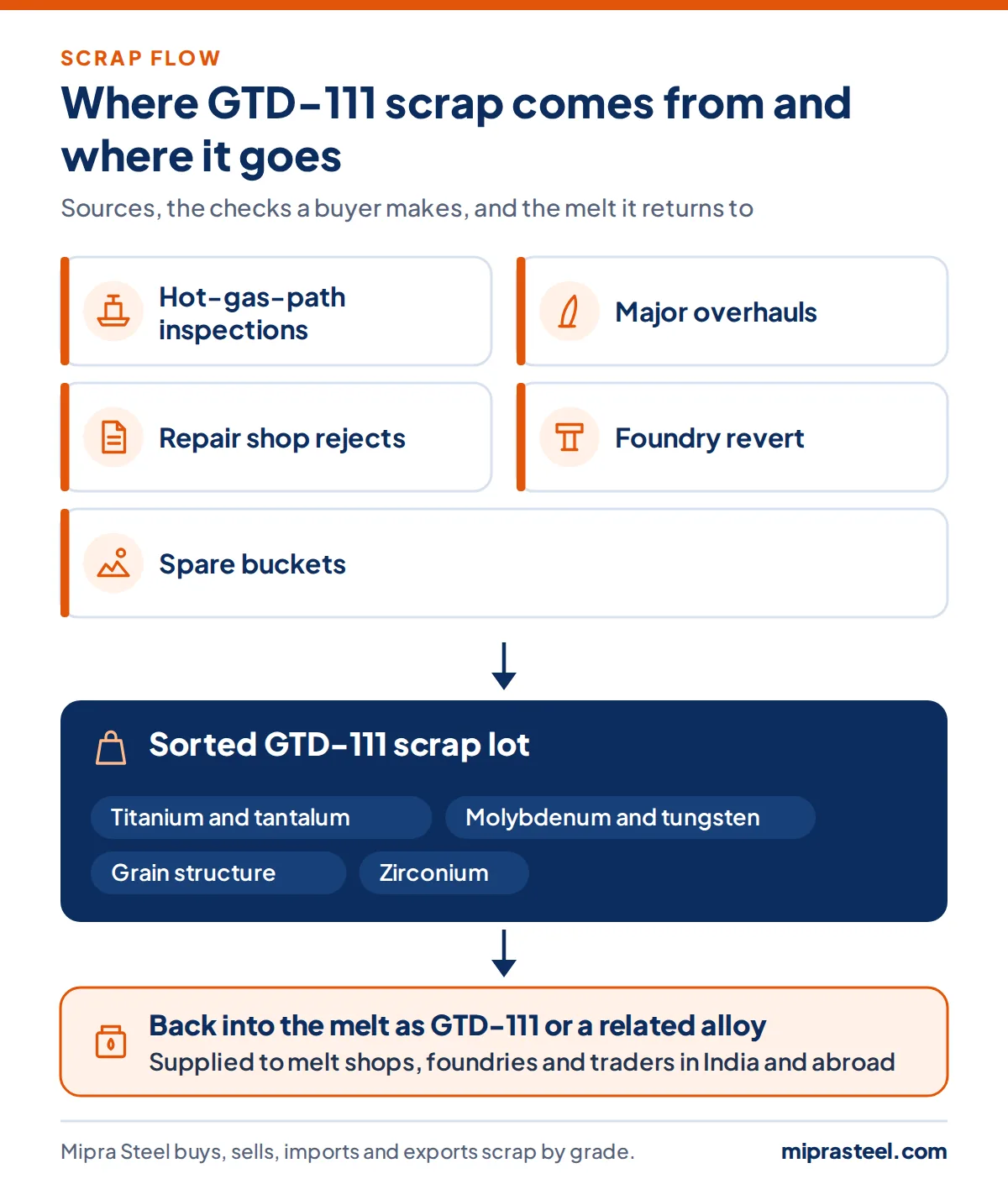
Most GTD-111 is released by the maintenance cycle of heavy-duty gas turbines, with foundry revert making up the rest.
Hot-Gas-Path Inspections
Front-stage bucket sets replaced when they reach their service life or show creep, oxidation or tip damage. See power generation scrap.
Major Overhauls
Full rotor rebuilds release several stages at once, often alongside nozzle segments in other alloys that must be kept apart.
Repair Shop Rejects
Buckets found beyond repair after coating removal and inspection. These often arrive stripped, with repair records.
Foundry Revert
Gates, risers, sprues and rejected castings from equiaxed and DS bucket production, traceable to heats.
Spare Buckets
New or unused buckets written off when a unit is retired or a design is superseded, usually with part numbers intact.
GTD-111 Scrap Specification Chart
| Grade | GTD-111 |
|---|---|
| UNS | Not assigned (proprietary GE alloy) |
| W.Nr. / EN | Not assigned |
| Identified by | GE Power specification, part records and analysis |
| Also known as | GTD 111, GTD-111 low Zr, GTD-111 DS |
| Alloy type | Cast γ′ superalloy |
| Density | Not published |
| Magnetic | Non-magnetic. |
| HS code (customs heading) | 7503.00 (nickel waste and scrap) |
GTD-111 Chemical Composition
Nominal composition in weight per cent, used to describe and identify the grade. The governing specification sets the limits for each product.
| Element | Symbol | Nominal wt% | |
|---|---|---|---|
| Nickel | Ni | Balance (about 60.5) | |
| Chromium | Cr | 14 | |
| Cobalt | Co | 9.5 | |
| Titanium | Ti | 4.9 | |
| Tungsten | W | 3.8 | |
| Aluminium (aluminum) | Al | 3 | |
| Tantalum | Ta | 2.8 | |
| Molybdenum | Mo | 1.5 |
GTD-111 Equivalent Grades and Other Names
| Designation | Value |
|---|---|
| Trade name | GTD-111 |
| UNS | Not assigned (proprietary GE alloy) |
| W.Nr. / EN | Not assigned |
| Other names in the trade | GTD 111, GTD-111 low Zr, GTD-111 DS |
Look up any designation in the grade name converter or the equivalent grade chart.
GTD-111 Standards and Specifications
Supplied to turbine OEM specifications.
GTD-111 Applications
- First- and second-stage turbine buckets in heavy-duty gas turbines
Source industries: power generation.
How GTD-111 Scrap Is Identified
GTD-111 is identified by its titanium-tantalum balance on XRF, by grain structure, and by where it came from. The zirconium question needs more than a quick handheld reading.
| Check | What it shows for GTD-111 |
|---|---|
| Titanium and tantalum | About 4.9% titanium with 2.8% tantalum. René 80 has similar titanium but no tantalum. |
| Molybdenum and tungsten | About 1.5% molybdenum and 3.8% tungsten. René 80 reads about 4% of each. |
| Grain structure | Equiaxed buckets show small grains after etching or grit blasting; DS buckets show long columnar grains along the airfoil. Describe the two separately. |
| Zirconium | Only matters for low Zr lots. It needs a clean ground surface and an instrument set up for low-level zirconium, or OES or lab analysis. See XRF vs OES vs lab. |
| Coating | Ex-service buckets carry protective coatings. Read the root or a ground spot, not the coated airfoil. |
| Turbine and stage records | The stage and the turbine the buckets came from, with part numbers, tie a set to GTD-111 more firmly than any single reading. |
Grades Most Often Confused with GTD-111
- René 80: about 5% titanium, 4% molybdenum and 4% tungsten, with no tantalum.
- MGA 1400: same 14% chromium, but about 2.7% titanium, 4.7% tantalum and 4% aluminium.
- GTD-222: the nozzle alloy often removed in the same overhaul: about 22.5% chromium and 19% cobalt.
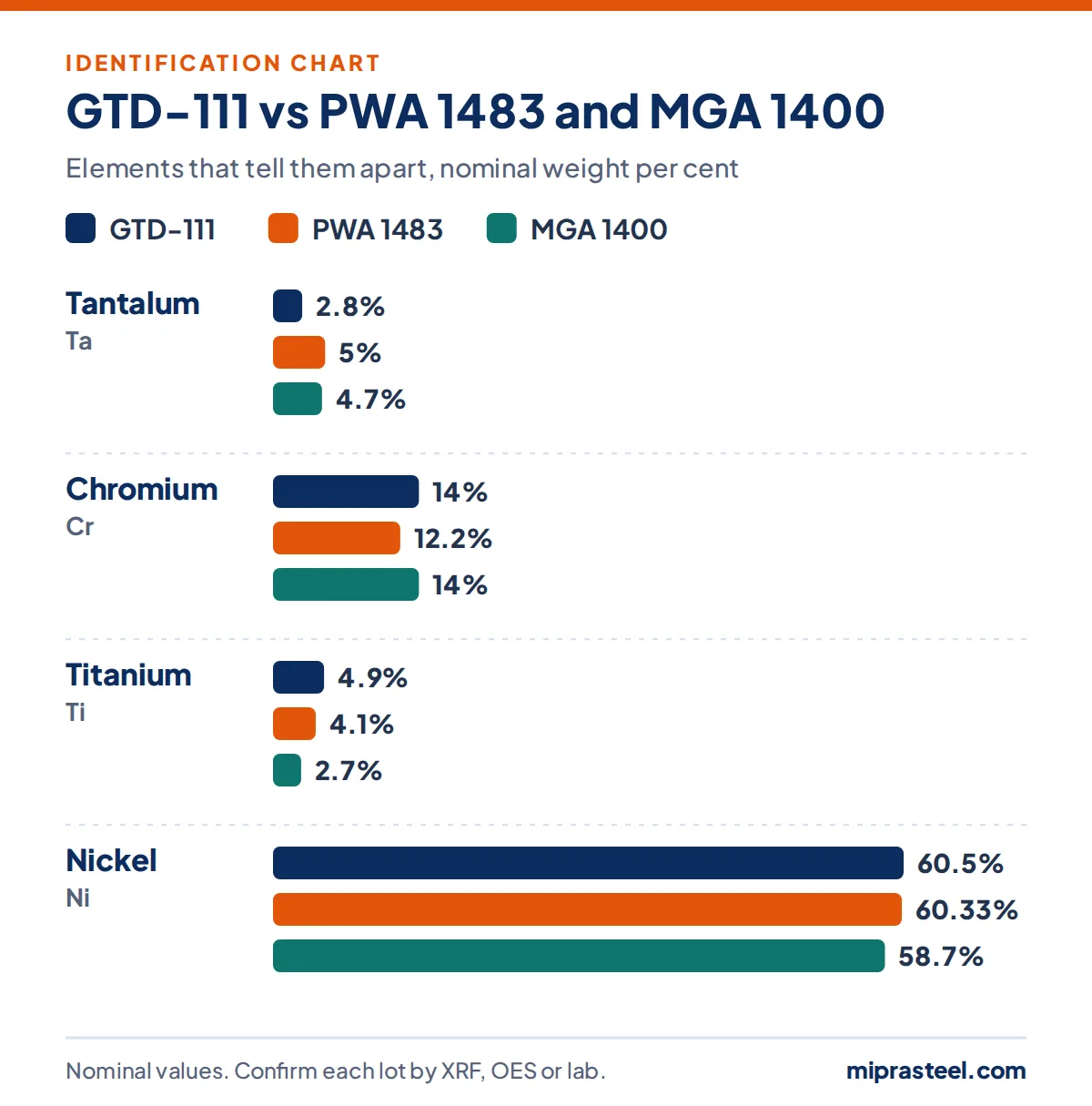
Nominal values for GTD-111 against its closest grades on this site.
Preparing GTD-111 Scrap for Sale
- Keep buckets and nozzle segments from the same outage in separate containers.
- Separate equiaxed and DS buckets, and label each.
- Keep any lot offered as low Zr apart, with its analysis attached.
- Remove seal pins, damper pins and shims from dovetails.
- Record the stage and piece count on each container.
GTD-111 Scrap Price per Kg: What Decides It
A GTD-111 scrap price per kg starts from nickel and cobalt and adds credit for tantalum and tungsten. The bigger swings come from how the lot is described.
- Contained nickel and cobalt, the base of every offer.
- Tantalum (about 2.8%) and tungsten (about 3.8%), which give GTD-111 an edge over tantalum-free bucket alloys.
- Separation from the nozzle alloys removed in the same outage: one GTD-222 or IN-939 segment in a bucket lot changes the chromium and cobalt a melter receives.
- Low Zr status, where documented by analysis, which suits melts that need zirconium kept down.
- Equiaxed or DS, declared and kept apart.
- Coating condition and attachments: stripped buckets without seal pins, damper pins or shims need less allowance.
For background on pricing, read what moves nickel alloy scrap prices.
GTD-111 Scrap Import and Export
Importing GTD-111 Scrap into India
Heavy-duty gas turbine fleets abroad release GTD-111 sets at their outage cycles, and Indian buyers import them through traders and directly from overhaul shops. Consignments come with a pre-shipment inspection certificate, commercial invoice, packing list and bill of lading, through Nhava Sheva, Mundra or Chennai. When a lot is sold as low Zr, the analysis that supports it should travel with the shipping papers. See importing nickel alloy scrap into India.
Exporting GTD-111 Scrap from India
Indian power stations and repair shops also release GTD-111 buckets after outages. Exported lots are described by grade and casting type on the invoice and packing list, weighed, and shipped in drums, crates or as loose buckets in containers from Nhava Sheva or Mundra. Our offices in South Korea and the UAE sit close to turbine operators, traders and melt shops in East Asia and the Gulf, and we also serve Japan. See export documents.
Customs heading: 7503.00 (nickel waste and scrap). The HS code is the international tariff heading the scrap is declared under; national tariff lines add further digits, so confirm the full line with your customs broker.
Other GTD Scrap Grades
Related Reading
GTD-111 Scrap FAQ
What does "GTD-111 low Zr" mean?
It is a trade description, not a published grade. It refers to GTD-111 lots held low in zirconium and documented by analysis, kept for melts that need zirconium controlled. No fixed threshold is published, so the description rests on the readings or certificates that come with the lot.
Is GTD-111 the same as René 80?
No, though they are close. Both have about 14% chromium and 9.5% cobalt with high titanium. GTD-111 adds about 2.8% tantalum and carries about 1.5% molybdenum and 3.8% tungsten, while René 80 has no tantalum and about 4% each of molybdenum and tungsten.
Which turbine parts are made from GTD-111?
Mainly first- and second-stage buckets (rotating blades) in heavy-duty land-based gas turbines. Nozzles in the same machines are usually cast from other alloys such as GTD-222, which is why bucket and nozzle scrap from one outage should be kept apart.
Are DS GTD-111 buckets worth more than equiaxed ones?
The metal is the same alloy, so the base value is similar. DS buckets are described separately because a buyer wants to know what it is charging, and a clearly declared lot is easier to place than a mixed one. Say which you have when you enquire.
How is zirconium checked in a GTD-111 lot?
On a clean, ground surface with an instrument set up to read zirconium at low levels, or by OES or a laboratory. Coated or oxidised surfaces give misleading results. Buyers of low Zr lots normally want the analysis in writing.
Under which HS code is GTD-111 scrap shipped?
GTD-111 is nickel-base, so its scrap is typically classified under HS 7503.00, nickel waste and scrap. National tariff lines add digits; check the full line with your customs broker.
Does Mipra Steel buy full sets of gas turbine buckets?
Yes. Mipra Steel buys GTD-111 bucket sets from power plants, overhaul shops and traders, as well as part sets and revert. Send the stage, piece count, weight, coating condition and photographs.
Why is GTD-111 scrap kept separate from IN-939 and GTD-222?
Because those nozzle alloys carry about 22% chromium and 19% cobalt, against 14% and 9.5% in GTD-111. Mixing them gives a melter a chemistry neither alloy can use without correction, and the lot is then priced as mixed superalloy.
What is GTD-111 made of?
Nominally 60.5% nickel, 14% chromium, 9.5% cobalt, 4.9% titanium, 3.8% tungsten, 3% aluminium, 2.8% tantalum, 1.5% molybdenum. Specification ranges vary by product form and standard.
Published by Mipra Steel, Khetwadi, Mumbai · Updated