Titanium Grade 1 Scrap Buyer, Importer and Exporter in India
From Khetwadi, Mumbai, Mipra Steel trades Titanium Grade 1 scrap as its own grade, sourcing from exchanger servicers, clad-plate fabricators and plants, and supplying described lots to melters and traders.
Sell Titanium Grade 1 Scrap
Selling Grade 1 titanium? Tell us whether it is PHE plate, clad trim, lining sheet or anode material, the approximate weight and where it sits. Photographs of both faces, the exchanger nameplate or the mill certificate help most, since Grade 1 is proven on paper. We review incoming enquiries and respond with relevant next steps.
Buy Titanium Grade 1 Scrap
Melt shops and traders sourcing low-oxygen CP titanium can ask us for Grade 1 by form: stripped PHE plates, sheet offcuts or clad-free trim. Give the quantity, the oxygen ceiling your melt needs, the documents you expect and the destination port, and we can discuss what is available.
What Makes Titanium Grade 1 Scrap Different from Other CP Titanium?
Grade 1 is titanium with almost nothing else in it. Oxygen and iron are the only meaningful residuals, and both are kept lower than in any other commercially pure grade. Low oxygen makes the metal soft and very ductile: a minimum tensile strength of about 240 MPa, against roughly 345 MPa for Grade 2. Designers choose it when the sheet has to be pressed deep, bent tight or bonded to steel without cracking.
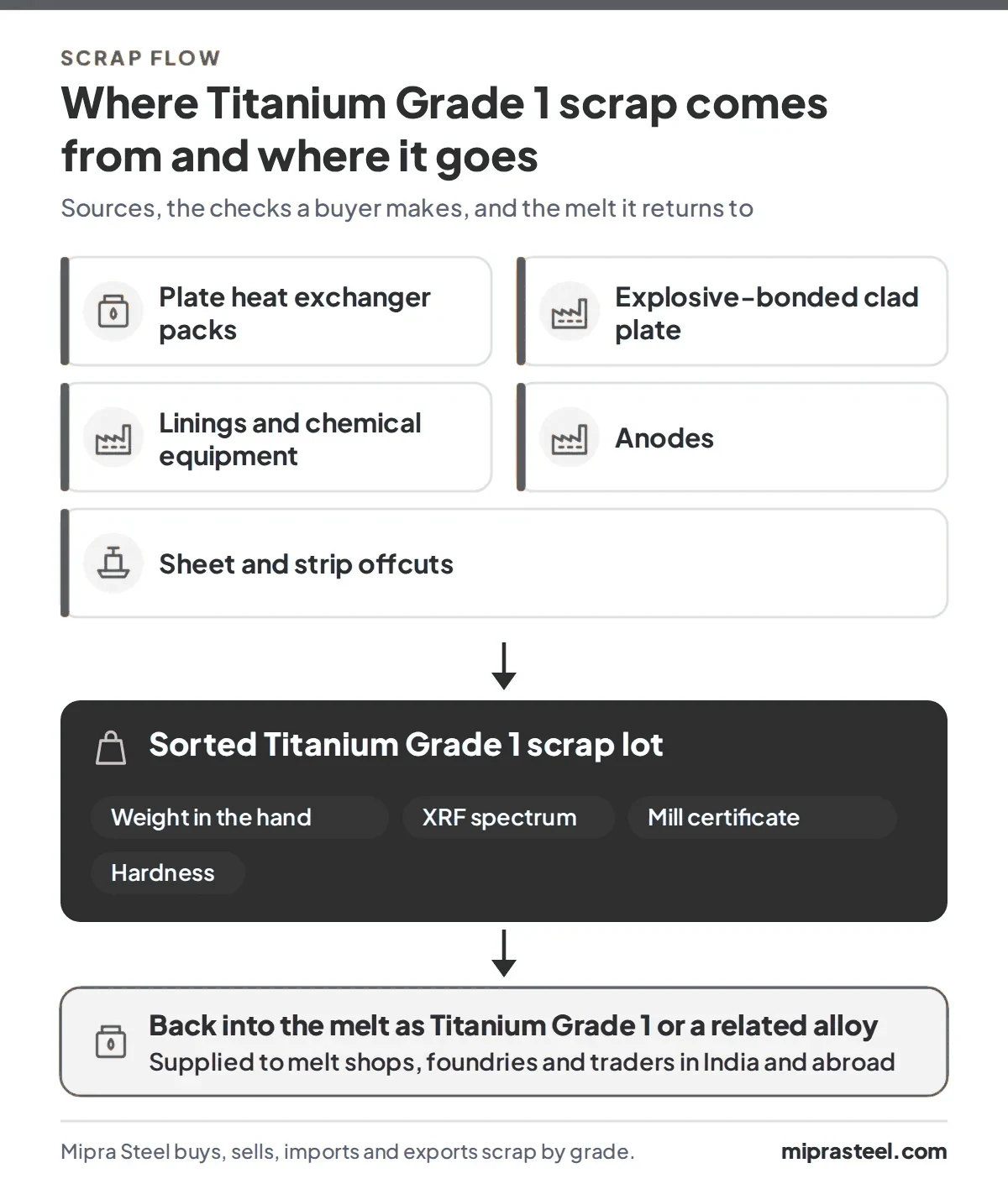
That is why the scrap has a recognisable shape. Thin corrugated plates from gasketed plate heat exchangers, trimmed edges of titanium-steel clad plate, sheet used to line tanks and ducts, and anode baskets or mesh make up most of what we see. Very little of it is machining swarf, because nobody chooses the softest grade for heavily machined parts.
For a melter, Grade 1 is the cleanest titanium feed there is. Its low oxygen gives a shop room to blend it with higher-oxygen material and still meet a specification. The reverse does not work. Grade 2 or unknown CP scrap fed into a Grade 1 heat can push oxygen over the 0.18% ceiling, and once oxygen is in titanium it cannot be refined out. Buyers therefore pay attention to proof that a lot really is Grade 1, not just CP titanium.
Titanium is a separate metal family with its own remelting route, so Grade 1 scrap should never travel in a nickel alloy lot. See titanium vs nickel alloy for why.
Titanium Grade 1 belongs to the Titanium family, part of exotic alloy scrap.
Where Grade 1 Titanium Scrap Is Generated
Grade 1 shows up wherever formability mattered more than strength in the original design.
Plate Heat Exchanger Packs
Seawater coolers on ships, in refineries and in power stations use pressed titanium plates. When a pack is replaced, the old plates come out with gaskets, glue and scale still on them. See marine scrap.
Explosive-Bonded Clad Plate
Fabricators of titanium-clad steel tubesheets and vessel heads trim and cut back the titanium layer. Offcuts of the cladding sheet before bonding are pure Grade 1; trim after bonding still has steel attached.
Linings and Chemical Equipment
Tank, duct and vessel linings in chlorine, bleach and chloride service are often Grade 1 sheet because it forms easily around corners. See chemical processing scrap.
Anodes
Retired anode substrates, baskets and mesh from electrochemical and cathodic protection work. Coated anodes are declared separately from bare metal.
Sheet and Strip Offcuts
Press-shop skeletons and coil ends from making the parts above, usually clean and traceable to a mill certificate.
Titanium Grade 1 Scrap Specification Chart
| Grade | Titanium Grade 1 |
|---|---|
| UNS | R50250 |
| W.Nr. / EN | 3.7025 |
| Also known as | CP titanium Grade 1 |
| Alloy type | Commercially pure titanium |
| Density | 4.51 g/cm³ (0.163 lb/in³) |
| Magnetic | Non-magnetic. |
| HS code (customs heading) | 8108.30 (titanium waste and scrap) |
Titanium Grade 1 Chemical Composition
Nominal composition in weight per cent, used to describe and identify the grade. The governing specification sets the limits for each product.
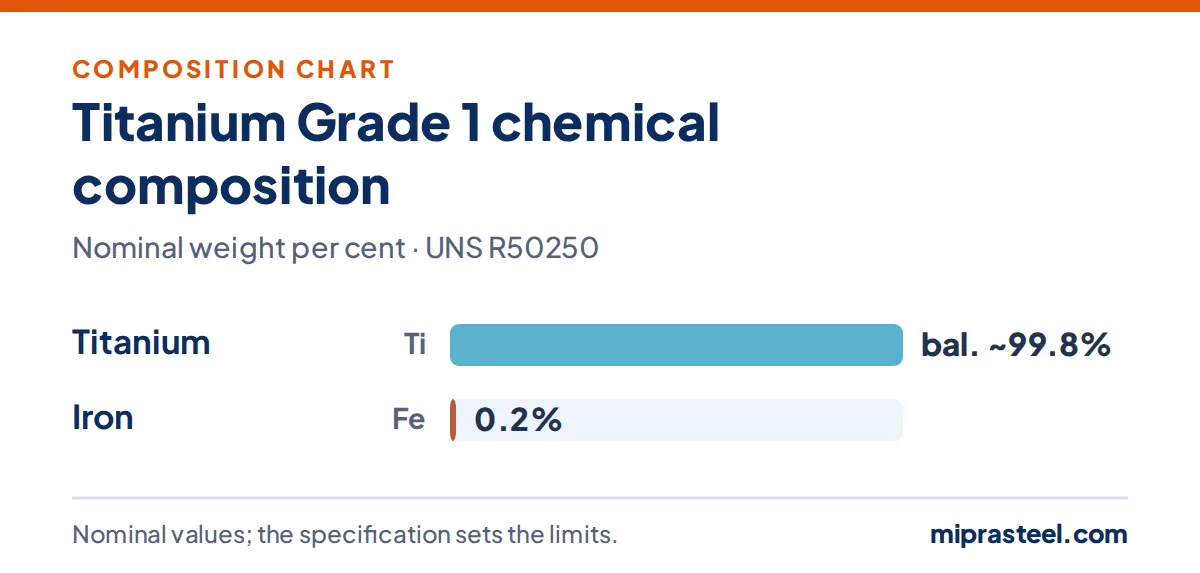
| Element | Symbol | Nominal wt% | |
|---|---|---|---|
| Titanium | Ti | Balance (about 99.8) | |
| Iron | Fe | 0.2 |
Titanium Grade 1 Equivalent Grades and Other Names
| Designation | Value |
|---|---|
| Trade name | Titanium Grade 1 |
| UNS | R50250 |
| W.Nr. / EN | 3.7025 |
| Other names in the trade | CP titanium Grade 1 |
Look up any designation in the grade name converter or the equivalent grade chart.
Titanium Grade 1 Standards and Specifications
Titanium Grade 1 Applications
- Plate heat exchanger plates
- Cladding and explosive-bonded plate
- Chemical equipment linings
- Anodes
Source industries: chemical processing, desalination.
How Titanium Grade 1 Scrap Is Identified
Grade 1 cannot be told apart from Grade 2 by eye, by magnet or by a handheld XRF, so identification is mostly about paperwork and mechanical behaviour.
| Check | What it shows for Titanium Grade 1 |
|---|---|
| Weight in the hand | At 4.51 g/cm3, titanium is about 40% lighter than steel or stainless plate of the same size. A mixed PHE lot with stainless plates in it shows up quickly this way. |
| XRF spectrum | Should show titanium with only a trace of iron and no aluminium, vanadium or palladium. Any of those means a different grade. |
| Mill certificate | Oxygen at or under 0.18% and iron at or under 0.20%, quoting ASTM B265 Grade 1 or R50250, is the cleanest proof. See reading mill test certificates. |
| Hardness | Grade 1 tests softer than Grade 2. A hardness comparison against a known reference piece is the usual practical check when papers are missing. |
| Equipment records | PHE nameplates and plate data sheets often state the plate material, which ties a pack to Grade 1. |
| Steel backing | Check the back face of any thick piece. Magnetic steel behind the titanium means clad material, not solid Grade 1. |
Grades Most Often Confused with Titanium Grade 1
- Titanium Grade 2: allows up to 0.25% oxygen and 0.30% iron and is noticeably stronger; same appearance and same XRF picture.
- Titanium Grade 11: is Grade 1 with about 0.15% palladium added, which an XRF picks up.
- Stainless steel PHE plates: look similar when pressed but weigh far more and read chromium, nickel and iron on XRF.
Nominal values for Titanium Grade 1 against its closest grades on this site.
Preparing Titanium Grade 1 Scrap for Sale
- Strip gaskets and glue from PHE plates before weighing, or tell us they are still on.
- Keep Grade 1 plates apart from stainless plates and from any Grade 2 or Grade 11 packs.
- Cut clad trim into its own lot and mark it as titanium on steel.
- Bag coated anodes separately from bare titanium.
- Keep certificates, nameplates and heat numbers with the material they describe.
- Stack flat sheet and plates tightly to cut handling volume.
Titanium Grade 1 Scrap Price per Kg: What Decides It
Grade 1 scrap is priced on how confidently a buyer can treat it as low-oxygen titanium, then on how much cleaning it needs.
- Documented grade: certificates or nameplate data showing Grade 1 let a lot be sold as Grade 1; without them it is often treated as general CP titanium.
- Gaskets, adhesive and scale on PHE plates: every kilo of rubber and glue is weight the buyer has to remove, and organic residue is unwelcome in a vacuum melt.
- Steel attached: clad trim and plates with bonded backing are valued on the titanium they carry, not on gross weight.
- Surface oxidation: flame-cut or heavily heat-tinted edges have picked up oxygen and nitrogen and may need cropping.
- Mixing with stainless, Grade 2 or palladium grades: one wrong plate type in a stack lowers what the whole stack can be sold as.
- Lot size and form: flat, stacked sheet and plate packs densely and ships more cheaply than loose formed parts.
Titanium scrap trades on demand from melters and on what the lot can be used for, so any offer is valid for a stated date only. Our guide to selling titanium scrap explains the wider method.
Titanium Grade 1 Scrap Import and Export
Importing Titanium Grade 1 Scrap into India
Grade 1 scrap reaches India mainly from regions with large seawater cooling and chemical plant bases, such as the Gulf, East Asia and Europe, where plate heat exchanger replacement releases titanium plate regularly. Each shipment of metal scrap into India normally carries a pre-shipment inspection certificate, commercial invoice, packing list and bill of lading. Titanium waste and scrap is typically declared under HS 8108.30, and Grade 1 lots should state "Titanium Grade 1, UNS R50250" with certificates attached so the description holds at Nhava Sheva, Mundra or Chennai.
Exporting Titanium Grade 1 Scrap from India
Indian clad-plate fabrication, exchanger servicing and chemical plant maintenance release Grade 1 titanium that suits overseas melters wanting low-oxygen feed. Exported lots are described as Titanium Grade 1 with UNS R50250 on the invoice and packing list, weighed, and shipped stacked on pallets or bagged in containers. Japan has a long-established titanium industry, and our South Korea office and our Dubai office keep us close to buyers in East Asia and the Gulf. Read export documents for alloy scrap.
Customs heading: 8108.30 (titanium waste and scrap). The HS code is the international tariff heading the scrap is declared under; national tariff lines add further digits, so confirm the full line with your customs broker.
Other Titanium Scrap Grades
Related Reading
Titanium Grade 1 Scrap FAQ
What is the difference between Titanium Grade 1 and Grade 2 scrap?
Oxygen and iron. Grade 1 allows at most 0.18% oxygen and 0.20% iron; Grade 2 allows 0.25% and 0.30%. That small difference makes Grade 1 softer and more formable, and gives melters more headroom on oxygen. The two look and read the same on handheld XRF, so the grade is proven by certificates or hardness. See how Grade 2 compares with Grade 5.
Are used plate heat exchanger plates Grade 1 titanium?
Often, but not always. Many seawater PHE plates are pressed from Grade 1 because it forms deep corrugations without cracking, while some packs use Grade 2 or stainless. The exchanger nameplate, plate data sheet or a hardness check settles it before the lot is described.
Can Grade 1 titanium scrap be sold as Grade 2?
Yes, chemically it fits inside Grade 2 limits, so a melter making Grade 2 can use it. The opposite is the problem: Grade 2 cannot pass as Grade 1 because its oxygen may exceed 0.18%. Selling proven Grade 1 as plain CP titanium gives away its main advantage.
How should titanium-clad steel trim be sold?
As clad material, in its own lot. The titanium layer is usually thin compared with the steel backing, so the lot is valued on the titanium it contains. Mixing clad pieces into solid Grade 1 is a common reason a lot gets downgraded.
Which HS code covers Titanium Grade 1 scrap?
Titanium waste and scrap typically falls under HS 8108.30. The national tariff line adds digits that differ by country, so confirm the full code with your customs broker before booking a shipment.
Will Mipra Steel buy a small quantity of Grade 1 titanium plates?
Send the details whatever the size: the form, approximate weight, location, photographs and any nameplate or certificate. Small lots are easier to place when they are clean, stripped of gaskets and kept to one grade.
Why does oxygen matter so much in Grade 1 titanium scrap?
Oxygen is what defines the CP grades, and titanium remelting cannot remove it. A melt shop must keep the charge under the grade limit, so every lot with uncertain oxygen narrows its options. Proven low-oxygen Grade 1 scrap is the feed that gives the most room.
What is Titanium Grade 1 made of?
Nominally 99.8% titanium, 0.2% iron. Specification ranges vary by product form and standard.
Published by Mipra Steel, Khetwadi, Mumbai · Updated