René 108 Scrap Buyer, Importer and Exporter in India
Mipra Steel buys and sells René 108 and related DS blade revert from Mumbai, describing each lot by the name its documents support.
Sell René 108 Scrap
For René 108, the paperwork is worth as much as the photographs. Send heat certificates or part numbers if you have them, plus the weight, the form (casting returns, rejected castings, service blades) and whether parts are coated. If you only have handheld readings, tell us; the lot can still be traded as DS revert of this type. We review incoming enquiries and respond with relevant next steps.
Buy René 108 Scrap
Foundries and alloy makers that use René 108 or MAR-M 247 type revert can tell us the grade name they need, whether a "type" description is acceptable, the quantity and the delivery port. If your melt has limits on zirconium, carbon or other minor elements, state them so the right lots are offered.
What Is René 108, and Why Is It Cast Directionally Solidified?
Directional solidification lines the grains of a blade up along its length, so there are no grain boundaries running across the direction of load. That gives a blade more creep and rupture life than an equiaxed casting of the same alloy. René 108 is built for that process. Its heavy tungsten, tantalum and aluminium content gives strength, and its 1.5% hafnium is there for castability: hafnium reduces hot tearing as the long columnar grains finish solidifying. Alloys of this type are prone to hot tear cracking when poured as ordinary equiaxed castings, which is one reason they are cast DS.
Put a René 108 analysis next to MAR-M 247 and the two are almost the same: tungsten 9.5 against 10, cobalt 9.5 against 10, chromium 8.4 against 8.25, hafnium 1.5 against 1.5. The DS derivative CM 247 LC is closer still, with 8.1% chromium, 9.2% cobalt, 0.5% molybdenum and 0.7% titanium. For a scrap buyer this matters more than any datasheet difference. A handheld analyser cannot reliably tell these grades apart, so the name on a lot depends on the paperwork that comes with it.
In practice, René 108 lots are usually sold with the castings' heat records or with part numbers that tie them to a known blade or vane. Without them, the honest description is "MAR-M 247 type DS revert", which is still a useful material to a melt shop making any of these grades. Spellings in enquiries include René 108, Rene 108 and R108.
René 108 belongs to the René family, part of superalloy scrap.
Typical Sources of René 108 Scrap
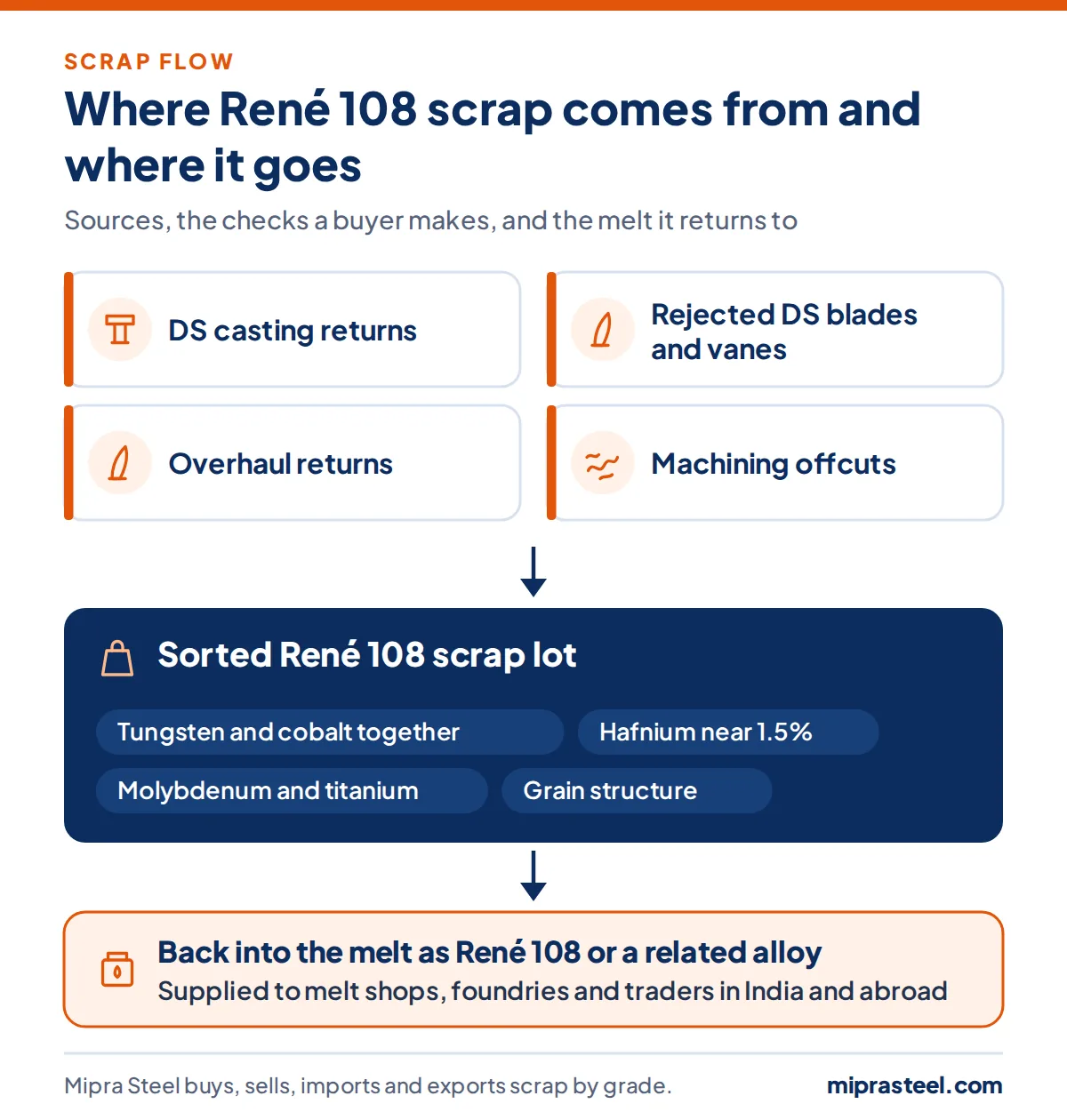
Most René 108 that reaches traders comes from the casting side of the industry, with a smaller flow of service parts.
DS Casting Returns
Pour cups, runners, starter blocks and cut-off clusters from blade and vane moulds. Uncoated and normally traceable to a heat number.
Rejected DS Blades and Vanes
Castings scrapped for misaligned grains, freckle chains, surface cracks or core problems. The alloy is unchanged, so these are good revert after cleaning.
Overhaul Returns
Blades and vane segments removed from aero engines and some industrial turbines. Expect aluminide or MCrAlY coatings and possible braze repairs.
Machining Offcuts
Root and shroud machining leave small solids and grinding swarf. Swarf is kept apart because it oxidises easily and picks up abrasive.
René 108 Scrap Specification Chart
| Grade | René 108 |
|---|---|
| UNS | Not assigned (proprietary GE alloy) |
| W.Nr. / EN | Not assigned |
| Identified by | GE material specification, casting records and analysis |
| Also known as | Rene 108 |
| Alloy type | Directionally solidified cast superalloy |
| Density | Not published |
| Magnetic | Non-magnetic. |
| HS code (customs heading) | 7503.00 (nickel waste and scrap) |
René 108 Chemical Composition
Nominal composition in weight per cent, used to describe and identify the grade. The governing specification sets the limits for each product.
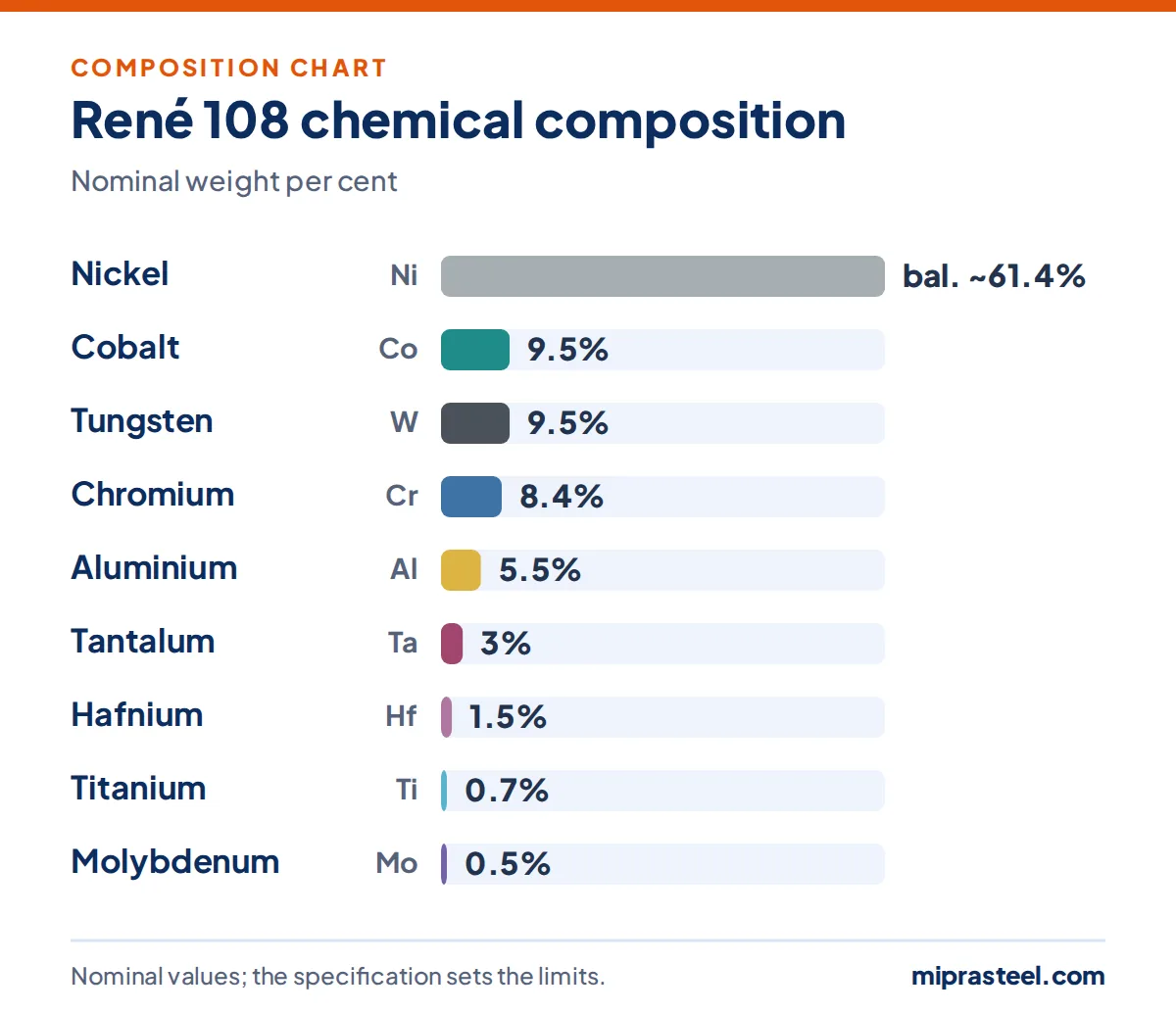
| Element | Symbol | Nominal wt% | |
|---|---|---|---|
| Nickel | Ni | Balance (about 61.4) | |
| Cobalt | Co | 9.5 | |
| Tungsten | W | 9.5 | |
| Chromium | Cr | 8.4 | |
| Aluminium (aluminum) | Al | 5.5 | |
| Tantalum | Ta | 3 | |
| Hafnium | Hf | 1.5 | |
| Titanium | Ti | 0.7 | |
| Molybdenum | Mo | 0.5 |
René 108 Equivalent Grades and Other Names
| Designation | Value |
|---|---|
| Trade name | René 108 |
| UNS | Not assigned (proprietary GE alloy) |
| W.Nr. / EN | Not assigned |
| Other names in the trade | Rene 108 |
Look up any designation in the grade name converter or the equivalent grade chart.
René 108 Standards and Specifications
Supplied to turbine OEM specifications.
René 108 Applications
- Directionally solidified turbine blades and vanes
Source industries: aerospace, power generation.
How René 108 Scrap Is Identified
Identification for René 108 is less about finding the family and more about deciding how far the reading can be trusted to separate it from its near twins.
| Check | What it shows for René 108 |
|---|---|
| Tungsten and cobalt together | Both near 9.5%. Few other blade alloys show this pairing with only about 8% chromium. |
| Hafnium near 1.5% | Hafnium at this level marks a hafnium-modified blade alloy such as René 108, René 125 or MAR-M 247. A single-crystal alloy such as René N5 reads only around 0.15%. |
| Molybdenum and titanium | About 0.5% and 0.7% in René 108. MAR-M 247 reads about 0.7% and 1%. The gap is close to the uncertainty of a handheld gun, so treat it as a hint only. |
| Grain structure | A lightly etched DS part shows long grains running root to tip; an equiaxed casting shows a speckled pattern. This tells you the casting route, not the alloy. |
| Documents | Heat certificates or blade part numbers are what actually prove René 108 over MAR-M 247 or CM 247 LC. |
| Surface | Grind through coating and oxide before reading; platinum aluminide and MCrAlY coats push up aluminium, chromium and cobalt. |
Grades Most Often Confused with René 108
- MAR-M 247: 10% tungsten, 10% cobalt, 8.25% chromium, 1% titanium, 0.7% molybdenum: practically the same reading.
- René 125: also hafnium-bearing, but about 7% tungsten, 2.5% titanium and 2% molybdenum.
- MAR-M 246: 10% tungsten and cobalt as well, but 2.5% molybdenum, 1.5% tantalum and no hafnium.
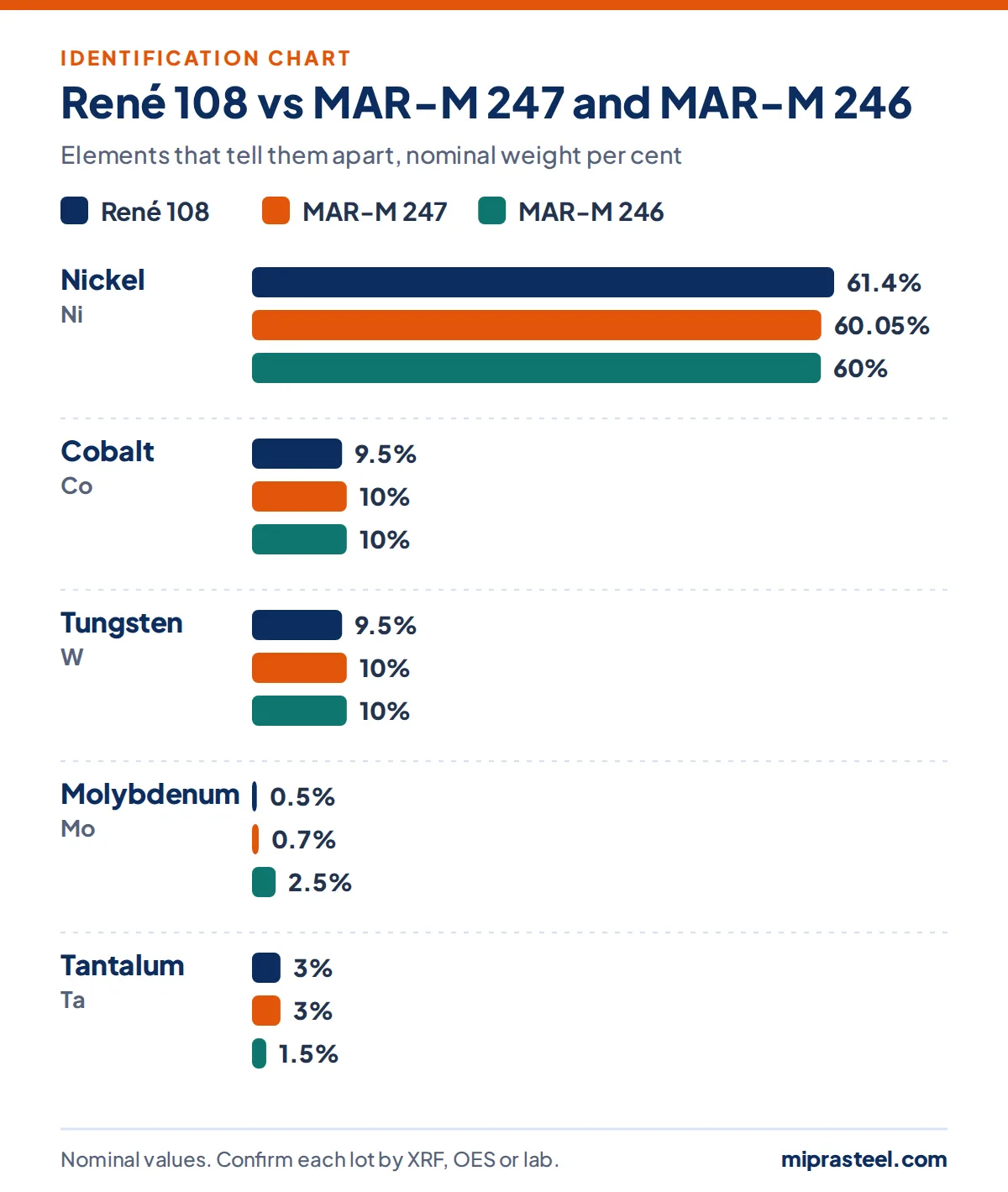
Nominal values for René 108 against its closest grades on this site.
Preparing René 108 Scrap for Sale
- Keep René 108 apart from MAR-M 247, CM 247 LC and René 125 even though the readings look alike.
- Label each drum with the heat or part number it came from.
- Separate coated service blades from bare foundry returns.
- Knock off loose shell and core, and say if residue remains inside blades.
- Bag grinding swarf on its own and keep it dry.
René 108 Scrap Price per Kg: What Decides It
What a buyer pays for René 108 scrap starts with the refractory metals it carries and then turns on how precisely the lot can be named.
- Tungsten at about 9.5% and tantalum at about 3%, which make up a large part of the contained value alongside nickel and cobalt.
- Paperwork: lots backed by heat records can be sold as René 108 to a melter who needs that grade; undocumented lots go as MAR-M 247 type revert.
- Uncoated casting returns versus coated service parts.
- Hafnium oxide skin and ceramic residue on castings, which add non-metallic weight and must be allowed for.
- Mixing with other DS grades: even look-alike chemistries are kept apart if their minor elements, including zirconium and carbon, differ.
- Form and size: whole blades and solid gates handle better than swarf.
Tungsten and nickel prices set the base, so offers carry a date. For how a revert buyer reasons about value, read superalloy revert recycling.
René 108 Scrap Import and Export
Importing René 108 Scrap into India
Most DS blade revert imported into India comes from casting houses and overhaul centres in Europe and East Asia, with service parts from the Gulf. Each shipment of metal scrap travels with a pre-shipment inspection certificate, commercial invoice, packing list and bill of lading. Describe the lot exactly as its paperwork supports: "René 108 DS revert" when heat records exist, or "nickel superalloy DS revert, MAR-M 247 type" when they do not. Consistent wording avoids disputes at the port and later with the melter. See importing nickel alloy scrap into India.
Exporting René 108 Scrap from India
DS revert of this chemistry is used by vacuum melters producing blade alloys and by makers of master alloy, mainly in Europe, the United States and East Asia. Indian lots are exported weighed and described by grade, with the basis for the name stated, and packed in drums or bulk bags inside containers from Nhava Sheva or Mundra. Our Dubai and South Korea offices help connect with buyers in the Gulf and East Asia. For the paper trail, see export documents for alloy scrap.
Customs heading: 7503.00 (nickel waste and scrap). The HS code is the international tariff heading the scrap is declared under; national tariff lines add further digits, so confirm the full line with your customs broker.
Other René Scrap Grades
Related Reading
René 108 Scrap FAQ
Is René 108 the same as MAR-M 247?
Not by name, but the chemistries are very close. René 108 carries 9.5% tungsten and cobalt, 8.4% chromium and 1.5% hafnium; MAR-M 247 has 10% tungsten and cobalt, 8.25% chromium and the same hafnium. A handheld reading cannot reliably separate them, so scrap is named from heat records or part numbers.
Why does René 108 contain hafnium?
Hafnium helps the alloy survive directional solidification without hot tearing. It changes how the last liquid freezes between the long columnar grains, which reduces cracking in the casting. That is why DS blade alloys of this family carry about 1.5% hafnium, while single-crystal alloys need much less.
Can I sell René 108 blades without certificates?
Yes, but they will be described by what the readings show rather than by the René 108 name. Without heat records or part numbers, the lot is usually traded as MAR-M 247 type DS revert. That is still a sought-after material; it just cannot be sold to a buyer who specifically requires certified René 108.
How do I know if a blade is directionally solidified?
Look for long grains running from root to tip after light etching, or on a weathered surface. An equiaxed casting shows a random, speckled grain pattern, and a single crystal shows none. The grain structure tells you the casting route, which narrows the alloy list but does not name the alloy.
Does Mipra Steel buy René 108 casting returns from foundries?
Yes. Mipra Steel buys and sells René 108 casting returns, rejected castings and service parts. Foundry returns with heat records are the easiest to describe. Send the weight, form, location, photographs and any certificates.
Which HS code fits René 108 scrap?
René 108 is a nickel-base alloy, so its scrap is typically entered under HS 7503.00, the heading for nickel waste and scrap. Countries add their own subheading digits, so confirm the full code with your customs broker before shipping.
Does René 108 contain rhenium?
No. René 108 is a rhenium-free DS alloy. Its value comes from tungsten, tantalum, cobalt, hafnium and nickel. Lots should still be kept apart from rhenium-bearing single-crystal scrap such as René N5, because a stray rhenium blade in a 108 lot is a contamination problem for the melter.
What is René 108 made of?
Nominally 61.4% nickel, 9.5% cobalt, 9.5% tungsten, 8.4% chromium, 5.5% aluminium, 3% tantalum, 1.5% hafnium, 0.7% titanium, 0.5% molybdenum. Specification ranges vary by product form and standard.
Published by Mipra Steel, Khetwadi, Mumbai · Updated