F75 Co-Cr-Mo Scrap Buyer, Importer and Exporter in India
Mipra Steel trades F75 Co-Cr-Mo scrap from Mumbai, working with implant foundries, machine shops and traders who generate or use cobalt-chromium-molybdenum material.
Sell F75 Co-Cr-Mo Scrap
Foundries and machine shops with F75 to sell should send the form (gates and sprues, rejected castings, offcuts or grinding swarf), the weight, location and photographs. An analysis showing cobalt, chromium, molybdenum and nickel helps a buyer confirm the material is F75 and not a mixed cobalt lot. If swarf is involved, say how it was dried and whether it contains abrasive.
Buy F75 Co-Cr-Mo Scrap
Producers of cobalt-chromium-molybdenum alloys, and traders supplying them, can ask us for F75 lots. Let us know the quantity, acceptable forms, nickel and iron limits, destination and timing. Each lot is described by grade and analysis, with UNS R30075 named where the documents support it.
What Is F75 Cobalt-Chrome-Moly, and Where Does Its Scrap Come from?
F75 is not a trade name. It is the ASTM standard for cobalt-28 chromium-6 molybdenum castings and casting alloy for surgical implants, and its UNS designation is R30075. ISO 5832-4 covers the same family of cast alloy. Foundries pour it into investment moulds to make orthopaedic implant components such as hip and knee parts, along with other surgical castings.
What sets it apart from the cobalt alloys used in turbines is what has been left out. The standard caps nickel at 0.5%, iron at 0.75% and tungsten at 0.2%, and allows up to 0.35% carbon. Chromium runs from 27 to 30% and molybdenum from 5 to 7%. The result is a dense alloy (about 8.4 g/cm³), with no tantalum, no zirconium and almost no nickel. Cobalt makes up the balance, roughly two-thirds of the weight.
For scrap, that clean recipe is the selling point. F75 revert from an implant foundry is about as uniform as superalloy-type scrap gets: a known alloy, poured under controlled conditions, cut from castings whose dimensions are checked closely. Kept on its own, it is a ready cobalt-chromium-molybdenum input. Mixed with cobalt vane alloys carrying 10% nickel and 7% tungsten, or with stainless steel from the same machine shop, it loses that advantage.
Search terms vary: CoCrMo, cobalt chrome moly, Co-28Cr-6Mo and "medical alloy scrap" all describe the same material when the source is cast implant work. Our cobalt alloy scrap page covers the other cobalt grades we trade.
F75 Co-Cr-Mo belongs to the Cobalt alloy family, part of superalloy scrap.
Where F75 Scrap Is Generated
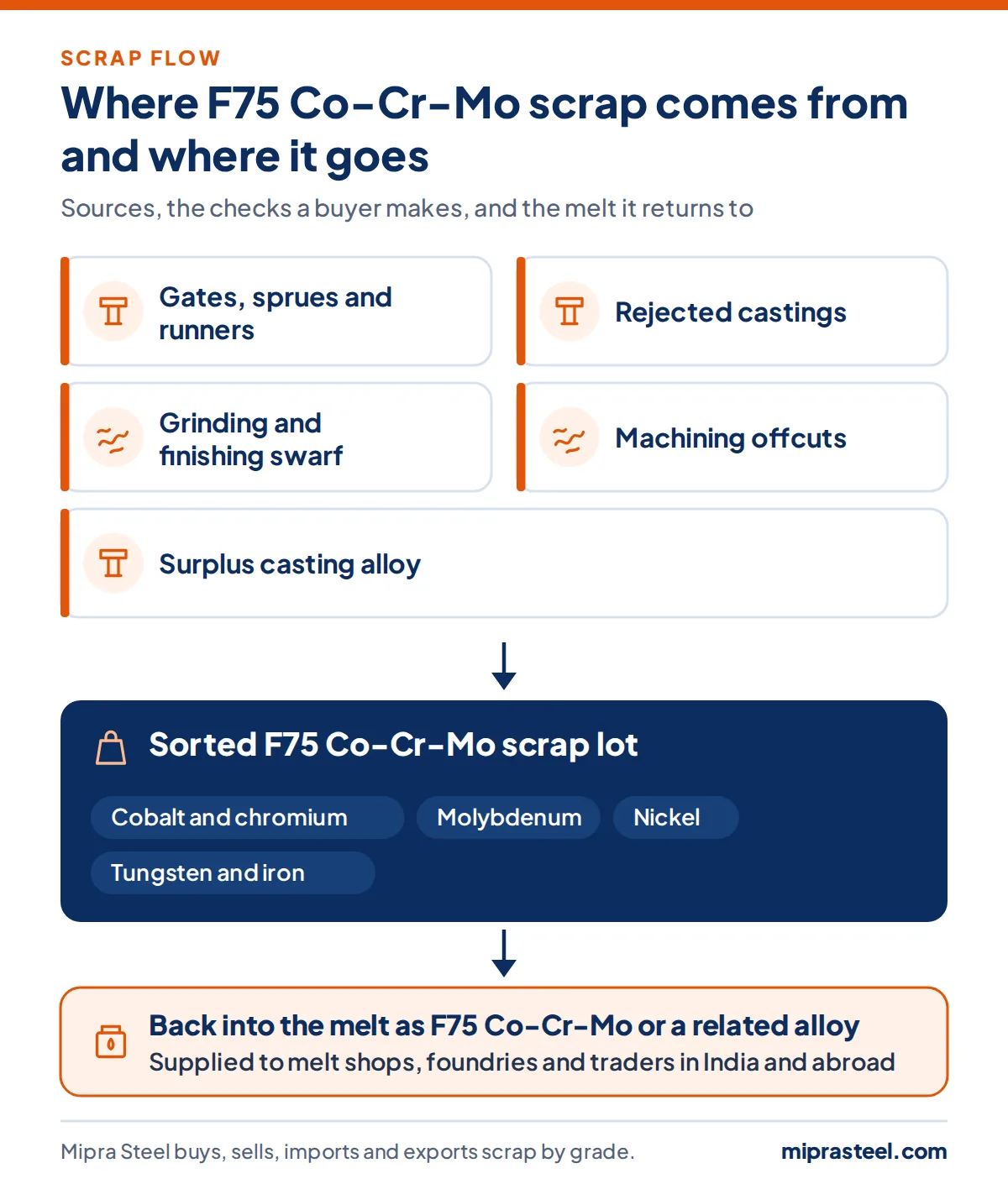
Nearly all F75 scrap comes from manufacturing, not from used devices. The points below are where it collects.
Gates, Sprues and Runners
Cut from investment-cast implant trees after casting. The heaviest and cleanest stream, usually from a single alloy in a dedicated foundry.
Rejected Castings
Components failing dimensional, surface or radiographic inspection before finishing.
Grinding and Finishing Swarf
Fine material from grinding and polishing cast parts. Lower value, and easily contaminated by abrasive and coolant.
Machining Offcuts
Pieces removed when cast parts are machined to final form, often small but clean if kept dry.
Surplus Casting Alloy
Unused remelt ingot or bar stock of F75 chemistry held by foundries, released when a product line changes.
F75 Co-Cr-Mo Scrap Specification Chart
| Grade | F75 Co-Cr-Mo |
|---|---|
| UNS | R30075 |
| W.Nr. / EN | Not assigned; specified by UNS R30075 and ASTM F75 and ISO 5832-4 |
| Also known as | ASTM F75, Co-28Cr-6Mo, CoCrMo, ISO 5832-4 |
| Alloy type | Cast cobalt-chromium-molybdenum alloy (implant grade) |
| Density | 8.4 g/cm³ (0.303 lb/in³) |
| Magnetic | Not a reliable test for this grade; confirm by XRF. |
| HS code (customs heading) | 8105.30 (cobalt waste and scrap) |
F75 Co-Cr-Mo Chemical Composition
Nominal composition in weight per cent, used to describe and identify the grade. The governing specification sets the limits for each product.
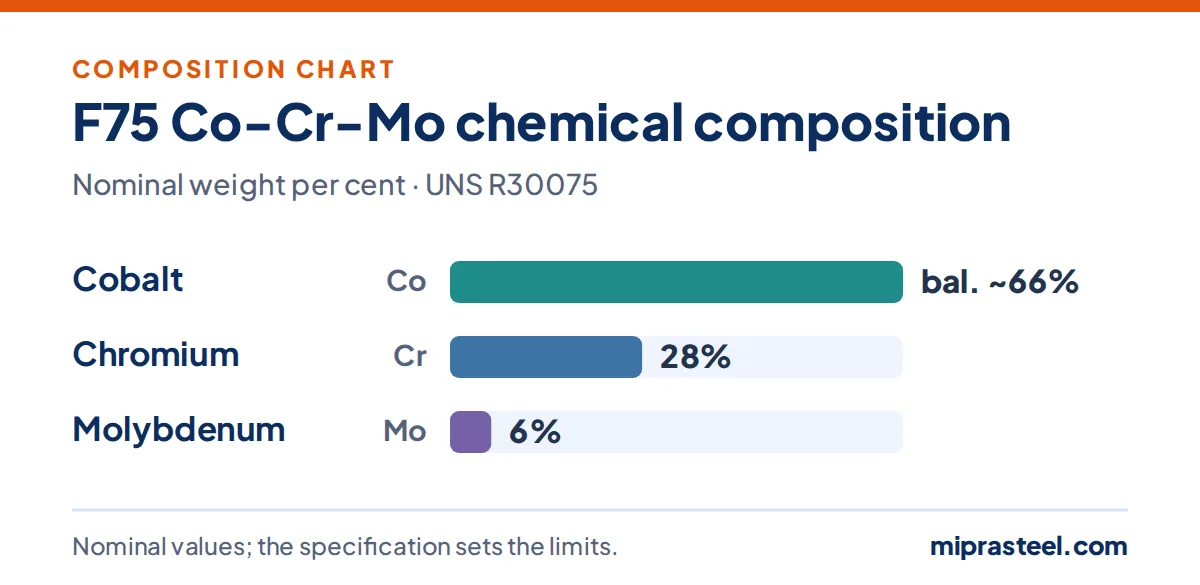
| Element | Symbol | Nominal wt% | |
|---|---|---|---|
| Cobalt | Co | Balance (about 66) | |
| Chromium | Cr | 28 | |
| Molybdenum | Mo | 6 |
F75 Co-Cr-Mo Equivalent Grades and Other Names
| Designation | Value |
|---|---|
| Trade name | F75 Co-Cr-Mo |
| UNS | R30075 |
| W.Nr. / EN | Not assigned; specified by UNS R30075 and ASTM F75 and ISO 5832-4 |
| Key specification | ASTM F75 and ISO 5832-4 |
| Other names in the trade | ASTM F75, Co-28Cr-6Mo, CoCrMo, ISO 5832-4 |
Look up any designation in the grade name converter or the equivalent grade chart.
F75 Co-Cr-Mo Standards and Specifications
ASTM F75; ISO 5832-4.
F75 Co-Cr-Mo Applications
- Orthopaedic implant castings, such as hip and knee components
- Surgical castings
How F75 Co-Cr-Mo Scrap Is Identified
A cobalt-led reading with molybdenum and almost no nickel is the F75 fingerprint. These checks confirm it.
| Check | What it shows for F75 Co-Cr-Mo |
|---|---|
| Cobalt and chromium | Cobalt as the main element with chromium between 27 and 30%. |
| Molybdenum | Between 5 and 7%. Cobalt turbine alloys such as MAR-M 509 and ECY-768 read essentially no molybdenum. |
| Nickel | At or below 0.5%. Readings around 10% nickel mean a cobalt vane alloy, not F75. |
| Tungsten and iron | Tungsten should be close to zero and iron below 0.75%. Several per cent of either suggests contamination or a different alloy. See tramp elements in remelting. |
| Stainless contamination | Implant machining shops often run stainless steel too. A reading of high iron with nickel around 10% flags a stray stainless piece that must come out. |
| Swarf condition | Check fines for abrasive grit, polishing compound and coolant before describing them. See solids versus turnings. |
Grades Most Often Confused with F75 Co-Cr-Mo
- MAR-M 509: cobalt-base but with about 10% nickel, 7% tungsten, 3.5% tantalum and roughly 23.5% chromium, and no molybdenum.
- ECY-768: reads like MAR-M 509 on most elements, so it shows the same nickel, tungsten and tantalum and the same absence of molybdenum.
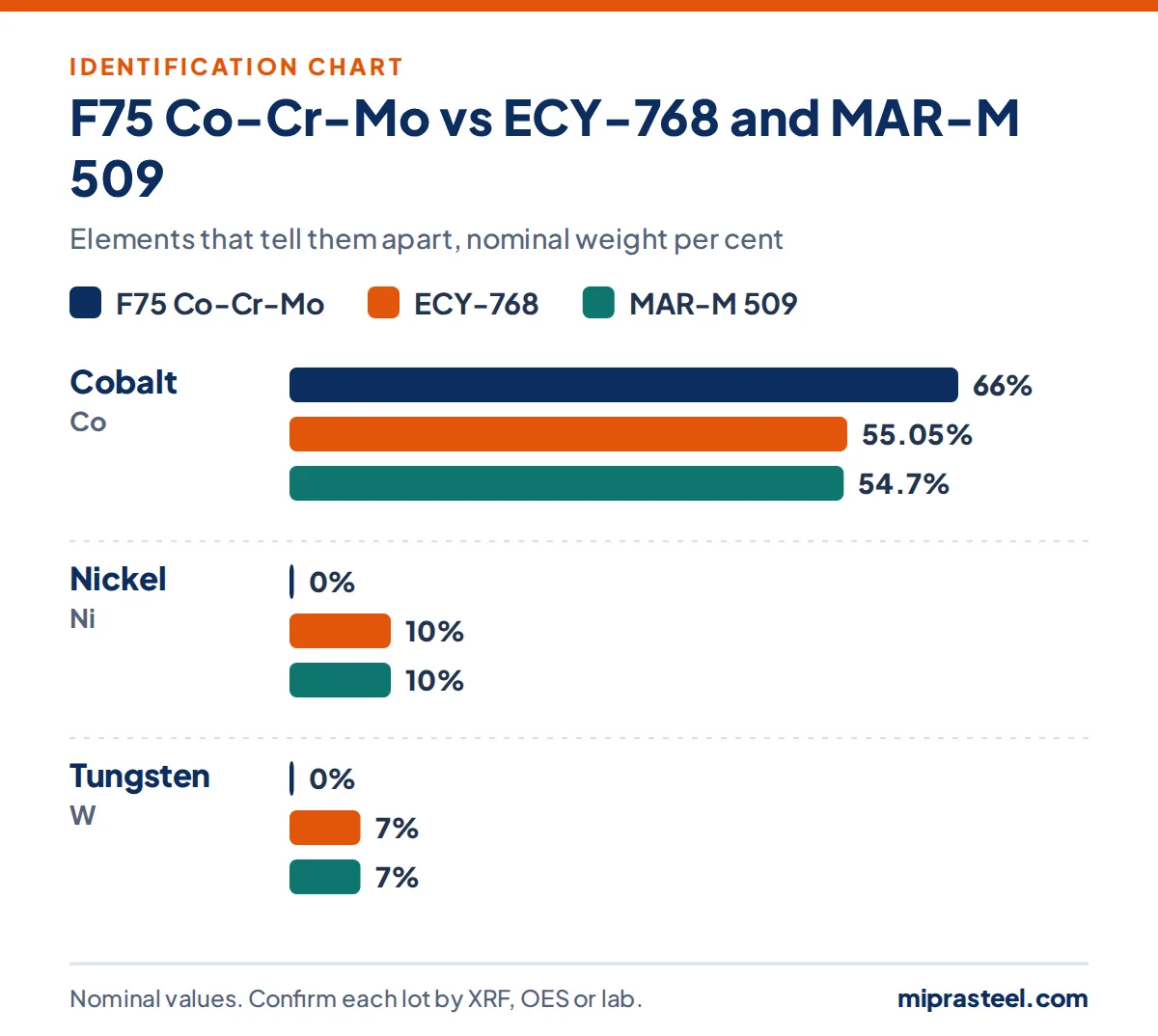
Nominal values for F75 Co-Cr-Mo against its closest grades on this site.
Preparing F75 Co-Cr-Mo Scrap for Sale
- Collect F75 in dedicated bins, never shared with stainless steel or titanium from the same shop.
- Keep gates and sprues, rejected castings and swarf in separate containers.
- Dry grinding swarf and keep it sealed against moisture.
- Remove abrasive media, wax residue and shell where it comes away easily.
- Label each container with source line and analysis reference.
F75 Co-Cr-Mo Scrap Price per Kg: What Decides It
The F75 scrap price per kg is set mainly by cobalt, with chromium and molybdenum adding to it. Purity and form then decide how much of that the buyer can pay.
- Cobalt at roughly two-thirds of the weight, priced on the cobalt market.
- Molybdenum around 6%, useful to producers of cobalt-chromium-molybdenum alloys.
- Purity: low nickel, iron and tungsten are the alloy's defining feature, so any contamination cuts the value sharply.
- Form. Solid gates and rejected castings are worth more than grinding swarf, which carries abrasive and coolant.
- Single source. Revert from one foundry with a consistent analysis is easier to place than mixed parcels from several shops.
- Lot size and packing, since F75 often comes in modest quantities that need consolidating.
Cobalt prices move independently of nickel, so any figure for F75 is dated. See why tramp elements matter in remelting for the purity question in more depth.
F75 Co-Cr-Mo Scrap Import and Export
Importing F75 Co-Cr-Mo Scrap into India
Countries with implant manufacturing generate F75 revert and swarf, and some of it reaches India through traders. Cobalt-base alloy scrap is typically declared under HS 8105.30; your customs broker should confirm the national tariff line. Imported metal scrap is inspected before shipment and travels with a pre-shipment inspection certificate, commercial invoice, packing list and bill of lading. Describe the material as ASTM F75 cobalt-chromium-molybdenum alloy scrap, UNS R30075, and attach analyses so the customs and commercial descriptions match. For process detail, read importing alloy scrap into India.
Exporting F75 Co-Cr-Mo Scrap from India
India's implant and precision casting sector produces F75 revert and machining scrap that can be exported to cobalt alloy producers abroad. Lots are invoiced with the grade, UNS number and form, weighed, and shipped in sealed drums or bags inside containers, usually from Nhava Sheva or Mundra. Our offices in South Korea and the UAE help with East Asian and Gulf buyers, and we also serve the Netherlands and Spain. See export documents for alloy scrap.
Customs heading: 8105.30 (cobalt waste and scrap). The HS code is the international tariff heading the scrap is declared under; national tariff lines add further digits, so confirm the full line with your customs broker.
Other Cobalt Alloy Scrap Grades
Related Reading
F75 Co-Cr-Mo Scrap FAQ
Is F75 the same as CoCrMo?
F75 is one specific CoCrMo alloy: the cast cobalt-28 chromium-6 molybdenum alloy defined by ASTM F75 for surgical implants, UNS R30075. People use "CoCrMo" more loosely, so a lot described only as CoCrMo should be backed by an analysis showing the F75 ranges.
Is cobalt chrome moly scrap valuable?
Yes. Cobalt makes up about two-thirds of F75, and cobalt carries a substantial price of its own, with molybdenum adding to it. The actual value of a lot depends on the cobalt market on the day, the form of the scrap and how free it is of nickel, iron and other contamination.
Can F75 scrap be mixed with MAR-M 509 or other cobalt alloys?
It should not be. MAR-M 509 and similar vane alloys carry around 10% nickel and 7% tungsten with no molybdenum, while F75 is defined by very low nickel and tungsten and about 6% molybdenum. A blended lot suits neither use and is valued as general cobalt alloy scrap.
Does Mipra Steel accept used implants as scrap?
Mipra Steel trades F75 manufacturing scrap such as casting revert, rejected castings, offcuts and swarf. For anything else, describe the material in detail, with weight, location and photographs, and we review incoming enquiries and respond with relevant next steps.
What HS code does F75 cobalt alloy scrap use?
F75 is cobalt-base, so its scrap is typically declared under HS 8105.30, cobalt waste and scrap. Confirm the national tariff line with a customs broker, as countries add further digits.
How is F75 different from cobalt vane alloys?
F75 relies on molybdenum and very low nickel, iron and tungsten, because it was designed for implant castings. Vane alloys such as ECY-768 and MAR-M 509 carry nickel, tungsten and tantalum for strength in hot gas. An XRF reading of molybdenum and nickel separates them quickly.
What is the density of F75 alloy?
About 8.4 g/cm³. That is lower than MAR-M 509 at about 8.86 g/cm³, which reflects F75's lack of tungsten and tantalum. Density alone is not enough to identify a piece, so analysis remains the basis for describing a lot.
What is F75 Co-Cr-Mo made of?
Nominally 66% cobalt, 28% chromium, 6% molybdenum. Specification ranges vary by product form and standard.
Published by Mipra Steel, Khetwadi, Mumbai · Updated