What Separates Bucket Alloy from Nozzle Alloy in a GTD Lot?
The GTD family splits cleanly along the line between rotating and stationary parts of a land-based turbine. GTD-111 is the bucket alloy: 14% chromium, 9.5% cobalt and a high γ′ content from about 4.9% titanium and 3% aluminium, with 2.8% tantalum and 3.8% tungsten. It is cast both equiaxed and directionally solidified for first- and second-stage buckets. The other three are nozzle alloys built on a very different base, about 22.5% chromium and 19% cobalt with only modest titanium. GTD-222 carries about 1% tantalum and 0.8% niobium. GTD-241 removes the tantalum and raises niobium to about 1.35%. GTD-262 is 241 with aluminium lifted from about 1.2% to 1.7%.
In practice this means a single outage can release two kinds of scrap that must never share a container. A bucket set and a nozzle set taken out of the same turbine differ by about 8 points of chromium and nearly 10 points of cobalt. A melter charging GTD-111 revert cannot absorb a nozzle segment without pushing the heat off chemistry, and the reverse is equally true.
Inside the nozzle group the problem is subtler. The three nozzle alloys look almost identical on a handheld analyser. Tantalum separates 222 from 241, and that reads reasonably well. Aluminium separates 241 from 262, and a 0.5-point aluminium difference needs OES or a light-element setup. Part numbers, the turbine model and the stage are often more reliable than the reading, which is why GTD nozzle lots should stay tied to their records.
GTD-111 brings two trade descriptions of its own: "DS" for directionally solidified buckets and "low Zr" for bucket revert whose zirconium has been measured and found low, which suits heats where zirconium is capped. Neither has a published threshold or separate specification. For the wider picture see superalloy scrap.
GTD Scrap Grades We Buy and Sell
GTD Chemical Composition
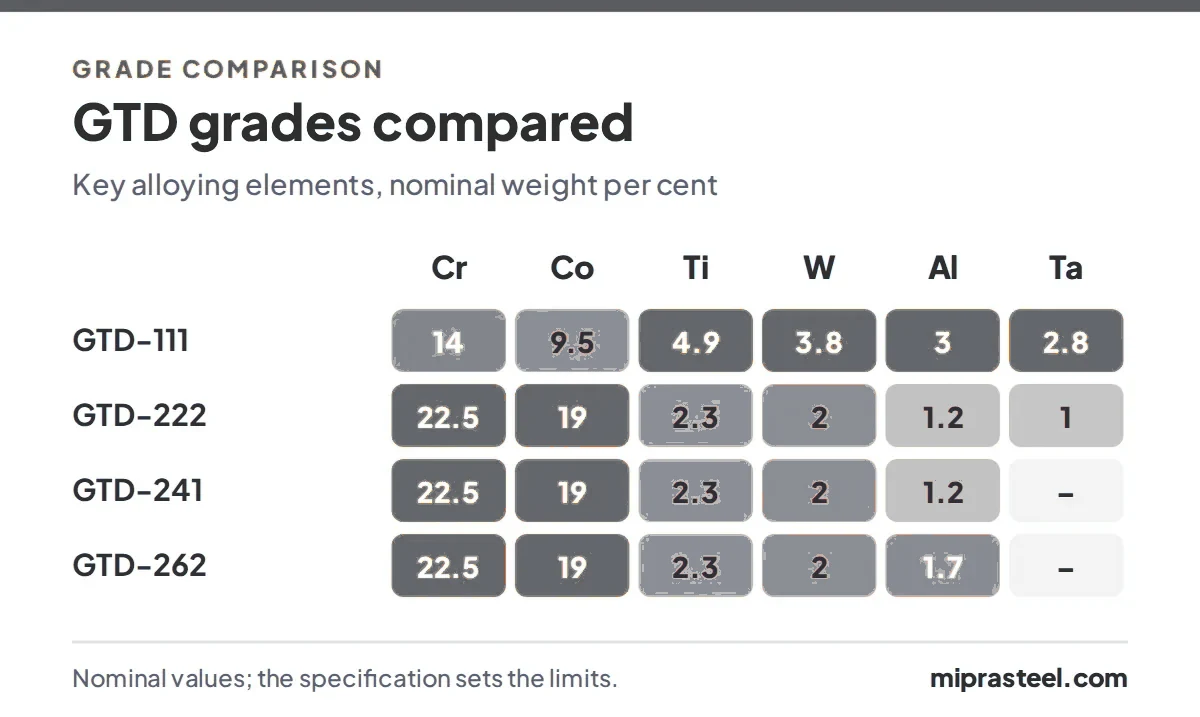
| Grade | Ni | Cr | Co | Ti | W | Al | Ta | Mo | Nb |
|---|---|---|---|---|---|---|---|---|---|
| GTD-111 | 60.5 | 14 | 9.5 | 4.9 | 3.8 | 3 | 2.8 | 1.5 | – |
| GTD-222 | 51.2 | 22.5 | 19 | 2.3 | 2 | 1.2 | 1 | – | 0.8 |
| GTD-241 | 51.7 | 22.5 | 19 | 2.3 | 2 | 1.2 | – | – | 1.4 |
| GTD-262 | 51.2 | 22.5 | 19 | 2.3 | 2 | 1.7 | – | – | 1.4 |
Nominal weight per cent. Specification ranges vary by product form and standard.
How to Tell GTD Grades Apart
Chromium sorts GTD scrap into buckets and nozzles in seconds. After that, the work is in tantalum, niobium, aluminium and the paperwork. For instrument limits see XRF testing of nickel alloys.
| Check | What it shows for GTD |
|---|---|
| Chromium and cobalt | 14% chromium with 9.5% cobalt is GTD-111. 22.5% chromium with 19% cobalt places a part in the nozzle group. |
| Titanium | Close to 5% titanium supports GTD-111; about 2.3% is typical of all three nozzle alloys. |
| Tantalum | About 1% tantalum on the nozzle base means GTD-222; none means 241 or 262. In GTD-111, 2.8% tantalum separates it from René 80. |
| Aluminium | About 1.2% for 241 against 1.7% for 262. Needs OES or a light-element XRF setup on a clean surface. |
| Zirconium | Only relevant for GTD-111 offered as low Zr. Requires a ground surface and a method set up for low-level zirconium, or a lab result. |
| Records | Turbine model, stage, part numbers and repair-shop reports often settle the alloy where readings cannot. |
Grades Most Often Confused with GTD
- René 80: a near match for GTD-111 with about 5% titanium, yet tantalum-free, and its molybdenum and tungsten both sit near 4%.
- IN-939: shares the 19% cobalt nozzle base, but with about 22.4% chromium and 3.7% titanium, against roughly 2.3% titanium in the GTD nozzle alloys.
- MGA 2400: another 19% cobalt vane alloy, with lower chromium at about 19% and around 6% tungsten.
Tantalum Identifies GTD-111
About 2.8% tantalum with 4.9% titanium. René 80 is similar but has no tantalum.
Chromium and Cobalt Identify GTD-222
22.5% chromium and 19% cobalt, close to IN-939, which carries more titanium.
Variant Suffixes
"Low Zr" and "DS" suffixes describe trace-element and casting variants. Confirm against casting documentation before describing a lot.
Where GTD Scrap Comes From
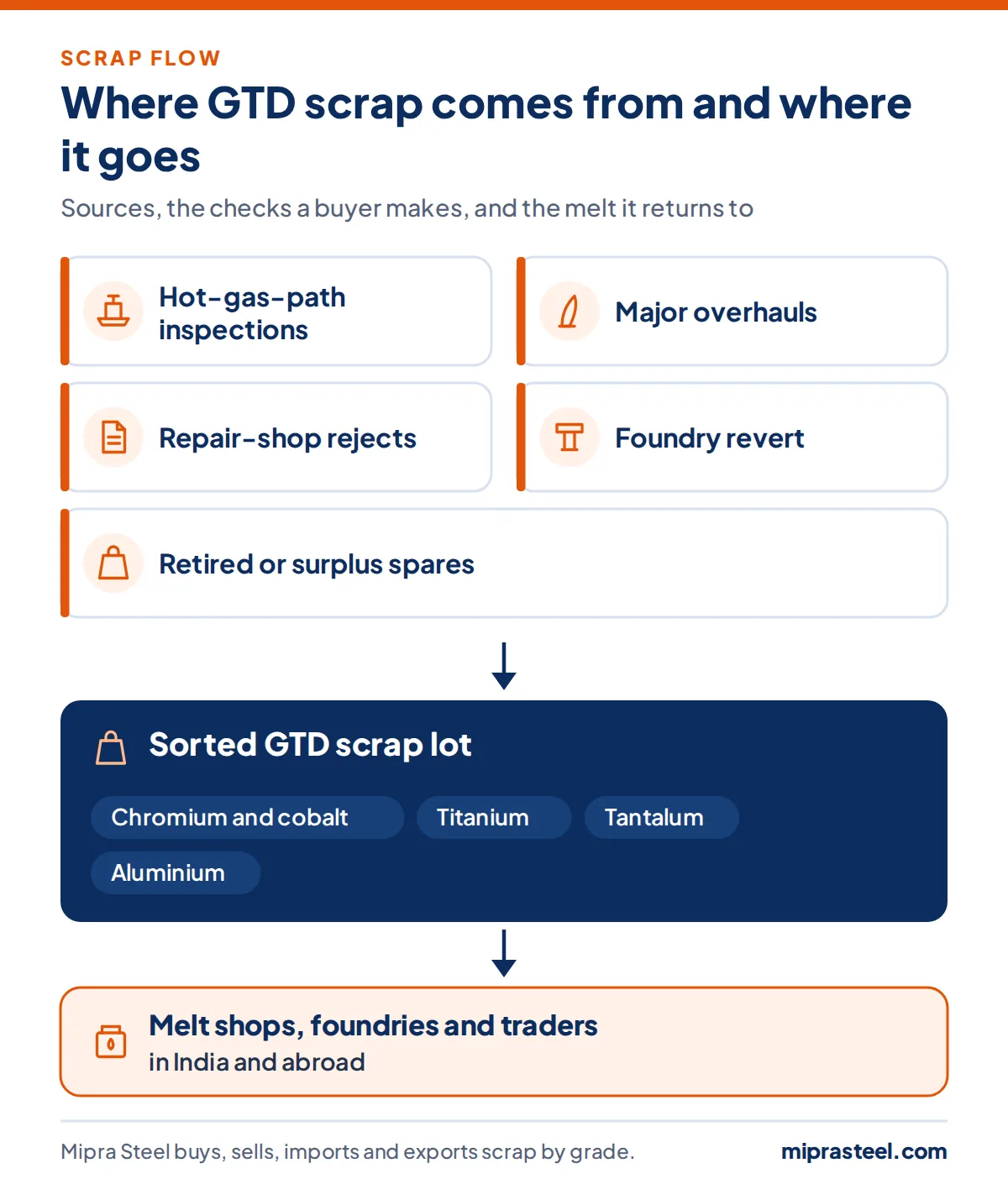
GTD alloys are almost entirely a power-generation stream. They leave the turbine on the operator's maintenance schedule, which makes supply lumpy but well documented.
Hot-Gas-Path Inspections
Front-stage buckets and nozzle segments replaced or sent for repair; parts beyond repair limits become scrap. See power generation scrap.
Major Overhauls
Full rotor and stator work releases several stages together, so GTD-111 buckets, nozzle segments in 222, 241 or 262, and sometimes IN-939 parts arrive at once.
Repair-Shop Rejects
Components stripped of coatings and found cracked, eroded or undersize after inspection. These often come with repair records that help identify the alloy.
Foundry Revert
Gating, risers and rejected castings from bucket and nozzle production, uncoated and traceable to a heat.
Retired or Surplus Spares
New buckets and nozzles left over when a unit is decommissioned or upgraded, usually with part numbers intact.
Source industries: power generation.
GTD Alloy Scrap Buyer, Importer and Exporter in India
Mipra Steel handles GTD buckets, nozzles and revert from Mumbai, and from offices in Dubai and South Korea that sit near big power-generation fleets.
Sell GTD Scrap
Offering GTD scrap? Separate the buckets from the nozzles first, then tell us for each: the alloy if known, the turbine model and stage, the piece count and weight, and whether the parts are coated, stripped or repaired. For GTD-111, say whether the buckets are equiaxed or DS and send any zirconium result if you call the lot low Zr. Photos of roots, platforms and part numbers help. We review incoming enquiries and respond with relevant next steps.
Buy GTD Scrap
Foundries and revert melters sourcing GTD material can tell us which alloy they need, whether buckets, nozzle segments or foundry revert, any coating limits, the tonnage and the port. Buyers of GTD-111 low Zr should say what analysis they expect, and nozzle buyers whether a 241 and 262 mix is acceptable. Each lot is described by alloy, part type and origin.
Preparing GTD Scrap for Sale
- Crate buckets and nozzle segments separately at the outage, before they are mixed in a skip.
- Label every container with turbine model, stage, part type and piece count.
- Keep equiaxed and DS GTD-111 buckets apart.
- Hold GTD-111 offered as low Zr in its own containers with the analysis attached.
- Keep 222 nozzles away from 241 and 262 unless the records say otherwise.
- Pull seal pins, damper pins and shims from bucket dovetails.
GTD Scrap Price per Kg: What Decides It
A GTD scrap price per kg is really two prices: one for bucket alloy and one for nozzle alloy. Within each, the description of the lot moves the offer as much as the metal.
- Bucket or nozzle: GTD-111 carries tantalum and tungsten on a 9.5% cobalt base, while the nozzle alloys carry about twice the cobalt with less refractory content.
- Clean separation of buckets from nozzles from the same outage.
- For the nozzle group, whether 222, 241 and 262 can be told apart by records or reliable readings.
- Documented low zirconium on GTD-111 lots, and a clear statement of equiaxed or DS.
- Coatings, repair welds, braze and attachments such as seal pins, damper pins and shims.
- Revert from the foundry against engine-run parts, with heat records counting in favour.
- Nickel, cobalt and tantalum markets, set size and location.
For general pricing logic read nickel alloy scrap value.
GTD Scrap Import and Export
Importing GTD Scrap into India
GTD scrap enters India from regions with large GE-design heavy-duty turbine fleets, including the Gulf, Europe, East Asia and Australia, through overhaul shops, operators and traders. Every consignment should carry its pre-shipment inspection certificate, with the commercial invoice, packing list and bill of lading, and lands at Nhava Sheva, Mundra or Chennai. A good packing list keeps buckets and nozzles on separate lines and names the stage. When GTD-111 is sold as low Zr, ship the supporting analysis with the documents. Our guide on importing nickel alloy scrap explains the steps.
Exporting GTD Scrap from India
Indian combined-cycle and captive power plants running heavy-duty turbines release GTD buckets and nozzles at their outages, and overseas revert melters are the natural buyers. Exported sets are listed by alloy, part type and stage on the invoice and packing list, weighed, and shipped in crates, drums or loose in containers. Customers in South Korea, Japan, Saudi Arabia and the UAE usually want part records with the shipment, and our Dubai and Korea offices help match lots to buyers.
Customs heading: 7503.00 (nickel waste and scrap). The HS code is the international tariff heading the scrap is declared under; national tariff lines add further digits, so confirm the full line with your customs broker.
Related Reading
GTD Alloy Scrap FAQ
Which GTD alloy is used for buckets and which for nozzles?
GTD-111 is the bucket alloy, used for first- and second-stage rotating blades. GTD-222, GTD-241 and GTD-262 are nozzle (stationary vane) alloys on a 22.5% chromium, 19% cobalt base. That split is the first thing to get right when sorting scrap from an outage.
Why should buckets and nozzles from one outage be kept apart?
Because their chemistry is far apart: about 14% chromium and 9.5% cobalt in GTD-111 buckets, against 22.5% chromium and 19% cobalt in the nozzles. A melter charging one cannot absorb the other, so a mixed skip loses the value of both.
Is GTD-111 low Zr a separate grade?
No. Traders use the phrase for GTD-111 lots whose zirconium has been checked and found low, supplied to buyers who limit zirconium in their heats. There is no published limit, so the description depends on the analysis supplied with the lot.
Can GTD-241 and GTD-262 be told apart on site?
Not reliably with a standard handheld XRF. The two differ mainly in aluminium, about 1.2% against 1.7%, which needs OES or a light-element setup on a clean surface. Part numbers and stage records are often the practical answer.
Does Mipra Steel buy complete bucket or nozzle sets?
Yes. We buy and sell full or part sets of GTD buckets and nozzles, as well as foundry revert, in India and abroad. Tell us the turbine model, stage, alloy if known, piece count, weight and condition so we can look at the set.
What customs heading do GTD turbine parts travel under as scrap?
As nickel-base superalloy, GTD scrap is typically classified under HS 7503.00, nickel waste and scrap, for both bucket and nozzle alloys. National lines add more digits; your customs broker should confirm the exact code for the destination.
How is GTD-111 different from MGA 1400?
Both are bucket alloys with about 14% chromium. GTD-111 carries about 4.9% titanium and 2.8% tantalum; MGA 1400 has about 2.7% titanium, 4.7% tantalum and 4% aluminium. They come from different makers' turbines, so they are sold as separate lots.
Published by Mipra Steel, Khetwadi, Mumbai · Updated