254 SMO Scrap Buyer, Importer and Exporter in India
Mipra Steel trades 254 SMO as a high-molybdenum austenitic grade in its own lots from Khetwadi, Mumbai, buying from plants, fabricators and traders and supplying stainless and alloy melt shops.
Sell 254 SMO Scrap
Selling 6Mo scrap from a seawater or bleach-plant job? Tell us the forms (pipe sections, plate, flanges, offcuts), the approximate weight and the location, and send photos showing any S31254 or F44 markings. Molybdenum and nickel readings matter more than anything else for this grade. We review incoming enquiries and respond with relevant next steps.
Buy 254 SMO Scrap
Melt shops producing 6Mo, super duplex or other high-molybdenum grades can send their tonnage, accepted forms, molybdenum tolerance and destination port. Lots are offered as 254 SMO, UNS S31254, with whatever readings and certificates the source provides, so you can check the molybdenum yourself before shipment.
What Makes 254 SMO Scrap Different from Ordinary Stainless Scrap?
Engineers specify 254 SMO when 316L pits in seawater and a nickel alloy would be overkill. Raising molybdenum to about 6%, adding nitrogen and lifting nickel to around 18% gives a steel that handles chlorides, warm seawater and bleach-plant liquors far better than standard austenitic grades, at a fraction of nickel-alloy content. In the trade it is often just called "6Mo", and forged flanges and fittings carry the ASTM A182 F44 designation.
As scrap, 254 SMO is still an iron-base stainless steel, roughly 55% iron. It is not a nickel alloy and does not go into a nickel alloy lot. What a melt shop pays for is the contained nickel and, above all, the 6% molybdenum, which is hard to come by in ordinary stainless returns. Producers of high-molybdenum stainless grades can use clean 254 SMO as alloy-bearing feed, saving on primary molybdenum and nickel additions.
That value only survives if the lot stays pure. Standard 304 and 316 scrap looks and behaves exactly like 254 SMO in the yard: same colour, same non-magnetic response. A few pieces of 316L dilute the molybdenum, and a lot that reads 4% to 5% molybdenum is no longer a 6Mo lot. Every piece should be read before it joins the pile. The duplex and 254 SMO family page covers the neighbouring grades.
254 SMO belongs to the Duplex and super-austenitic family, part of exotic alloy scrap.
Where 6Mo Stainless Scrap Comes From
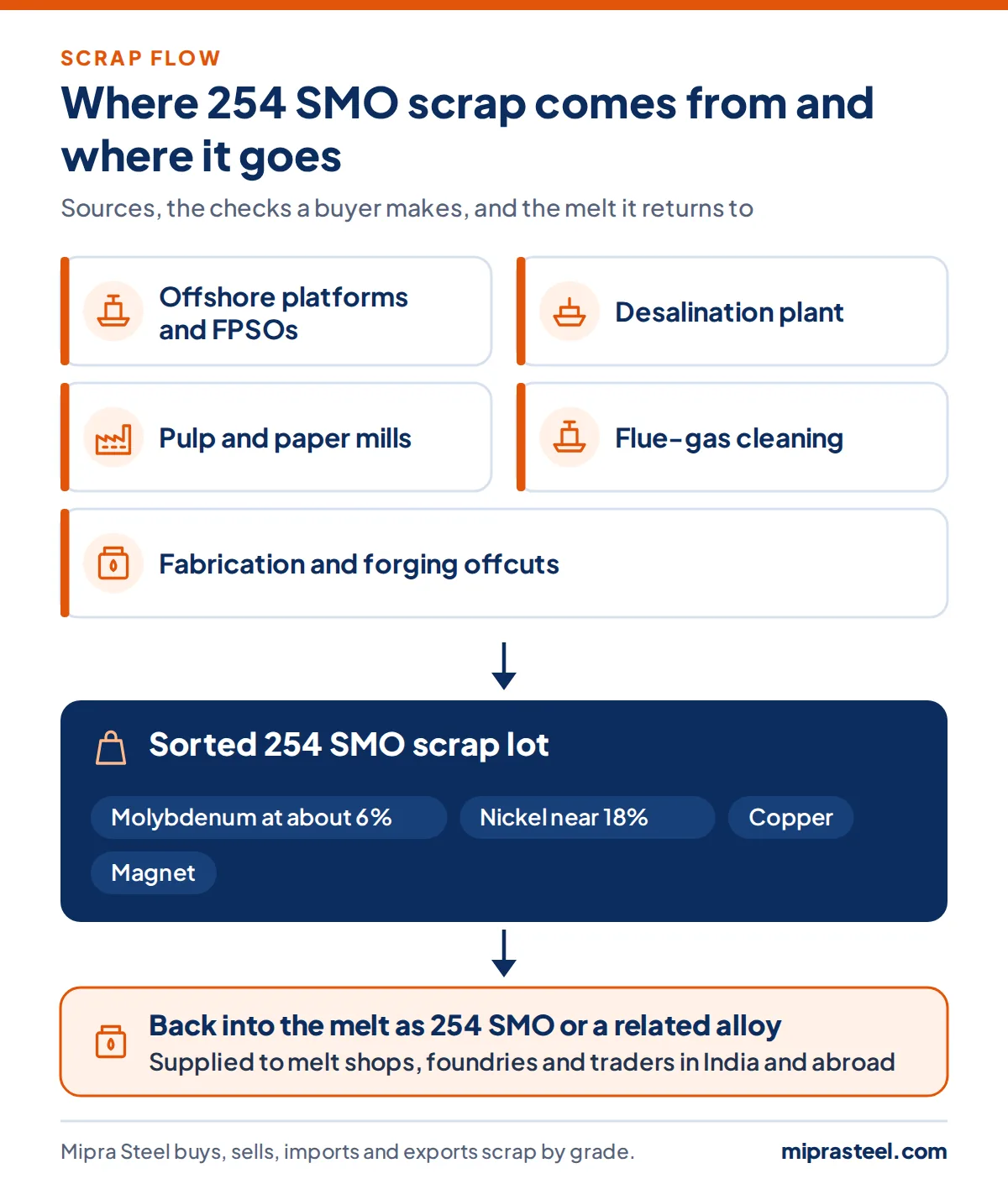
254 SMO is a seawater and chloride grade, so its scrap follows plants that handle seawater, brine and bleach.
Offshore Platforms and FPSOs
Firewater ring mains, seawater lift and cooling lines replaced during upgrades, plus F44 flanges and fittings. See oil and gas scrap.
Desalination Plant
Seawater intake piping, brine lines and pump parts released at rebuilds. See desalination scrap.
Pulp and Paper Mills
Bleach-plant washers, mixers and piping in chlorine dioxide service, replaced during mill rebuilds.
Flue-Gas Cleaning
Scrubber internals, ducts and absorber components where chloride levels ruled out 316L.
Fabrication and Forging Offcuts
Plate trim to ASTM A240, bar ends to A479 and F44 forging crops. These are the cleanest 254 SMO lots and often carry heat numbers.
254 SMO Scrap Specification Chart
| Grade | 254 SMO |
|---|---|
| UNS | S31254 |
| W.Nr. / EN | 1.4547 |
| Also known as | SMO 254, 6Mo, Alloy 254, F44 |
| Alloy type | Super-austenitic stainless steel |
| Density | 8 g/cm³ (0.289 lb/in³) |
| Magnetic | Non-magnetic (austenitic). |
| HS code (customs heading) | 7204.21 (stainless steel waste and scrap) |
254 SMO Chemical Composition
Nominal composition in weight per cent, used to describe and identify the grade. The governing specification sets the limits for each product.
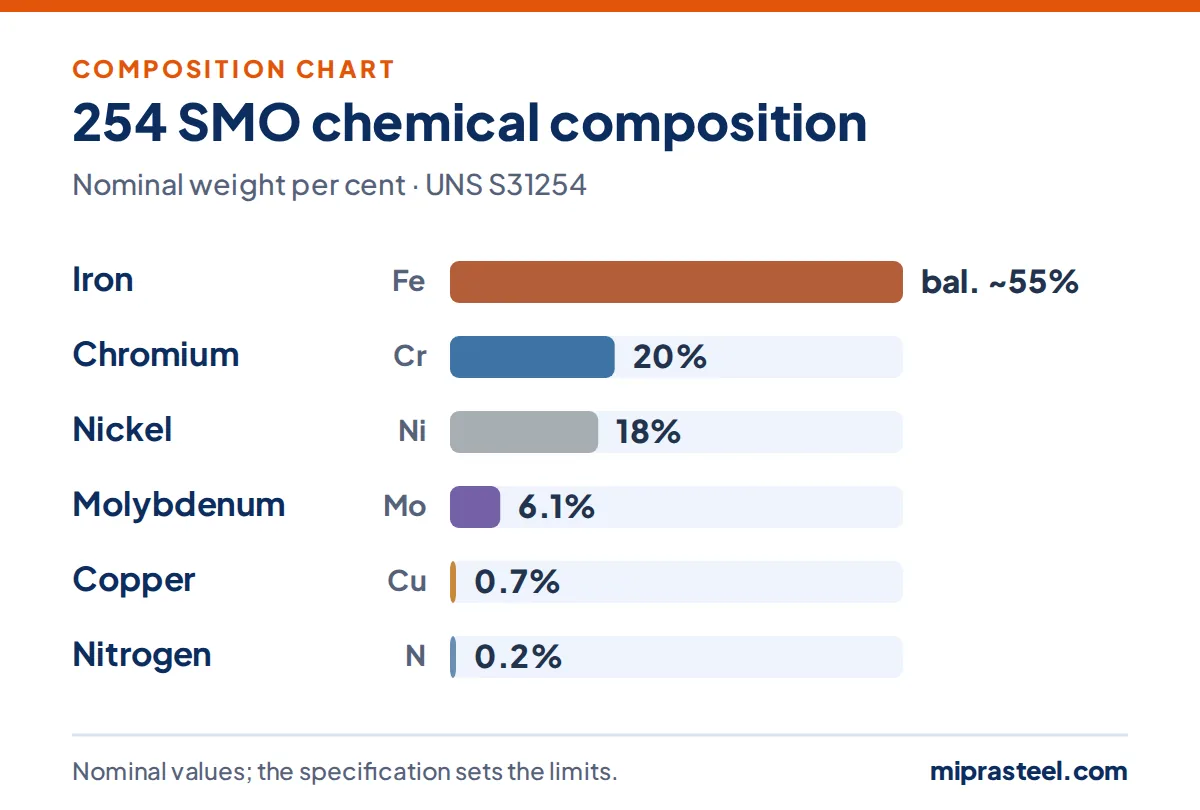
| Element | Symbol | Nominal wt% | |
|---|---|---|---|
| Iron | Fe | Balance (about 55) | |
| Chromium | Cr | 20 | |
| Nickel | Ni | 18 | |
| Molybdenum | Mo | 6.1 | |
| Copper | Cu | 0.7 | |
| Nitrogen | N | 0.2 |
254 SMO Equivalent Grades and Other Names
| Designation | Value |
|---|---|
| Trade name | 254 SMO |
| UNS | S31254 |
| W.Nr. / EN | 1.4547 |
| Other names in the trade | SMO 254, 6Mo, Alloy 254, F44 |
Look up any designation in the grade name converter or the equivalent grade chart.
254 SMO Standards and Specifications
254 SMO Applications
- Seawater cooling and firewater systems
- Desalination plant
- Pulp-bleach equipment
- Flue-gas cleaning
- Offshore process piping
Source industries: desalination, marine and shipbuilding, oil and gas, chemical processing.
How 254 SMO Scrap Is Identified
254 SMO cannot be sorted by eye or magnet from other austenitic stainless steels. Analysis does the work.
| Check | What it shows for 254 SMO |
|---|---|
| Molybdenum at about 6% | The deciding reading. Standard 316L shows 2% to 3%; 904L about 4.5%. A 254 SMO lot should read 6% or a little above on every piece. |
| Nickel near 18% | Separates it from 904L (about 25%) and from the other 6Mo grade, UNS N08367 (about 24%). |
| Copper | 254 SMO carries 0.5% to 1% copper. A reading of 1% to 2% copper with 25% nickel points to 904L. |
| Magnet | 254 SMO is non-magnetic. A magnetic piece is duplex or carbon steel and must come out. See the magnet test guide. |
| Nitrogen | About 0.2% nitrogen does not show on handheld XRF. If a buyer needs it confirmed, OES or a lab analysis is used. |
| Markings and certificates | Look for S31254, 1.4547 or F44 stamps and mill certificates, which settle any doubt. |
Grades Most Often Confused with 254 SMO
- 316L stainless: is non-magnetic and looks identical, but reads only 2% to 3% molybdenum and 10% to 14% nickel. It must be kept out.
- 904L (UNS N08904): reads about 25% nickel, 20% chromium, 4.5% molybdenum and more copper.
- Duplex 2205: is magnetic, with about 5% nickel and 3% molybdenum.
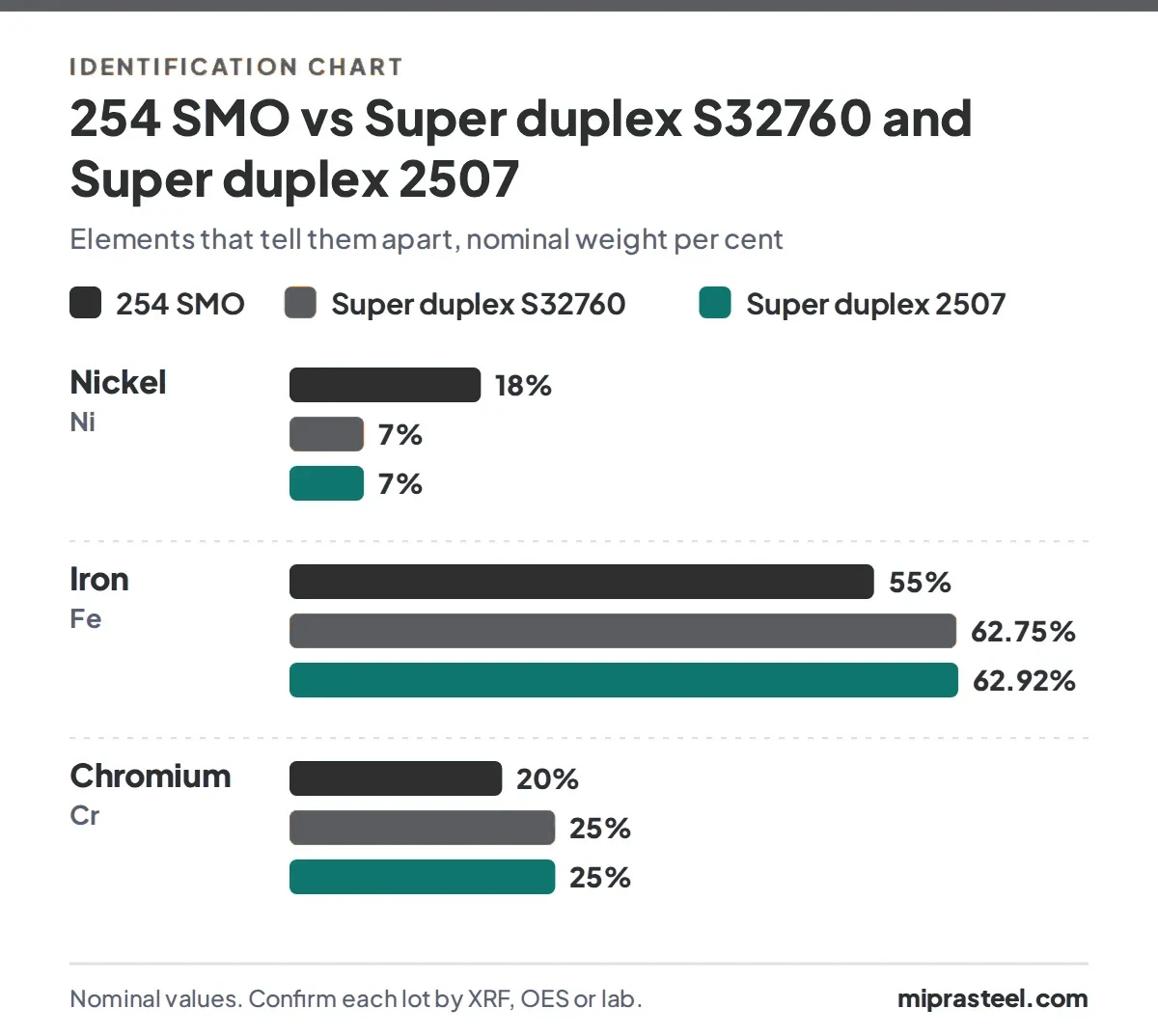
Nominal values for 254 SMO against its closest grades on this site.
Preparing 254 SMO Scrap for Sale
- Read molybdenum on every piece and reject anything under about 6%.
- Keep 316L, 904L, duplex and nickel alloys in separate piles.
- Cut off carbon-steel supports, clamps and dissimilar-metal welds.
- Strip rubber linings, coatings and insulation from pipe sections.
- Keep F44 flanges and fittings with their heat-number stamps visible.
254 SMO Scrap Price per Kg: What Decides It
A 254 SMO offer is built on its alloy content, then adjusted for how certain the buyer can be that every piece is genuine 6Mo.
- Contained molybdenum (about 6%) and nickel (about 18%), priced against the molybdenum and nickel markets on the day.
- Purity: no 304, 316L, 904L or duplex in the lot. Mixed austenitic stainless is priced as ordinary stainless.
- Proof: readings on each piece, or certificates and stamps, let the lot be sold as S31254 rather than "high-moly stainless".
- Form: plate, bar and forging crops rank above weld-fabricated sections with dissimilar welds, and well above oily turnings.
- Attachments and coatings: carbon-steel supports, rubber or plastic linings and paint must be removed.
- Lot size and location: a sorted container from a port city is cheaper to move than mixed loads inland.
There is no standing 254 SMO scrap price per kg; each offer is dated. For the commercial side of this family, read selling duplex and 6Mo scrap and our 254 SMO scrap article.
254 SMO Scrap Import and Export
Importing 254 SMO Scrap into India
India imports 254 SMO scrap mainly from the Gulf, where offshore, desalination and seawater-cooled plants replace 6Mo piping and fittings, and from Europe's pulp and paper sector. As an alloyed stainless steel it is typically declared under HS 7204.21 (stainless steel waste and scrap), not under nickel scrap; confirm the full national line with your customs broker. The consignment needs a pre-shipment inspection certificate, commercial invoice, packing list and bill of lading. See the India import checklist, which applies equally to high-alloy stainless.
Exporting 254 SMO Scrap from India
Indian fabricators of desalination, offshore and pulp-mill equipment produce clean 254 SMO plate trim and F44 forging crops. Exported lots are described as 254 SMO, UNS S31254, on the invoice and packing list, weighed and shipped loose or in bags in containers from Nhava Sheva or Mundra. European stainless melters in Italy, Spain and the Netherlands use high-molybdenum feed, and our Dubai office works with Gulf suppliers.
Customs heading: 7204.21 (stainless steel waste and scrap). The HS code is the international tariff heading the scrap is declared under; national tariff lines add further digits, so confirm the full line with your customs broker.
Other Duplex and Super-Austenitic Scrap Grades
Related Reading
254 SMO Scrap FAQ
What is the difference between SMO 254 and 904L scrap?
254 SMO has about 6% molybdenum and 18% nickel, while 904L has about 4.5% molybdenum, 25% nickel and more copper. On XRF the molybdenum and nickel readings separate them clearly, and the two should be sold as different lots.
Is 254 SMO a nickel alloy?
No. It is an iron-base super-austenitic stainless steel with about 55% iron and 18% nickel. It trades as high-alloy stainless scrap, valued for its molybdenum and nickel, and is kept out of nickel alloy lots.
Why do buyers reject 254 SMO lots mixed with 316L?
Because 316L carries only 2% to 3% molybdenum, so mixing it in lowers the average molybdenum of the whole lot. A melt shop paying for 6Mo feed then has to correct its charge with primary molybdenum, and it prices the lot accordingly.
What does F44 mean on a flange?
F44 is the ASTM A182 designation for forged 254 SMO (UNS S31254) flanges and fittings. A stamped F44 with a heat number is good evidence that the piece is 6Mo material.
What HS code should be used to ship 254 SMO scrap?
Being stainless steel, 254 SMO scrap is typically declared under HS 7204.21, stainless steel waste and scrap. Check the full tariff line in both countries with your customs broker before booking the shipment.
How do I sell 6Mo scrap to Mipra Steel?
Send the weight, forms, location, photos and any molybdenum readings or certificates. Lots that are already separated from 316L and duplex are easier to describe and to offer on.
Can 254 SMO turnings be traded?
Yes, if they are single-grade, drained of coolant and dry. Turnings from a shop that also machines 316L are a contamination risk, so buyers usually ask for readings from several samples.
What is 254 SMO made of?
Nominally 55% iron, 20% chromium, 18% nickel, 6.1% molybdenum, 0.7% copper, plus about 0.2% nitrogen. Specification ranges vary by product form and standard.
Published by Mipra Steel, Khetwadi, Mumbai · Updated